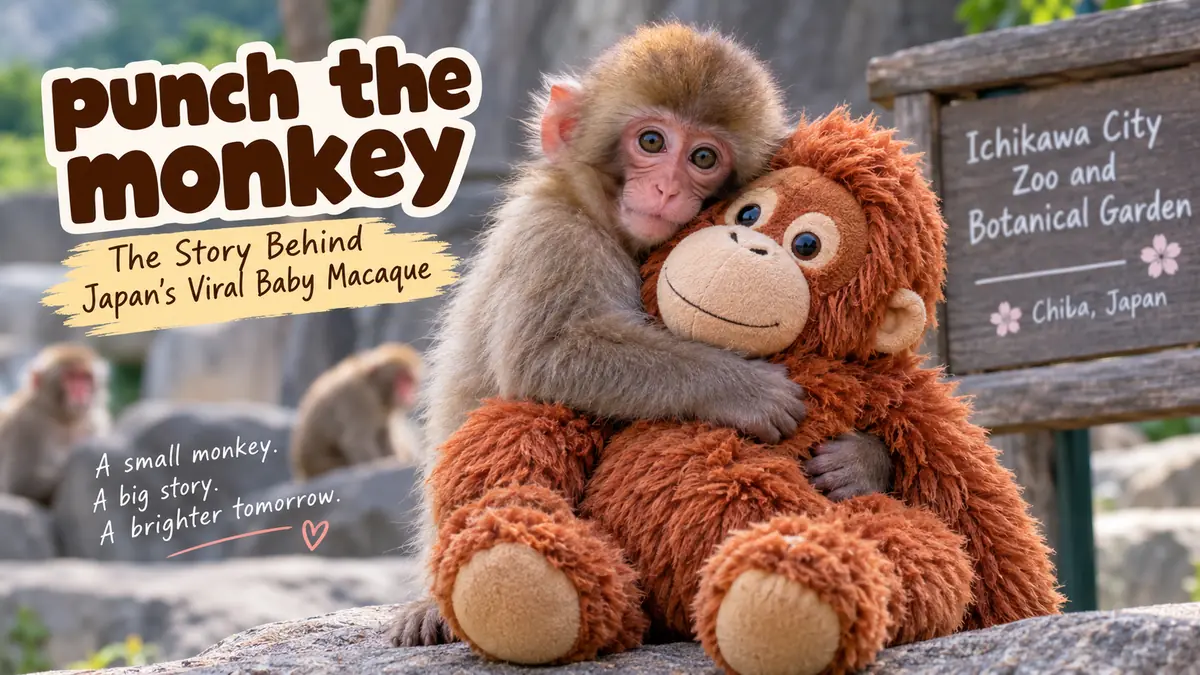
A tiny Japanese macaque carrying an oversized stuffed orangutan became one of 2026’s most recognizable animal stories. Known as punch the monkey, Punch captured worldwide attention after people learned that he had been hand-raised following separation from his mother and was gradually learning how to live within a macaque troop.
His story is more complicated—and ultimately more encouraging—than many short social-media clips suggest.
Punch is a male Japanese macaque born at Ichikawa City Zoo and Botanical Garden in Chiba Prefecture, Japan, on July 26, 2025. After he was not cared for by his mother, keepers hand-raised him and provided a stuffed orangutan for comfort. His attachment to the toy later made him an international social-media sensation.
Who Is punch the monkey?
Punch is a Japanese macaque (Macaca fuscata), the species commonly called the Japanese monkey or snow monkey. He lives at Ichikawa City Zoo and Botanical Garden, east of Tokyo in Chiba Prefecture.
Punch was born on July 26, 2025. According to information released by the zoo, he was found without adequate maternal care shortly after birth, leading staff to begin artificial feeding and hand-rearing.
His unusual upbringing eventually created the circumstances behind the photographs and videos that millions of people would recognize.
Instead of spending his infancy continuously clinging to his biological mother, Punch became closely attached to a stuffed orangutan.
That toy wasn’t simply introduced for an amusing photograph.
It had a practical role in his development.
Why Was Punch Hand-Raised?
Infant primates normally receive far more than food from their mothers. Physical contact provides security while climbing, clinging and moving with a parent contributes to normal physical and behavioral development.
Ichikawa Zoo explained that its primary goal was eventually to integrate Punch into the macaque troop rather than make him dependent on humans.
Keepers therefore raised him inside or around the Monkey Mountain environment where other macaques could become familiar with him. Staff also gave him towels and stuffed toys that he could hold onto.
The zoo said this technique was not unique to Punch; similar methods had been used with other artificially reared primates.
Why Does Punch Carry an Orangutan Toy?
The large orange stuffed animal became Punch’s most recognizable companion.
Keepers experimented with substitutes that Punch could cling to, including towels and stuffed animals. A plush orangutan eventually became the object with which he formed the strongest attachment. Reuters reported that the toy was an orangutan sold by IKEA.
For Punch, clinging served an important function.
The zoo explained that Japanese macaque infants at this developmental stage ordinarily move away from their mothers to explore and play but return when they need comfort or security. Punch displayed a comparable pattern with his stuffed companion.
That distinction matters because online posts sometimes described the toy simply as Punch’s “adoptive mother.” It’s an understandable shorthand, but the actual care program involved much more: keeper contact, feeding, gradual exposure to other macaques and eventual troop integration.
How punch the monkey Became Famous Online
Punch had been receiving specialized care for months before most of the world knew his name.
The major change came in early February 2026.
Ichikawa City Zoo publicly introduced Punch and explained that the young macaque carrying a stuffed animal in Monkey Mountain had been born on July 26, 2025, hand-raised and placed with the troop beginning January 19, 2026.
Images and videos spread rapidly across social platforms.
The visual was instantly memorable: a small macaque moving around a large enclosure while dragging or hugging an orange stuffed orangutan nearly as large as himself.
His story soon traveled beyond Japan.
International media covered his upbringing, and the hashtag #HangInTherePunch became associated with supporters following his progress. Reports from Japan described large numbers of visitors traveling to Ichikawa specifically to see him.
Why Did People Connect With Punch?
There was a simple emotional narrative behind many viral posts:
- a baby monkey was separated from his mother;
- he appeared to find comfort in a stuffed animal;
- he struggled while entering an established macaque troop;
- people watched as he gradually developed relationships with other monkeys.
Those elements made his story understandable even to people who knew nothing about primate behavior.
But that simplicity also created problems.
Short clips were frequently interpreted using human ideas about friendship, loneliness, parenting and bullying. Those interpretations were not always consistent with what zoo staff observed.
That difference became particularly important when videos of Punch interacting with dominant macaques went viral.
Was punch the monkey Being Bullied?
One of the biggest questions surrounding Punch was whether other monkeys were bullying him.
Some widely shared videos appeared disturbing when viewed without context. They showed other macaques pushing, grabbing or disciplining the young monkey.
Ichikawa Zoo addressed these concerns directly.
In an official statement dated March 10, 2026, the zoo explained that Japanese macaques live within a hierarchical social structure. Dominant animals may display disciplinary behavior toward subordinate members, and staff cautioned against automatically interpreting every such interaction as the equivalent of human abuse.
The zoo also emphasized that Punch spent most of his day peacefully and that an increasing number of monkeys were looking after or playing with him.
That doesn’t mean staff ignored aggressive behavior.
The zoo reported that a few high-ranking macaques had shown aggression more frequently, so those animals were temporarily removed from the troop on March 8 while staff continued monitoring the situation.
Three veterinarians were also checking the animals’ health, according to the zoo.
Why Didn’t the Zoo Simply Separate Punch?
For viewers watching upsetting clips online, removing Punch from the group could seem like the obvious solution.
From an animal-management perspective, the decision is more complicated.
The zoo’s objective was for Punch to develop into a functioning member of a Japanese macaque troop. Permanently isolating him could interfere with that goal.
Ichikawa Zoo specifically warned that separating Punch after he had begun adjusting could create a risk that he would never successfully return to the group.
Social integration therefore required careful monitoring rather than simply preventing every uncomfortable interaction.
Quick Takeaway: Videos lasting several seconds cannot show Punch’s entire daily experience. Official zoo statements provide essential context because staff observe the troop continuously and can distinguish routine social behavior from interactions requiring intervention.
How Punch Was Introduced to the Macaque Troop
Punch’s introduction to Monkey Mountain wasn’t a sudden decision.
The process happened gradually.
Ichikawa Zoo provided a detailed account of its approach in February 2026. Keepers raised Punch where members of the troop could recognize him and become familiar with his presence.
At around three months old, he was allowed to interact with monkeys through barriers.
After four months, he began entering the Monkey Mountain enclosure while accompanied by caretakers.
Before his full introduction, Punch also spent time with a young female macaque that had behaved gently toward him.
After observing those interactions, keepers concluded that he was ready to live within the group without continuous human intervention.
On January 19, 2026, Punch began living with the troop.
Why Troop Integration Matters
Japanese macaques are highly social animals.
Young macaques learn behaviors through interactions with other members of their group. Living among their own species provides opportunities that human caretakers or toys cannot fully replicate.
That explains why the orangutan plushie was never intended to become a permanent replacement for macaque companionship.
It provided security during a transitional period.
The larger objective was social development.
The zoo even pointed to an earlier hand-reared macaque named Otome as an example of why this approach could work. According to its February statement, Otome eventually separated naturally from her stuffed toy, later gave birth four times and successfully raised her offspring.
Punch’s development will follow its own path, but the earlier case illustrates the reasoning behind Ichikawa’s approach.
Is punch the monkey Still Attached to His Stuffed Orangutan?
Yes, the stuffed orangutan remained an important comfort object during Punch’s early integration, but signs emerged that he was becoming less dependent on it.
The zoo reported that as Punch became more comfortable around other macaques, he spent increasing amounts of time away from the toy.
That’s a meaningful development.
For a young macaque, increased exploration and social interaction are expected as independence develops.
The goal isn’t to suddenly take the plush away. Instead, the natural progression is for Punch to rely less heavily on it as relationships with other monkeys strengthen.
This is one reason photos alone can give an incomplete picture.
An image of Punch hugging the orangutan may look lonely, while another showing him playing with macaques may suggest complete independence. Both moments can occur during the same developmental period.
Is punch the monkey Okay Now?
Available updates indicate that Punch has continued making progress within his troop.
By April 2026, Ichikawa Zoo head Takashi Yasunaga told ABC News that the number of monkeys getting along with Punch appeared to be increasing day by day. The update came roughly two months after Punch became an international viral sensation.
The zoo has continued emphasizing careful observation of his health and social development.
Punch also passed an important milestone on July 26, 2026: his first birthday.
A more recent zoo video, released after a first-birthday exhibition, documented roughly 365 days of his development—from his early period with keepers to life alongside other members of the troop.
The broader picture is therefore quite different from the most dramatic clips circulated during February and March.
Punch’s story is ongoing, but he is not simply an abandoned infant sitting alone with a stuffed animal. He has been going through a deliberate process of becoming socially integrated with other Japanese macaques.
The IKEA Orangutan and Its Unexpected Role
Punch’s orange companion also became famous.
The toy is associated with IKEA’s DJUNGELSKOG collection. As Punch’s videos circulated internationally, viewers began looking for the same orangutan plushie.
The connection became so prominent that IKEA representatives visited Ichikawa City Zoo in February and donated stuffed toys. Reports also described increased interest in the orangutan toy following Punch’s viral rise.
Yet the stuffed orangutan’s significance goes beyond internet merchandise.
For Punch, it functioned as something he could physically grasp.
This reflects a broader principle of hand-rearing primates: caregivers sometimes need to recreate certain physical experiences normally supplied by the mother while simultaneously avoiding excessive attachment to humans.
Ichikawa Zoo explained that stuffed toys and towels helped achieve that balance.
The toy therefore became both an emotional symbol for viewers and a practical component of Punch’s early care.
What Species Is Punch?
Punch is a Japanese macaque (Macaca fuscata), rather than an orangutan or another type of monkey.
Japanese macaques are native to Japan and are famous for surviving colder environments than most non-human primates.
They’re often called snow monkeys, particularly in popular media.
Their societies have recognizable dominance relationships, and understanding those relationships helps explain some of Punch’s interactions at Monkey Mountain.
A push, chase or reprimand that looks alarming in an isolated video may occur within a larger system of macaque social communication.
That doesn’t mean aggression should always be dismissed as harmless.
Instead, frequency, severity, physical condition and the animal’s broader behavior all matter—which is why professional observation is more informative than judging a few seconds of viral footage.
Where Does punch the monkey Live?
Punch lives at Ichikawa City Zoo and Botanical Garden in Ichikawa, Chiba Prefecture, Japan.
His home within the zoo is generally referred to as Monkey Mountain, where Japanese macaques live as a social group.
Punch’s popularity dramatically changed public interest in the enclosure.
Crowds began arriving after his story spread online, creating operational challenges for the zoo. The facility eventually published rules intended to reduce disruption around Monkey Mountain.
Visitors were instructed to remain quiet, respect restricted areas, limit time at the front viewing area and avoid equipment such as tripods and selfie sticks. Live broadcasting was also prohibited around the enclosure.
These rules aren’t simply about crowd management.
Excessive noise, congestion and intrusive behavior can interfere with animal care and create additional stress for the troop.
A Viral Animal Still Needs Space
Punch may be an internet celebrity, but he doesn’t understand internet fame.
From his perspective, daily life consists of eating, exploring, interacting with other macaques and responding to his environment.
That distinction is worth remembering for anyone following him online or visiting the zoo.
Supporting a famous animal should not mean interfering with its routine.
Why the Zoo Stopped Sharing Details About Other Monkeys
Punch’s enormous online following created another unexpected problem: people began trying to identify individual macaques appearing alongside him.
Fans wanted to know which monkeys were his friends, relatives or supposed “bullies.”
Ichikawa Zoo eventually limited the information it released about individual members of the troop.
In a May 1 statement, the zoo explained that it had received numerous questions about Punch’s biological parents, previously hand-reared monkeys and animals interacting with him.
Officials worried that publicly naming individual macaques would generate demands to protect certain animals or remove others from the group, potentially interfering with normal zoo operations and animal care.
The zoo also issued an important warning about online information.
It said social media contained material supposedly based on conversations with keepers, claims from people presenting themselves as insiders, and AI-generated images and videos, with much of that material being inaccurate.
That warning is particularly relevant when searching for Punch updates.
How to Tell Real Punch Updates From Misinformation
Viral animal stories attract fan accounts, edited videos, reposts and emotional captions. Once content is copied repeatedly, speculation can easily look like established fact.
A few checks help separate reliable information from rumors:
- Look for an original zoo statement. Ichikawa City Zoo is the primary source for Punch’s care and condition.
- Check the date. A February video may be reposted months later as if it happened today.
- Don’t assume captions explain behavior accurately. Words such as “bullying,” “rescue,” “mother” or “girlfriend” may be interpretations rather than observations from keepers.
- Watch for edited or AI-generated material. The zoo itself has warned that inaccurate synthetic and misleading content is circulating.
- Separate individual moments from long-term behavior. One interaction doesn’t establish the overall relationship between two macaques.
This is especially useful with Punch because his story naturally encourages people to interpret his behavior emotionally.
Concern for an animal can be positive. Accurate context makes that concern more useful.
punch the monkey vs. the Old Internet “Punch the Monkey” Ad
There’s another reason searches for punch the monkey can be confusing.
Long before Punch the Japanese macaque became famous, “Punch the Monkey” referred to a notorious interactive banner advertisement from the early web.
Around the late 1990s and early 2000s, users encountered advertisements inviting them to hit or “punch” an animated monkey for the chance to receive a reward.
The promotion was associated with TreeLoot, an online prize and entertainment site. Contemporary discussions from 2000 specifically referred to TreeLoot’s “punch-the-monkey” marketing gimmick and described the monkey appearing in web banner ads.
A 2001 Suck.com article described TreeLoot’s banner as an unusually successful example of interactive online advertising.
So there are two very different internet references:
| Term | What It Refers To | Era |
|---|---|---|
| Punch the Monkey | TreeLoot interactive banner advertisement | Late 1990s–early 2000s |
| Punch the monkey | Viral Japanese macaque at Ichikawa City Zoo | 2026 |
| Punch-kun | Common name used for the viral macaque | 2026–present |
| #HangInTherePunch | Social-media support associated with Punch | 2026 |
The modern viral animal story has given an old internet phrase an entirely new meaning.
Why Punch’s Story Became Bigger Than a Cute Animal Video
Plenty of zoo animals become popular online. Punch’s story had several characteristics that made it unusually compelling.
First was the visual contrast.
A tiny macaque carrying a large orange orangutan plushie immediately communicates vulnerability even before viewers know the backstory.
Then came a narrative people could follow.
Punch wasn’t famous for one funny moment. His audience could watch a developmental story unfold: hand-rearing, comfort from the stuffed toy, introduction to Monkey Mountain, difficult social interactions and gradually improving relationships.
That ongoing progression encouraged people to return for updates.
It also created a useful conversation about how easily humans interpret animal behavior through human emotions.
What Punch Teaches Us About Animal Behavior
Punch can look sad, happy, frightened or affectionate to human viewers.
Some of those interpretations may correspond with observable behavior, but assigning human motivations to every interaction can be misleading.
Macaques have their own social structures.
Dominance, grooming, play, physical discipline, proximity and avoidance all carry meaning within that system.
Professional animal care therefore requires observation over time rather than conclusions drawn from a single dramatic clip.
Punch’s experience demonstrates why context matters.
The stuffed orangutan wasn’t simply a “replacement mom.” Troop interactions weren’t automatically “bullying.” And integrating Punch wasn’t simply a matter of putting him into an enclosure and hoping other monkeys accepted him.
Each element belonged to a longer management and socialization process.
What Happened After Punch Became Famous?
The consequences of Punch’s viral fame extended beyond social media.
Visitors traveled to Ichikawa to see him. His stuffed orangutan became recognizable worldwide. International news organizations covered his progress, and supporters continued following updates about his social relationships.
The attention also produced challenges.
Zoo staff had to manage larger crowds, misinformation, intrusive visitor behavior and intense public interest in individual monkeys.
In May 2026, authorities identified two suspects following an incident involving unauthorized entry around Punch’s enclosure, illustrating how online fame could create real-world complications for the zoo. Punch was reported safe following the incident.
The zoo’s subsequent communication increasingly emphasized something easily forgotten online:
Punch is an animal receiving professional care, not a character in a social-media drama.
The Latest Picture of punch the monkey
The most useful way to understand Punch’s story is as a process rather than a single viral moment.
He began life without normal maternal care.
Keepers bottle-fed and hand-raised him while trying to prevent excessive human dependence. A stuffed orangutan provided something safe to cling to. Gradual exposure introduced him to other macaques. On January 19, 2026, he began living with the troop.
Some interactions were difficult enough to worry viewers, and zoo staff intervened when particular animals displayed excessive aggression.
At the same time, Punch increasingly played with and received attention from other macaques. He began spending more time away from his stuffed companion, suggesting that his social world was expanding beyond the object that had provided security during infancy.
By his first birthday in July 2026, his story had moved far beyond the original photographs that made him famous.
The tiny macaque hugging an orange plushie is still the image most people associate with punch the monkey, but the more meaningful story is his gradual development into a member of a Japanese macaque troop.
That progress—and the careful work behind it—is what makes Punch’s story worth following.