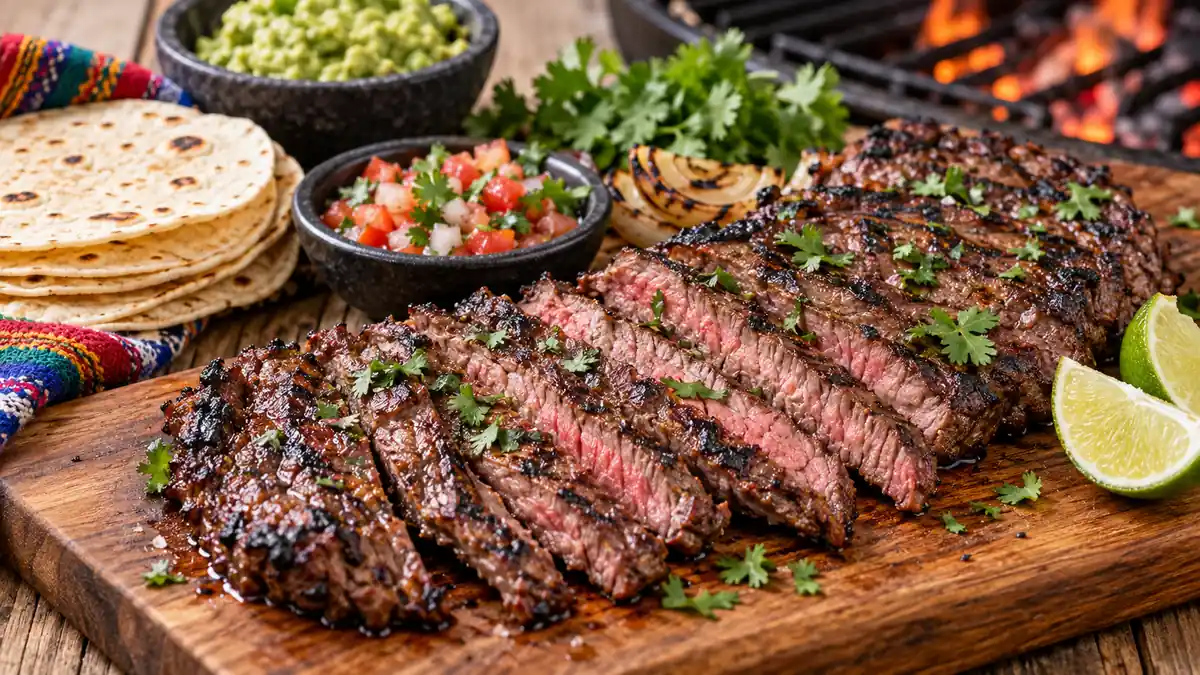
Few foods capture the appeal of live-fire cooking as simply as carne asada. Beef, salt, citrus, chiles, and a very hot grill can produce deeply browned edges, smoky aromas, and a juicy center—provided the meat is seasoned well and sliced correctly.
Carne asada is grilled or seared beef associated especially with Mexican and broader Latin American cooking. Mexican versions commonly use skirt, flap, or flank steak, sometimes marinated with citrus, garlic, chiles, cilantro, and seasonings. The meat is cooked quickly over high heat, rested, then sliced thinly against the grain for tenderness.
The phrase literally refers to grilled or roasted meat, but there is no single universal carne asada recipe. Regional traditions, family recipes, available beef cuts, and even the fuel used for grilling can change the finished dish.
What Is carne asada?
At its simplest, carne asada is beef cooked over intense heat and typically sliced or chopped before serving. It can be eaten as the centerpiece of a meal or used in tacos, burritos, tortas, quesadillas, nachos, and other dishes.
The term comes from Spanish: carne means meat and asada refers to meat that has been roasted or grilled. English dictionaries generally describe the dish as seasoned or marinated beef cooked over high heat and cut into strips.
The version familiar from Mexican restaurants and taquerias is particularly associated with northern Mexico and its cattle-ranching culture. Sonora and Nuevo León are frequently connected with carne asada traditions.
That background matters because carne asada is not defined by an elaborate sauce. The beef and the grill are supposed to remain central.
Is carne asada always marinated?
No.
A common misconception is that authentic carne asada requires a long, complicated citrus marinade. Some versions are marinated, while others depend primarily on good beef, salt, fire, and perhaps a simple seasoning mixture.
Modern recipes vary considerably. Citrus juices, garlic, cilantro, jalapeño or serrano chile, vinegar, cumin, black pepper, and oil appear frequently, but they are not a mandatory formula.
That variation is part of the dish rather than evidence that one recipe is automatically wrong.
The Best Meat for carne asada
The cut of beef affects almost everything: flavor, tenderness, cooking time, slicing technique, and how well the meat absorbs a marinade.
Common choices include:
| Beef cut | Texture | Flavor | Best use |
|---|---|---|---|
| Skirt steak | Loose, pronounced grain | Rich and beefy | Tacos and traditional-style grilling |
| Flap steak | Tender with coarse grain | Strong beef flavor | Grilling and chopping |
| Flank steak | Leaner and firmer | Beefy but less fatty | Sliced carne asada |
| Sirloin | Moderately tender | Balanced | Easy substitute |
| Flat iron | Tender | Rich | Grilling and sliced servings |
| Chuck/diezmillo | Richer, variable tenderness | Deep beef flavor | Regional preparations |
Skirt steak is especially common in recipes because its relatively thin shape suits fast, high-temperature cooking. Food Network notes that several cuts can work, including flank, skirt, flat iron, sirloin, and even brisket, while its featured restaurant recipe favors skirt steak.
In Mexico, arrachera is closely associated with grilled skirt-style beef, while ranchera or flap steak also appears in carne asada preparations.
Skirt steak vs. flank steak
They are often treated as interchangeable, but they behave differently.
Skirt steak is generally thinner with a looser, more obvious grain. It cooks very quickly and develops excellent char, but overcooking can make it chewy.
Flank steak is thicker and leaner. It may require slightly longer cooking and makes attractive thin slices, but slicing across the muscle fibers is particularly important.
Quick Takeaway: If you can find good skirt or flap steak, either is an excellent starting point. Flank steak remains a dependable alternative. Whichever cut you choose, high heat and proper slicing matter more than chasing a supposedly perfect cut.
carne asada Marinade: What Actually Matters
There is no official ingredient list for carne asada marinade.
A useful Mexican-inspired marinade balances four elements:
- Salt for seasoning.
- Acid for brightness.
- Aromatics and chiles for flavor.
- Oil to distribute seasonings and help coat the surface.
Popular versions use fresh lime juice, orange juice, garlic, cilantro, jalapeño or serrano, vinegar, cumin, oregano, black pepper, and olive or vegetable oil. Food Network’s traditional-style recipe, for example, combines lime and orange with garlic, jalapeño, cilantro, oil, vinegar, sugar, salt, and pepper.
A balanced marinade for 2 pounds of beef
For an approachable homemade version, combine:
- 1/3 cup fresh orange juice
- 1/4 cup fresh lime juice
- 1/4 cup neutral oil or olive oil
- 4 garlic cloves, finely minced
- 1 jalapeño, finely chopped
- 1/2 cup chopped fresh cilantro
- 1 teaspoon ground cumin
- 1 teaspoon Mexican oregano
- 1 1/2 teaspoons kosher salt
- 1/2 teaspoon freshly ground black pepper
Optional additions include a small amount of vinegar or serrano chile when you want more acidity or heat.
Orange contributes sweetness and citrus aroma, while lime provides a sharper acidic edge. Garlic, fresh chiles, and cilantro create the aromatic character associated with many contemporary Mexican-style versions.
But more ingredients do not automatically make better steak. If the marinade becomes overly acidic, the exterior texture can suffer.
How long should you marinate carne asada?
For thin skirt or flap steak, 2 to 4 hours is a useful starting point when the marinade contains substantial citrus juice.
Food Network specifically recommends two to four hours for its citrus-heavy recipe and warns that leaving the steak much longer allows the acidic juice to affect the meat’s exterior. Other recipes use longer marination periods, showing that timing depends partly on marinade composition.
A marinade with relatively little acid can usually sit longer than one dominated by lime juice.
Do not assume that 24 hours must be better than four. Marinades mostly season the surface and shallow layers of meat; excessively long exposure to strong acid can change the outer texture without magically tenderizing the center.
How to Make carne asada on the Grill
A charcoal grill is particularly well suited to carne asada because high heat creates browning while the charcoal contributes smoke.
Gas grills work too. Indoors, a heavy cast-iron skillet or grill pan is the practical alternative.
1. Marinate the beef
Put the steak and marinade in a nonreactive container or resealable bag.
Turn the meat until every surface is coated, refrigerate it, and allow the seasoning time to work.
Keep raw marinating beef refrigerated rather than leaving it on the counter for hours.
2. Preheat the grill
Carne asada benefits from serious heat.
Prepare a charcoal or gas grill for high or medium-high heat and clean the grates thoroughly. Lightly oiling the grates can help prevent sticking.
Charcoal or wood fire provides the strongest smoky character. Carne asada is grilled rather than slowly smoked, so the goal is intense direct heat rather than hours of low-temperature cooking.
3. Remove excess marinade
Take the steak from its marinade and allow excess liquid to drip away.
This step is easy to overlook.
A dripping-wet steak has to evaporate surface moisture before it can brown effectively. Bits of garlic or herbs may also burn over intense heat.
Patting the surface lightly with paper towels can encourage better searing.
Discard marinade that has been in contact with raw beef unless it is subsequently cooked to a safe temperature before being used as a sauce.
4. Grill quickly
Put the steak directly over the hottest part of the grill.
Thin skirt steak may need only a few minutes per side. A thicker flank steak naturally takes longer.
Rather than relying entirely on a timer, check the meat’s internal temperature with an instant-read thermometer.
USDA food-safety guidance for whole beef steaks calls for cooking to 145°F (62.8°C) followed by at least a three-minute rest. Individual recipes sometimes specify lower temperatures for preferred doneness, so distinguish culinary preference from official food-safety guidance.
Bon Appétit’s version, for example, grills skirt or flank steak for roughly five to nine minutes total depending on thickness and emphasizes using a thermometer rather than cooking solely by time.
5. Let the meat rest
Do not start chopping the steak the instant it leaves the fire.
Move it to a clean cutting board and give it approximately 5 to 10 minutes to rest. Thicker pieces can benefit from a little longer.
Resting also gives you time to prepare tortillas, salsa, grilled onions, or other accompaniments.
6. Slice against the grain
This may be the most important technique in the entire recipe.
Look carefully at the steak. You will see lines running through it; those are the direction of the muscle fibers.
Cut across those lines, not parallel with them.
Slicing against the grain shortens the muscle fibers, making each bite easier to chew. This is especially important with skirt and flank steak.
Both Bon Appétit and The Kitchn emphasize thin slicing across or against the grain after the steak rests.
How to Cook carne asada Without a Grill
No outdoor grill does not mean no carne asada.
What you need to reproduce indoors is intense heat and rapid browning.
Cast-iron skillet
A cast-iron pan is one of the best indoor options.
Heat the empty skillet until very hot, lightly oil it, then add a reasonably dry piece of marinated steak. Do not overcrowd the pan.
Overcrowding traps moisture and causes the beef to steam rather than sear.
Depending on thickness, approximately three to five minutes per side can be enough for many steaks, although internal temperature—not the clock—should determine doneness. The Kitchn uses this general range for its stovetop method.
Expect smoke. Turn on the exhaust fan and ventilate the kitchen before you start.
Broiler
A broiler is another effective method because it exposes the steak to concentrated direct heat.
Place the meat on a foil-lined baking sheet or suitable broiler pan and position it near the heating element. The Kitchn’s method broils its carne asada for roughly eight to ten minutes, with final timing determined by steak thickness and internal temperature.
You may not reproduce charcoal’s aroma, but you can still achieve browned, lightly charred edges.
Griddle or grill pan
A heavy griddle is particularly useful when cooking thin pieces or chopped taqueria-style beef.
Work in batches. Maintaining surface temperature is more important than forcing every piece into the pan at once.
Why Restaurant-Style carne asada Tastes Different
Home cooks sometimes use a flavorful marinade yet still end up with steak that tastes noticeably different from taqueria carne asada.
The missing ingredient may be heat management, not seasoning.
Commercial grills and flat-tops can maintain substantial heat while cooking multiple portions. At home, adding cold, wet meat to a small skillet can rapidly drop its surface temperature.
Instead of browning, the beef releases liquid and begins simmering.
Three changes make a major difference:
- Heat the cooking surface thoroughly before adding meat.
- Remove excessive surface marinade.
- Cook in batches rather than crowding the pan.
The other major difference is fire.
Charcoal produces aromas that a standard frying pan cannot fully duplicate. Bon Appétit specifically recommends an outdoor grill, preferably charcoal, for pronounced smoky flavor, while suggesting a very hot cast-iron grill pan as the indoor alternative.
Browning matters
The dark crust on grilled steak is not simply “burnt meat.”
High heat drives browning reactions on the dry exterior of the beef, creating hundreds of aromatic compounds. Marinade ingredients can influence this process, especially when they contain small amounts of sugar.
There is a balance, though. Sugar, garlic, and herbs can burn before a thicker steak reaches the desired internal temperature.
That is another reason to let excess marinade drain before grilling.
Common carne asada Mistakes
Carne asada looks straightforward because it is straightforward. That also means technique errors are difficult to hide.
Using too much acid
More lime juice does not automatically produce more tender beef.
Strong acidic marinades can alter the steak’s exterior when left too long. Use citrus for flavor and brightness rather than treating it as a substitute for selecting and slicing the meat properly.
Cooking wet steak
Excess liquid interferes with rapid browning.
Drain the steak and lightly dry the exterior before it hits the grill or pan.
Starting with a lukewarm pan
You want an immediate sizzle.
If a skillet has not preheated sufficiently, moisture accumulates around the beef and you lose the charred exterior that defines the dish.
Overcrowding
This is particularly problematic when making chopped carne asada indoors.
Cook batches if necessary.
Overcooking thin steak
Skirt steak can go from juicy to dry surprisingly quickly.
Use a thermometer when possible and remember that thin meat responds to heat much faster than a thick steak.
Cutting immediately
Give the steak time to rest before slicing.
Cutting with the grain
Even well-cooked steak can seem tough if it is sliced incorrectly.
When tenderness disappoints despite proper cooking, inspect the direction of the muscle fibers. Cutting thinly against them often solves the problem.
What Does carne asada Taste Like?
Good carne asada tastes first and foremost like grilled beef.
The exterior should have savory browned or charred notes, while the interior remains juicy. Depending on the recipe, citrus contributes freshness, garlic provides savory depth, and jalapeño, serrano, or other chiles bring heat and vegetal flavor.
Cilantro adds an herbal note, while cumin or Mexican oregano may supply earthiness.
But carne asada should not necessarily taste like a dozen spices fighting for attention.
In simpler northern Mexican preparations, the quality of the beef, salt, and charcoal can play a larger role than an elaborate marinade. The enormous variety among published recipes reinforces the point that there is no single seasoning profile required for the name.
How Is carne asada Traditionally Served?
Carne asada can be a complete grilled-meat meal rather than merely taco filling.
In northern Mexico, carne asada also carries a social meaning: the phrase may refer to a gathering built around grilling meat, somewhat like saying you’re having a barbecue or cookout.
At the table, common accompaniments include warm corn or flour tortillas, salsa, grilled onions, beans, guacamole, lime wedges, cilantro, and fresh or roasted chiles.
For tacos, keep the assembly simple:
warm tortilla + chopped beef + onion + cilantro + salsa + lime
That simplicity lets the charred steak remain the main flavor.
Carne asada is also widely used in:
- Burritos
- Quesadillas
- Tortas
- Nachos
- Tostadas
- Sopes
- Gorditas
- Alambres
- Carne asada fries
Carne asada fries are especially associated with San Diego-style Mexican-American food, combining chopped grilled beef with French fries and toppings such as cheese, guacamole, or salsa. Bon Appétit also highlights tacos, burritos, nachos, and carne asada fries as practical uses for the grilled meat.
carne asada vs. Fajitas: What’s the Difference?
The two can look similar because both may feature grilled beef sliced into strips, but they are not interchangeable terms.
| Feature | Carne asada | Fajitas |
|---|---|---|
| Main idea | Grilled beef preparation | A specific Tex-Mex dish/style |
| Common beef | Skirt, flap, flank | Traditionally skirt steak |
| Marinade | Optional and highly variable | Often seasoned or marinated |
| Vegetables | Optional | Peppers and onions strongly associated |
| Serving | Tacos, plates, burritos, tortas and more | Commonly served with tortillas |
| Main characteristic | Charred grilled meat | Sizzling meat-and-vegetable presentation |
Carne asada focuses primarily on the grilled beef itself.
Fajitas refer to a separate culinary tradition and presentation, even though skirt steak creates an obvious overlap.
carne asada vs. Steak
Carne asada is steak, but not every steak is carne asada.
A ribeye cooked in butter in a skillet and served whole is steak. A skirt or flap steak seasoned and cooked rapidly over charcoal, then sliced for tortillas, fits much more naturally within the carne asada tradition.
The difference therefore comes from preparation and culinary context rather than the animal.
Similarly, carne asada differs from slow-cooked shredded beef preparations. It should retain the texture of grilled steak rather than becoming braised, pulled meat.
Mexican carne asada and Other Latin American Traditions
It is useful not to reduce every Latin American grilled-beef tradition to one Mexican recipe.
Carne asada and related forms of grilled meat appear across Latin America, with different cuts, marinades, sauces, accompaniments, and cultural traditions. Food Network notes versions associated with Mexico, Nicaragua, Argentina, Uruguay, Paraguay, Brazil, and other cattle-producing regions.
Nicaraguan preparations, for example, may use citrus-marinated beef and serve it alongside traditional sides. Colombian versions can also employ citrus, garlic, cumin, vinegar, and other seasonings; Cornell Cooperative Extension’s Colombian-style recipe illustrates one such regional interpretation.
In parts of South America, asado describes a broader and distinct grilling tradition.
That distinction is worth preserving. There is no single “Latin American carne asada” recipe representing every country.
How to Store and Reheat carne asada
Leftover grilled steak is useful, but reheating it aggressively can turn a tender piece of beef dry and chewy.
Refrigerate leftovers promptly in a sealed container.
When reheating, a hot skillet works well. Cut the steak first and warm it quickly rather than repeatedly cooking a whole piece until its center becomes hot.
You can also repurpose cold or gently reheated carne asada in quesadillas, breakfast eggs, salads, nachos, burritos, or tacos. The Kitchn specifically suggests leftovers for steak and eggs, quesadillas, and nachos.
For the best texture, cook only as much as you expect to eat fresh and save any remaining steak in larger pieces. Slice those leftovers immediately before reheating.
A Simple Formula for Better carne asada
You do not need a complicated restaurant recipe to make satisfying carne asada at home.
Remember this sequence:
- Choose skirt, flap, or flank steak.
- Season simply or use a balanced citrus-chile marinade.
- Avoid excessively long exposure to strong acidic marinades.
- Heat the grill or skillet thoroughly.
- Drain excess marinade before cooking.
- Cook rapidly over high heat.
- Use internal temperature rather than guessing entirely by time.
- Rest the beef before cutting.
- Identify the direction of the muscle fibers.
- Slice thinly against the grain.
- Serve immediately with tortillas, salsa, lime, grilled onions, beans, or other preferred sides.
The defining character of carne asada does not come from piling on more ingredients. It comes from good beef, confident seasoning, intense heat, proper browning, and careful slicing. Get those fundamentals right and you have tender, smoky grilled steak that works just as naturally on a plate as it does inside a warm tortilla.