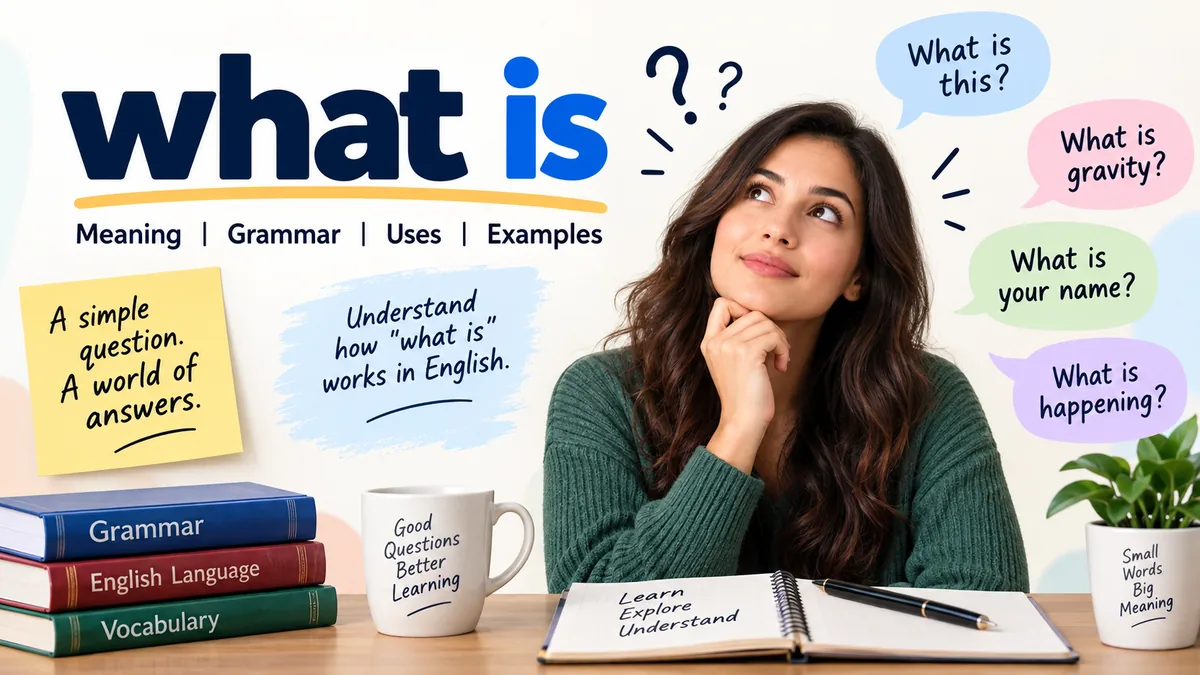
Two of the simplest words in English form one of its most useful question patterns: what is.
You hear it in classrooms, conversations, search engines, dictionaries, and everyday questions: “What is this?”, “What is your name?”, “What is gravity?”, or “What is happening?” Although the phrase looks basic, understanding its grammar helps explain how English asks for definitions, identities, descriptions, and information.
What is is a question phrase formed from the interrogative word what and the verb is, the third-person singular present form of to be. It commonly asks someone to identify, define, explain, or describe something. In everyday speech and informal writing, “what is” is frequently contracted to what’s.
What Is the Meaning of what is?
The phrase what is normally begins a question asking for information.
Consider these examples:
- What is this?
- What is your name?
- What is a URL?
- What is the problem?
- What is happening?
- What is the capital of France?
The exact information being requested changes from sentence to sentence.
“What is this?” asks for identification.
“What is gravity?” asks for a definition or explanation.
“What is your name?” asks for a specific fact.
“What is happening?” asks about an ongoing situation or action.
Cambridge classifies what as a wh-word and explains that it can function in questions as well as a pronoun and determiner. It is commonly used to request information about things and actions.
Breaking the phrase into two words
The easiest way to understand the construction is to examine each word.
| Word | Grammatical role | Basic function |
|---|---|---|
| what | Interrogative pronoun/determiner | Requests information |
| is | Form of the verb to be | Links a subject with information or helps form a verb phrase |
| what is | Question construction | Asks for identification, definition, description, or other information |
The word what does much of the questioning work.
The word is belongs to the verb be.
Together, they create an extremely common English question structure.
What Is “What” in English Grammar?
What belongs to the family of question words often called wh-words. Other familiar members include who, where, when, which, why, and how, although “how” does not begin with wh.
Cambridge describes what as a word used to request information about people or things. It can also serve several other grammatical functions.
What as an interrogative pronoun
An interrogative pronoun can stand in place of the unknown information being requested.
For example:
What happened?
The speaker knows that something happened but wants to know what.
Another example is:
What is making that noise?
Here, what represents the unknown thing responsible for the noise.
What as a determiner
“What” can appear directly before a noun:
What time is it?
What color is the car?
What size do you need?
What kind of music do you like?
Here, what helps specify which piece of information the speaker wants.
What meaning “the thing that”
“What” does not always introduce a direct question. It can also mean something close to “the thing that” or “that which.”
For example:
What she said surprised everyone.
Take what you need.
Cambridge identifies this as another established use of what.
That distinction matters because seeing the word what does not automatically mean the sentence is a question.
What Is “Is” in English Grammar?
The second half of what is is the verb is.
“Is” is a present-tense form of the verb to be. It is generally used with a third-person singular subject:
She is ready.
The computer is on.
London is a city.
The answer is correct.
The broader present-tense pattern is:
| Subject | Form of be |
|---|---|
| I | am |
| You | are |
| He | is |
| She | is |
| It | is |
| We | are |
| They | are |
This explains why English uses:
What is it?
but:
What are they?
The form of be changes according to the grammatical subject.
Is as a linking verb
“Is” frequently acts as a linking verb, connecting a subject to information that identifies or describes it.
For example:
The sky is blue.
“Is” connects the sky with the description blue.
In a question, English can reverse the structure:
What is the color of the sky?
Is as an auxiliary verb
“Is” can also function as an auxiliary, or helping verb.
Compare:
She is running.
and:
What is she doing?
Here, is helps form the present continuous construction with the -ing form of another verb.
That is why “what is” does not always ask for a definition. Its function depends on the words that follow.
What Is the Basic Sentence Structure?
One of the most common patterns is:
What + is + subject/complement + ?
Examples include:
What is your address?
What is the answer?
What is that sound?
What is his job?
But English questions can take several related forms.
Asking for identification
Use the phrase when you want to know what an unknown object, idea, or thing is.
What is that?
What is this device?
What is the object on the table?
The expected answer identifies the unknown item.
Asking for a definition
This is one of the most familiar patterns in educational and informational writing:
What is photosynthesis?
What is artificial intelligence?
What is democracy?
What is a noun?
The expected response explains the meaning or nature of the subject.
This construction is also common in search queries because users frequently type definition-style questions when learning about an unfamiliar concept.
Asking for a description
Sometimes the speaker already knows what something is but wants more information about its characteristics.
For example:
What is the weather like?
What is the new office like?
These are descriptive rather than purely definitional questions.
Asking about an action
Consider:
What is she doing?
This question does not ask what she is. It asks about her current activity.
The construction is:
What + is + subject + verb-ing?
Examples:
What is he reading?
What is the machine doing?
What is causing the problem?
Here, is participates in a continuous verb construction.
What Is the Difference Between “What Is” and “What’s”?
In many situations, there is very little difference in meaning.
What’s is a contraction.
Cambridge defines it as the shortened form of either what is or what has.
For example:
What is your name?
can become:
What’s your name?
And:
What is happening?
can become:
What’s happening?
The contracted form is especially common in conversation and informal writing.
“What’s” does not always mean “what is”
This is a useful detail that beginners sometimes miss.
Consider:
What’s happened?
Here, what’s means what has, not what is.
Expanded, the sentence becomes:
What has happened?
Context and the grammatical structure that follows the contraction tell you which meaning applies.
Formal versus informal usage
Both forms are standard English, but their tone differs slightly.
| Form | Typical use |
|---|---|
| What is | Formal writing, emphasis, careful speech |
| What’s | Conversation, informal writing, natural speech |
| What has | Full form when “what’s” represents what has |
For example, an academic explanation might say:
What is the primary cause of the reaction?
In casual conversation, someone would naturally say:
What’s the problem?
Neither construction is inherently better. The appropriate choice depends on context.
What Is the Difference Between What, Which, Who, and Why?
English question words request different types of information.
| Question word | Usually asks about | Example |
|---|---|---|
| What | Things, information, identity | What is that? |
| Who | People | Who is she? |
| Which | Selection from a limited set | Which is yours? |
| Where | Place | Where is it? |
| When | Time | When is lunch? |
| Why | Reason | Why is it closed? |
| How | Manner, condition, degree | How is it made? |
The distinction between what and which can be particularly useful.
Compare:
What color do you want?
This leaves the possibilities relatively open.
Now compare:
Which color do you want: red or blue?
“Which” typically becomes natural when choosing among an identified or limited set.
What is vs. who is
Use who when asking about the identity of a person:
Who is your teacher?
Use what when asking for other kinds of information:
What is your teacher’s name?
The first asks for a person. The second asks for a piece of information about that person.
What is vs. why is
Compare:
What is the problem?
with:
Why is this a problem?
The first asks the speaker to identify or describe the problem. The second asks for its reason or cause.
Choosing the correct question word makes the information request more precise.
How “What Is” Changes in Different Questions
The phrase is flexible because the words following it determine what kind of answer is expected.
What is this?
This is a basic identification question.
Imagine finding an unfamiliar object. You could point toward it and ask:
What is this?
The answer might be:
It is a thermometer.
What is that?
“What is that?” works similarly, although this and that can communicate differences in distance or conversational reference.
In simple physical contexts, this usually refers to something perceived as nearer and that to something perceived as farther away.
What is it?
“What is it?” normally relies on something already established by the context.
For example:
I found something strange in the garden.
What is it?
The pronoun it refers back to the unidentified thing.
What is your name?
This construction asks for specific personal information:
What is your name?
My name is Alex.
Notice that the expected answer does not repeat the question structure.
What is something used for?
The pattern what … for? can ask about purpose.
For example:
What is this button for?
The expected answer explains the button’s function.
Cambridge notes that what … for? may ask about purpose and can also function informally in contexts where it means something similar to why.
What Is a Direct Question?
A direct question asks something explicitly and normally ends with a question mark:
What is your favorite book?
What is the answer?
What is happening outside?
The word order is especially significant.
A statement might say:
This is the answer.
The corresponding question becomes:
What is the answer?
English question formation often places the verb before the subject or complement in ways that differ from ordinary declarative sentences.
What Is an Indirect Question?
The word what can also appear inside an indirect question.
Compare:
Direct:
What is the answer?
Indirect:
Do you know what the answer is?
Notice the word-order change.
A common mistake is:
Do you know what is the answer?
For the intended standard indirect-question construction, the natural form is:
Do you know what the answer is?
Another example:
Direct:
What is her name?
Indirect:
Can you tell me what her name is?
The direct-question inversion disappears inside the embedded clause.
Cambridge likewise gives examples of what appearing in indirect questions.
A practical rule
When a normal question becomes part of a larger sentence, do not automatically preserve its original question word order.
Compare:
Where is the station?
with:
Do you know where the station is?
And:
What is the problem?
with:
Can you explain what the problem is?
This small change makes English sound much more natural.
Common Mistakes With “What Is”
The construction itself is easy. Most errors happen when speakers apply it in the wrong grammatical environment.
Mistake 1: Using “is” with a plural subject
Incorrect:
What is these things?
Standard:
What are these things?
Because things is plural, are is required.
Similarly:
What are the results?
not:
What is the results?
Mistake 2: Incorrect indirect-question word order
Less natural or incorrect for the intended embedded question:
Can you tell me what is your name?
Standard:
Can you tell me what your name is?
Direct and indirect questions follow different word-order patterns.
Mistake 3: Treating “what’s” as only “what is”
Remember:
What’s that?
means:
What is that?
But:
What’s changed?
can mean:
What has changed?
Always examine the words following the contraction.
Mistake 4: Using “what” as an ordinary relative pronoun
Cambridge identifies constructions such as using what where standard English requires which as a typical error.
For example:
This is the book which the teacher mentioned.
is standard.
But what can legitimately mean “the thing that” when there is no preceding noun:
This is what the teacher mentioned.
These structures look similar but work differently.
What Does “What” Mean by Itself?
The word has uses beyond ordinary information questions.
Someone may simply respond:
What?
That can mean:
Please repeat what you said.
Cambridge notes this informal use, while also observing that it may sound less polite in some contexts.
A more polite alternative could be:
Sorry?
or:
Could you repeat that?
“What?” can also express surprise:
You won the lottery.
What?!
Here, the speaker is reacting rather than requesting a dictionary-style definition.
What About “What If,” “What For,” and “What About”?
Several common expressions begin with what but perform different functions.
What if
What if introduces a possible or hypothetical situation:
What if it rains tomorrow?
What if the plan fails?
The speaker wants to consider the consequences of a possibility.
What for
What for? can ask about purpose:
What is this tool for?
It can also informally ask why something is being done.
What about
What about can introduce another subject or make a suggestion:
What about Saturday?
What about the other students?
What about asking Sam for help?
Cambridge’s learner material recognizes this suggestion-related use of what about.
These expressions demonstrate why learning what as a flexible grammatical word is more useful than memorizing a single translation or definition.
Why “What Is” Is So Common in Informational Questions
The phrase naturally matches one of the most basic things people do with language: ask for knowledge they do not have.
A learner encounters a new word:
What is photosynthesis?
A customer notices an unfamiliar item:
What is this?
A student wants clarification:
What is the difference?
A person notices unusual activity:
What is happening?
The underlying pattern remains similar: there is an information gap, and what represents the missing information.
This is also why “what is” frequently appears at the beginning of educational searches. A search beginning with those words usually signals a desire to understand a concept, term, person, object, process, or phenomenon.
Google itself explains that its search systems attempt to interpret the meaning and intent behind a query rather than relying solely on exact words.
How to Answer a “What Is” Question Clearly
A strong answer depends on the type of information requested.
If someone asks:
What is a laptop?
A useful answer should first identify the object:
A laptop is a portable personal computer designed for use in different locations.
You can then explain its features.
For definition questions, a practical structure is:
- Give the direct definition first.
- Explain the concept in simpler language.
- Describe its main characteristics or purpose.
- Provide a concrete example when helpful.
- Distinguish it from similar concepts if confusion is likely.
This structure works for everything from vocabulary explanations to technical concepts.
For example, if someone asks “What is RAM?”, immediately explaining what RAM stands for and what it does is more useful than beginning with several paragraphs of background history.
Is “What Is” Grammatically Correct?
Yes. What is is a standard English construction.
It is especially common before singular nouns and pronouns:
What is this?
What is the reason?
What is your goal?
What is she doing?
When the relevant grammatical subject is plural, English usually requires are instead:
What are these?
What are the reasons?
That difference follows the normal subject-verb agreement system of English.
Can “What Is” Be Used in Formal Writing?
Yes.
There is nothing inherently informal about what is.
It can appear naturally in academic, technical, educational, journalistic, and professional contexts:
What is the purpose of the experiment?
What is the relationship between supply and demand?
What is meant by constitutional law?
The contraction what’s is generally more conversational, although contractions are also common in many forms of modern writing.
The appropriate form depends more on style and context than grammatical correctness.
What Is the Easiest Way to Remember It?
Think of what is as a request to fill an information gap.
When you say:
What is X?
you are essentially asking:
Tell me what X means, what X is called, what X is like, or what information belongs here.
The precise answer depends on X and the surrounding context.
That simple idea covers a surprisingly large number of English questions.
Quick takeaway
What requests unknown information. Is is a present form of to be. Put them together, and what is commonly begins a question seeking identification, definition, description, explanation, or another fact.
The contraction what’s often replaces what is in ordinary conversation, while indirect questions change the word order: “What is it?” becomes “Do you know what it is?”
Final Thoughts on what is
Understanding what is gives you more than the meaning of two common words. It reveals a basic pattern English uses to request information.
“What” functions as a versatile question word, pronoun, and determiner, while “is” is a present-tense form of to be. Together, they can ask for a definition, identity, description, fact, purpose, or explanation.
The most useful next step is to notice the pattern in real sentences: What is this? What is the difference? What is happening? Once you recognize what information each question requests, using what is becomes straightforward.