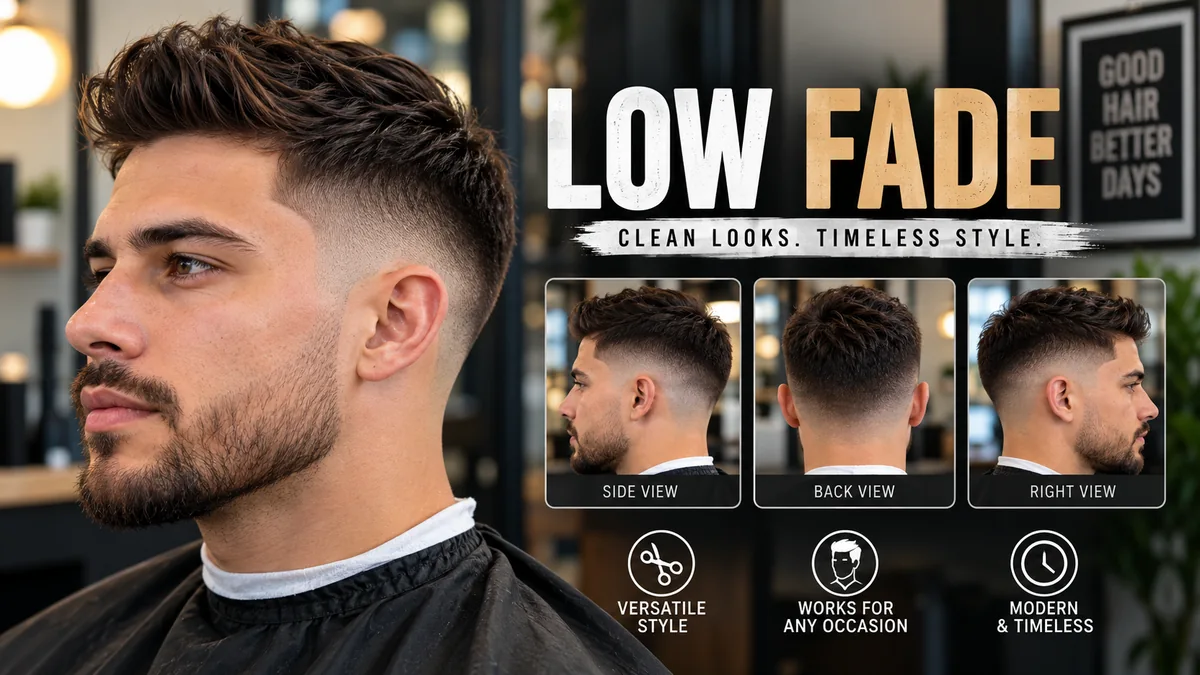
A low fade is one of those haircuts that can make a noticeable difference without completely changing your appearance. The sides look cleaner, the neckline becomes sharper, and the hair on top keeps enough length and weight to preserve your natural style.
Unlike a mid or high fade, the transition begins close to the ears and neckline. That lower starting point creates a softer silhouette and makes the haircut easy to combine with everything from a textured crop and buzz cut to curls, waves, a side part, or longer hair.
A low fade is a haircut in which the hair gradually becomes shorter near the lower sides and back of the head, with the transition beginning just above the ears and around the neckline. It leaves more hair and visual weight on the sides than mid or high fades, creating a subtle, clean finish.
The concept sounds simple, but there is an important detail: “low” describes where the fade begins, not how short the bottom must be. A low fade can finish at bare skin, zero, a 0.5 guard, or a longer clipper length.
What Is a Low Fade Haircut?
A fade creates a gradual transition between different hair lengths. Instead of seeing a hard line where short hair suddenly becomes long, you see a smooth gradient.
With a low fade, that gradient stays near the bottom of the head. It usually begins just above the ear and follows the lower hairline toward the nape. By comparison, a mid fade moves the transition closer to the temple, while a high fade places it even higher.
That placement matters because it determines how much hair remains on the sides.
A low fade preserves more weight. From the front, the haircut may look relatively natural. Turn to the side, however, and the clean transition around the ear becomes much more visible.
This combination makes the style useful for someone who wants:
- Cleaner sides without removing too much hair
- A subtle transition rather than extreme contrast
- Plenty of styling flexibility on top
- A fade that works with short, medium, curly, or textured hair
- A less drastic introduction to faded haircuts
The exact appearance still depends on the shortest clipper setting, how wide the transition is, and what hairstyle you choose above it.
Quick Takeaway: “Low” refers primarily to fade placement. You still need to decide whether you want skin, zero, 0.5, 1, or another length at the bottom.
Low Fade vs Low Taper: They Are Not Always the Same
One of the most useful things to understand before visiting a barber is the difference between a low fade and a low taper fade.
People often use the names interchangeably, and terminology can vary between barbershops. Technically, however, they can describe different shapes.
A low taper concentrates the shortening around specific edges, especially the sideburns and nape, while leaving much of the side panel relatively full. A low fade generally creates a more continuous faded section around the lower sides and back.
| Feature | Low Fade | Low Taper Fade |
|---|---|---|
| Main transition | Lower sides and back | Primarily sideburns and neckline |
| Amount of side hair removed | More | Less |
| Overall contrast | More noticeable | More subtle |
| Side profile | Clear gradient | Fuller side panel |
| Grow-out | Visible as lower hair grows | Usually softer |
| Good for | Clearly faded appearance | Minimal, natural cleanup |
This distinction becomes especially important if you show your barber a photograph of a low taper but simply ask for a fade.
If you want the sides to remain dark and full, say so.
A useful instruction would be:
“Keep the taper low and compact around my sideburns and neckline, and leave the sides above my ears fuller.”
If you actually want the gradient to continue around the lower portion of the head, ask for a low fade instead.
Low Fade vs Mid Fade vs High Fade
Fade height dramatically changes the silhouette even when the top remains exactly the same.
The easiest way to understand the difference is to look at where the shortest section and transition sit.
| Fade | Starting Area | Contrast | Side Weight | Overall Effect |
|---|---|---|---|---|
| Low fade | Just above ears | Low to moderate | More | Subtle and clean |
| Mid fade | Around middle sides/temple area | Moderate | Medium | Balanced and defined |
| High fade | Near or above temples | Strong | Less | Sharp and dramatic |
Current barber guides consistently distinguish the three mainly by transition height: low near the ear, mid around the middle or temple area, and high closer to or above the temple.
Low fade
The low version leaves the greatest amount of hair around the sides. That helps preserve the natural outline of the haircut and provides a smoother connection between longer hair on top and the faded section.
Mid fade
A mid fade moves the transition upward. More of the side hair disappears, making the fade easier to see from the front.
It sits between subtle and dramatic.
High fade
A high fade removes considerably more side weight and produces strong separation between the top and sides.
Because the transition starts higher, the hairstyle on top often appears more prominent.
One practical rule is worth remembering: start lower when uncertain. A barber can take a fade higher during the appointment, but removed hair cannot be restored.
Low Fade vs Skin Fade: Height and Length Are Different Decisions
Another common misconception is that every fade reaches the skin.
It doesn’t.
“Low” describes the height of the transition.
“Skin” describes the shortest length.
That means a haircut can simultaneously be a low skin fade.
You could also request:
- Low zero fade
- Low 0.5 fade
- Low number 1 fade
The lower the base length, the more scalp becomes visible and the stronger the contrast generally appears.
Low skin fade
A low skin fade gradually reaches bare or nearly bare skin at the bottom while keeping the transition positioned low.
It produces a particularly crisp finish around the ears and neckline.
The downside is that regrowth becomes visible quickly because even a few millimeters of new hair changes the clean skin-to-hair contrast.
Low zero fade
A zero fade uses an unguarded clipper or similarly very short base rather than intentionally taking the section completely to bare skin.
It can give you sharp definition without quite the same scalp exposure.
Low 0.5 or number 1 fade
Leaving a little more hair at the bottom creates a softer gradient.
This can also be worth considering for people who dislike strong scalp exposure or experience irritation after extremely close cutting. Barber guidance commonly recommends guarded lengths instead of very close shaving for clients prone to razor bumps.
Popular Low Fade Styles
The fade is only the foundation of the haircut.
What happens on top determines most of its personality.
That versatility explains why the same basic fade can accompany very different hairstyles, from a short buzz cut to several inches of textured hair.
1. Low Fade With Textured Top
A textured top creates movement while the faded sides provide structure.
Rather than combing every strand perfectly into position, the hair is separated into visible pieces using natural texture and a relatively matte finish.
This pairing works especially well with straight or slightly wavy hair.
Ask the barber to preserve enough length on top for texture rather than cutting everything uniformly short.
2. Low Fade With Textured Crop
The textured crop keeps the top relatively short and manageable while using choppy texture for definition.
Because both elements are compact, the style doesn’t require dramatic height to look intentional.
A crop can also include a short fringe pushed toward the forehead.
3. Low Fade With Fringe
Instead of brushing the hair backward, the fringe brings some of the top forward.
That makes the hairstyle particularly adaptable because the fringe can be:
- Straight
- Choppy
- Textured
- Curly
- Soft and natural
- Slightly messy
The contrast between a fuller fringe and clean lower sides gives the haircut its shape.
4. Low Fade With Curly Hair
Curls and fades work naturally together.
The fade removes excess bulk from the lower perimeter while leaving enough length above for the curl pattern to remain visible.
The biggest mistake is taking the transition unnecessarily high. If too much side hair is removed, the haircut can lose the rounded shape that makes the curls look full.
A low transition helps preserve that volume.
5. Low Fade With Wavy Hair
Wavy hair provides built-in movement.
Instead of flattening it with heavy product, keeping some length on top allows the waves to create natural texture.
A low faded perimeter then makes the deliberately loose top look cleaner.
6. Low Fade With Straight Hair
Straight hair exposes cutting lines easily, which makes blending particularly important.
Possible top styles include a side part, crop, fringe, quiff, comb-over, or simple short textured finish.
People with fine straight hair should usually avoid making the top unnecessarily heavy. Strategic texture can make the style look less flat.
7. Low Fade With Buzz Cut
A buzz cut doesn’t have to be one uniform length.
Adding a low fade creates graduation around the ears and back while preserving slightly more length toward the upper sides and top.
The result remains extremely short but gains considerably more shape.
Because there is little hair available to hide inconsistencies, the blend and outline need to be precise.
8. Low Fade With Side Part
A side part creates a more traditional silhouette.
The top can be combed neatly while the lower fade cleans the perimeter without making the sides look excessively short.
This combination works particularly well when you want definition without the dramatic separation associated with a high fade.
9. Low Fade With Comb-Over
A comb-over leaves enough length to direct the hair sideways or slightly backward.
The fade prevents the lower sides from becoming bulky while preserving enough upper-side weight to connect naturally with the longer top.
A matte paste creates a more relaxed result; pomade can produce greater shine and control.
10. Low Fade With Quiff
A quiff places volume toward the front of the head.
Keeping the fade low helps balance that height because the upper sides remain relatively full.
The hairstyle can range from a modest everyday quiff to a much larger, styled version.
11. Low Fade With Pompadour
A pompadour requires more length and volume.
Pairing it with a low fade provides a gradual transition into the sides instead of immediately separating a large top from extremely short hair.
This is particularly useful if you prefer the classic proportions of a pompadour but want cleaner modern edges.
12. Low Fade With Longer Hair
You don’t need short hair on top to wear a fade.
Keeping several inches of length provides enough flexibility for swept-back styles, loose waves, curtains, a middle part, or naturally messy hair.
In fact, the contrast can work especially well: clean edges underneath, movement above.
13. Low Drop Fade
A standard fade doesn’t necessarily remain perfectly horizontal.
A drop fade curves downward behind the ear, following the shape of the head toward the back.
When this drop is positioned low, it preserves considerable hair around the upper sides while creating a more sculpted rear profile.
14. Low Fade With Waves
For tightly curled or coily hair trained into waves, a low fade can frame the wave pattern without removing too much of it.
The barber needs to understand where the visible wave pattern should end before establishing the fade.
15. Low Fade With Beard
A fade can also be blended toward facial hair.
Rather than allowing the sideburn to form a heavy block between the haircut and beard, the barber gradually transitions the lengths.
The key is proportion. The haircut fade and beard blend should look connected without erasing the natural shape of either one.
Quick Takeaway: Choose the hairstyle on top first, then decide how the fade should support it. The fade should complement the overall silhouette rather than becoming the entire haircut.
Does a Low Fade Work With Every Hair Type?
It can be adapted to straight, wavy, curly, and coily textures, but the barber should not use exactly the same technique for every client.
Hair density matters too.
Fine hair
Fine hair can reveal scalp easily.
Going extremely short around a large portion of the sides may exaggerate that difference. Keeping the transition low preserves more visual density.
Lightweight products usually work better than heavy waxes that collapse volume.
Thick hair
Thick hair often develops bulk around the sides.
A fade can remove some of that weight, but staying low means enough fullness remains to maintain a natural silhouette.
Debulking above the fade may sometimes be more important than taking the fade higher.
Curly hair
With curly hair, the barber needs to account for curl pattern and shrinkage.
Removing too much weight can change the shape dramatically. A conservative transition gives the curls above it room to remain defined.
Coily hair
A low fade can frame coily textures, short curls, twists, waves, and other styles while cleaning the perimeter.
Precise blending and line work tend to be especially visible on shorter styles.
How Face Shape Affects a Low Fade
There isn’t a universal formula saying one fade belongs to one face shape.
Hairline, forehead, head shape, hair density, beard, and top hairstyle all influence the final result.
Still, proportions are useful.
Oval face
An oval face provides flexibility because its proportions generally accommodate many different top lengths.
You can keep the top short or create moderate volume without relying on the fade to reshape the silhouette.
Round face
If you want to visually lengthen a rounder face, retaining some height on top can help.
Avoid creating excessive width at the sides. A controlled low fade combined with texture or moderate vertical volume can provide definition without removing all side weight.
Square face
A square face already has strong angles.
A clean fade can emphasize those lines, especially when paired with a neat hairline and a structured top.
Alternatively, natural texture can soften the overall appearance.
Long or rectangular face
Excessive height on top can make a longer face appear even more elongated.
Keeping some fullness on the sides is therefore useful, which is one reason a low transition can work well.
Diamond or heart-shaped face
These shapes can benefit from keeping some visual width through the upper sides rather than taking the entire side extremely short.
Again, the top style matters just as much as the fade.
How to Ask Your Barber for a Low Fade
Simply saying “give me a low fade” leaves several decisions unresolved.
Two barbers can interpret the request differently and still technically give you what you asked for.
A clearer consultation covers four things.
1. Specify the height
Tell the barber that you want the transition kept low, close to the ears and neckline.
If you don’t want it drifting toward a mid fade, explicitly say:
“Keep the fade below the temple.”
2. Choose the shortest length
Decide how much scalp you want showing.
For example:
- Skin for maximum contrast
- Zero for extremely short stubble
- 0.5 for a softer base
- Number 1 for greater coverage
Remember that fade height and base length are separate choices.
3. Explain what you want on top
Instead of saying “leave it longer,” provide useful information.
Tell your barber whether you want:
- Scissors on top
- A specific approximate length
- Natural curls preserved
- Choppy texture
- A fringe
- A side part
- A middle part
- A quiff
- A slicker finish
- A messy finish
4. Show a reference from multiple angles
A photograph can eliminate ambiguity, but one front-facing image isn’t always enough.
The most useful reference shows the side because that’s where fade height is easiest to identify.
If possible, show front, side, and rear views.
Current barber guidance similarly recommends side-view references because terminology and fade placement can vary between barbers.
What Clipper Guard Should You Choose?
Clipper guards control cutting length, but they don’t define the entire fade.
A skilled barber may use several guard lengths, an adjustable clipper lever, trimmers, clipper-over-comb, and sometimes scissors to build the transition.
The bottom length is the decision that matters most to you.
| Base | Appearance | Scalp Exposure | Grow-Out Visibility |
|---|---|---|---|
| Skin | Very sharp | Maximum | Very noticeable |
| Zero | Extremely short | High | Noticeable |
| 0.5 | Soft but crisp | Moderate | Moderate |
| #1 | Fuller | Lower | Softer |
Guard numbering can also vary slightly depending on equipment and technique, so showing the desired finish is often more reliable than relying on a number alone.
How a Barber Creates the Fade
Understanding the process makes it easier to communicate what went wrong if you ever receive a fade you dislike.
A barber generally works through several stages:
- Establish the shape. The desired fade height is identified around the ears and back.
- Create the shortest area. Clippers or trimmers establish the base length.
- Build the transition. Progressively longer lengths are used above the base.
- Remove visible lines. Short intermediate adjustments soften boundaries between sections.
- Connect the upper sides. Clippers, clipper-over-comb, or scissors blend the fade into the longer hair.
- Refine the outline. Sideburns, around the ears, and neckline are cleaned.
- Cut and style the top. The final shape is adjusted to complement the fade.
The goal isn’t merely to make the bottom short.
A good fade should look like a smooth gradient rather than several obvious horizontal bands.
Common Low Fade Mistakes
Even a technically clean fade can look wrong when its proportions don’t suit the intended hairstyle.
Taking the fade too high
This is probably the most frustrating mistake because it cannot be reversed immediately.
If you requested a subtle cut and the shortest section reaches the temples, you’ve effectively moved toward mid-fade territory.
Start conservative when uncertain.
Confusing a taper with a full fade
If you only want clean sideburns and a tidy neckline, you may actually want a low taper rather than a continuous low fade.
Use photographs and explain how much of the side panel should remain full.
Choosing skin automatically
A fade does not need to expose bare scalp.
Skin creates stronger contrast, but a 0.5 or #1 may suit your preferences better and can provide a softer grow-out.
Ignoring the back
People often concentrate entirely on the side view.
But the fade has to transition around the back of the head as well. Decide whether you want a relatively even low transition or something that drops lower behind the ear.
Removing too much bulk from curly hair
Curls need enough mass to maintain their shape.
Aggressive thinning or taking the fade too high can leave a top-heavy silhouette instead of a balanced haircut.
Using too much styling product
A clean haircut doesn’t require hair that looks coated.
Start with a small amount, distribute it through your hands, and add more only if needed.
How to Style a Low Fade
The faded section itself needs almost no daily styling.
Most of your routine concerns the hair on top.
For a natural textured finish
Start with slightly damp or dry hair.
Work a small amount of matte paste or clay through the top, then separate sections with your fingers rather than forcing them into perfect alignment.
For volume
Use a blow dryer to direct the hair upward or backward while shaping it with your fingers or a brush.
Once the basic shape is established, add a small amount of styling product.
For curls
Prioritize moisture and curl definition rather than rigid hold.
Apply an appropriate curl product without aggressively disturbing the natural pattern.
For a neat side part
Establish the direction while the hair is slightly damp, comb it into place, then use a controlled amount of pomade or styling cream.
The goal is hold without making the top unnecessarily stiff.
How Often Does a Low Fade Need a Haircut?
There isn’t one mandatory schedule because hair growth, base length, and personal standards vary.
A skin finish loses its freshly cut appearance sooner than a fade that begins at a 0.5 or #1.
As a broad practical range, many current barber guides place fade or taper maintenance around two to four weeks, while softer guarded tapers may remain presentable longer.
Think in terms of appearance rather than the calendar.
You may want a refresh when:
- The outline around the ears loses definition
- The neckline becomes untidy
- The lower gradient stops looking clear
- Side growth changes the silhouette
- The top no longer connects cleanly with the sides
If you like a very crisp skin fade, you’ll notice regrowth relatively quickly.
If you prefer a softer finish, letting it grow for longer may actually suit the style.
How to Maintain a Low Fade Between Barber Visits
You don’t need to recreate the fade at home.
In fact, trying to repair the gradient yourself can turn a small amount of regrowth into a much bigger correction for your barber.
Focus on preserving the haircut rather than recutting it.
Keep your hair and scalp clean
Choose a washing routine suited to your scalp and hair texture. Very curly or coily hair may have different moisture needs from fine, straight hair.
Maintain the top
Your haircut will look better if the longer section is controlled.
That could mean brushing waves, defining curls, styling a fringe, or simply keeping a textured top neat.
Avoid pushing the hairline backward
Repeatedly trying to sharpen your own hairline can gradually change its shape.
If you’re not comfortable with trimmers, leave detailed line work to the barber.
Don’t chase the fade line
A common DIY mistake is spotting one darker patch and cutting it shorter.
Then the section above looks dark, so that gets shortened too.
Before long, your low fade has accidentally become a high fade.
Is a Low Fade Professional?
The hairstyle can be adapted to conservative environments because most of the sides remain relatively full compared with higher fades.
A guarded low fade with a neat side part, crop, or short textured top will look much more understated than a skin fade combined with a dramatic top.
Workplace expectations vary, of course, so the relevant question isn’t simply whether the haircut is called a fade.
Consider:
- How much scalp is exposed
- How sharp the contrast is
- Top length and styling
- Hairline design
- Overall grooming standards in your environment
If you want the most subtle version, keep the transition compact and choose a guarded base rather than taking it to skin.
Does a Low Fade Grow Out Well?
Generally, the lower placement makes regrowth less dramatic than a haircut that removes most of the side hair.
There is simply more surrounding length available to soften the transition.
The exact grow-out depends heavily on the starting length.
A skin fade creates a strong initial contrast, so new growth becomes noticeable relatively quickly. A 0.5 or #1 base produces a less dramatic difference between freshly cut and grown-out hair.
Low tapers can be even more forgiving because they preserve more of the full side panel; current barber references commonly describe their grow-out as softer than a full low fade.
Who Should Consider a Low Fade?
The haircut makes particular sense if you want your sides cleaner but don’t want a dramatic transformation.
It is also a practical starting point if you’ve never worn a fade.
You may like it if you:
- Want to preserve fullness around the upper sides
- Prefer subtle rather than extreme contrast
- Have curls or waves you don’t want excessively shortened
- Want flexibility in how you style the top
- Are growing longer hair but still want clean edges
- Want to experiment with a fade without immediately committing to a higher version
On the other hand, someone who specifically wants most of the sides extremely short may prefer a mid or high fade.
The Most Important Detail Is Not the Name
Haircut terminology isn’t perfectly standardized.
One barber’s low fade can be another barber’s low-mid fade. One shop may use “low taper fade” interchangeably with “low taper,” while another makes a clear technical distinction.
That is why visual communication works so well.
Instead of relying on a haircut name alone, tell the barber:
where the fade should start, how short the bottom should be, how much side weight you want preserved, and what you want done with the top.
Those four decisions describe the haircut much more accurately than a trend name ever could.
Final Thoughts on the Low Fade
The low fade works because it changes the details of a haircut without forcing you into one specific hairstyle. By keeping the transition close to the ears and neckline, it preserves more side weight than a mid or high fade while still giving the perimeter a clean, blended finish.
It can be paired with straight, wavy, curly, or coily hair and adapted to textured crops, fringes, buzz cuts, waves, quiffs, side parts, pompadours, and longer styles.
Before your next haircut, decide on the four details that matter most: fade height, shortest length, amount of side weight, and top style. Bring a clear side-view reference as well. That gives your barber far more useful information than simply asking for a “low fade.”