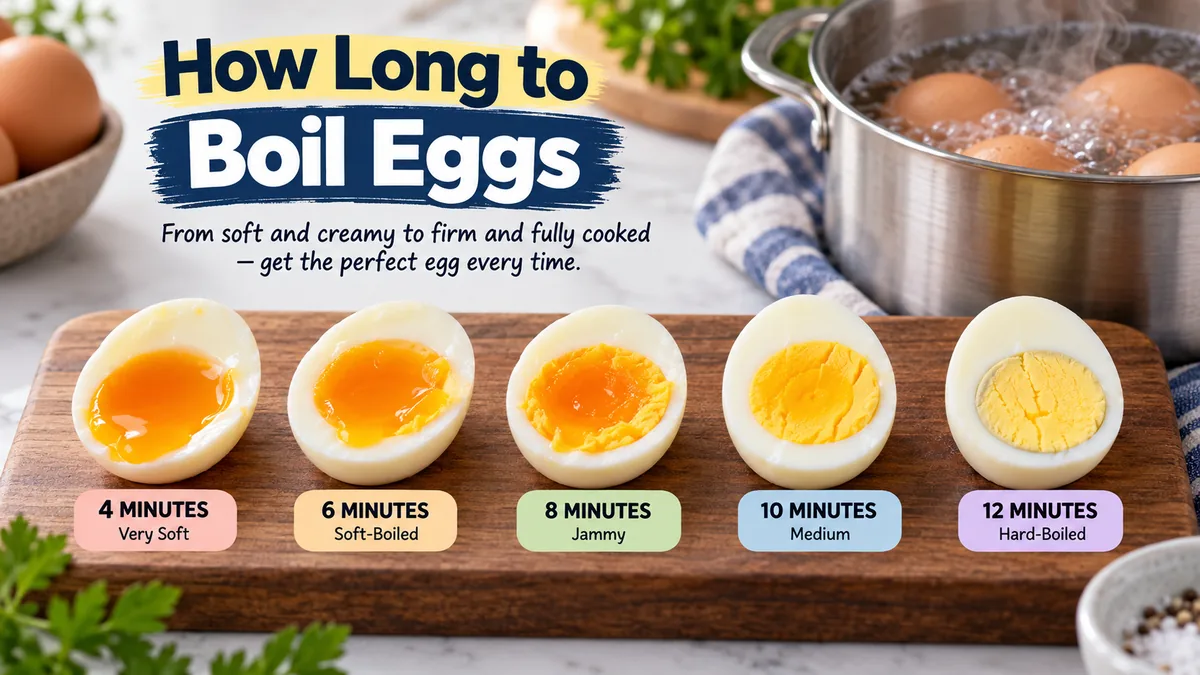
Boiling an egg sounds simple until you cut one open and find a yolk that is far softer—or much drier—than you wanted. The difference between a runny breakfast egg, a creamy jammy center, and a fully cooked hard-boiled egg can come down to just a few minutes.
For large eggs lowered into already-boiling water, boil for about 5–6 minutes for a runny yolk, 7–8 minutes for a jammy or medium-set center, and 10–12 minutes for a firm hard-boiled egg. Transfer the eggs immediately to cold or ice water when the timer ends to stop further cooking.
The exact answer to how long to boil eggs also depends on egg size, starting temperature, cooking method, and the yolk texture you prefer. Once those variables are controlled, consistently cooked eggs are surprisingly easy.
How Long to Boil Eggs for Different Yolk Textures
If you want predictable results, decide how you want the yolk before putting the eggs into the saucepan.
The following times are practical starting points for large chicken eggs added carefully to boiling water. Good Food recommends roughly 5 minutes for a runny yolk, 7 minutes for an almost-set sticky center, 8 minutes for a softly set or jammy center, and 10 minutes for a classic hard-boiled egg.
| Boiling Time | Egg White | Yolk | Best For |
|---|---|---|---|
| 5 minutes | Just set | Very runny | Dipping and toast soldiers |
| 6 minutes | Set | Runny and creamy | Breakfast, toast |
| 7 minutes | Firm | Sticky, partly set | Ramen, toast, bowls |
| 8 minutes | Firm | Soft and jammy | Salads, Scotch eggs |
| 9 minutes | Firm | Mostly set | Grain bowls, sandwiches |
| 10 minutes | Fully firm | Firm but still tender | Classic hard-boiled eggs |
| 11–12 minutes | Fully firm | Completely cooked | Egg salad, meal prep, deviled eggs |
Think of these times as a starting point rather than an unbreakable rule. A jumbo refrigerator-cold egg will not necessarily cook exactly like a medium room-temperature egg.
Martha Stewart’s current guidance similarly puts large hard-boiled eggs at approximately 10–12 minutes, while noting that egg size, starting temperature, and water volume can affect the result.
Quick Takeaway: For most large eggs, remember 6 minutes for runny, 8 minutes for jammy, and 10–12 minutes for hard-boiled.
How Long to Boil Eggs for Soft-Boiled Results
A good soft-boiled egg has a set white surrounding a warm, liquid or creamy yolk.
5 Minutes: Very Runny Yolk
At around five minutes, the egg white should be largely set while the center remains very fluid. This is a good texture when you plan to open the egg in an egg cup and dip toast into the yolk.
Good Food recommends approximately five minutes for a set white with a runny yolk when large eggs are lowered into boiling water.
Because the yolk is still liquid, timing matters. Leaving the egg in hot water for even another minute noticeably changes its consistency.
6 Minutes: Creamy and Runny
At six minutes, the white becomes more reliably set while the yolk remains soft and liquid.
This texture works particularly well for breakfast eggs, toast, rice bowls, noodles, and dishes where you want the yolk to flow when cut.
If the eggs are very cold or unusually large, they may need slightly longer. Good Food specifically notes that egg size and starting temperature can alter cooking time.
7 Minutes: Sticky, Nearly Set Yolk
Seven minutes moves the egg into the space between soft- and medium-boiled.
The yolk is no longer completely liquid. Instead, it becomes thicker and sticky while remaining noticeably softer than a traditional hard-boiled yolk.
This is an excellent texture when you want an egg that can be sliced without losing all of its center.
How Long to Boil Eggs for a Jammy Center
If you have seen eggs served with ramen or grain bowls with deep yellow-orange, creamy centers, you are looking for what is commonly called a jammy egg.
Aim for approximately 7–8 minutes for large eggs.
At eight minutes, the white should be completely set while the yolk remains soft in the middle. Good Food describes an eight-minute egg as softly set and jammy.
The ice bath becomes especially useful here. Without rapid cooling, residual heat continues traveling toward the center after the egg leaves the saucepan. A yolk that looked destined to be jammy can therefore become considerably firmer.
What Does a Jammy Egg Look Like?
A properly jammy yolk should:
- hold together when the egg is sliced;
- remain moist and creamy;
- have a deeper, softer center;
- avoid the dry or crumbly texture of an overcooked yolk.
For ramen, salads, rice bowls, avocado toast, and similar dishes, this middle texture often provides the best balance between structure and creaminess.
How Long to Boil Eggs for Hard-Boiled Eggs
For a classic hard-boiled egg, approximately 10–12 minutes is a reliable range for large eggs when timing begins after they enter boiling water.
At about 10 minutes, the yolk should be firm enough for slicing or mashing without becoming excessively dry. Good Food identifies 10 minutes as its classic hard-boiled result, while Martha Stewart gives a 10–12 minute range for large eggs.
If you specifically want a completely firm yolk for egg salad, deviled eggs, sandwiches, or meal preparation, moving toward the upper end of that range gives you more certainty.
Cooking substantially longer is usually unnecessary.
Why Do Hard-Boiled Yolks Sometimes Turn Gray-Green?
That gray or greenish ring around a cooked yolk is commonly associated with excessive heat exposure and continued cooking after the egg should have been cooled.
Prompt cooling helps prevent it. Food Network’s guidance specifically recommends transferring cooked eggs to ice water, while Good Food also advises immediate cold-water cooling to stop further cooking.
The discoloration does not automatically mean the egg is spoiled, but it is a useful sign that your cooking or cooling technique could be improved.
Quick Takeaway: Once hard-boiled eggs reach your preferred doneness, get them out of the hot water promptly. Residual heat is still cooking the egg.
How to Boil Eggs Step by Step
There are two common approaches: starting eggs in already-boiling water or beginning with eggs in cold water.
Both can work. The important part is using one method consistently because the timing is not directly interchangeable.
For easy-to-repeat results, the boiling-water method makes it straightforward to define exactly when the cooking clock begins.
1. Bring the Water to a Boil
Fill a saucepan with enough water to comfortably cover the eggs.
Bring the water to a boil.
Avoid overcrowding the pan. Eggs should have enough space to sit comfortably rather than being packed into several unstable layers.
2. Lower the Eggs in Carefully
Use a large spoon or slotted spoon to gently lower each egg into the hot water.
Do not simply drop eggs into the saucepan. The impact against the bottom can crack the shell.
Good Food recommends slowly lowering eggs into the water rather than dropping them.
3. Reduce to a Controlled Boil or Simmer
You do not need the eggs violently bouncing around the pan.
Once they are added, maintain enough heat to keep the water steadily hot and gently bubbling. Aggressive movement increases the chance that shells will knock together and crack.
4. Start Your Timer
Use the texture you want as your guide:
- 5–6 minutes: runny yolk.
- 7 minutes: sticky, nearly set center.
- 8 minutes: jammy yolk.
- 10 minutes: classic firm yolk.
- 10–12 minutes: fully hard-boiled, depending on size and preferred firmness.
Timing becomes much more useful when you consistently use eggs of approximately the same size and starting temperature.
5. Transfer the Eggs to Cold Water
When the timer sounds, remove the eggs with a slotted spoon and immediately put them into a bowl of very cold water or an ice bath.
This rapidly slows the cooking process and makes the final texture more predictable. Cold-water cooling is recommended across several established egg-cooking methods.
Let the eggs cool until comfortable to handle. For eggs you plan to store, cool them thoroughly before refrigeration.
Should You Start Eggs in Cold or Boiling Water?
This is one reason recipes sometimes give apparently contradictory answers to how long to boil eggs.
Some methods begin with boiling water. Others put eggs into cold water and heat everything together. Another common hard-boiled technique brings the water to a boil, removes the saucepan from the burner, covers it, and lets the eggs finish cooking in the retained heat.
These methods require different timings.
Boiling-Water Start
With this approach:
- Bring the water to a boil.
- Carefully lower in the eggs.
- Start timing.
- Cook to your desired doneness.
- Cool immediately.
The advantage is repeatability: the cooking timer begins at a clearly defined point.
Good Food uses this technique for its detailed 5-, 6-, 7-, 8-, and 10-minute progression.
Cold-Water Start
With a cold-water method, eggs are placed in the saucepan first and covered with water before heating.
One widely used variation is the hot-water standing method. The American Egg Board recommends placing eggs in a single layer, covering them with cold water by about one inch, bringing the water just to a boil, removing the pan from the burner, covering it, and letting large eggs stand for about 12 minutes.
Food Network offers a similar technique in which eggs are covered with cold water, brought to a boil, then removed from the heat and left covered for 8–10 minutes before cooling.
The important lesson is not that one recipe must be wrong. Different cooking methods require different clocks.
Do not take a 10-minute timing intended for eggs lowered into boiling water and automatically apply it to a recipe that begins with cold water.
Does Egg Size Change Boiling Time?
Yes.
Most general boiling guides assume you are cooking large eggs, so medium, extra-large, and jumbo eggs can require adjustments.
The American Egg Board’s hot-water standing method, for example, recommends approximately:
| Egg Size | Hot-Water Standing Time |
|---|---|
| Medium | 9 minutes |
| Large | 12 minutes |
| Extra-large | 15 minutes |
These times apply specifically to its cold-water-to-boil, remove-from-heat method—not to every boiling technique.
For a boiling-water method, Good Food suggests adjusting its large-egg timings by roughly 30 seconds: slightly less for medium eggs and slightly more for extra-large eggs.
This is why following a timer blindly can occasionally disappoint. Egg size is part of the recipe.
If you buy the same size eggs regularly, keep track of the timing that gives you your favorite center. Once you find it, repeating the result becomes much easier.
Do Cold Eggs Take Longer to Boil?
Starting temperature can make a difference.
An egg straight from the refrigerator begins colder than one that has been sitting at room temperature. Good Food notes that fridge-cold eggs may need additional cooking time in its boiling-water method and that room-temperature eggs may also be less likely to crack when entering hot water.
There is no need to obsess over tiny temperature differences. Consistency matters more.
If you normally cook eggs directly from the refrigerator, keep doing that and establish the timing that works for your refrigerator-cold eggs. If you normally let them warm somewhat first, base your timing on that routine.
Why Eggs Crack While Boiling
Shells may crack because of:
- a sudden temperature change;
- being dropped into the saucepan;
- eggs knocking together in violently boiling water;
- existing hairline cracks in the shell.
Lowering eggs gently with a spoon and keeping the water under control reduces unnecessary impacts.
If an egg does develop a minor crack while cooking, some white may escape into the water. That does not necessarily ruin the rest of the egg, although severely cracked eggs can become messy.
Why an Ice Bath Makes Better Boiled Eggs
The timer is only part of successful egg boiling.
When you take an egg out of hot water, the egg itself remains hot. That retained heat can continue cooking the white and yolk. If you are aiming for a precisely runny or jammy center, those extra moments matter.
An ice bath or very cold water rapidly removes heat and slows carryover cooking.
This is particularly valuable for:
- soft-boiled eggs;
- jammy eggs;
- batches of hard-boiled eggs;
- eggs you want to peel soon;
- eggs being prepared ahead for salads or meal prep.
Good Food advises transferring cooked eggs into very cold water to prevent further cooking, and the American Egg Board similarly recommends cold running water or an ice-water bowl for cooling hard-cooked eggs.
How Long Should Eggs Stay in Ice Water?
For immediate eating, cool them until they are comfortable to handle.
For hard-boiled eggs that need to cool completely, leave them in cold water longer and replace warming water when necessary.
The goal is simple: remove enough heat that the yolk does not continue moving beyond your chosen level of doneness.
How to Peel Boiled Eggs More Easily
A perfectly cooked egg can still become frustrating when half the white comes away with the shell.
Start by cooling the egg thoroughly.
Then:
- Tap the shell gently against a firm surface.
- Crack it in several places.
- Roll it lightly to loosen the shell.
- Begin peeling around the wider end.
- Work your fingers beneath the thin membrane.
- Rinse away any small shell fragments.
Good Food recommends cracking the shell all over and starting from the wide end, where loosening the shell and membrane can make peeling easier.
Are Older Eggs Easier to Peel?
You may notice that extremely fresh eggs can sometimes be more stubborn to peel than eggs that have been stored for a while.
That does not mean you should deliberately keep eggs beyond safe storage periods just to make peeling easier. Instead, use proper cooling and gentle peeling technique, particularly when appearance matters for dishes such as deviled eggs.
For egg salad, a slightly rough peeled surface obviously matters far less.
How Many Eggs Can You Boil at Once?
You can boil several eggs together, provided your saucepan is large enough to accommodate them comfortably.
For predictable results, arrange eggs in a single layer rather than stacking a large number in a small pan. The American Egg Board specifically recommends a saucepan large enough to hold eggs in one layer for its hard-cooking method.
Also make sure there is enough water to maintain a stable cooking environment.
Adding many cold eggs to a small quantity of boiling water can cause the water temperature to drop sharply. That means the same timer that worked for two eggs may not behave identically with a crowded batch.
When batch cooking, use a sufficiently large saucepan and enough water.
Common Mistakes When Boiling Eggs
Most disappointing boiled eggs come from a few simple mistakes rather than a complicated cooking problem.
Starting the Timer at the Wrong Point
If your recipe says to lower eggs into boiling water, start the timer when the eggs enter.
If your recipe starts with cold water, follow that method’s specific timing instructions instead.
Mixing the two methods is one of the easiest ways to get inconsistent results.
Using Different Egg Sizes
A medium egg and an extra-large egg do not heat through at exactly the same rate.
If consistency matters, use eggs of the same size in a batch.
Boiling Too Aggressively
A violent rolling boil makes eggs bounce around unnecessarily.
Once the eggs are in the pan, controlled heat is enough.
Skipping the Cold-Water Bath
This is especially noticeable with soft and jammy eggs. Without cooling, carryover heat continues changing the yolk after your timer ends.
Cooking Hard-Boiled Eggs for Too Long
More cooking does not automatically mean a better hard-boiled egg.
Once the white and yolk are completely set, prolonged heating can produce a drier texture. Around 10–12 minutes is sufficient for large eggs using the boiling-water approach described above.
Guessing Instead of Using a Timer
A difference of one or two minutes can transform the yolk.
Use an actual timer, particularly when making soft-boiled or jammy eggs.
How to Tell If a Boiled Egg Is Done
The difficult part about boiling eggs is that the shell hides what is happening inside.
The most reliable solution is therefore controlled timing, not visual inspection.
Once you know the egg size, starting temperature, and cooking method, use the same timing every time.
If you are experimenting with a new carton of unusually large eggs, cook one first. Cool it, cut it open, and check the center.
If it is too runny, add roughly 30–60 seconds next time. If it is too firm, shorten the next batch.
That small test is often more useful than trying to judge doneness through the shell.
How Long to Boil Eggs at High Altitude
Altitude is an often-overlooked reason that a familiar egg recipe can behave differently after you move or travel.
Water boils at a lower temperature as elevation increases. That means food cooked in boiling water can require more time at higher altitudes than it does near sea level.
Rather than relying on exactly the same minute count everywhere, use your normal timing as a baseline and adjust if the center consistently comes out undercooked.
This is also why a cooking time that works perfectly in one kitchen is not necessarily universal.
How Long Do Hard-Boiled Eggs Last?
If you are making eggs for meal preparation rather than eating them immediately, storage becomes part of the process.
The American Egg Board says hard-boiled eggs in their shells can be refrigerated for up to one week.
Cool cooked eggs promptly and keep them refrigerated.
If you prepare a batch for breakfasts, salads, sandwiches, or snacks, keeping track of the day they were cooked makes it easier to use them within the recommended period.
Soft-Boiled vs. Medium-Boiled vs. Hard-Boiled Eggs
The terminology can be confusing because there is no universal dividing line between every stage.
A practical way to think about it is by yolk texture:
| Style | Approx. Time* | Yolk Texture |
|---|---|---|
| Soft-boiled | 5–6 minutes | Liquid/runny |
| Medium or jammy | 7–8 minutes | Sticky to creamy |
| Nearly hard-boiled | 9 minutes | Mostly set |
| Hard-boiled | 10–12 minutes | Firm |
*Approximate timing for large eggs lowered into boiling water; size, temperature, altitude, and cooking technique can change the result.
There is no requirement to fit your preferred egg into a particular label. If an eight-minute yolk is exactly how you like it, that is the useful number to remember.
What Is the Best Boiling Time for Eggs?
For most kitchens, three numbers cover almost everything:
6 minutes: Choose this when you want a fully set or nearly set white with a runny yolk.
8 minutes: Choose this when you want a creamy, jammy center that holds together when sliced.
10–12 minutes: Choose this when you want a traditional hard-boiled egg with a fully cooked yolk.
From there, adjust in small increments for egg size, starting temperature, altitude, and personal preference.
That is ultimately the most reliable answer to how long to boil eggs: start with 5–6 minutes for soft-boiled, 7–8 minutes for jammy, and 10–12 minutes for hard-boiled large eggs, then cool them immediately in cold or ice water. Once you find the exact minute that produces your favorite yolk, use the same egg size and method each time for consistently better results.