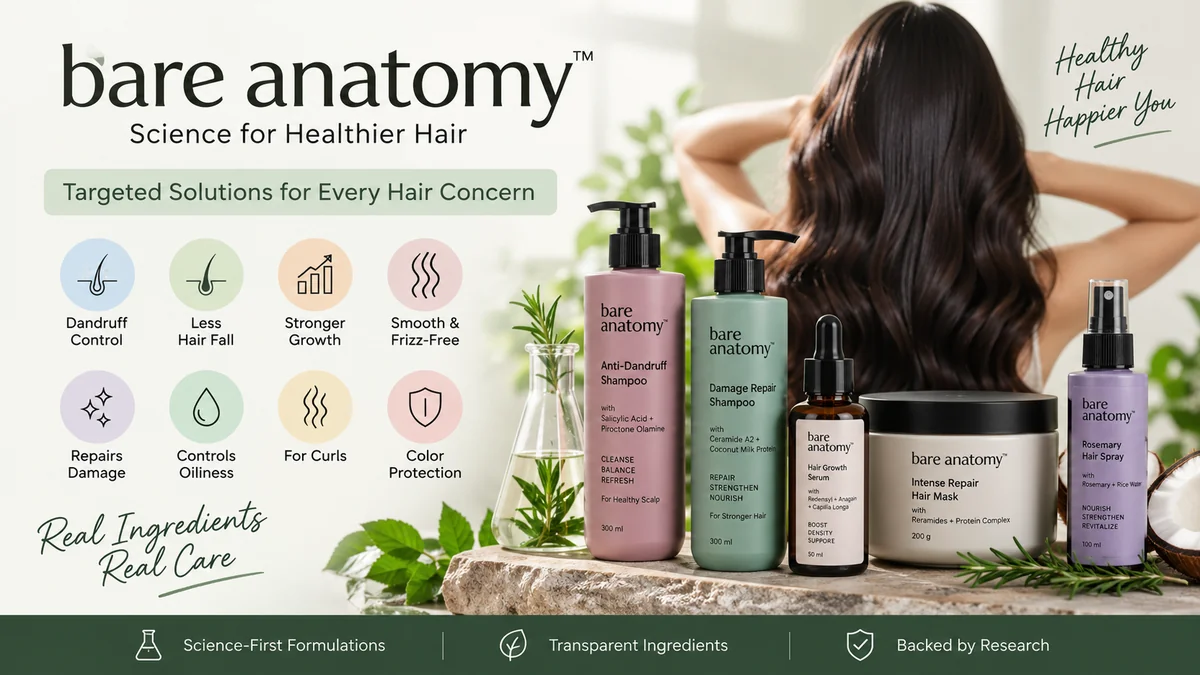
Hair care shelves are crowded with products promising smoother hair, less dandruff, reduced hair fall, and better growth. bare anatomy has built its identity around a more specific idea: targeted hair and scalp products built around recognizable cosmetic ingredients and science-focused formulations.
The brand’s current range extends beyond basic shampoo and conditioner into hair growth serums, rosemary sprays, masks, anti-dandruff treatments, curl products, color-protection formulas, volumizing products, and solutions for damaged or oily hair.
bare anatomy is a hair care brand operated under Innovist, a personal-care company that describes its approach as science-first, transparent, and driven by in-house research and development. Its products address concerns including dandruff, hair fall, dryness, frizz, damaged hair, scalp oiliness, hair density, curls, and color-treated hair.
This guide explains what the brand is, the products it offers, how important ingredients work, and what to consider before adding one of its formulas to a hair care routine.
What Is bare anatomy?
Bare Anatomy is primarily a hair and scalp care brand within the Innovist portfolio. Innovist also operates personal-care brands including Chemist at Play, SunScoop, and Vinci Botanicals. The company says its broader formulation philosophy centers on clean formulations, ingredient transparency, clinical testing, and in-house R&D.
Rather than organizing its range only around traditional categories such as shampoo or conditioner, Bare Anatomy frequently organizes products around specific concerns.
These include:
- dandruff and scalp buildup
- hair fall and weak strands
- dry and frizzy hair
- damaged hair
- oily scalp
- low volume
- curls and curl definition
- color-treated hair
- premature-looking greying
- hair density and growth support
That concern-based structure helps explain why two Bare Anatomy shampoos may contain very different active or supporting ingredients.
For example, its current anti-dandruff shampoo highlights salicylic acid and piroctone olamine, while its smoothing shampoo uses ingredients including niacinamide and aloe vera extract. Its damage-repair formula instead emphasizes Ceramide A2 and coconut milk protein.
Is Bare Anatomy an Indian brand?
Bare Anatomy operates as part of Innovist’s personal-care portfolio and is prominently distributed in the Indian beauty and personal-care market. Its products are currently available through the Innovist/Bare Anatomy storefront and major Indian retailers and marketplaces such as Nykaa, Flipkart, Apollo Pharmacy, and Tata 1mg.
The more useful question for consumers, however, is not simply where a brand comes from. Hair products should be evaluated according to their formulation, ingredients, intended concern, individual tolerance, and realistic expectations.
What Products Does bare anatomy Make?
The Bare Anatomy range has become fairly broad.
Its current catalog includes products for cleansing, conditioning, smoothing, scalp care, growth-focused routines, curls, color protection, volume, damage repair, and children’s hair care.
| Product category | Typical purpose | Examples of highlighted ingredients |
|---|---|---|
| Anti-dandruff shampoo | Flakes, buildup and scalp care | Salicylic acid, piroctone olamine, biotin |
| Anti-hair fall shampoo | Weak strands and hair-fall control | Adenosine, peptides |
| Smoothing shampoo | Dryness and frizz | Niacinamide, aloe vera |
| Growth serum | Hair density/growth-focused routine | Redensyl, Anagain, Capilia Longa |
| Rosemary spray | Scalp and hair-fall routine | Rosemary, rice water |
| Damage repair shampoo | Dry, damaged hair | Ceramide A2, coconut milk protein |
| Volumizing shampoo | Flat or low-volume hair | Rice milk protein, peptides |
| Oil-control shampoo | Oily scalp and buildup | Salicylic acid, hyaluronic acid, tea tree |
| Color-protect products | Color-treated hair | Quinoa protein, amino acid complex |
| Curl products | Curl definition and frizz control | Formula varies by product |
The exact formula can change, so the current ingredient list printed on the product or published by the manufacturer should take priority over older reviews or product descriptions.
bare anatomy Shampoo: Understanding the Main Types
“Which Bare Anatomy shampoo is best?” does not have one universal answer.
A shampoo designed for dandruff is solving a different problem from one designed for frizz or damaged hair. Choosing according to the underlying concern is more sensible than simply selecting the most popular bottle.
Anti-Dandruff Shampoo
Bare Anatomy’s Anti Dandruff Shampoo currently highlights salicylic acid, piroctone olamine, and biotin. The manufacturer markets it for visible dandruff, scalp itching, and scalp cleansing, and lists a scalp pH of 5.4.
Salicylic acid is particularly relevant to a dandruff-focused cleanser because of its keratolytic action: it can help loosen and remove accumulated dead skin and scale.
Piroctone olamine is commonly incorporated into anti-dandruff cosmetic formulations.
Bare Anatomy makes strong numerical claims for dandruff reduction on its product pages. These should be understood as manufacturer-reported product claims rather than a guarantee that every person will receive the same outcome.
Persistent dandruff can also have several causes. If severe flaking, redness, sores, pain, or significant itching continues despite appropriate scalp care, a dermatologist can determine whether something beyond routine cosmetic dandruff care is involved.
Anti-Hair Fall Shampoo
The current Anti-Hair Fall Shampoo highlights adenosine and peptides and is positioned toward weak strands and hair-fall control. Bare Anatomy lists its pH as 4.6 and describes the formula as sulphate- and paraben-free.
There is an important distinction here.
Hair breakage, shedding, and progressive hair loss are not necessarily the same problem.
A shampoo can improve cleansing conditions and reduce damage or breakage associated with poor hair condition, but significant hair loss may be associated with genetics, nutritional deficiencies, hormonal factors, stress, illness, medication, or scalp disorders.
A rinse-off cosmetic shampoo therefore should not automatically be treated as a medical solution for every type of hair loss.
Ultra Smoothing Shampoo
The Ultra Smoothing Shampoo is aimed more specifically at dry and frizzy hair.
The current formula highlights niacinamide and aloe vera extract, and the manufacturer positions it around hydration, frizz management, and improved smoothness.
This makes the product conceptually different from an anti-dandruff cleanser.
If your main concern is rough texture rather than scalp flakes, selecting a moisturizing or smoothing formula is generally more logical than using a treatment-oriented scalp shampoo without a reason.
Oil Control Shampoo
Bare Anatomy also lists an Oil Control Shampoo containing salicylic acid, hyaluronic acid, and tea tree among its highlighted ingredients. It is designed for excess oil, oily buildup, and an itchy scalp.
People with oily scalps sometimes respond by aggressively washing their hair or using several clarifying products simultaneously.
That can be counterproductive if the routine starts irritating the scalp.
A better approach is to introduce one targeted cleanser, observe how the scalp responds, and adjust washing frequency according to oil production, exercise, styling-product use, and hair type.
Damage Repair Shampoo
The Damage Repair Shampoo currently emphasizes Ceramide A2 and coconut milk protein and is intended for dry or damaged hair.
Damage-focused products are particularly relevant to hair exposed repeatedly to:
- bleaching
- permanent coloring
- chemical treatments
- high-temperature styling
- excessive friction
- frequent straightening or curling
No shampoo can permanently restore severely damaged hair to its original biological state. Cosmetic formulations can, however, improve manageability, reduce roughness, condition the fiber, and make damaged hair look and feel healthier.
Volumizing Shampoo
Bare Anatomy’s Volumizing Shampoo currently uses rice milk protein and peptides as highlighted ingredients and is designed to give flat hair more visible body and bounce.
Volume and hair growth should not be confused.
A volumizing product primarily changes how full the existing hair looks and behaves. Increasing the apparent volume of strands is different from producing new follicles or treating a medical cause of thinning.
Quick takeaway: Choose shampoo according to the scalp or hair problem you actually have. Dandruff, excess oil, damage, frizz, low volume, and hair loss are separate concerns and may require different approaches.
bare anatomy Hair Growth Products Explained
Growth-focused hair products generate some of the biggest expectations, so this category deserves more careful interpretation.
Bare Anatomy’s current range includes a Rosemary & Rice Water Hair Growth Spray, an Advanced Hair Growth Serum, and a serum roll-on, alongside other hair-fall products.
Advanced Hair Growth Serum
The Advanced Hair Growth Serum currently highlights 3% Redensyl, 4% Anagain, and 1% Capilia Longa. The manufacturer’s storefront positions the serum around reduced hair fall and new-hair-growth outcomes over a three-month period.
Retail listings also associate the product with Redensyl, Anagain, Baicapil, rosemary, and related growth-focused ingredients depending on the listed formulation or product version.
These ingredient names are common in modern cosmetic hair-growth marketing, but consumers should distinguish three things:
- evidence supporting an individual ingredient;
- testing performed on the finished formulation;
- results a particular individual can realistically expect.
They are not automatically interchangeable.
Hair growth is slow, and visible changes generally require consistent observation over time rather than judging a serum after several applications.
Rosemary and Rice Water Spray
Bare Anatomy currently sells a Rosemary & Rice Water Hair Growth Spray positioned around scalp nourishment, density, and hair-fall reduction.
Rosemary has become extremely popular in consumer hair-care routines.
The important practical point is that “natural” does not mean universally irritation-free. Botanical ingredients and fragrances can still bother sensitive scalps.
If you’re introducing a new leave-on scalp product, starting conservatively and monitoring for itching, burning, redness, or worsening flakes is sensible.
Hair Growth Serum Roll-On
A roll-on version is also available, currently highlighting 5% rosemary, 4% Anagain, and 3% Redensyl.
The main practical distinction is application.
A roll-on can make targeted application to specific scalp areas more convenient, whereas a conventional dropper serum may be easier to distribute over larger areas.
Neither delivery format changes the fundamental rule: consistency and scalp tolerance matter more than applying excessive quantities.
Key Ingredients Found Across bare anatomy Products
Bare Anatomy’s science-focused positioning is closely connected to its use of named ingredients.
Understanding those ingredients is more useful than simply memorizing product names.
Salicylic Acid
Salicylic acid appears in Bare Anatomy’s anti-dandruff and oil-control ranges.
In scalp care, its exfoliating properties can help loosen scale and accumulated material. This makes it particularly relevant to products designed for flakes or oily buildup.
It may not suit every scalp, particularly when combined with an already aggressive routine.
Piroctone Olamine
Piroctone olamine appears prominently in the Anti Dandruff Shampoo.
It is widely used in anti-dandruff hair-care formulations and complements the scale-removing role of ingredients such as salicylic acid.
Niacinamide
Most people recognize niacinamide from skin care, but it also appears in scalp and hair formulations.
Bare Anatomy’s Ultra Smoothing Shampoo currently highlights niacinamide alongside aloe vera extract.
Its presence alone does not determine how effective a shampoo will be. The complete formula—including cleansing agents, conditioning components, concentration, contact time, and frequency of use—matters.
Peptides
Peptides appear in several modern hair formulations, including Bare Anatomy’s anti-hair-fall and volumizing products.
Different peptides serve different formulation purposes, so “contains peptides” should not be interpreted as a standardized benefit shared by every peptide-containing product.
Redensyl and Anagain
Redensyl and Anagain are cosmetic actives commonly marketed for hair-density and growth-support applications.
Bare Anatomy currently uses them in its Advanced Hair Growth Serum and roll-on products.
Marketing around growth ingredients often sounds highly precise, but individual outcomes can differ substantially.
This matters especially when someone’s hair loss has an underlying medical or genetic cause.
Rosemary
Rosemary appears across multiple Bare Anatomy products, including its growth spray, serum roll-on, anti-grey products, conditioner listings, and hair oil products sold through retailers.
Its popularity makes it easy to assume that every rosemary product works identically.
They do not.
A water-based spray, oil, shampoo, and concentrated leave-on serum have very different formulations and contact times.
Ceramides and Proteins
For damaged hair, ingredients aimed at conditioning and supporting the hair fiber become more relevant.
Bare Anatomy’s Damage Repair Shampoo highlights Ceramide A2 and coconut milk protein, while its Color Protect range uses quinoa protein and an amino acid complex.
These products make more sense for hair-fiber concerns than treating them as scalp-growth products.
bare anatomy for Dry, Frizzy, Curly, and Color-Treated Hair
Not every hair problem begins at the scalp.
Hair lengths can become rough, tangled, dull, or difficult to manage even when the scalp itself is healthy.
Dry and Frizzy Hair
Bare Anatomy’s smoothing range includes shampoo, hair masks, serums, and leave-in products designed around moisture, smoothness, shine, and frizz management.
The Ultra Smoothing Hair Mask is one of the brand’s more widely listed products across retailers.
A practical routine for dry hair normally focuses on reducing unnecessary stripping while improving conditioning.
That could mean:
- cleansing primarily at the scalp;
- applying conditioner or mask mainly through the lengths;
- avoiding extremely hot water;
- limiting repeated high-heat styling;
- using a leave-in product when extra slip is needed.
More product is not necessarily better. Overloading fine hair with heavy conditioning formulas can leave it flat or greasy.
Curly Hair
Bare Anatomy also offers curl-focused kits incorporating products such as Curl Defining Shampoo, Curl Enhancing Hair Mask, leave-in conditioner, and gel.
The manufacturer currently markets some of these combinations around curl retention and frizz protection.
For curls, the entire routine matters.
A shampoo may cleanse effectively, but curl definition often depends heavily on conditioning, moisture balance, styling technique, gel application, drying method, and how frequently the curls are disturbed after drying.
Color-Treated Hair
The brand’s Color Protect range includes shampoo and a hair mask containing highlighted ingredients such as quinoa protein and an amino acid complex. Bare Anatomy markets the range around color retention, smoothness, and protection over repeated washing.
Color-treated hair can become more porous and vulnerable to dryness, especially after bleaching.
Gentle cleansing and adequate conditioning are therefore often more relevant than simply choosing a product carrying the word “color” on its label.
Is bare anatomy Sulphate-Free and Paraben-Free?
Some Bare Anatomy formulas are specifically described as sulphate-free and paraben-free. For example, Innovist describes the Anti-Hair Fall Shampoo this way, and retail descriptions similarly identify certain products as sulphate-free.
Innovist also states that its wider formulation standards exclude parabens, sulphates, MCIT, and MIT.
Still, consumers should read the ingredient list of the specific product they intend to use rather than assuming every product carrying the same brand name has an identical formulation philosophy.
“Sulphate-free” also should not automatically be translated into “better for everyone.”
Cleansing systems vary widely. What matters is whether a particular formula cleans effectively without leaving your scalp or hair uncomfortably dry or irritated.
Is bare anatomy Good for Hair?
Bare Anatomy has a broad enough range that judging the entire brand as simply “good” or “bad” misses the useful question.
The better question is: Does a particular Bare Anatomy formula match your hair or scalp concern?
There are several positive characteristics worth considering. The brand organizes many formulas around specific concerns, identifies key ingredients prominently, provides specialized options beyond generic shampoo and conditioner, and offers different ranges for dandruff, hair fall, frizz, oil, damage, curls, volume, and color protection.
But there are also limitations.
Manufacturer percentages such as “5X hair fall control,” “100% dandruff reduction,” or precise improvements in smoothness should be interpreted within the context of the brand’s testing methodology and should not be treated as guaranteed personal outcomes.
Cosmetic products also have natural limits.
A shampoo cannot correct every cause of hair loss. A smoothing mask cannot reverse structural damage permanently. A scalp serum cannot guarantee new hair growth for every user.
What do Bare Anatomy reviews indicate?
The products have accumulated substantial consumer feedback on major Indian retail platforms.
For example, Flipkart currently lists large numbers of ratings for several products, including the anti-dandruff shampoo, rosemary water spray, and anti-hair-fall products. Tata 1mg and Nykaa also show customer ratings across the range.
Reviews can reveal patterns around fragrance, texture, packaging, ease of use, or common experiences.
They are much less reliable for proving biological effectiveness.
One person’s hair fall may have resulted primarily from breakage; another person’s may involve androgenetic alopecia or a temporary shedding event. Their reviews of the same shampoo can therefore differ dramatically.
How to Choose the Right bare anatomy Product
Start with the problem—not the most viral ingredient.
| Your main concern | Product type to investigate |
|---|---|
| Visible flakes | Anti-dandruff shampoo |
| Oily scalp/buildup | Oil-control shampoo |
| Weak hair or breakage | Anti-hair-fall/strengthening range |
| Dry, rough hair | Smoothing shampoo + conditioner/mask |
| Frizz | Smoothing serum or leave-in conditioner |
| Damaged hair | Damage-repair range |
| Flat hair | Volumizing shampoo |
| Curly hair | Curl-focused routine |
| Color-treated hair | Color-protect shampoo and mask |
| Growth-focused routine | Growth serum or rosemary spray |
Next, consider your scalp.
Someone with oily roots and dry ends may need targeted scalp cleansing plus conditioning only through the lengths. Someone with a sensitive scalp may need a simpler routine and should introduce new active-heavy products carefully.
Then check the complete ingredient list.
Don’t buy solely because a formula says rosemary, peptides, rice water, niacinamide, Redensyl, or salicylic acid on the front.
Finally, introduce products gradually.
If you simultaneously begin a new shampoo, serum, oil, conditioner, scalp spray, and mask, it becomes difficult to identify what helped—or what caused irritation.
Quick takeaway: Match the formula to the concern, evaluate the complete ingredient list, introduce new products gradually, and judge results over an appropriate period rather than after one or two washes.
How to Build a Simple bare anatomy Hair Care Routine
A useful hair routine does not need ten products.
Step 1: Choose One Appropriate Cleanser
Select shampoo based primarily on scalp needs.
Dandruff calls for a different cleansing strategy than frizz. An oily scalp has different requirements from a dry, easily irritated one.
Apply shampoo mainly to the scalp and massage gently rather than aggressively scratching with fingernails.
Step 2: Condition the Lengths
Conditioner is primarily useful where hair tends to become dry, tangled, or rough.
For many people, that means the mid-lengths and ends rather than the scalp.
If hair is extremely dry or chemically treated, a mask can provide additional conditioning.
Step 3: Add a Leave-In Only When Needed
Frizzy, curly, or dry hair may benefit from a leave-in conditioner or smoothing serum.
Fine hair usually requires less product than thick, coarse, or highly porous hair.
Step 4: Add a Scalp Treatment for a Specific Reason
Growth serums, rosemary sprays, and similar leave-on treatments should have a defined purpose in your routine.
Follow the product’s application directions and avoid assuming that using twice the recommended amount will produce twice the benefit.
Step 5: Track Changes
Hair growth and shedding fluctuate naturally.
Instead of checking the mirror every day, compare your experience over a meaningful period. Photos taken under similar lighting and from similar angles can be more useful for tracking visible changes.
If a product causes persistent burning, rash, severe itching, or significant worsening of scalp symptoms, stop using it.
Common Mistakes When Using Hair Care Products
One frequent mistake is treating every case of hair fall as a shampoo problem.
People naturally shed hair, while excessive shedding can have numerous causes. Changing shampoos repeatedly may accomplish little when the underlying issue has nothing to do with cleansing.
Another mistake is chasing individual ingredients.
Rosemary is not automatically appropriate because it is popular. Salicylic acid is not automatically necessary because it sounds clinical. Protein-rich products aren’t automatically better for every type of hair.
Overusing treatments is another problem.
A routine containing exfoliating shampoo, scalp serum, oil, rosemary spray, strong clarifier, and multiple masks can become unnecessarily complicated.
Start with the minimum routine that addresses the actual problem. Add products only when they serve a clear purpose.
When Hair Care Products Are Not Enough
Cosmetic hair products have a useful role, but persistent scalp or hair problems can require professional evaluation.
Consider seeing a dermatologist when you experience sudden or substantial shedding, clearly defined bald patches, progressive thinning, painful scalp lesions, severe persistent itching, redness, scarring, or dandruff that does not improve with appropriate care.
This distinction matters particularly when researching bare anatomy hair-growth products.
A cosmetic serum can be part of a personal hair routine, but it should not delay investigation of significant unexplained hair loss.
What Makes bare anatomy Different?
Bare Anatomy’s clearest characteristic is its concern-specific, ingredient-led approach.
Rather than maintaining only a generic shampoo-conditioner lineup, the current catalog separates formulas for dandruff, hair fall, smoothing, damage repair, volume, oil control, curls, color protection, hair growth, and other needs.
Its parent company, Innovist, also emphasizes ingredient disclosure, science-focused formulation, clinical testing, and in-house R&D as central parts of its broader brand strategy.
That doesn’t mean every formula will work equally well for every person.
Hair type, scalp condition, styling habits, chemical processing, climate, washing frequency, sensitivity, and the underlying cause of a concern can all affect results.
Final Thoughts on bare anatomy
bare anatomy has developed into a broad hair-care range covering much more than ordinary shampoo and conditioner. Its current products address dandruff, hair fall, growth-focused routines, frizz, dryness, damage, oily scalp, low volume, curls, and color-treated hair, using highlighted ingredients such as salicylic acid, piroctone olamine, niacinamide, peptides, rosemary, Redensyl, Anagain, ceramides, proteins, and botanical extracts.
The most useful way to approach the brand is not to ask whether Bare Anatomy works universally. Identify your primary hair or scalp concern first, then examine the formula designed for that problem, its complete ingredient list, directions, and realistic limitations.
A targeted, simple routine usually tells you far more than trying several trending products at once.