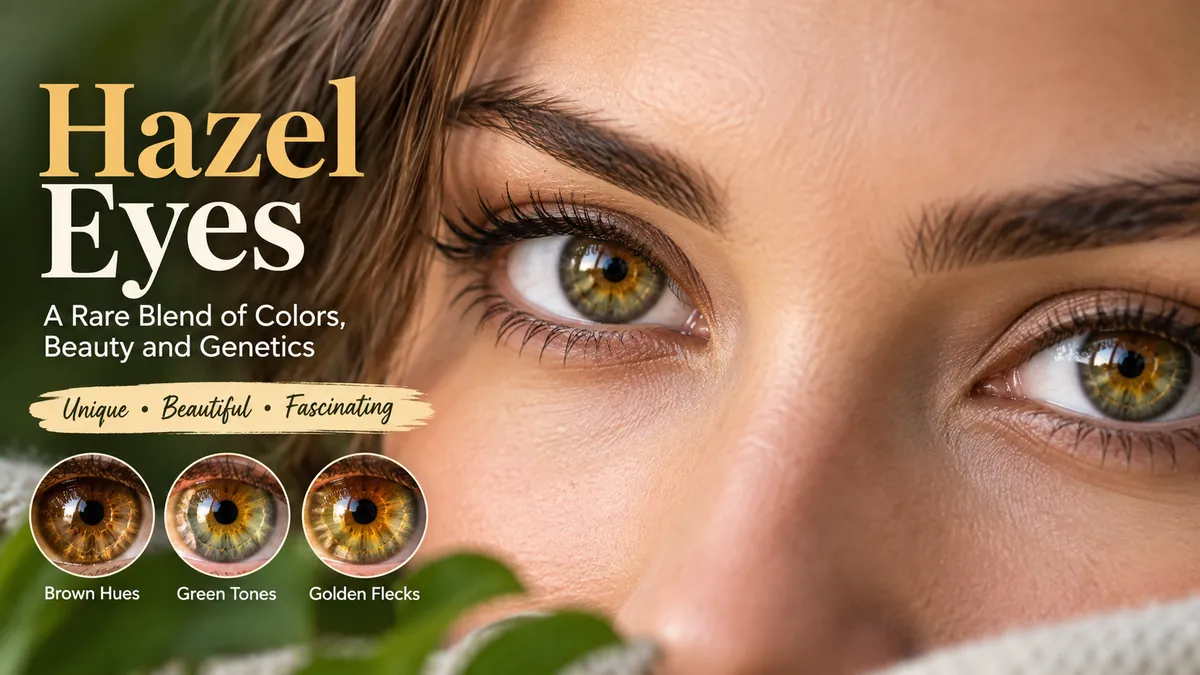
Hazel eyes can look green in one room, golden in sunlight and noticeably brown in a photograph. That shifting appearance is one reason this eye color is difficult to describe—and easy to confuse with green, amber or light brown eyes.
Hazel eyes are a natural eye color characterized by a mixture of brown, green and often gold or amber tones. Their appearance results mainly from the amount and distribution of melanin in the iris and the way light interacts with its structure. Genetics determines the underlying pigmentation pattern.
Unlike paint, the human iris does not contain separate green, blue and hazel pigments. The main pigment involved in eye color is melanin. Different concentrations and distributions of this pigment, combined with the optical behavior of light, create the range of eye colors we see.
That makes hazel less of a single fixed shade and more of a distinctive pigmentation pattern.
What Are Hazel Eyes?
Hazel eyes usually contain a visible combination of brown, green and golden tones rather than one uniform color. Cleveland Clinic describes hazel as various combinations of green, gold or brown.
A common pattern is:
- Brown or golden coloring close to the pupil
- Greenish coloring farther from the center
- A darker outer iris ring in some people
- Small variations or flecks throughout the iris
The exact pattern differs substantially from person to person.
Someone may therefore have predominantly green hazel eyes with a small brown center, while another person has mostly light brown eyes with green around the edges.
What color are hazel eyes exactly?
There isn’t one precise shade that qualifies as hazel.
Eye-color classifications themselves aren’t completely standardized. Different scales can categorize intermediate colors differently, which explains why the same eyes might be called hazel by one person and green or light brown by another.
Think of eye colors as a continuum rather than separate paint samples:
| Eye color | Typical visual appearance | Relative iris melanin |
|---|---|---|
| Blue | Blue to blue-gray | Low |
| Gray | Gray, silver or blue-gray | Low |
| Green | Mostly green | Low to moderate |
| Hazel | Brown + green + gold | Moderate/intermediate |
| Amber | Golden, copper or yellow-brown | Variable |
| Brown | Light to very dark brown | Higher |
This spectrum also explains why borderline cases can be difficult to classify.
Quick takeaway: If an iris clearly combines green and brown/gold instead of displaying one relatively uniform shade, it is commonly described as hazel.
What Causes Hazel Eyes?
The starting point is the iris, the colored circular structure surrounding your pupil.
Your iris regulates how much light enters the eye by changing the size of the pupil. Its pigmentation is also responsible for what we perceive as eye color.
Three interconnected factors are especially relevant to hazel eye color:
- The amount of melanin in the iris
- How that melanin is distributed
- How light interacts with the iris
Melanin plays the central role
Melanin is a pigment involved in the coloration of your eyes, hair and skin.
Brown eyes generally contain more melanin in the front layers of the iris, while blue eyes contain much less. Green and hazel eyes fall between these extremes.
But total melanin isn’t the entire story.
Its distribution across the iris matters too.
If pigmentation is more concentrated near the pupil and lighter toward the outside, for example, the eye can develop the characteristic brown-center and green-outer appearance associated with many hazel eyes.
Hazel isn’t a separate pigment
A common misconception is that people with hazel eyes possess green, brown and gold pigments mixed together.
That isn’t how human eye color works.
The principal pigment involved is brownish melanin. Greenish or bluish appearances arise partly from the interaction between pigment, iris structure and incoming light.
This is similar in principle to why something can appear a particular color even without containing pigment of exactly that color.
Why Do Hazel Eyes Change Color?
One of the most recognizable characteristics of hazel eyes is their apparent ability to change.
Your eyes might look greener outside, browner indoors and golden in warm sunlight.
In most cases, the iris isn’t actually changing its pigmentation from moment to moment. Instead, the relative visibility of its existing colors changes.
Lighting conditions, surroundings and contrast can all influence what you perceive.
Lighting makes different tones stand out
Bright natural light can reveal subtle green and golden areas that are less noticeable under dim illumination.
Warm indoor lighting may emphasize brown or amber tones.
The direction and intensity of illumination can also change how clearly different regions of the iris appear.
That’s why two photographs taken minutes apart can make the same person’s eyes seem surprisingly different.
Clothing and surroundings affect perception
Colors surrounding your face can change the perceived contrast of your iris.
Green clothing may make green tones appear more prominent, while earthy browns and warm colors can visually emphasize golden or brown regions.
This is a perceptual effect rather than your clothing physically changing your iris pigment.
Pupil size can alter the appearance
Your pupil expands and contracts as lighting conditions change.
Because the iris surrounds the pupil, these movements can slightly change how its patterns are presented to an observer. Combined with different illumination, this can contribute to the impression of a color shift.
So when someone says their hazel eyes “turn green,” they’re usually describing a change in appearance, not a rapid biological change in eye pigmentation.
Hazel Eyes Genetics: How Are They Inherited?
Eye-color inheritance is much more complicated than the simple genetics charts many people learned at school.
The old explanation often treated brown as a straightforward dominant trait and blue as recessive. Modern genetics shows that human eye color is polygenic, meaning multiple genes and genetic variants contribute to the final phenotype.
Two particularly important genes are OCA2 and HERC2, located in a region of chromosome 15.
OCA2 is involved in pigmentation, while variation involving HERC2 can influence OCA2 expression. Other genes and DNA variants contribute additional variation.
Can two brown-eyed parents have a hazel-eyed child?
Yes.
You cannot reliably determine a child’s future eye color simply by looking at the parents’ eye colors.
Each parent carries genetic variants affecting pigmentation, and a child’s particular combination may produce an eye color that isn’t immediately obvious from either parent’s appearance.
The same principle means siblings can have noticeably different eye colors despite having the same parents.
Can hazel-eyed parents have a blue-eyed child?
It can be possible.
Again, the reason is that inheritance involves multiple genetic variants rather than a single “hazel gene.”
This is why statements such as “hazel is dominant over blue” are oversimplifications when used to predict an individual child’s eye color.
Are hazel eyes dominant or recessive?
There isn’t a scientifically useful single-gene answer.
Eye color doesn’t follow a simple dominant-versus-recessive model. MedlinePlus explains that multiple genes involved in the production, transportation and storage of melanin contribute to eye color.
The better question is: Which combination of genetic variants influences the amount and distribution of iris pigmentation?
That combination ultimately contributes to whether someone develops brown, blue, green, gray, amber or hazel-looking eyes.
How Rare Are Hazel Eyes?
Hazel is considerably less common worldwide than brown.
Some commonly cited estimates place hazel eyes at roughly 5% of the global population, although exact global percentages should be treated cautiously because eye-color categories and population datasets differ.
Brown remains the world’s most common eye color. Its prevalence is particularly high across populations in Africa and Asia.
Eye-color frequency also varies substantially by ancestry and geographic population.
That means a color considered unusual globally might be considerably more familiar in a particular region.
Are hazel eyes rarer than green eyes?
Generally, estimates cited by eye-health sources put green at around 2% globally, compared with approximately 5% for hazel. On those estimates, green is less common.
But these figures shouldn’t be treated like an exact worldwide census.
A major difficulty is classification. An eye near the green-hazel boundary might be counted as green in one dataset and hazel in another.
Quick takeaway: Hazel is an uncommon eye color globally, but claims about an exact percentage depend heavily on how researchers define and classify eye colors.
Hazel Eyes vs. Green Eyes
Hazel and green are probably the easiest eye colors to confuse.
The simplest distinction is color distribution.
Green eyes usually look predominantly green across most of the visible iris. Hazel eyes more commonly show an obvious mixture of green with brown, gold or amber.
| Feature | Hazel eyes | Green eyes |
|---|---|---|
| Dominant appearance | Green-brown-gold mixture | Mostly green |
| Brown near pupil | Common | May occur, usually less dominant |
| Color variation | Often pronounced | Usually more consistently green |
| Golden tones | Common | Possible |
| Apparent lighting changes | Often noticeable | Can also occur |
| Estimated global frequency | Around 5% in some estimates | Around 2% in some estimates |
There is no perfect dividing line.
If an eye is green around the outside but has a substantial golden-brown area around the pupil, many observers would describe it as hazel.
If green dominates nearly the entire iris, “green” is usually the more natural description.
Hazel Eyes vs. Amber Eyes
Amber is another color frequently confused with hazel.
The biggest visual difference is that amber tends to look more uniform, whereas hazel usually contains clearly distinguishable green and brown components.
Amber eyes may appear:
- Golden
- Honey-colored
- Coppery
- Yellow-brown
Hazel eyes typically have a more varied appearance, particularly when green is visible alongside brown or gold.
Under warm lighting, however, a brown-dominant hazel eye can look remarkably amber.
That is one reason photographs alone aren’t always enough to classify an intermediate eye color confidently.
Hazel Eyes vs. Brown Eyes
Light brown and brown-dominant hazel eyes can also overlap visually.
Brown eyes generally have greater concentrations of melanin in the front layers of the iris than hazel or green eyes.
A light brown eye tends to remain predominantly brown under different lighting.
Hazel eyes are more likely to reveal a noticeable green component, particularly in bright or natural light.
A useful visual test is to examine the iris in neutral daylight—not direct sunlight—and ask:
Does the entire iris remain essentially brown, or are there distinct green areas?
If substantial green and brown regions coexist, hazel becomes a more likely description.
Different Types of Hazel Eyes
There isn’t an official medical classification system dividing hazel eyes into fixed “types.”
Still, several informal descriptions are useful because hazel exists along a broad color spectrum.
Green hazel eyes
These are predominantly green but contain visible brown, gold or amber around the pupil.
At a distance they may simply look green.
Close inspection reveals the mixed pigmentation.
Brown hazel eyes
Brown dominates these eyes, particularly near the center, while green is more noticeable toward the outer iris.
They can easily be mistaken for light brown eyes in indoor lighting.
Golden hazel eyes
Gold or honey tones are especially prominent.
These can approach amber in appearance, but visible green or brown-green variation usually produces the characteristic hazel effect.
Light hazel eyes
Lower overall pigmentation can create a lighter mixture of green, gold and pale brown.
Bright illumination may make these eyes look particularly green.
Dark hazel eyes
Greater visible brown pigmentation gives dark hazel eyes a deeper appearance.
From a distance, they can look brown; their green or golden areas become clearer at close range or under brighter lighting.
These labels are descriptive rather than biological categories. Two people both described as having “green hazel” eyes can still have very different iris patterns.
Is Central Heterochromia the Same as Hazel Eyes?
Not necessarily.
This distinction is often overlooked.
Heterochromia describes differences in eye coloration. Complete heterochromia means one eye differs in color from the other, while other forms involve differently colored regions within an iris. Cleveland Clinic notes that heterochromia is often caused by harmless genetic variation, although acquired cases can have other causes.
Central heterochromia can create a ring of one color around the pupil surrounded by another color.
That pattern may resemble hazel.
The concepts overlap visually, but they aren’t interchangeable. Hazel describes an overall eye-color appearance, while heterochromia describes a pattern of color variation.
Can Hazel Eyes Develop During Childhood?
Yes.
A baby’s initial eye color doesn’t necessarily represent the shade they will have later.
Melanin can continue accumulating in the iris after birth. As pigmentation develops, an initially lighter eye may become green, hazel or brown.
Eye color often changes most noticeably during infancy and early childhood.
This is normal development rather than the eye spontaneously switching between genetically unrelated colors.
The final result depends on inherited pigmentation biology and how melanin develops within the iris.
Do Hazel Eyes Really Change With Mood?
Not in the way the claim is usually understood.
Emotions don’t normally cause your iris to suddenly manufacture or remove enough melanin to transform its underlying color.
What can change is appearance.
Emotional states can coincide with changes in pupil size, facial expression, lighting or even how closely another person is looking at your eyes. Those factors can emphasize different colors already present.
Someone’s hazel eyes may therefore look greener or darker at certain moments without actually undergoing a pigment change.
Can Hazel Eyes Naturally Become Another Color?
Normal appearance can vary, but a genuine new eye-color change in an adult deserves more attention.
A person’s established iris pigmentation is generally stable. Some differences in perceived color come from lighting, pupil size, photography or surrounding colors rather than a true pigmentation change.
If one or both eyes genuinely begin changing color—particularly when accompanied by pain, redness, visual symptoms or new iris spots—an eye-care professional should evaluate the change.
Medications can affect iris pigmentation
Certain medications can produce genuine pigmentation changes.
For example, some prostaglandin medications used for glaucoma can gradually increase brown pigmentation in the iris. This is different from the temporary “changing” appearance commonly associated with hazel eyes.
Eye injury and some medical conditions can also alter iris appearance.
So there is an important distinction:
Hazel looking green today and brown tomorrow because of lighting is common. A permanent new change in adult iris color is something different.
Are Hazel Eyes More Sensitive to Light?
Eye color can influence how much visible light is absorbed within the iris because melanin absorbs light.
Lighter-colored irises contain less melanin in their front layers than darker brown irises. Hazel generally falls somewhere between very light and dark eye colors.
That doesn’t mean every hazel-eyed person will experience significant light sensitivity, however. Individual sensitivity varies and can have many causes unrelated to iris color.
Whatever your eye color, protecting your eyes from ultraviolet radiation remains sensible. Sunglasses should provide proper UV protection rather than simply having dark lenses.
Does Hazel Eye Color Affect Vision?
Having hazel eyes by itself doesn’t mean you have better or worse visual acuity.
Eye color describes pigmentation of the iris, while clear vision depends on many other structures and processes involving the cornea, lens, retina, optic nerve and brain.
Someone with hazel eyes can have excellent vision, nearsightedness, farsightedness, astigmatism or another eye condition just like someone with brown, blue or green eyes.
Eye color should therefore never be used as a shortcut for assessing overall eye health.
How to Tell If You Have Hazel Eyes
Because hazel sits between several eye-color categories, judging your own eyes from one photograph can be misleading.
For a more consistent assessment:
- Use neutral natural daylight. Stand near a window without looking directly into bright sunlight.
- Avoid colored lighting. Warm bulbs can exaggerate gold and brown, while cooler lighting can emphasize green.
- Look at the whole iris. Don’t classify the eye based only on the ring surrounding the pupil.
- Identify the dominant colors. Look for clearly visible brown, green, gold or amber regions.
- Compare several conditions. If the eye repeatedly displays both substantial green and brown/golden areas, hazel is a reasonable description.
Avoid relying on heavily processed smartphone photographs. Automatic white balance, HDR, exposure adjustments and filters can alter subtle iris colors.
A mirror in neutral daylight is often more informative.
Why Every Pair of Hazel Eyes Looks Different
Eye-color labels make human pigmentation sound much simpler than it really is.
“Brown,” “green” and “hazel” place highly complex biological patterns into a handful of convenient categories.
Even people placed in the same category can have different:
- Melanin concentrations
- Pigment distributions
- Iris textures
- Rings around the pupil
- Darker outer boundaries
- Flecks or spots
- Green-to-brown proportions
Cleveland Clinic notes that no two people have eyes with exactly the same coloration; even identical twins can have subtle visible differences.
This variation is particularly noticeable in hazel because multiple tones are often visible at once.
Iris Freckles, Nevi and Color Variations
Not every darker spot in a hazel iris represents part of its basic eye color.
People can have localized areas of pigmentation sometimes described as iris freckles or nevi. Variations within an iris can also occur naturally.
Most longstanding color variations aren’t automatically a sign of disease.
What matters more is change.
A new or enlarging spot, a genuine change in iris pigmentation, eye pain, redness or altered vision warrants professional evaluation rather than assuming it is simply a feature of hazel eyes.
Common Myths About Hazel Eyes
“Hazel eyes contain green pigment”
Not exactly.
The visible green component isn’t evidence of a separate green pigment. Melanin and the optical interaction of light with the iris produce the appearance.
“Hazel eyes physically change color every day”
Usually false.
They can appear dramatically different under changing illumination, but the underlying pigment normally remains stable.
“One gene causes hazel eyes”
False.
Human eye color involves multiple genes and genetic variants, with OCA2 and HERC2 playing particularly important roles.
“Hazel is just another name for green”
No.
The categories can overlap, but hazel generally describes an obvious combination of green with brown, gold or amber.
“You can accurately predict a baby’s eye color from the parents”
Not reliably.
Parental eye colors provide clues, but polygenic inheritance makes simple predictions unreliable.
“Hazel eyes mean you have better eyesight”
No established biological rule connects hazel pigmentation with superior visual acuity.
When a Change in Hazel Eyes Deserves Attention
Hazel eyes naturally appear different under different lighting conditions. That alone usually isn’t concerning.
What isn’t typical is a clear, persistent new change in an adult’s actual iris pigmentation.
Consider an eye examination if you notice:
- One eye permanently becoming a different color
- A new or changing pigmented area
- A sudden persistent change in iris color
- Eye pain or significant redness
- New light sensitivity
- Blurred or altered vision
- Color change following an eye injury
Acquired heterochromia can have several causes, including eye injury, certain treatments and medical conditions, so an unexplained new difference should be assessed rather than self-diagnosed.
What Makes Hazel Eyes Distinctive?
The defining characteristic of hazel eyes isn’t one particular shade. It’s the interaction of several features.
Moderate or intermediate iris pigmentation provides the foundation. Uneven melanin distribution can produce brown and golden regions alongside greener-looking areas. Light then interacts with the iris, changing which components appear most prominent under different conditions. Genetics determines much of the underlying pigmentation pattern.
The result can range from green-dominant hazel to deep brown hazel, with countless variations in between.
That’s why hazel eyes are so difficult to represent with a single color swatch—and why checking them under different lighting can produce surprisingly different impressions.
The key distinction is simple: hazel eyes typically combine visible brown, green and gold or amber tones rather than presenting one uniform color. Their apparent shifts are generally optical, while their underlying pigmentation remains stable.
If your eye color has always behaved this way, it’s usually simply part of your natural iris pattern. If the actual color of an adult eye suddenly or persistently changes, especially alongside other eye symptoms, have an eye-care professional examine it.