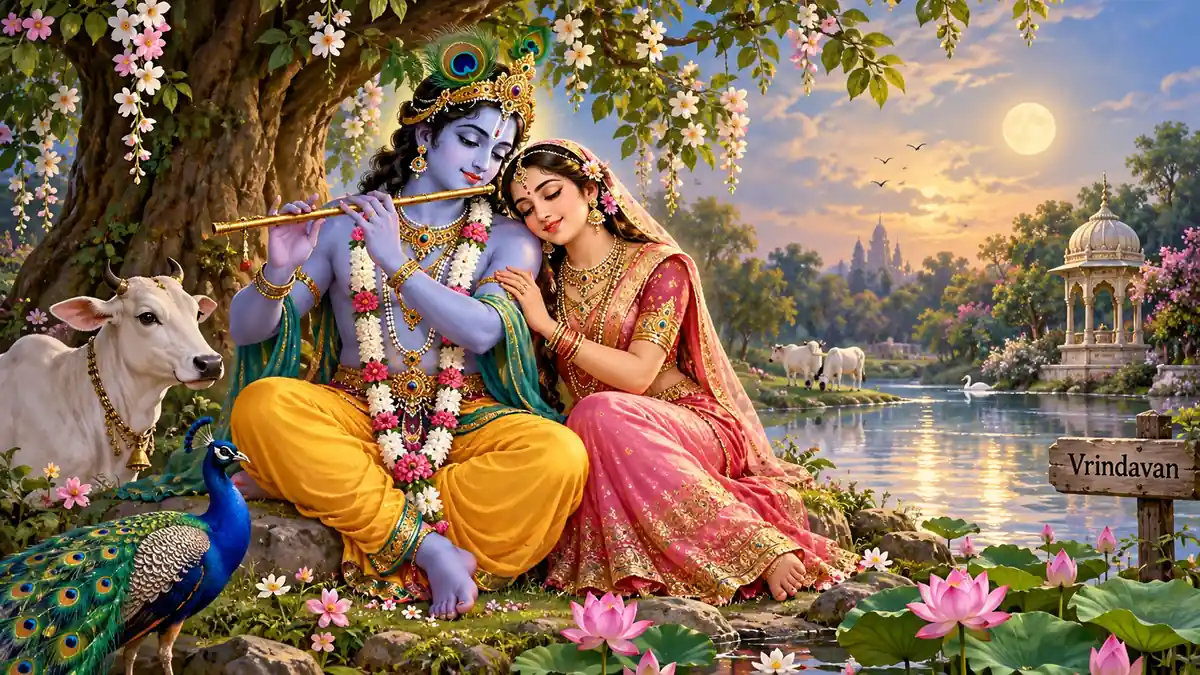
Few devotional subjects are as instantly recognizable as radha krishna images. Krishna’s flute, peacock feather and blue complexion, Radha’s graceful presence, flowering landscapes, the Yamuna and the forests of Vrindavan combine to create imagery associated with divine love, devotion and spiritual longing.
Search results today range from traditional paintings and temple-inspired artwork to HD wallpapers, mobile backgrounds, profile pictures, illustrations and AI-generated art. Understanding what these visual elements represent can help you appreciate an image rather than choosing it only because it looks beautiful.
Radha Krishna images portray Radha and Krishna together in devotional Hindu art, commonly representing divine love and the relationship between the devotee and the Divine. Familiar elements include Krishna’s bansuri, peacock feather, Radha beside him, flowers, cows, lotuses and the sacred landscape of Vrindavan.
What Do radha krishna images Represent?
Radha and Krishna occupy an important place in several Vaishnava devotional traditions. The Salar Jung Museum describes Radha-Krishna as a divine couple and notes that, in several traditions of Vaishnavism, they are understood in relation to feminine and masculine aspects of the divine.
That religious context explains why paintings of the pair communicate more than romantic affection.
Their relationship has long been interpreted through bhakti, or loving devotion. Consequently, artists frequently emphasize tenderness, longing, companionship and complete absorption in the divine.
A picture might show Krishna playing his flute while Radha listens nearby. Another may place them beneath flowering trees beside the Yamuna. More elaborate compositions add gopis, cows, peacocks, lotus flowers, garlands and moonlit scenery.
Each choice contributes to the mood and meaning of the scene.
Radha and Krishna Together
The presence of Radha changes how Krishna imagery is read.
Krishna alone can appear in numerous narratives and divine forms. When Radha appears beside him, the composition commonly emphasizes devotion and divine love.
Their poses can vary considerably. They may be standing together, sitting beneath a tree, sharing a swing, walking through a pastoral landscape or appearing in a stylized portrait.
Despite these variations, the devotional relationship remains the central subject.
Why Vrindavan Appears So Often
Many beautiful Radha Krishna images use Vrindavan as their visual setting.
Vrindavan is closely connected with traditions surrounding Krishna’s youthful pastimes and his relationship with Radha and the gopis. Consequently, artists frequently surround the couple with forests, flowering plants, riverbanks, cows and peacocks.
The result is the familiar pastoral atmosphere seen across both traditional paintings and modern digital artwork.
Symbols Commonly Seen in radha krishna images
A useful way to understand Radha Krishna art is to look closely at the details.
| Visual element | Common association |
|---|---|
| Flute or bansuri | Krishna and divine attraction |
| Peacock feather | Krishna’s recognizable iconography |
| Radha beside Krishna | Devotional love and companionship |
| Vrindavan | Krishna’s sacred pastoral landscape |
| Yamuna River | Sacred geography connected with Krishna traditions |
| Lotus | Purity and spiritual beauty |
| Cows | Krishna’s cowherd identity |
| Flower garlands | Love, worship and celebration |
| Peacock | Beauty and Krishna-associated imagery |
| Jhula or swing | Festive Radha-Krishna scenes |
| Moonlit forest | Poetic and devotional atmosphere |
These interpretations can differ between traditions, artists and individual devotees. A visual symbol should therefore not automatically be treated as having one universally fixed meaning.
Krishna’s Flute or Bansuri
The bansuri is among Krishna’s most recognizable attributes.
In devotional interpretations, its music can represent the divine call that draws devotees toward Krishna. Visually, it also provides artists with an immediate way of identifying Krishna.
A classic composition shows Krishna standing with crossed legs while playing the flute, with Radha close beside him.
Traditional artwork can be considerably more detailed. A documented Radha-Krishna painting discussed by India’s National Mission for Manuscripts, for example, depicts Krishna playing a flute, wearing a peacock-feather headdress and sharing a lotus pedestal with Radha.
Krishna’s Peacock Feather
The peacock feather is another unmistakable element of Krishna iconography.
Traditional descriptions connect the feather with Krishna’s Vrindavan form. The Bhagavata Purana and Brahma Samhita contain descriptions of Krishna wearing peacock-feather adornment, although popular explanations of why he wears it can come from later devotional traditions and legends.
This distinction matters.
A symbolic interpretation such as humility, beauty or love may be meaningful within a particular devotional tradition, but it should not automatically be presented as a direct scriptural explanation.
Lotus Flowers
The lotus is widely used throughout Indian religious art.
Within Radha Krishna paintings, it contributes an atmosphere of purity, beauty and sacredness. Artists may place lotuses in the foreground, around a pond, near the couple’s feet or within decorative borders.
Some compositions even place Radha and Krishna on a lotus pedestal.
Cows and Krishna’s Pastoral Identity
Cows appear frequently because Krishna is deeply associated with a pastoral cowherd identity.
Names such as Govinda and Gopala reinforce that association. In visual compositions, cows also help establish the peaceful rural setting surrounding Krishna’s Vrindavan traditions.
A background containing green pastures, cows, trees and a distant river can therefore carry narrative meaning rather than simply serving as decoration.
Yamuna River
Water in a Radha Krishna scene frequently evokes the Yamuna, which is strongly associated with Krishna traditions and the sacred geography around Mathura and Vrindavan.
Artists may portray it realistically as a river or simply suggest it through blue water behind the figures.
The river helps anchor an otherwise idealized devotional scene within recognizable sacred geography.
Quick Takeaway: Flute, peacock feather, lotus, cows, flowers, Vrindavan and the Yamuna are not merely decorative additions. Together, they help establish Krishna’s identity and the devotional setting of the artwork.
Beautiful Radha Krishna Images and Their Major Styles
Modern searches reveal an enormous variety of artistic treatments.
Current image collections include traditional-looking devotional pictures alongside HD wallpapers, romantic compositions, profile pictures, cartoon illustrations, anime-inspired designs, 3D artwork, aesthetic backgrounds and AI-generated images.
Knowing these categories makes it easier to find imagery appropriate for a particular purpose.
Traditional Radha Krishna Paintings
Traditional artwork is particularly valuable for people interested in religious iconography and Indian art history.
Depending on the period, region and school, details such as facial features, clothing, architecture, landscape, perspective and ornamentation can differ substantially.
Traditional compositions may feature:
- Elaborate crowns and jewelry
- Krishna holding or playing the flute
- Radha in richly decorated clothing
- Lotus pedestals
- Halos
- Peacocks and other animals
- Forest landscapes
- Moonlit scenes
- Attendants or gopis
- Decorative borders
Historical artwork also reminds us that there is no single visual template for Radha and Krishna.
Regional artistic traditions developed their own interpretations.
Radha Krishna HD Images
Radha Krishna HD images are primarily distinguished by resolution rather than artistic tradition.
High-resolution pictures preserve details when displayed on larger screens. Fine features such as jewelry, flowers, facial expressions and fabric patterns remain clearer than they do in small or heavily compressed files.
When assessing an HD image, look at the actual pixel dimensions rather than trusting a filename containing “HD.”
An image can be labeled HD while still being a low-resolution picture enlarged artificially.
Radha Krishna 4K Wallpapers
A true 4K wallpaper normally needs enough resolution for a 3840 × 2160 display.
For desktop use, horizontal compositions generally work best. Radha and Krishna should ideally be positioned so desktop icons or cropping do not obscure their faces.
Mobile wallpapers require almost the opposite composition.
A vertical image leaves more usable space for the phone’s clock, notifications and app interface.
Romantic Radha Krishna Images
The phrase romantic Radha Krishna images commonly describes compositions emphasizing affection, closeness and tenderness between Radha and Krishna.
Common settings include moonlight, flowers, riverbanks, swings and forest scenery.
In devotional contexts, however, their relationship is understood through religious and theological traditions rather than simply through the conventions of ordinary human romance. That distinction helps preserve the spiritual context of the imagery.
Radha Krishna Love Images
Radha Krishna love images frequently overlap with romantic artwork, but they can place greater emphasis on symbolic expressions of devotion.
Flowers, garlands, shared gazes and peaceful natural environments are common.
These pictures are frequently shared with devotional messages or quotations about love and bhakti.
Cute and Cartoon Radha Krishna Pictures
Cartoon-style pictures simplify facial features and clothing while retaining recognizable identifiers such as Krishna’s blue complexion, flute and peacock feather.
These illustrations are especially common in:
- Mobile wallpapers
- Greeting graphics
- Social posts
- Children’s devotional materials
- Profile pictures
- Festival messages
Stylization itself does not determine whether an image is respectful. Context and presentation matter more.
AI-Generated Radha Krishna Art
AI-generated devotional artwork has become another visible category in current image results. Searches now surface AI, anime and 3D variations alongside conventional wallpapers.
Such images can produce elaborate lighting, detailed clothing and dramatic environments, but they also deserve closer inspection.
Generative systems sometimes create incorrect fingers, distorted flutes, mismatched jewelry, strange facial details or culturally inconsistent iconography.
If accuracy matters, inspect the picture carefully rather than assuming polished artwork is historically or religiously authentic.
Radha Krishna Images for Mobile, Desktop and Profile Pictures
The most beautiful picture is not automatically the most useful one.
Composition matters.
A detailed horizontal painting can look excellent on a laptop but become almost unreadable when squeezed into a circular WhatsApp profile image.
For Mobile Wallpaper
Choose a portrait-oriented image with sufficient empty space around the main figures.
Ideally:
- Radha and Krishna remain visible after screen cropping.
- Important facial details are away from the top clock area.
- The background is not so busy that icons become difficult to read.
- Resolution matches or exceeds your phone’s display.
- The image remains clear without excessive sharpening.
Vertical artwork with Radha and Krishna near the center generally adapts well to modern smartphone screens.
For Desktop Wallpaper
Landscape artwork is usually more suitable.
Look for wide Vrindavan landscapes, river scenes or compositions in which the figures sit slightly away from areas occupied by desktop icons.
A 1920 × 1080 image works well for many Full HD displays, while 3840 × 2160 is appropriate for 4K screens.
Using the correct aspect ratio reduces unwanted stretching and cropping.
For WhatsApp DP
A Radha Krishna DP should survive a square or circular crop.
Close-up portraits work particularly well because tiny details disappear at profile-picture size.
Before using a picture, preview the circular crop and make sure neither Radha nor Krishna is partially cut off.
For Instagram and Social Profiles
The same principle applies to Instagram and other social networks.
Simple compositions generally outperform extremely detailed scenes at small sizes—not because they are spiritually preferable, but because they remain visually recognizable.
An image featuring the faces, Krishna’s flute and peacock feather can remain identifiable even as a small thumbnail.
How to Choose Radha Krishna Images by Mood
Instead of scrolling through hundreds of nearly identical pictures, start with the feeling you want the artwork to convey.
| Desired mood | Visual elements to look for |
|---|---|
| Peaceful | Soft landscape, river, gentle expressions |
| Devotional | Traditional iconography, garlands, lotus |
| Joyful | Bright flowers, peacocks, festive scenery |
| Meditative | Minimal composition, flute, subdued background |
| Romantic | Moonlight, forest, Radha and Krishna together |
| Traditional | Classical painting style and detailed ornamentation |
| Modern | Digital illustration, minimalist or stylized design |
| Festive | Flowers, lamps, decorative clothing and bright details |
This approach is more useful than choosing solely according to resolution.
Images With Flute
Choose flute-centered compositions when you want Krishna’s identity to remain immediately recognizable.
The flute also produces a naturally calm visual pose.
Vrindavan Scenes
Choose Vrindavan-inspired landscapes when you prefer a narrative picture rather than a simple portrait.
Trees, cows, peacocks, flowers and river scenery create depth while placing the figures within Krishna’s pastoral world.
Minimalist Artwork
Minimalist illustrations reduce the composition to a few recognizable elements.
A silhouette, flute, peacock feather or paired figures may be enough to communicate the subject.
These designs often work especially well as phone backgrounds because icons remain readable.
How to Tell Whether an Image Is Really High Quality
Image quality involves more than pixel dimensions.
A 4K file generated from a blurry original is still blurry.
Check these characteristics before saving an image:
- Resolution: enough pixels for the intended display.
- Sharpness: facial features and ornamentation should remain clear.
- Aspect ratio: appropriate for mobile, desktop or social media.
- Compression: avoid obvious blockiness around detailed areas.
- Color: watch for excessive saturation and unnatural skin tones.
- Cropping: hands, crowns, flute and faces should not be unintentionally cut.
- Source quality: original museum or artist files are preferable for studying historical artwork.
- Authenticity: distinguish historical works from contemporary illustrations and AI-generated imagery.
Zooming to 100% is a simple practical test.
If edges break apart, facial details become smeared or textural patterns turn into blocks, the source file probably lacks sufficient quality.
Understanding Image Resolution and File Formats
Several technical terms commonly appear beside downloadable devotional images.
HD
HD generally refers to high-definition imagery, although websites use the term loosely.
Always check dimensions.
Full HD
Full HD normally refers to 1920 × 1080 pixels, which uses a 16:9 aspect ratio.
This format suits many laptop and desktop displays.
4K
For consumer displays, 4K UHD generally means 3840 × 2160 pixels.
The additional resolution is useful for large monitors and televisions, especially when the artwork contains detailed jewelry and clothing.
JPG and JPEG
JPEG is efficient for colorful paintings and photographic artwork because it can keep file sizes relatively small.
Heavy compression, however, creates visible artifacts.
PNG
PNG supports lossless compression and transparency.
It can be useful for illustrations and graphics but may produce significantly larger files than JPEG or WebP.
WebP
WebP can provide strong visual quality at relatively small file sizes, making it useful for websites where page speed matters.
For publishers, optimized WebP files can reduce image weight while maintaining good visual quality.
Traditional Art vs Modern Digital Radha Krishna Images
Traditional and digital artwork serve different purposes, and one should not automatically be considered superior to the other.
| Traditional artwork | Modern digital artwork |
|---|---|
| Connected with particular artistic traditions | Can combine many contemporary styles |
| Often contains region-specific details | Easily adapted to screens |
| Valuable for art-historical study | Suitable for wallpapers and social graphics |
| Usually follows established visual conventions | Allows greater stylistic experimentation |
| Source and date may sometimes be documented | Origin can sometimes be unclear |
Museum collections are particularly useful when you want to study historical representations rather than simply find a decorative wallpaper.
The Salar Jung Museum’s presentation of Radha-Krishna, for example, places the imagery within a broader cultural and religious context rather than treating it merely as downloadable decoration.
Respectful Ways to Use radha krishna images
Religious imagery can simultaneously be art, cultural heritage and an object of devotion.
That makes context important.
For personal wallpaper or a profile picture, choose a presentation you consider appropriate to the devotional subject. Avoid edits that intentionally ridicule sacred figures or place them in degrading contexts.
If an image is being used in a temple, prayer area or devotional publication, traditional conventions may matter more than they would for a personal phone background.
Individual Hindu traditions and households can also have different customs regarding sacred imagery, so there is no single universal rule governing every situation.
Respect Copyright Too
A devotional subject is not automatically copyright-free.
An ancient story or religious figure may be part of cultural tradition, while a particular photograph, digital illustration or modern painting can still have an identifiable creator and copyright status.
Before republishing an image on a website, poster, social account or commercial project, check:
- Who created the specific image?
- Does the source provide a license?
- Is attribution required?
- Is modification permitted?
- Is commercial reuse allowed?
This becomes especially important with image-gallery websites. The fact that a picture can be downloaded does not necessarily mean unrestricted republication is permitted.
Why Colors Differ Across Radha Krishna Artwork
Krishna is widely recognizable through his blue or blue-black appearance, but the exact shade varies considerably among artists.
You may see deep indigo, royal blue, cyan or softer blue tones.
Color choices can reflect artistic convention, materials, regional style or the visual mood an artist wants to create.
Radha’s clothing is equally varied.
Red, pink, yellow, green and blue garments are common in modern representations, often combined with gold jewelry and floral decorations.
Rather than expecting one universally “correct” palette, look at the artistic tradition behind a particular work.
Radha Krishna Images During Festivals
Interest in Radha Krishna imagery naturally intersects with major Krishna devotional celebrations.
During Janmashtami, images of Krishna are widely used in devotional messages, decorations and digital greetings. Radha-Krishna compositions may also appear in festival artwork.
Radhashtami, associated specifically with Radha, naturally places greater emphasis on Radha and her devotional significance.
Another familiar motif is the jhula, or swing.
Radha and Krishna shown together on a decorated swing appear in devotional and festival imagery, often surrounded by flowers and lush vegetation. The motif is visually distinctive because it combines celebration, intimacy and the Vrindavan setting.
What Makes a Radha Krishna Picture Feel Authentic?
There is no single test because Radha Krishna imagery has developed across different periods, regions and artistic schools.
Still, several recognizable elements can help you understand what you are seeing.
Krishna may carry a bansuri, wear a peacock feather, appear in a pastoral setting or be surrounded by cows and peacocks. Radha is typically positioned beside him as the central companion in the composition.
Vrindavan-inspired scenery, the Yamuna, lotus flowers and garlands add further context.
Historical examples can include halos, richly decorated garments and more complex narrative surroundings. The National Mission for Manuscripts’ description of one traditional painting records blue skin, flute playing, peacock-feather ornamentation, a lotus pedestal, halos, forest scenery and peacocks within the same composition.
Modern artwork may simplify nearly all of these details.
Sometimes the silhouette of Krishna’s flute and feather beside Radha is enough.
Choosing Images for Prayer and Meditation
People using Radha Krishna pictures for personal devotion often benefit from simplicity.
A visually crowded image can be impressive but distracting. For meditation or quiet reflection, a balanced composition with clear expressions and limited background detail may create a calmer focal point.
Traditional portraits, flute scenes and peaceful Vrindavan landscapes are common choices.
Personal devotional practice varies, however, so the most appropriate image is ultimately one that fits the individual’s tradition and purpose.
Quick Takeaway: For devotional use, prioritize meaning and respectful presentation. For wallpapers, prioritize resolution and composition. For profile pictures, prioritize simple subjects that remain recognizable after cropping.
Common Mistakes When Selecting Radha Krishna Wallpapers
One common mistake is downloading the first image labeled “HD” or “4K.”
Check the actual dimensions first.
Another is ignoring aspect ratio. A beautiful desktop painting can lose half its composition when forced onto a vertical smartphone display.
People also sometimes confuse contemporary digital illustrations with traditional paintings. If historical accuracy matters, verify the source, artist, collection and approximate period rather than relying on appearance alone.
Finally, avoid assuming that every symbolic explanation found online is scriptural. The peacock feather is a good example: scripture describes Krishna wearing it, while some popular explanations for its meaning come from devotional interpretation or later legend.
That distinction makes an article—or an appreciation of the artwork—more accurate.
The Lasting Appeal of radha krishna images
The enduring appeal of radha krishna images comes from the way art, devotion, symbolism and storytelling meet within a single visual tradition.
A flute can identify Krishna. A peacock feather strengthens that identity. Radha’s presence shifts attention toward devotional love. Vrindavan, cows, flowers, lotus blossoms and the Yamuna expand a portrait into a sacred landscape.
Modern formats have simply given this old visual tradition new surfaces. Traditional paintings now sit alongside HD wallpapers, mobile backgrounds, WhatsApp DPs, digital illustrations, 3D designs and AI-generated artwork.
When choosing an image, look beyond resolution and decoration. Notice the symbols, setting, artistic style, source and intended use. That small amount of attention turns a beautiful picture into something more meaningful: a visual doorway into the devotional and artistic traditions surrounding Radha and Krishna.