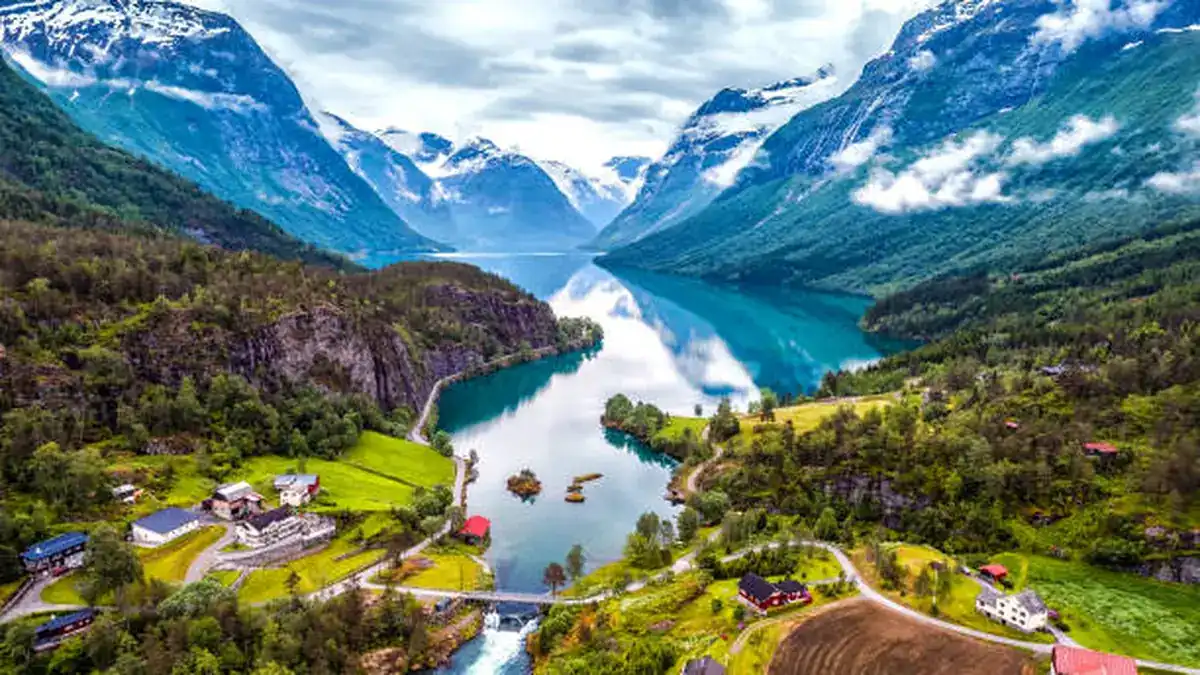
This norway travel guide is built for people who want the real numbers, not just pretty photos of fjords. Cliffs drop straight into black water, roads tunnel through mountains for twenty minutes at a stretch, and in summer the sun barely sets at all. Norway is also one of the most expensive countries you’ll ever visit — and one where a little planning saves you real money.
Quick answer: Norway is a Nordic country known for its fjords, northern lights, and midnight sun. Visit May–September for hiking and fjord cruises, or October–March for the aurora. Budget travelers spend roughly $85–130 a day; a Schengen-area visa-free stay covers most nationalities for 90 days, though ETIAS becomes mandatory in late 2026. This norway travel guide breaks down exactly what to expect at every stage of planning.
Norway Travel Guide: When to Go — Seasons, Midnight Sun, and Northern Lights
There’s no single “best” time to visit Norway — it depends on which version of the country you want.
Summer (June–August) is peak season. Days stretch impossibly long, and north of the Arctic Circle you get true midnight sun — sunlight at 2 a.m., which sounds novel until you’re trying to fall asleep. This is when fjord cruises, hiking trails, and scenic drives are fully open, and it’s also when hotel prices spike hardest.
Shoulder seasons (April–May, September–October) are the sweet spot for value. Accommodation drops 30–40% from summer peaks, trails are still walkable, and the crowds thin out considerably.
Winter (November–March) is northern lights season. Tromsø, the Lofoten Islands, and Alta are the classic viewing bases, with the best activity often clustering around October–November and February–March. Sightings are never guaranteed — they depend on solar activity and a clear sky — so build in a few nights, not just one.
| Season | Best For | Trade-off |
|---|---|---|
| Jun–Aug | Midnight sun, hiking, fjord cruises | Highest prices, biggest crowds |
| Apr–May, Sep–Oct | Value, fewer crowds | Some high-mountain routes still closed |
| Nov–Mar | Northern lights, winter sports | Cold, limited daylight in the far north |
Quick takeaway: Chasing the aurora? Go north, go winter, stay several nights. Chasing scenery and hiking? Go May–September and book accommodation early.
Norway Travel Guide: Entry Requirements in 2026 — Visa, ETIAS, and EES
This is the part most older guides get wrong, so it’s worth being precise. Norway isn’t in the EU, but it’s a full member of the Schengen Area, which means the standard 90-days-within-180-days visa-free rule applies to citizens of the US, UK, Canada, Australia, and most Western countries.
Two systems are changing entry in 2026:
- EES (Entry/Exit System) replaces manual passport stamping for non-EU/EEA travelers with digital records — a facial photo and fingerprints on your first entry, then biometric verification afterward. It’s most relevant at Oslo Gardermoen, Bergen, Stavanger, and Tromsø airports.
- ETIAS (European Travel Information and Authorization System) is expected to launch in the last quarter of 2026. Once live, visa-exempt travelers will need to apply online before boarding — a roughly 10-minute process with a fee around €7–20, valid for up to three years.
If your nationality isn’t visa-exempt, you’ll need a Schengen Type C visa (short stay, up to 90 days) or a Type D visa for longer stays, applied for through a Norwegian embassy, consulate, or a VFS Global center. Processing typically takes about 15 working days, so apply four to six weeks ahead — and don’t book non-refundable travel until it’s approved.
What you’ll need regardless of visa status: a passport valid at least three months beyond your stay, proof of onward travel, and travel insurance covering at least €30,000 in medical costs.
Norway Travel Guide: What It Really Costs
Norway consistently ranks among Europe’s priciest destinations, but the range is wide enough that both backpackers and comfortable mid-range travelers can make it work.
| Travel Style | Daily Budget (per person) |
|---|---|
| Budget (hostels, self-catering, public transit) | $85–130 |
| Mid-range (private rooms, one restaurant meal/day) | $150–255 |
| Comfortable/luxury | $310+ |
A few numbers worth knowing: a night in a mid-range hotel averages around NOK 1,725, a budget hostel dorm runs roughly €27–44, and a simple restaurant meal costs NOK 190–350. The gap between eating out and self-catering is enormous — cooking even half your meals using supermarket chains like Rema 1000 or Kiwi can cut your food budget by more than half.
The exchange rate has actually worked in travelers’ favor recently — the krone has weakened against the dollar and euro compared to a few years back, so Norway is somewhat more affordable now than its reputation suggests.
Where the money actually goes:
- Accommodation is usually your biggest line item.
- Alcohol is taxed heavily — a beer in a bar can cost as much as a meal.
- Public transport is cheap and reliable; taxis are not.
- Fjords, hiking trails, and mountains are free. The best things in Norway don’t cost anything.
Quick takeaway: If you’re watching your budget, spend on transport and experiences, and save on food and alcohol by shopping like a local.
Norway Travel Guide: Getting Around by Train, Ferry, and Car
Norway’s geography — long, narrow, mountainous, fjord-cut — shapes how you move through it.
Trains run on the Vy network and cover the country’s most scenic routes. The Bergen Railway and the Flåm Railway (a steep branch line dropping through waterfalls and switchbacks toward the fjord) are the two most famous, and both regularly appear on lists of the world’s most scenic train journeys. The classic combination — train, boat, and bus through the Sognefjord and Nærøyfjord region — is marketed as “Norway in a Nutshell” and remains the most popular single-day route for first-time visitors.
Ferries connect coastal towns and fjord communities that roads simply can’t reach efficiently. Hurtigruten’s coastal express has sailed the same route for over a century and doubles as a cruise and a genuine transport link for Norwegians living along the coast.
Renting a car gives you access to remote fjord villages and scenic drives that trains don’t reach, but expect to budget for tolls (managed through the Autopass system), ferry crossings, and fuel. It’s the right call if you’re planning to explore beyond Oslo, Bergen, and Tromsø; it’s overkill if you’re sticking to the big cities.
Domestic flights save serious time on a country this long and stretched — flying from Oslo to Tromsø beats a two-day overland trip.
Norway Travel Guide: Where to Go — Regions Worth Your Time
- Oslo — the compact, walkable capital, with the Vigeland Park sculptures, the Munch Museum, and the Bygdøy peninsula’s Viking Ship and Fram museums.
- Bergen — the historic gateway to the fjords, known for the colorful Hanseatic wharf at Bryggen, a lively fish market, and a funicular up Mount Fløyen.
- The fjords — Geirangerfjord and Nærøyfjord (both UNESCO-listed) are the postcard fjords; Aurlandsfjord near Flåm and Lysefjord near Stavanger (home to the cliff-top hike to Preikestolen) round out the highlight reel.
- Tromsø and the far north — the base for northern lights hunting and, in summer, whale-watching trips out of nearby Skjervøy and Andenes.
- The Lofoten Islands — dramatic peaks rising straight from the sea, fishing villages, and some of the best midnight-sun hiking in the country.
Quick takeaway: If you only have a week, pick two regions rather than trying to cover all of them — Norway’s distances are deceptively large.
Norway Travel Guide: A Realistic First-Timer Itinerary
Most guidebooks recommend two weeks for a proper first visit, but a week is enough to get a genuine feel for the country if you focus.
- Days 1–2: Oslo. City sights, museums, day trip to the surrounding fjord.
- Days 3–4: Bergen via the Bergen Railway. Bryggen, the fish market, Mount Fløyen.
- Days 5–6: The fjords. Ride the Flåm Railway, cruise the Nærøyfjord, base yourself in Flåm or Balestrand.
- Day 7: Return to Oslo or fly onward to Tromsø if you have extra days and want a shot at the northern lights.
With two weeks, add Tromsø or the Lofoten Islands as a second leg — flying rather than driving to save time.
Norway Travel Guide: Food, Culture, and the Right to Roam
Norwegian breakfasts are substantial: bread, cheese, cured and pickled fish, eggs, and coffee. Lunch is often smørbrød, an open-faced sandwich piled with toppings, sold in cafe windows everywhere. Dinner tends to center on fresh Atlantic cod, reindeer, or other game in the north, and — if you’re watching your budget — a grocery-store pizza or stew instead of a sit-down restaurant.
One concept worth understanding before you go: allemannsretten, the “right to roam.” It’s a legal principle that gives everyone the right to walk, camp, and forage on uncultivated land, regardless of who owns it. It’s why Norwegians hike constantly and why wild camping is both legal and completely normal here — treat the land respectfully and it’s yours to explore, free.
Norwegians are often described by visitors as reserved rather than unfriendly — direct communication and comfortable silences are cultural norms, not rudeness.
Norway Travel Guide: Safety and Practical Tips
Norway is consistently ranked among the safest countries in the world, and violent crime against tourists is rare. The real risks are environmental, not human:
- Landslides and avalanches are a genuine hazard in steep terrain, especially after heavy rain or snowmelt.
- Quick clay (kvikkleire) is a specific Norwegian soil type that can cause sudden ground collapse in certain low-lying areas — check local advisories if you’re staying somewhere unfamiliar and remote.
- Weather changes fast in the mountains; check forecasts before any serious hike and pack layers even in summer.
- Petty theft does happen around train stations and busy tourist sites in Oslo — the standard precautions apply.
Pack for layers regardless of season: temperatures hover in the 60s°F (15–18°C) even in summer, and a warm hat, thin gloves, and a proper rain shell matter more than any single “statement” item.
Final Word
Norway rewards travelers who plan around its two real constraints — distance and cost — rather than fighting them. Pick your season based on whether you want endless daylight or the northern lights, budget realistically for a country that doesn’t apologize for its prices, and don’t try to see everything in one trip. Start with two regions, do them properly, and you’ll understand why people keep coming back.
Want more travel inspiration? Browse our collection of destination guides.
FAQ Section
Is Norway expensive to visit?
Yes, Norway is one of Europe’s priciest destinations, but budgets range widely. Backpackers can manage on roughly $85–130 a day by self-catering and using hostels, while mid-range travelers should plan for $150–255 daily.
How many days do you need in Norway?
A week covers Oslo, Bergen, and the fjords comfortably. Two weeks lets you add Tromsø or the Lofoten Islands without feeling rushed, given how spread out the country is.
Do US citizens need a visa for Norway?
No visa is required for stays up to 90 days within any 180-day period, since Norway is a Schengen Area member. Starting in late 2026, US travelers will need ETIAS authorization before boarding, though this isn’t a traditional visa.
What is the best month to see the northern lights in Norway?
The season runs roughly September through March, with activity often peaking in October–November and February–March. Tromsø, Alta, and the Lofoten Islands are the top viewing bases.
Is Norway safe for solo travelers?
Yes — Norway ranks among the world’s safest countries. The main risks are environmental, like fast-changing mountain weather and occasional landslides, rather than crime.
Can you drink tap water in Norway?
Yes, tap water is safe and considered excellent quality throughout the country. Bringing a refillable bottle also saves money, since bottled water is pricey.
What currency does Norway use?
The Norwegian krone (NOK). Card payments are accepted almost everywhere, and many places prefer digital payment over cash.
Is English widely spoken in Norway?
Yes, English proficiency is very high, especially among younger Norwegians and anyone working in tourism, so language is rarely a barrier for visitors.