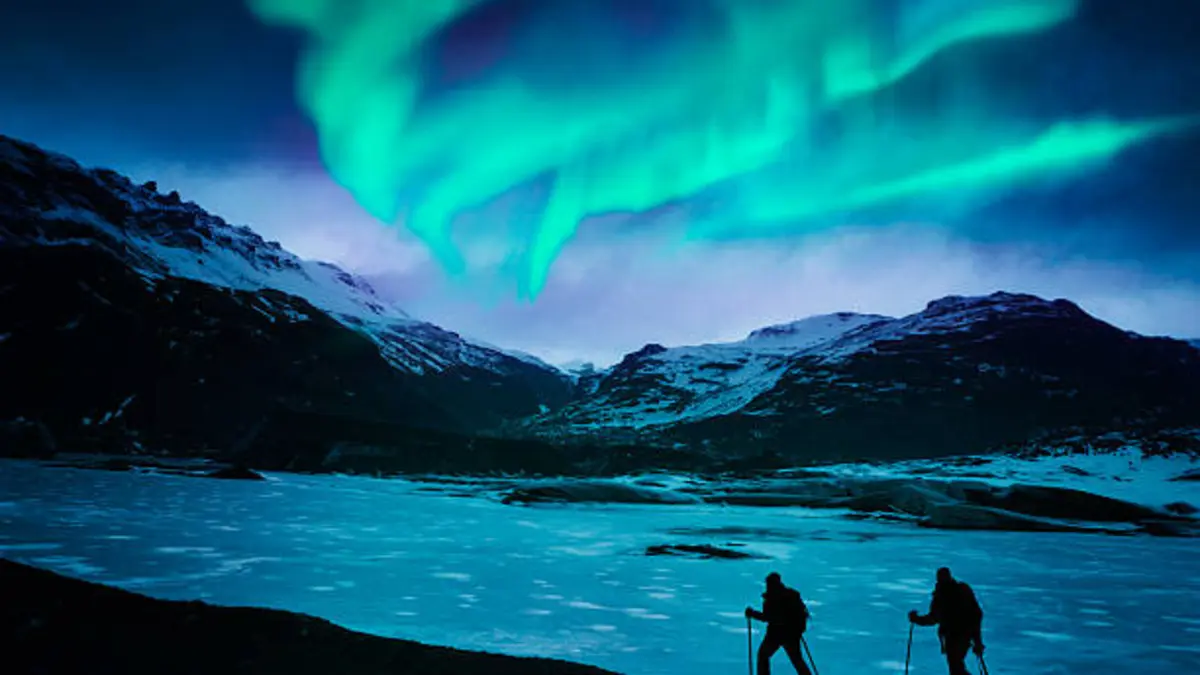
I’ve watched the aurora do nothing for three nights straight, then explode across the sky on the fourth. That’s the honest truth about chasing lights in Iceland — no tour company can promise a show, but the right tour dramatically improves your odds and makes the wait worth it either way.
Quick answer: The best Iceland northern lights tours run September through April, with November–February offering the darkest skies. Small-group minibus tours from Reykjavík cost roughly $60–$120 per person for 2–5 hours, while Super Jeep and private tours run $200–$1,900. Most reputable operators include a free retry if clouds block the view.
What Actually Causes the Northern Lights (and Why It Matters for Booking)
The aurora borealis isn’t random. It happens when charged particles from solar flares and coronal mass ejections collide with gases in Earth’s atmosphere, and Iceland sits almost directly inside the auroral zone — the ring around the magnetic pole where this activity concentrates. That’s why Iceland is one of the best places in the world to see the Northern Lights due to its location within the Auroral Zone, a region around the Earth’s magnetic poles where auroral activity is most intense.
Three things need to line up: solar activity has to be strong enough (tracked via the KP-index), the sky needs to be clear of cloud cover, and you need to be far enough from city lights that light pollution doesn’t wash out the faint green glow. Guides watch all three in real time, which is the entire value proposition of booking a tour instead of guessing on your own.
Quick Takeaway: No app or tour guarantees a sighting. What you’re really paying for is expertise in reading the forecast and driving to wherever the sky happens to be clearest that night.
Best Time to Go
Timing matters more than almost anything else in this decision. The best period to see them is from late August to early April, when the nights are longest and darkest, and within this window, the peak months are typically November through February. September and March tend to offer a nicer trade-off — they offer a balance of long nights and milder weather conditions compared to the harsher storms of deep winter.
Here’s the honest trade-off nobody spells out clearly enough: December and January have the longest dark hours, but they also bring the worst storms and heaviest cloud cover, which can cancel tours outright. If your dates are flexible, late September, October, and March often deliver a better balance of visibility and comfort.
Types of Tours Compared
Not all tours are built the same, and the differences change both your price and your experience.
| Tour Type | Typical Group Size | Duration | Approx. Price (per person) | Best For |
|---|---|---|---|---|
| Minibus/shared bus tour | 15–19 | 2–5 hrs | $60–$120 | First-timers, budget travelers, families |
| Super Jeep 4×4 tour | 4–8 | 3–5 hrs | $200–$400 | Photographers, adventure travelers |
| Boat tour | 20–40 | 3 hrs | $80–$140 | Couples, those prone to motion sickness on rough roads |
| Private tour | 1–8 | 3–4 hrs | $1,000–$1,900 per group | Special occasions, flexible timing |
| Combo tour (day sightseeing + evening hunt) | Varies | 11–16 hrs | $150–$300 | Limited-time visitors |
| Multi-day package | Varies | 2–10 days | $600+ | First trip to Iceland, want lights plus highlights |
Minibus tours remain the most popular entry point. These small-group tours depart from Reykjavík and North Iceland, run from September to April, and head into the quiet countryside, far from light pollution, to give guests the best possible chance of clear views, with included pickup and drop-off, blankets, and hot cocoa standard across most operators.
If photography is your priority, a jeep tour buys you more room and flexibility. Modified all-terrain 4×4 vehicles with fewer seats give photographers more space for cameras and tripods than a standard minibus.
Prefer to skip winding countryside roads altogether? Boat tours set sail from Reykjavík harbor into calmer waters, offering indoor lounges and open decks so you can watch from a stable platform rather than a bus seat.
Quick Takeaway: Bus tours are the value pick, jeeps are for serious photographers, boats suit anyone who gets carsick on gravel roads, and private tours exist purely for flexibility, not better sighting odds.
Reykjavík vs. Akureyri: Where to Base Yourself
Most visitors base themselves in Reykjavík, and for good reason — it has the widest tour selection and easy Golden Circle access. But if your trip already has you in the north, don’t overlook it. Akureyri-based evening departures let travelers staying in North Iceland avoid a long drive down from Reykjavík, and northern skies are frequently clearer and darker than the capital region on any given night, simply because there’s less coastal cloud cover and light pollution to fight through.
Guided Tour vs. Self-Drive
Renting a car and chasing the lights yourself is tempting, and plenty of people do it well. But guided tours solve three problems self-drivers underestimate: local road knowledge in the dark, real-time forecast interpretation, and safety on ice-covered rural roads you’ve never driven before. As one operator puts it, local guides bring a wealth of experience in predicting aurora activity and navigating Iceland’s sometimes unpredictable weather, and know the best, most remote locations to escape light pollution.
If you’re a confident winter driver with flexible dates and don’t mind reading a KP-index forecast yourself, self-driving gives you total control over timing and location. If this is a one-shot trip and you don’t want to risk missing the show over a wrong turn, a guide earns their fee.
What to Wear and Bring
You’ll be standing outside, often for 30–90 minutes, in temperatures that regularly drop below freezing with wind chill on top. Layer aggressively: thermal base layer, insulating mid-layer, windproof/waterproof outer shell, insulated waterproof boots, wool socks, a hat that covers your ears, and mittens over thin gloves (so you can still operate a camera). Most tours provide blankets and hot chocolate, but they don’t provide boots — bring your own.
Photographing the Aurora
Your phone’s night mode can capture a decent aurora photo today, but a proper camera on a tripod still wins. Set your camera to manual mode, use a wide-angle lens, aperture as low as it will go (f/2.8 or wider if possible), ISO between 1600–3200, and shutter speed between 3–15 seconds depending on how fast the aurora is moving — faster, brighter displays need shorter exposures or you’ll blur the detail into a green haze. Bring a tripod; handheld long exposures simply won’t work in the cold and dark.
Booking, Cancellations, and the Free Retry Policy
Nearly every reputable operator now offers some version of a weather guarantee. Northern Lights tour prices vary by tour type, season, and availability, with shared minibus tours usually the most budget-friendly, while Super Jeep, combo, and private tours cost more because of smaller groups and added flexibility. On the cancellation side, if a tour is canceled due to weather conditions, most companies will offer the option to reschedule for another night rather than a refund — worth knowing before you book, especially on a short trip.
Read the fine print on the free retry: it’s typically valid only for the original tour holder, non-transferable, and often only good for a set window (commonly up to 1–3 years depending on the operator), not indefinitely.
Realistic Expectations: Your Actual Odds
Nobody advertises this clearly enough: a good chunk of nights, you’ll see nothing, or something so faint it barely registers to the naked eye. Real traveler accounts back this up — some groups saw the northern lights on two or three different nights during a week-long trip, while others report theweather simply didn’t cooperate despite an otherwise excellent tour. Book at least 3–4 nights if seeing the aurora is a priority, not a single evening, and treat any sighting as a bonus on top of an already worthwhile night under Iceland’s dark sky.
Final Thoughts
An Iceland northern lights tour is really two products in one: a guided night out under some of the darkest, clearest skies in Europe, and a chance — not a guarantee — at the aurora itself. Pick the tour type that matches your budget and priorities, build in multiple nights if you can, dress like you mean it, and let a local guide handle the part you can’t: knowing exactly where the sky will be clear tonight.
Ready to book? Compare a small-group minibus tour for your first night, and if you strike out, use your free retry on a Super Jeep tour for a second shot with better photography odds.
For more practical travel planning tips, check out our collection of travel guides.
FAQ Section
Q1: When is the best time to see the northern lights in Iceland?
Late August through early April, with November–February offering the darkest, longest nights. September and March often provide a better balance of visibility and milder weather.
Q2: How much does a northern lights tour in Iceland cost?
Shared minibus tours typically run $60–$120 per person. Super Jeep and boat tours cost more, and private tours can run $1,000–$1,900 per group depending on group size and duration.
Q3: What happens if I don’t see the lights on my tour?
Most reputable operators offer a free retry or rebooking if weather blocks visibility, though policies vary on transferability and expiration windows, so check before booking.
Q4: Is it better to self-drive or book a guided tour?
Guided tours offer local forecast knowledge and safer navigation on dark, icy roads. Self-driving works well if you’re an experienced winter driver with flexible dates and want full control over timing.
Q5: What should I wear on a northern lights tour?
Layer thermal base layers, an insulating mid-layer, and a windproof waterproof outer shell, plus insulated boots, a warm hat, and mittens over thin gloves for camera use.
Q6: How long do northern lights tours last?
Most evening tours run 2–5 hours including pickup and driving time. Combo tours run 11–16 hours, and multi-day packages range from 2 to 10 days.
Q7: Can you see the northern lights from Reykjavík itself?
Occasionally during strong displays, but light pollution usually washes out fainter shows, which is why tours drive into the dark countryside.
Q8: Do I need a professional camera to photograph the aurora?
No, but a tripod helps significantly. Modern smartphone night modes can capture visible aurora, while a manual camera with a wide lens gives sharper, more detailed results.