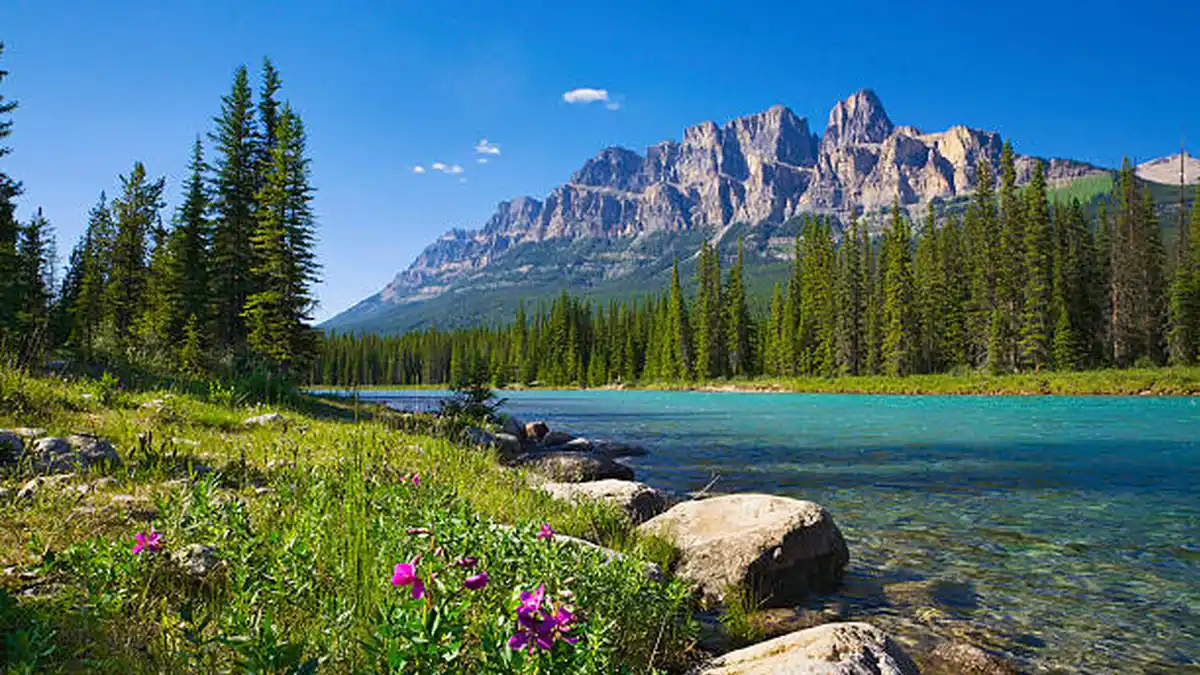
The first time you round the bend on the Trans-Canada Highway and Cascade Mountain fills the windshield, you understand why four million people show up here every year. Banff isn’t subtle. It’s turquoise lakes and jagged limestone peaks doing exactly what the postcards promised — and, if you show up unprepared, exactly the kind of place where a missed shuttle reservation or an expired park pass can eat half your day.
Banff National Park is Canada’s oldest national park, established in 1885 in the Alberta Rockies about 90 minutes west of Calgary. Spanning roughly 6,641 square kilometers, it’s known for glacier-fed lakes like Lake Louise and Moraine Lake, three ski resorts, and a UNESCO-listed landscape shared with neighboring Rocky Mountain parks.
Where Banff National Park Is and How to Get There
Banff sits in southwestern Alberta, straddling the Continental Divide near the British Columbia border. It’s about 128 km (80 miles) west of Calgary, which makes Calgary International Airport the obvious gateway — most visitors rent a car there and drive straight in on Highway 1.
If you’d rather skip the rental car, several shuttle and coach services run directly from the Calgary airport to Banff townsite, and once you’re inside the park, the ROAM transit system connects Banff, Lake Louise, and Canmore on hybrid buses. It’s a genuinely workable option if you’re staying centrally and don’t plan to chase remote trailheads at dawn.
One thing that trips up a lot of visitors: you don’t need a park pass if you’re only driving through on the Trans-Canada Highway without stopping. The moment you pull off at a viewpoint, trailhead, or the townsite itself, you do.
Park Passes and What Banff Costs in 2026
This is the part most guides get wrong or leave outdated, so here’s where things actually stand for 2026.
Entry is charged per vehicle, not per person, so everyone in the car is covered by a single pass. For short visits, the daily rate is usually cheaper; for anything longer, or if you’re also hitting Jasper, Yoho, or Kootenay, the annual Discovery Pass wins.
| Pass Type | 2026 Price | Best For |
|---|---|---|
| Daily vehicle pass | $10.50 CAD | 1–2 day visits, single park |
| Discovery Pass (adult) | $83.50 CAD/year | Solo travelers doing 3+ park-days |
| Discovery Pass (senior) | $71.50 CAD/year | Seniors, multi-park trips |
| Discovery Pass (family/group, up to 7) | $167.50 CAD/year | Families or groups spending 7+ combined days across parks |
| Canada Strong Pass | Free | Banff admission only, June 19–Sept 7, 2026 |
A quick note on that Canada Strong Pass: it’s a government promotional program giving free Banff admission for a specific summer window, plus a 25% camping discount during the same dates. It’s Banff-specific — if your itinerary also includes Jasper or Yoho, you’ll still want the Discovery Pass for those legs. Youth 17 and under always enter free, with or without a promotional window.
Buy online in advance if you’re arriving during peak summer weekends — gate lines at the east entrance can run 20–30 minutes on a Friday afternoon, and a digital pass lets you use the express lane.
Quick Takeaway: If you’re visiting Banff only, for 1–2 days, pay the daily fee. If you’re staying 3+ days, adding another Rockies park, or traveling outside the free-entry window, the Discovery Pass pays for itself fast.
Best Time to Visit Banff National Park
Banff genuinely works as a year-round destination, but “best” depends on what you’re after.
Summer (Victoria Day to Labour Day) is peak season — warmest weather, every trail and lake accessible, and the biggest crowds by far. This is when Lake Louise and Moraine Lake parking fills before 6 a.m.
Winter (November to May) turns Banff into a ski town, with three resorts — Lake Louise Ski Resort, Banff Sunshine, and Mount Norquay — offering a combined 7,700+ acres of terrain and one of the longest ski seasons in North America. Non-skiers get ice skating on a frozen Lake Louise, snowshoeing, and dogsledding.
Shoulder season (late May–June, September–October) is the sweet spot for a lot of experienced visitors: thinner crowds, lower hotel rates, and still-decent trail access, though some high-alpine routes stay snowbound into July. If wildflowers matter to you, aim for July.
One scheduling detail almost nobody mentions until you hit it in person: Larch Valley and Paradise Valley near Lake Louise impose seasonal hiking restrictions from mid-July through October, requiring hiking groups of four or more, because of bear activity in the area. Plan accordingly if a solo hike there is part of your list.
Top Things to See in Banff National Park
Lake Louise and Moraine Lake are the two names everyone already knows, and they earn the hype — glacial silt gives both lakes that unmistakable turquoise color. What most articles skip: Moraine Lake’s road is closed to private vehicles during peak season, and access now runs through a reservable shuttle and Parks Canada transit system. Book that ahead, not the morning you arrive.
Lake Minnewanka, about 20 minutes from Banff townsite, is a longer, fjord-like lake with rental canoes and kayaks and scenic boat cruises running May through October — a good alternative when Louise and Moraine feel oversaturated.
Vermilion Lakes and Two Jack Lake sit closer to town, are far less crowded, and are genuinely better for a quiet paddle or sunrise coffee than fighting for a Moraine Lake parking spot.
Johnston Canyon delivers waterfalls via a well-built catwalk trail, and in winter it converts into a guided ice-walk experience through frozen canyon pillars.
The Icefields Parkway (Highway 93N), connecting Lake Louise to Jasper, is one of the most scenic drives on the continent, with Bow Lake, Peyto Lake, and Mistaya Canyon as the standout stops — budget a full day if you want to actually get out of the car at each one.
The Banff Gondola up Sulphur Mountain and the seasonal Lake Louise Gondola both deliver panoramic views without requiring a hike, which matters if you’re traveling with kids or limited mobility.
Best Hikes and Outdoor Activities
Trail difficulty in Banff spans a huge range, so match the hike to your fitness level rather than your itinerary’s Instagram potential.
- Easy: Johnston Canyon lower falls, Fenland Trail, Bow River pathways
- Moderate: Tunnel Mountain, Lake Agnes Teahouse trail above Lake Louise
- Challenging: Larch Valley and Sentinel Pass, the Plain of Six Glaciers
- Adventure add-on: the guided Via Ferrata on Mount Norquay — steel cables, suspension bridges, and ladder rungs bolted to the cliff face, no technical climbing experience required
Wildlife is part of the deal here, not a rare bonus. Black bears, grizzlies, elk, and bighorn sheep are commonly seen along the Bow Valley Parkway. Carry bear spray on any backcountry trail, make noise on blind corners, and never approach or feed wildlife — Parks Canada actively enforces this, and it’s for the animals’ safety as much as yours.
Where to Stay, Getting Around, and a Sample 3-Day Itinerary
Banff townsite puts you closest to restaurants, the gondola, and hot springs, but at premium summer rates. Lake Louise is quieter and closer to the two marquee lakes, with fewer dining options. Canmore, just outside the park boundary, consistently runs cheaper and makes a smart base if you have a car and don’t mind a 20–25 minute drive in each day.
For getting around without constant driving, ROAM transit connects all three towns, and a growing shuttle network now serves Lake Louise and Moraine Lake specifically during peak hours — check current shuttle schedules before you go, since reservation systems have changed year to year.
Sample 3-day itinerary:
- Day 1: Banff townsite — Banff Gondola, Bow Falls, Banff Upper Hot Springs, dinner on Banff Avenue
- Day 2: Lake Louise and Moraine Lake (shuttle booked in advance), Lake Agnes Teahouse hike if time allows
- Day 3: Icefields Parkway day trip — Bow Lake, Peyto Lake, Mistaya Canyon, back by evening
Three to five days is genuinely the sweet spot for a first visit — enough time to hit the highlights without racing the clock, and enough slack to swap a hike for a rain day if the mountains decide otherwise.
Is Banff National Park Worth It?
Yes, with one honest caveat: come expecting crowds at the famous spots in July and August, and build your plan around the less-obvious lakes and trails instead of fighting for a Moraine Lake parking spot at sunrise. Do that, book your shuttle and pass in advance, and Banff delivers on every bit of its reputation.
For more expert travel tips and itineraries, explore our travel planning resources.
FAQ Section
What is Banff National Park known for?
Banff is known for turquoise glacial lakes like Lake Louise and Moraine Lake, the Icefields Parkway drive, three ski resorts, and abundant Rocky Mountain wildlife. Founded in 1885, it’s Canada’s first national park and part of a UNESCO World Heritage Site.
How much does it cost to enter Banff National Park in 2026?
A daily vehicle pass costs $10.50 CAD. The annual Discovery Pass is $83.50 CAD for an adult or $167.50 for a family/group. From June 19 to September 7, 2026, admission is free under the Canada Strong Pass program.
Do I need a car to visit Banff National Park?
Not necessarily. ROAM transit connects Banff, Lake Louise, and Canmore, and shuttle services run from Calgary airport. A car gives more flexibility, especially for the Icefields Parkway and Bow Valley Parkway.
How many days should I spend in Banff National Park?
Three to five days is the sweet spot for first-time visitors — enough to see Banff townsite, Lake Louise, Moraine Lake, and drive part of the Icefields Parkway without rushing.
Can I drive to Moraine Lake without a reservation?
During peak season, private vehicle access to Moraine Lake is restricted, and visitors need to book a shuttle or transit seat in advance. Check current-year shuttle booking rules before your trip.
Is Banff National Park safe for wildlife encounters?
Generally yes, if you follow basic precautions: carry bear spray on trails, keep a safe distance from wildlife, never feed animals, and check for seasonal trail restrictions like the group-of-four rule in Larch Valley during bear season.
What’s the best time to visit Banff National Park?
Summer (late May–September) offers full trail access and warmest weather but the biggest crowds. Winter (November–May) is prime for skiing. Shoulder season (June or September) balances good weather with fewer people.
Is Banff National Park worth visiting in winter?
Yes — it’s a genuine four-season destination with three ski resorts, ice skating on Lake Louise, snowshoeing, and a guided ice walk through Johnston Canyon.