A haircut can look clean without taking the sides extremely short. That balance is exactly what makes the mid taper such a practical choice.
Instead of fading a large portion of the sides and back, the cut creates a controlled transition around the temple, sideburn, and neckline while preserving more hair elsewhere. The result is noticeable definition without the dramatic scalp exposure associated with many full fades.
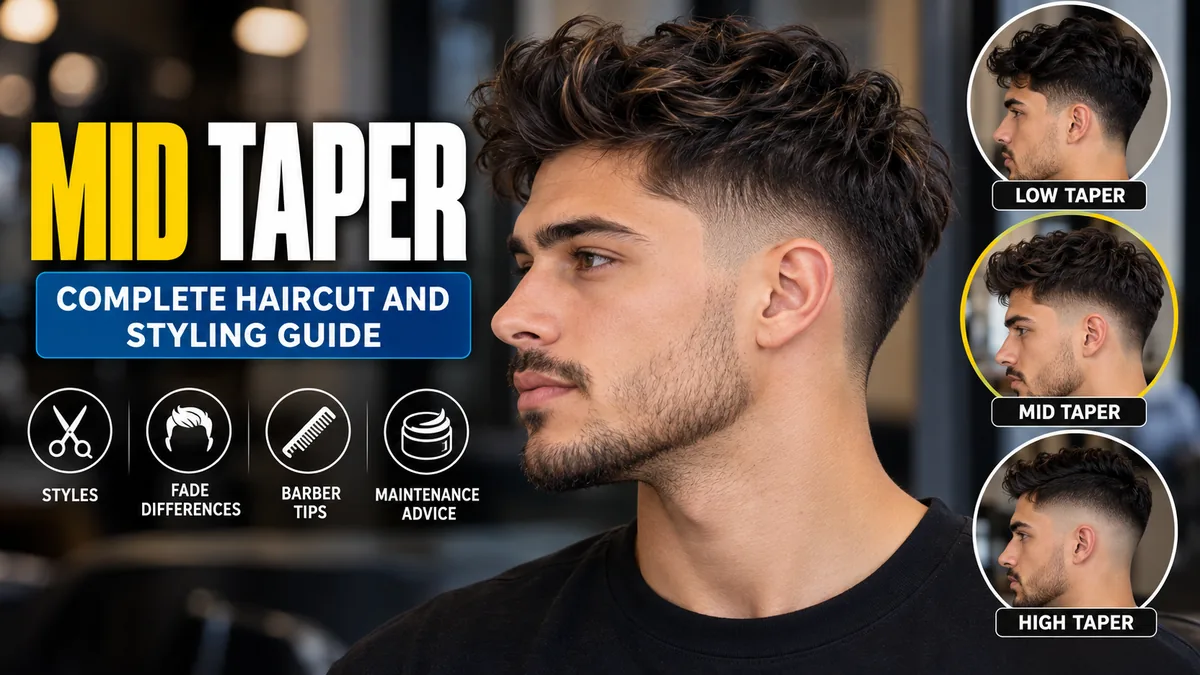
A mid taper is a haircut in which the gradual shortening begins around the temple or middle portion of the sides. The hair becomes progressively shorter toward the sideburns and neckline while more length and weight remain above the tapered areas. It sits between a low and high taper in placement and visual contrast.
What Is a Mid Taper?
The easiest way to understand a mid taper is to look at where the transition begins.
With a low taper, most of the shortening stays close to the ears and neckline. A high taper pushes the transition farther upward. A mid taper occupies the space between them, commonly beginning around temple level or approximately level with the upper portion of the ear.
The barber gradually changes clipper lengths to create a smooth transition from shorter hair near the perimeter into longer hair above.
However, there is an important distinction: the word “mid” describes placement, not the shortest clipper length.
A mid taper can finish at:
- Skin
- Zero
- 0.5 guard
- Number 1 guard
- Another slightly longer length
This means two people can both have mid tapers while their haircuts show very different amounts of scalp.
The exact location can also vary slightly between barbers. Rather than treating “mid” as an exact measurement, it is more useful to think of it as a general placement around the temple and middle-side area.
Mid Taper vs Mid Fade: They Are Not Exactly the Same
One of the biggest sources of confusion is the difference between a mid taper and mid fade.
Both use gradual clipper blending, but the amount of the head affected by the blend is different.
| Feature | Mid Taper | Mid Fade |
|---|---|---|
| Main blending area | Temples, sideburns and neckline | Wider sides and back |
| Hair retained on sides | More | Less |
| Contrast | Moderate | Moderate to strong |
| Scalp exposure | Usually lower | Usually higher |
| Overall appearance | Controlled and natural | More defined and dramatic |
| Grow-out | Generally softer | More noticeable |
A mid fade typically creates a broader gradient through the sides and back. A mid taper keeps more darkness and weight through the main side panel while concentrating the shortest areas around the perimeter.
That distinction matters when speaking with a barber.
Simply saying “mid fade” when you actually want a taper may result in considerably more hair being removed from the sides.
Mid Taper vs Low Taper
The difference between a low and mid taper mainly comes down to height and visibility.
A low taper begins closer to the ears and neckline. Because the transition remains low, more hair is preserved and the haircut looks relatively subtle.
The mid version moves the transition upward toward the temple.
| Low Taper | Mid Taper |
|---|---|
| Starts closer to the ear | Starts around the temple |
| Less visible transition | More visible transition |
| Retains more side length | Removes slightly more side bulk |
| Lower contrast | Moderate contrast |
| Very subtle finish | More defined finish |
A low taper can be useful when you mainly want to clean up the perimeter without making the taper a prominent part of the hairstyle.
Moving to mid height makes the gradient easier to see from the front and side.
Neither is universally better. They simply create different proportions.
Mid Taper vs High Taper
Moving the taper higher changes the haircut more noticeably.
A high taper begins above the temple and removes more hair from the upper sides. That increases separation between the top and sides.
A mid taper retains more weight.
| Feature | Mid Taper | High Taper |
|---|---|---|
| Starting area | Around temple level | Above the temple |
| Contrast | Moderate | Stronger |
| Side bulk | More retained | More removed |
| Scalp visibility | Lower | Higher |
| Top-to-side separation | Balanced | More dramatic |
The shortest point is still a separate decision. A mid taper can reach skin, while a high taper can finish above skin. The height of the blend and its finishing length should therefore be discussed separately with your barber.
Why the Mid Taper Works With So Many Hairstyles
The versatility comes from what the barber doesn’t remove.
Because significant length can remain through the sides and on top, the taper can act as a clean frame around many different hairstyles rather than becoming the dominant feature.
It can accompany:
- Textured tops
- Short crops
- Curly hair
- Waves
- Afro-textured hair
- Quiffs
- Side parts
- Fringe hairstyles
- Buzz cuts
- Longer textured styles
This flexibility also allows the barber to adjust the transition according to hair density, growth pattern and the desired silhouette.
The same basic taper can therefore look quite different depending on what happens above it.
Mid Taper With Textured Hair
Texture and tapering naturally complement each other because they create two different visual elements.
The top can remain loose and irregular while the hairline and sides appear controlled.
For straight or slightly wavy hair, a barber may leave several inches on top and add texture with scissors. Styling products can then create separation rather than forcing every strand into the same direction.
A matte clay, paste or light styling cream usually provides a more natural appearance than heavy, glossy products.
The amount needed depends on hair density. Start with a small quantity and add more only when necessary.
Mid Taper With Curly Hair
Curly hair is particularly well suited to tapered cuts because the barber can preserve natural volume while cleaning the perimeter.
Instead of cutting away all the side texture, the taper can remain concentrated near the temples, sideburns and nape.
This creates a clear transition between the curls and hairline without eliminating the character of the curl pattern.
For styling, avoid unnecessarily flattening the curls. A curl cream or suitable leave-in product can help define the natural pattern while reducing dryness and frizz.
How high the taper should go depends partly on where the curls become dense. Removing too much weight can change the overall silhouette, so showing your barber the amount of volume you want to retain is useful.
Mid Taper With Short Hair
You don’t need long hair on top to wear this cut.
A short textured crop or buzz-style top can pair with a mid taper to produce a very clean outline.
The advantage is controlled contrast. The perimeter becomes clearly defined without requiring the entire side of the head to be faded aggressively. Guides focused specifically on short hair similarly emphasize that the taper can preserve side weight while creating visible definition.
With extremely short hair, however, poor blending becomes easier to notice. Smooth clipper transitions matter because there is less length available to disguise visible lines.
Mid Taper With Longer Hair
Longer hair creates a completely different effect.
Keeping length and volume on top while tightening the temple and neckline creates separation without turning the hairstyle into an undercut.
This combination can work with:
- Swept-back hair
- Loose waves
- Messy textured tops
- Longer curls
- Voluminous fringe
- Modern quiffs
One advantage of tapering rather than applying a broad fade is that the connection between longer top hair and the sides can remain softer.
Mid Taper With a Fringe
A fringe brings attention toward the forehead while the taper cleans the areas around it.
The combination can work particularly well when the top is textured.
A barber can keep the fringe relatively heavy while reducing bulk around the temples. The resulting contrast helps the top maintain shape without requiring the entire side to become extremely short.
Straight, wavy and curly fringes can all work. The key is adjusting the length to the person’s natural hair movement rather than copying the exact dimensions of someone else’s haircut.
Mid Taper With a Buzz Cut
A buzz cut doesn’t have to be one uniform clipper length.
Adding a taper creates structure around the sideburns and neckline while keeping the simplicity of short hair.
The difference may appear small, but the cleaner perimeter can make the overall haircut look more intentional.
The shortest finish also becomes particularly important here. Going to skin produces more contrast, while leaving a small amount of hair at the bottom gives the transition a softer appearance.
Mid Taper for Different Hair Types
Hair texture changes how any taper appears.
Straight Hair
Straight hair can make blending lines easier to see, especially when the hair is fine or light in density.
A slightly longer finish at the bottom may produce a softer transition than taking everything immediately to skin.
The top can be styled with texture, a side part or a controlled fringe.
Wavy Hair
Natural waves provide movement and volume.
Keeping that texture on top while tightening the temples gives the haircut definition without removing the waves that make the style interesting.
Light styling cream or sea-salt-type products may help emphasize texture without making the hair look stiff.
Curly Hair
Curls create natural contrast against shorter sides.
The taper can clean the perimeter while preserving volume and curl definition higher on the head.
Moisture and curl control usually matter more than strong hold.
Coily and Afro-Textured Hair
A mid taper can frame dense coily or Afro-textured hair while preserving considerable volume.
The top can remain rounded, textured, twisted or otherwise styled while the temple and neckline receive more precise clipper work.
Because shrinkage and density affect the final shape, the barber should evaluate the hair in its natural state before removing significant bulk.
Does Face Shape Matter?
Face shape can influence how the haircut is customized, but it should not be treated as a rigid rule.
The barber can modify:
- Top length
- Side volume
- Taper height
- Fringe shape
- Overall silhouette
For a rounder face, retaining height or texture on top may create more vertical emphasis.
Someone with a longer face may prefer less height on top and slightly more weight through the sides.
Square facial features often pair naturally with clean lines and structured hairstyles, while oval proportions can accommodate many different top styles.
Hairline, head shape, density, facial hair and personal preference can matter just as much as a broad face-shape category.
Skin Mid Taper vs Shadow Mid Taper
Another choice is how short the bottom should become.
Skin Finish
The lowest portion is taken extremely short or down to bare skin.
This creates:
- More contrast
- A sharper fresh-cut appearance
- Greater scalp visibility
- More noticeable regrowth
Shadow Finish
A small amount of hair remains at the shortest point.
The result is:
- Softer contrast
- Less scalp exposure
- A more gradual appearance
- Less dramatic regrowth
This distinction is separate from taper height. “Mid” tells your barber approximately where the transition should occur; “skin,” “zero,” “0.5,” or another guard tells the barber how short it should become.
How to Ask Your Barber for a Mid Taper
Haircut terminology isn’t perfectly standardized between barbershops.
A reference photo is therefore one of the most reliable ways to communicate what you want.
Then explain three things clearly:
- Taper placement: Tell the barber you want the blend around mid-temple level rather than extremely low or high.
- Bottom length: Specify whether you want skin, zero, 0.5, number 1 or a softer shadow finish.
- Top style: Explain how much length you want removed and how you normally style your hair.
A useful request would be:
“I’d like a mid taper around the temples and neckline, but keep the main sides darker. Don’t turn it into a full mid fade. Keep enough length on top for texture.”
This tells the barber considerably more than simply saying “give me a taper.”
If you have a photograph, show it before the cutting begins and point out the specific details you like.
Common Mid Taper Mistakes
A technically good haircut can still be the wrong haircut if the instructions were unclear.
Confusing a Taper With a Full Fade
This is probably the biggest communication problem.
A full fade affects a larger portion of the sides and back. If you want substantial darkness through the side panel, specifically tell the barber that.
Asking Only for “Mid”
The term doesn’t tell the barber how short the bottom should be.
Someone expecting a subtle number-one finish may be surprised by a skin taper.
Always discuss both height and shortest length.
Choosing a Reference Photo With Different Hair
A hairstyle shown on very dense curly hair will not behave exactly the same way on thin straight hair.
Use photographs as visual direction rather than expecting an identical result.
Taking the Taper Too High
Once the transition is moved substantially upward, the haircut begins creating stronger contrast and may no longer have the balanced appearance you expected.
Starting slightly more conservatively gives you room to go shorter or higher later.
Ignoring the Back
People often focus entirely on the temples.
The neckline matters too. Discuss whether you want the back natural, rounded, squared or tapered and how strongly you want it blended.
How Often Does a Mid Taper Need Maintenance?
There isn’t one universal schedule because hair growth rates, finishing length and personal standards differ.
A skin-finished taper will generally show regrowth sooner because the contrast between bare skin and surrounding hair begins changing almost immediately.
A longer shadow taper can remain visually balanced for longer.
Many contemporary barber guides place common mid-taper refresh cycles somewhere around two to five weeks, depending on how sharp the wearer wants the haircut to remain and how short it was initially cut.
Someone who wants a consistently fresh outline may visit sooner. Someone comfortable with a softer grown-out appearance can wait longer.
How to Maintain a Mid Taper Between Haircuts
You don’t need to recreate the barber’s clipper work at home.
Basic maintenance usually works better.
Keep the Hair Clean
Product buildup can make textured styles look flat or greasy.
Use shampoo according to your hair and scalp needs rather than automatically shampooing aggressively every day.
Condition When Needed
Conditioning becomes particularly useful with curly, coily, dry or longer hair because it can improve manageability.
Use the Right Styling Product
Choose the product according to the finish you want.
For example:
- Matte clay for texture and stronger control
- Paste for flexible hold
- Cream for natural movement
- Curl cream for definition
- Pomade for smoother, more polished styling
Avoid Trying to Repair the Fade Yourself
Cleaning obvious stray neck hairs is one thing. Attempting to move the fade line or blend several clipper guards without experience can quickly create patches or hard lines.
If the transition itself needs fixing, a barber refresh is usually easier than correcting an accidental home fade.
What Makes a Good Mid Taper?
A quality taper should not be judged only by how short it is.
Look for a smooth progression between lengths.
You shouldn’t see obvious horizontal lines where one clipper guard suddenly changes to another.
The temple area should connect naturally into the hairstyle above, while the neckline should look deliberate rather than abruptly shaved.
Good barbering also considers the individual’s natural features.
Cowlicks, growth direction, hair density, recession around the temples and head shape can all affect where the transition should begin.
That is why the same clipper formula should not automatically be applied to every person.
Is a Mid Taper the Same as a Temple Fade?
The terms can overlap in everyday barber language because both may concentrate short blending around the temple area.
However, terminology varies by region and shop.
Instead of relying entirely on the name, describe the visual result you want: where the taper should begin, which parts of the sides should retain weight, how short the bottom should become and what should happen at the neckline.
That prevents terminology differences from becoming haircut differences.
Should the Mid Taper Go Down to Skin?
It doesn’t have to.
A common misconception is that every modern taper must expose bare skin.
The finishing length is a personal choice.
Skin gives stronger contrast and a very crisp freshly cut appearance. A zero, 0.5 or longer finish retains a visible shadow and creates a softer transition.
If you have never had the style before, a slightly longer starting point can be useful because the barber can always shorten it during the appointment.
Going in the opposite direction requires waiting for the hair to grow.
Is a Mid Taper Good for Short or Long Hair?
It can work with both.
With short hair, the taper adds structure to a crop, buzz cut or compact textured top.
With medium-length hair, it can clean the sides while allowing enough length for a quiff, fringe or side-swept style.
With longer or curly hair, it can create definition around the perimeter without sacrificing most of the volume.
This adaptability is one reason the haircut appears with such a wide variety of top styles in current barber guides.
Mid Taper: The Key Takeaway
The mid taper is defined primarily by placement: the shortening begins around the temple or middle-side area and transitions toward shorter hair at the sideburns and neckline while preserving more weight than a broad mid fade.
Its biggest advantage is flexibility.
You can pair it with straight, wavy, curly or coily hair; keep the top short or long; and choose anything from a soft shadow finish to a skin-level transition.
The most important step is communicating clearly with your barber. Specify the taper height, shortest length, amount of side weight you want retained, and what should happen on top. A reference photo makes those instructions even clearer.
Done well, a mid taper gives you the definition of a fade-inspired haircut without requiring the entire side of the head to become the focus.