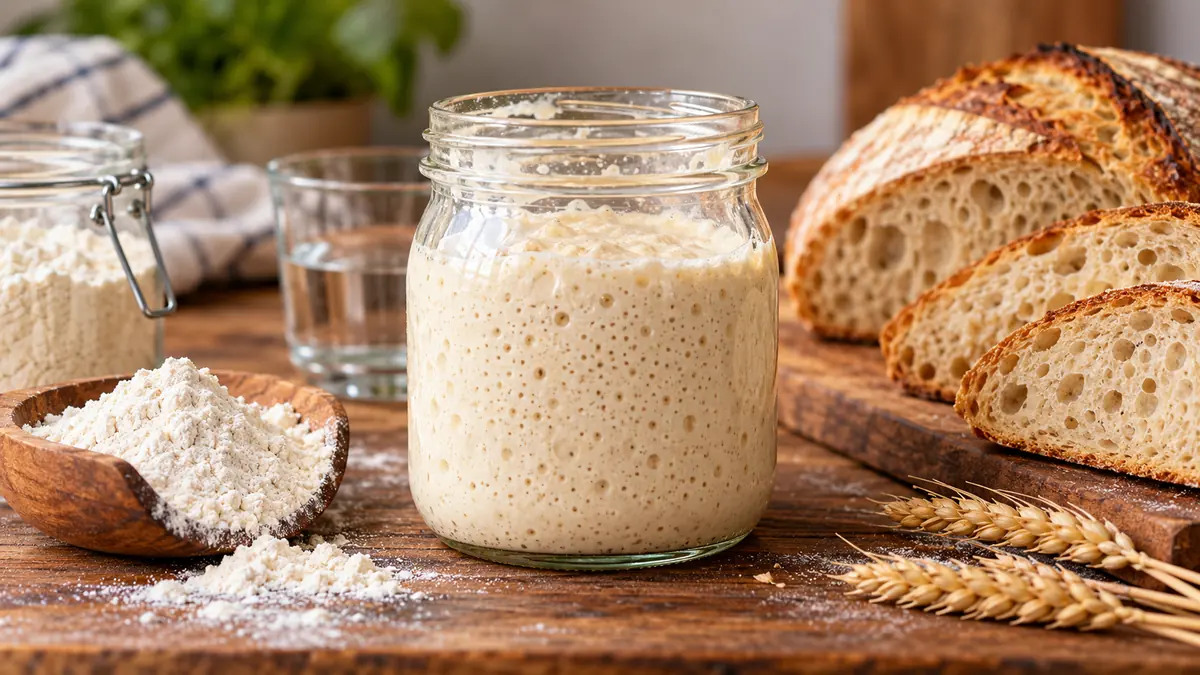
A good loaf of sourdough bread begins long before the dough is mixed. It starts in a jar with two basic ingredients: flour and water.
A sourdough starter is a living fermented culture of flour and water populated by yeasts and bacteria. With regular feeding, these microorganisms produce acids and carbon dioxide, giving sourdough its characteristic flavor and helping bread rise without relying on commercial yeast. PubMed
Making one from scratch isn’t difficult, but it does require patience. Some starters become vigorous within five to seven days, while others need two weeks or longer, particularly in cooler kitchens. The better measure of readiness is activity—not the date on the calendar. King Arthur Baking
What Is a Sourdough Starter?
A sourdough starter is essentially a small, continuously maintained fermentation ecosystem.
Flour naturally carries microorganisms. When flour and water are mixed and refreshed repeatedly, conditions begin favoring communities of yeast and bacteria capable of thriving in an increasingly acidic environment. Research describes sourdough as a flour-water mixture fermented primarily by lactic acid bacteria and yeasts. PubMed
The microorganisms perform different jobs.
Yeasts and other fermentation activity contribute carbon dioxide, which helps dough expand. Lactic acid bacteria produce organic acids and other compounds that influence acidity, aroma, flavor, texture, and the overall fermentation environment. ScienceDirect
This is why sourdough starter is more than simply “natural yeast.” It’s a microbial community.
Starter vs. Commercial Yeast
Commercial baker’s yeast provides selected yeast designed to ferment predictably and quickly.
A sourdough starter contains a more complex microbial community and usually ferments bread more slowly. The acids and fermentation products created during this process contribute to sourdough’s distinctive aroma and flavor. DOI
You don’t need commercial yeast to make a naturally leavened sourdough loaf when your starter is sufficiently active.
What You Need to Make Sourdough Starter
You can begin with surprisingly little equipment:
- Flour
- Water
- A clean jar or food-safe container
- Digital kitchen scale
- Spoon or spatula
- Loose-fitting lid or other suitable cover
- Rubber band or marker for tracking growth
A scale is especially useful. Measuring starter, flour, and water by weight produces more repeatable results than measuring by cups because the volume of flour and bubbly starter can vary considerably. King Arthur Baking likewise recommends weighing ingredients for accuracy and consistency. King Arthur Baking
What Is the Best Flour for Sourdough Starter?
Whole-grain flour is particularly useful when establishing a new culture.
Whole wheat works well, while whole-grain rye is another popular option. The Perfect Loaf recommends whole-grain rye combined with white flour when establishing a starter, while King Arthur’s current method begins with whole wheat or pumpernickel flour before transitioning to unbleached all-purpose flour. The Perfect Loaf
Once your starter is established, you have considerably more flexibility.
Common choices include:
- Unbleached all-purpose flour
- Bread flour
- Whole wheat flour
- Rye flour
- Blends of white and whole-grain flour
Changing flour can alter fermentation speed, consistency, aroma, and feeding requirements, so make major changes gradually when possible.
What Water Should You Use?
Ordinary drinking-quality water generally works.
If your tap water has a strong chlorine smell and your starter repeatedly struggles, filtered water is a reasonable troubleshooting step.
Water temperature also matters because fermentation responds strongly to temperature. Cool water can help slow an overly fast starter, while moderately warm water can help a sluggish starter in a cool kitchen. Avoid very hot water.
How to Make Sourdough Starter From Scratch
There are many successful starter-building methods. You don’t need to chase every variation you see online.
The following approach uses equal weights of starter, flour, and water for routine refreshments—a common 1:1:1 feeding ratio. King Arthur describes 1:1:1 as equal amounts of starter, flour, and water by weight and uses this ratio for its standard maintenance feeding. King Arthur Baking
Day 1: Mix Flour and Water
Combine:
50 g whole wheat or whole-grain rye flour
50 g water
Stir thoroughly until no dry flour remains.
Transfer the mixture to your jar, loosely cover it, and leave it at comfortable room temperature for approximately 24 hours.
Mark the mixture’s starting level with a rubber band or washable marker.
Don’t seal a fermenting starter tightly in a container that cannot safely vent accumulating gas.
Day 2: Check and Feed
After 24 hours, you might see bubbles.
Or you might see almost nothing.
Both situations can be normal during the early stages.
Keep:
50 g starter
Add:
50 g water
50 g unbleached all-purpose or bread flour
Mix thoroughly and mark its new level.
This leaves you with 150 g of starter.
Day 3: Watch for Changing Activity
Repeat the same 1:1:1 feeding:
50 g starter + 50 g water + 50 g flour
By this point you may notice bubbles, expansion, or a fruity or acidic smell.
King Arthur’s current starter method moves to approximately 12-hour feedings from day three as activity develops. King Arthur Baking
Don’t panic if your starter becomes extremely active and then seems to stop.
Early fermentation can change dramatically as different microorganisms compete and the culture gradually stabilizes. A dramatic initial rise does not necessarily mean you already have a mature starter.
Days 4 and 5: Keep Feeding Consistently
Continue discarding down to 50 g and feeding with:
50 g flour
50 g water
If following the twice-daily method, feed approximately every 12 hours.
Look for patterns rather than individual bubbles.
You want the starter eventually to:
- Rise after feeding
- Develop bubbles throughout
- Reach a predictable peak
- Fall afterward
- Repeat that cycle after its next feeding
That predictable cycle matters more than an arbitrary number of days.
Days 6 and 7: Test Its Strength
Continue the feeding schedule.
At this stage, a healthy starter may begin doubling reliably after feeding.
King Arthur considers a newly established starter ready when it has plenty of bubbles, a pleasantly tangy aroma, and roughly doubles within about 6 to 8 hours after feeding. If yours doesn’t, simply continue the feeding process rather than assuming it failed. King Arthur Baking
Some starters need considerably longer than seven days. The Clever Carrot notes that establishment can take two weeks or more, depending especially on temperature and individual conditions. The Clever Carrot
Sourdough Starter Feeding Ratio Explained
You’ll frequently encounter ratios such as:
1:1:1
1:2:2
1:5:5
These numbers refer to:
starter : flour : water
and are normally calculated by weight.
| Feeding ratio | Starter | Flour | Water |
|---|---|---|---|
| 1:1:1 | 25 g | 25 g | 25 g |
| 1:2:2 | 25 g | 50 g | 50 g |
| 1:5:5 | 20 g | 100 g | 100 g |
Higher ratios provide more fresh food relative to the amount of mature starter and generally extend the time required to reach peak activity. Feeding ratio therefore becomes a useful tool for matching fermentation to your schedule. King Arthur Baking
What Does 100% Hydration Mean?
Hydration compares the weight of water with the weight of flour.
If you feed:
50 g flour
50 g water
the newly added flour and water are at 100% hydration because the water weighs 100% as much as the flour.
A typical liquid starter maintained with equal weights of flour and water is therefore called a 100% hydration starter.
A stiff starter contains proportionally less water. Hydration isn’t merely a texture choice; scientific reviews note that water availability can influence microbial activity and the composition of a starter ecosystem. PubMed Central (PMC)
Why Do You Have to Discard Sourdough Starter?
Discarding seems wasteful when you’re new to sourdough, but there’s a practical reason for it.
Imagine keeping 100 g starter and feeding it equal amounts of flour and water.
After feeding:
100 + 100 + 100 = 300 g
Keep all 300 g for the next 1:1:1 feeding and you’d need:
300 g starter + 300 g flour + 300 g water = 900 g
One more feeding would produce 2.7 kilograms.
Removing most of the old starter keeps the culture manageable while maintaining an appropriate proportion of fresh food.
Can You Use Sourdough Discard?
Yes, once you have an established healthy culture, discard doesn’t necessarily belong in the trash.
It can be incorporated into recipes such as:
- Pancakes
- Waffles
- Crackers
- Pizza dough
- Flatbreads
- Cakes and muffins
King Arthur similarly recommends using maintained discard in pancakes, waffles, cake, pizza, flatbread, and other baked goods. King Arthur Baking
With a brand-new culture, however, waiting until the starter has become established before treating discard as a reusable kitchen ingredient is a sensible practice.
How to Know When Sourdough Starter Is Ready
This is where beginners often get trapped by the calendar.
Day seven does not magically turn starter into baking-ready starter.
Instead, evaluate its behavior.
A strong starter should rise predictably after feeding, show bubbles throughout its structure, smell pleasantly fermented, and roughly double within several hours under suitable conditions.
King Arthur uses doubling within approximately 6 to 8 hours as a practical benchmark for baking readiness. King Arthur Baking
Look for the Rise-Peak-Fall Cycle
Immediately after feeding, your starter sits relatively low in its container.
Then fermentation accelerates.
The starter expands.
Eventually it reaches its maximum height—the peak.
After its available food becomes depleted and its structure begins weakening, the starter falls.
Marking the jar after every feeding makes this cycle much easier to recognize.
What Does Active Starter Look Like?
A ripe starter commonly has:
- Numerous visible bubbles
- Noticeable expansion
- A light, aerated internal structure
- A pleasantly fermented aroma
- A slightly domed surface near peak activity
A starter that has just begun falling can still be useful. King Arthur notes that a starter slightly past its peak can remain suitable for baking. King Arthur Baking
Is the Float Test Necessary?
You’ll sometimes be told to drop starter into water and see whether it floats.
It can be an interesting observation, but don’t make it your only readiness test.
How much gas the starter retains can be affected by flour, hydration, handling, and when the sample is taken. A consistent rise after feeding gives you more useful information about fermentation strength.
How Temperature Affects Your Starter
Temperature is one of the biggest reasons two people following identical instructions get different results.
A warmer starter generally ferments faster. A cooler starter generally ferments more slowly.
King Arthur’s starter recipe uses approximately 70°F (21°C) as warm room temperature, while other successful methods target somewhat warmer environments. The Clever Carrot, for example, suggests roughly 70–75°F (21–24°C) for its beginner method. King Arthur Baking
This explains why someone’s starter may become active in under a week while another person’s needs considerably longer.
If Your Kitchen Is Cold
Try:
- Using slightly warmer water
- Finding a naturally warmer location
- Increasing the time between expected milestones
- Monitoring actual temperature instead of guessing
Don’t compensate for a cold room by putting the starter somewhere excessively hot.
If Your Kitchen Is Very Warm
Fermentation may move much faster.
Your starter can peak and collapse before the next scheduled feeding. If that happens consistently, increase the feeding ratio, shorten the interval between feedings, or use cooler water.
The goal isn’t maximum fermentation speed.
The goal is predictable fermentation.
How to Maintain Sourdough Starter
Once your culture is mature, maintenance becomes much easier.
Your best routine depends primarily on how frequently you bake.
Counter Storage for Frequent Bakers
If you’re baking several times per week, room-temperature storage can be convenient.
A common maintenance routine is:
- Keep 50 g mature starter.
- Add 50 g water.
- Add 50 g flour.
- Mix and loosely cover.
- Repeat roughly every 24 hours, adjusting according to temperature and activity.
King Arthur recommends approximately daily feeding for a room-temperature starter, noting that warmer kitchens cause starter to rise—and therefore require feeding—more quickly. King Arthur Baking
Refrigerator Storage for Occasional Bakers
If you bake less frequently, refrigeration reduces the maintenance burden.
King Arthur’s current maintenance guidance recommends feeding refrigerated starter approximately once per week. Before baking, bring it back into an active feeding routine until it reliably doubles or triples within roughly six to eight hours. King Arthur Baking
A practical routine is:
- Remove the starter from the refrigerator.
- Retain a small portion.
- Feed it normally.
- Allow fermentation to resume at room temperature.
- Repeat feedings as needed until activity becomes strong and predictable.
- Use the ripe starter in your dough.
A starter that has spent a long time refrigerated may need several refreshments rather than one.
Active Starter, Discard, and Levain: What’s the Difference?
These terms can become confusing because they’re related but not identical.
Active Starter
Active starter has recently been fed and is fermenting vigorously.
It’s typically used around its peak when you want dependable leavening power.
Sourdough Discard
Discard is the portion removed during maintenance.
Depending on its age and condition, it may contain living microorganisms but isn’t necessarily at peak leavening strength.
Levain
A levain is a portion of starter deliberately built for a particular bread recipe.
You might take a small amount of your mother starter and feed it with a specific flour, hydration, and ratio. Once that build reaches the desired maturity, you add it to the dough.
The underlying microorganisms come from your starter; the levain is simply a recipe-specific build.
Common Sourdough Starter Problems
Most starter problems don’t require starting over.
Fermentation naturally changes from day to day, especially during the first week.
My Sourdough Starter Isn’t Rising
First check temperature.
A cold starter can produce bubbles while expanding very little or simply take much longer to ferment.
Other possible causes include:
- Starter is still immature
- Feeding too frequently before activity develops
- Excessively large feedings for a weak young culture
- Very thin consistency that cannot retain gas effectively
- Poorly suited flour
- Using water that appears to inhibit fermentation
Give a new starter time before declaring it dead.
King Arthur notes that starters in cool environments can take up to two weeks—or potentially longer—to become vigorous. King Arthur Baking
My Starter Rose on Day 2 and Then Stopped
This frequently alarms beginners.
Early activity doesn’t necessarily indicate that the stable yeast-and-bacteria community you want has developed. Microbial succession occurs while a starter becomes established, meaning the organisms dominating early fermentation can change as repeated refreshments create a more acidic, selective environment. ScienceDirect
Continue feeding according to your method and watch the longer-term pattern.
My Starter Smells Sour
Good.
A clean acidic, fruity, yeasty, or fermented aroma can be completely normal.
The smell also changes depending on feeding schedule, temperature, flour, and how far the starter has progressed beyond its peak.
A strong solvent-like or acetone aroma can indicate that the starter has gone too long without sufficient fresh food. Feed it and reassess its behavior over subsequent cycles.
There Is Liquid on Top
Liquid can appear on a neglected or refrigerated starter.
King Arthur notes that liquid found on top of refrigerated starter is a fermentation byproduct and can either be drained off or stirred back in before feeding. King Arthur Baking
Persistent liquid formation accompanied by sluggish activity can also be a sign that your maintenance routine needs adjusting.
My Starter Is Too Runny
Consistency depends on flour type and hydration.
First verify your measurements by weight. A 100% hydration starter doesn’t have to look identical with every flour because different flours absorb water differently.
If it becomes dramatically thinner between feedings, that can also indicate that it has fermented past its peak.
My Starter Has a Dry Skin
A dry surface usually means too much air exposure.
Use a lid or cover that prevents excessive drying while still being appropriate for a fermenting culture.
When Should You Throw Away a Sourdough Starter?
Normal sourness, bubbles, separation, or an unusual fermented smell do not automatically mean a starter has spoiled.
Visible unwanted microbial growth is different.
If you see obvious fuzzy mold or unusual colored growth—particularly pink, orange, or other suspicious discoloration—the safest approach is to discard the contaminated starter rather than trying to rescue a spoonful from underneath it.
Clean your container and equipment thoroughly before beginning again.
When uncertain whether you’re looking at normal fermentation or contamination, don’t taste questionable raw starter to find out.
What Actually Lives in Sourdough Starter?
The old explanation that every sourdough starter simply captures a unique collection of wild yeast from the local air is too simplistic.
Flour itself is an important microbial source, and starter ecology is influenced by ingredients, environmental conditions, feeding practices, hydration, temperature, and microbial interactions. ScienceDirect
A large study examining 500 starters across four continents found extensive microbial diversity but little evidence that geography alone explained starter composition. Maintenance practices and microbial interactions appear to matter substantially. PubMed Central (PMC)
Among organisms associated with sourdough are lactic acid bacteria and numerous yeasts. Research has identified organisms including Fructilactobacillus sanfranciscensis—formerly called Lactobacillus sanfranciscensis—along with species belonging to groups such as Lactiplantibacillus, Levilactobacillus, Saccharomyces, and Kazachstania. PubMed Central (PMC)
You don’t need to identify the species living in your jar to bake excellent bread.
Your job as a baker is to maintain conditions in which the desirable fermentation community performs reliably.
A Simple Sourdough Starter Schedule
For beginners, consistency beats complexity.
| Stage | What to do | What to watch |
|---|---|---|
| Day 1 | Mix 50 g whole-grain flour + 50 g water | Thick mixture |
| Day 2 | Keep 50 g; feed 50 g flour + 50 g water | First bubbles |
| Day 3 | Repeat feeding; move toward 12-hour feeds as activity develops | Aroma and expansion |
| Days 4–5 | Continue regular feedings | Increasing bubbles |
| Days 6–7+ | Continue until performance is consistent | Predictable doubling |
| Mature starter | Adjust maintenance to baking frequency | Reliable rise-peak-fall cycle |
Treat this as a framework, not a deadline.
Your starter determines when it’s mature.
Mistakes That Make Sourdough Starter Harder Than It Needs to Be
The most common beginner mistake is changing too many variables at once.
Someone sees a sluggish starter and changes the flour, water, feeding ratio, jar, temperature, and schedule simultaneously. If it improves, they have no idea what fixed it.
Instead, keep your routine consistent and change one variable at a time.
Another mistake is maintaining enormous quantities of starter. Unless you’re baking commercially, you don’t need a giant jar. King Arthur’s updated 2026 method deliberately reduced its standard starter quantity in response to home bakers’ feedback. King Arthur Baking
Other common mistakes include:
- Measuring inconsistently
- Ignoring room temperature
- Expecting starter to mature on an exact day
- Feeding a weak starter repeatedly before it shows meaningful fermentation
- Confusing early bacterial activity with mature starter
- Using a tightly sealed unsuitable container
- Throwing away a healthy starter simply because it smells different
- Baking before the starter can rise reliably
Keep the process boring and repeatable. That’s usually when sourdough becomes easiest.
How to Build Enough Starter for a Recipe
You don’t have to permanently maintain the quantity required by your bread recipe.
Suppose you normally keep only 25 g of starter but need roughly 200 g for baking.
You can create a larger build before baking.
For example:
25 g starter + 100 g flour + 100 g water = 225 g starter
Once it reaches peak activity, use the amount required by your recipe while retaining enough culture for future feedings.
This small-starter approach reduces flour waste without sacrificing your ability to make larger batches.
How Long Can a Sourdough Starter Live?
Potentially for many years if it’s maintained successfully.
Unlike a one-time packet of yeast, starter is propagated through repeated refreshments. You keep a portion of the existing culture and provide fresh flour and water, a process also called refreshing or backslopping. PubMed Central (PMC)
Its microorganisms continue reproducing.
That means you don’t need to remake your starter every time you bake.
More importantly, an old starter isn’t automatically better than a younger healthy one. For everyday baking, fermentation strength and maintenance matter more than a romantic story about age or geography.
The Key to a Reliable Sourdough Starter
Making a sourdough starter is less about finding a secret ingredient and more about learning to recognize fermentation.
Start with flour and water. Measure by weight. Keep the temperature reasonably stable. Feed consistently. Watch how quickly the culture rises, peaks, and falls rather than obsessing over which day you’re on.
Once your starter reliably becomes bubbly and roughly doubles within about six to eight hours after feeding, you have a practical signal that it’s vigorous enough to begin baking. King Arthur Baking
From there, maintenance can fit your routine: keep it at room temperature and feed regularly if you bake often, or refrigerate it and refresh it periodically if you bake occasionally.
The jar will tell you what it needs. Learn its rhythm, and sourdough starter stops feeling mysterious—it simply becomes another ingredient you know how to maintain.