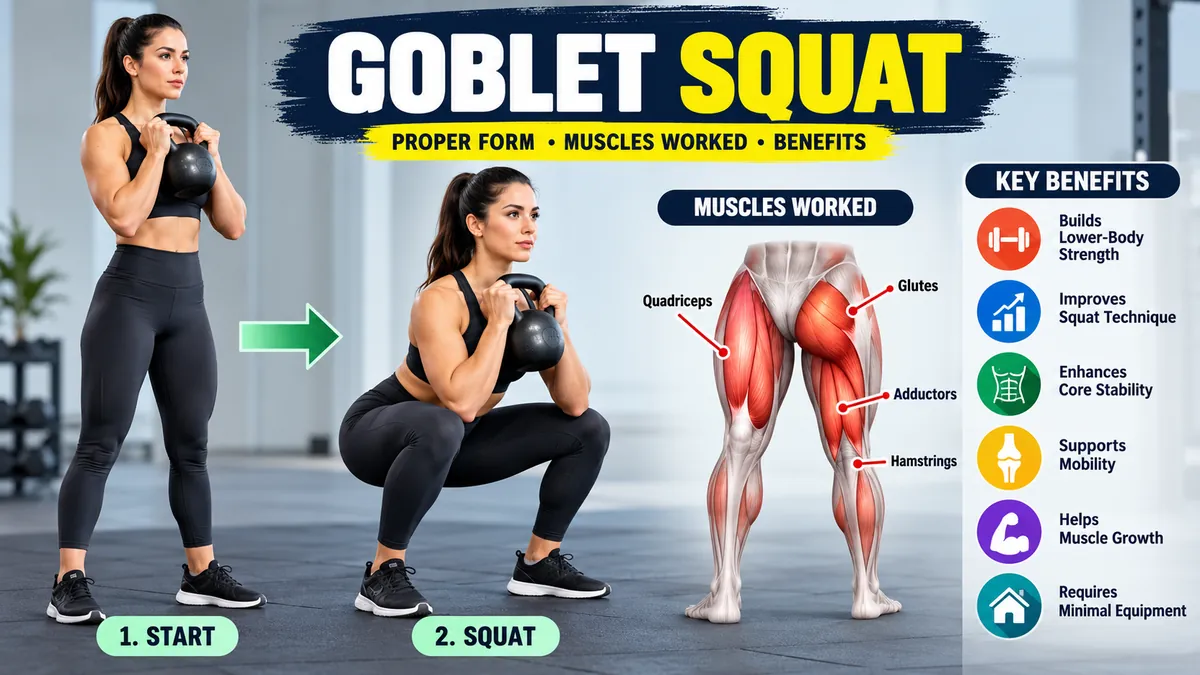
The goblet squat is one of the most accessible strength exercises for developing stronger legs, improving squat technique, and building confidence with resistance training. It requires minimal equipment, yet it can challenge several major muscle groups at once.
Unlike a traditional barbell squat, this movement places the weight in front of your chest, helping you maintain an upright torso while practicing a controlled squat.
A goblet squat is a lower-body strength exercise performed while holding a dumbbell or kettlebell close to your chest. You bend your hips and knees to lower into a squat, then push through your feet to stand. The exercise primarily trains the quadriceps and glutes while engaging the core, adductors, and upper back for stability.
What Is a goblet squat?
The goblet squat is a variation of the traditional squat in which a weight is held vertically or by its handles directly in front of the chest. Its name comes from the way the weight is held, resembling someone holding a large drinking goblet.
Strength coach Dan John is widely credited with popularizing the exercise as a practical way to teach squat mechanics.
The front-loaded position acts as a counterbalance. For some people, this makes it easier to squat with an upright torso and reach a comfortable depth without losing balance.
Unlike a back squat, where a barbell rests across the upper back, a goblet squat places the resistance in front of the body. This changes the balance demands and allows lifters to focus on movement quality without managing a heavy barbell.
Why is the goblet squat popular?
The exercise is commonly used in beginner strength programs, athletic conditioning, personal training, and home workouts because it offers several practical advantages.
- Requires only one dumbbell or kettlebell.
- Helps beginners learn squat movement patterns.
- Strengthens the quadriceps, glutes, and supporting muscles.
- Encourages core engagement and upper-body stability.
- Can be modified for different strength and mobility levels.
- Works well as a warm-up exercise or a primary lower-body movement.
Although it is beginner-friendly, experienced lifters also use it for higher-repetition training, technique practice, and accessory work.
How to Do a goblet squat With Proper Form
Learning the correct technique helps you train the intended muscles while reducing unnecessary stress on your joints.
Step 1: Choose and hold your weight
Select a dumbbell or kettlebell that you can control comfortably.
For a dumbbell goblet squat, hold one end of the dumbbell vertically with both hands beneath the upper weight plate.
For a kettlebell goblet squat, hold the kettlebell by the sides of its handle, keeping the bell close to your chest.
Keep your elbows pointed generally downward and your wrists in a comfortable, stable position.
Step 2: Establish your stance
Stand with your feet approximately shoulder-width apart.
Turn your toes slightly outward if that feels natural for your hip structure.
Keep your weight distributed across three main contact points of each foot: the heel, the base of the big toe, and the base of the little toe.
Your stance does not need to match someone else’s exactly. Hip anatomy, ankle mobility, and limb proportions influence the most comfortable squat position.
Step 3: Brace your core
Before descending, inhale and gently brace your abdominal muscles as though preparing for a light push against your stomach.
Keep your rib cage reasonably aligned over your pelvis.
Avoid excessively arching your lower back or pushing your chest upward.
The goal is to create a stable torso while allowing your hips, knees, and ankles to move naturally.
Step 4: Lower into the squat
Bend your knees and hips together.
Allow your knees to travel in the same general direction as your toes while keeping your feet planted.
Lower your body under control, maintaining the weight close to your chest.
Your knees may move past your toes. This is not automatically dangerous; comfortable knee travel is a normal part of many squat variations.
Continue descending until you reach a depth that allows you to maintain balance and control.
Step 5: Stand back up
Push through your whole foot to rise.
Extend your hips and knees together while keeping your torso stable.
Exhale as you move through the more demanding portion of the ascent.
Finish standing tall without leaning backward or excessively squeezing your glutes.
That completes one repetition.
Proper form checklist
| Movement component | Correct technique |
|---|---|
| Feet | Approximately shoulder-width, firmly planted |
| Knees | Track generally in the direction of the toes |
| Hips | Move downward between the legs |
| Back | Maintain a controlled, comfortable spinal position |
| Chest | Keep the weight close to the torso |
| Core | Brace throughout the repetition |
| Depth | Squat as low as comfortably controlled |
| Breathing | Inhale before lowering, exhale during ascent |
| Tempo | Lower and rise smoothly without bouncing |
A controlled repetition is more valuable than a deeper repetition that causes you to lose balance or spinal control.
What Muscles Does a goblet squat Work?
The goblet squat is a compound exercise, meaning several joints and muscle groups work together during each repetition.
Its primary emphasis is on the quadriceps and gluteal muscles, while other muscles contribute to movement control and stabilization.
NASM
+1
Primary muscles
Quadriceps
The quadriceps are located at the front of your thighs and consist of four muscles:
- Rectus femoris
- Vastus lateralis
- Vastus medialis
- Vastus intermedius
Their main role during the squat is to control knee bending on the way down and extend the knees as you stand.
Gluteus maximus
The gluteus maximus is the largest muscle of the buttocks. It contributes significantly to hip extension as you rise from the bottom position.
Squatting through a comfortable, substantial range of motion can increase the challenge placed on the glutes.
Secondary and stabilizing muscles
| Muscle group | Role during the exercise |
|---|---|
| Hamstrings | Assist with hip control and stabilization |
| Adductor magnus | Supports hip extension, particularly from deeper positions |
| Gluteus medius | Helps stabilize the hips and control knee movement |
| Rectus abdominis | Contributes to trunk stability |
| Transverse abdominis | Supports abdominal bracing |
| Obliques | Resist unwanted trunk movement |
| Erector spinae | Help maintain spinal position |
| Upper back and latissimus dorsi | Help stabilize the weight near the chest |
| Calves | Assist with ankle stability and balance |
The hamstrings participate in the movement, but they are not generally trained as directly as the quadriceps and glutes.
For more complete hamstring development, combine squats with hip-hinge exercises such as Romanian deadlifts.
Benefits of the goblet squat
The goblet squat offers advantages that extend beyond simply strengthening the legs.
1. Builds lower-body strength
Each repetition requires coordinated hip and knee extension, making the exercise useful for developing leg strength.
As you progressively increase the resistance or repetitions, the quadriceps and glutes adapt to the training demands.
These strength improvements can support everyday activities such as climbing stairs, standing from a chair, and lifting objects.
2. Helps improve squat technique
Holding a weight in front of your chest can make balancing during a squat easier.
This counterbalance often helps beginners maintain a more upright torso while learning how to bend their hips, knees, and ankles together.
The National Academy of Sports Medicine identifies the movement as a useful teaching exercise and progression toward more advanced squats.
NASM
3. Challenges core stability
Your abdominal and spinal stabilizing muscles must work to prevent excessive movement of the torso.
The weight’s position in front of your body increases the demand for maintaining a stable trunk.
Although goblet squats are not a replacement for every core exercise, they provide meaningful trunk-stability training.
4. Supports hip and ankle mobility
The exercise moves the hips, knees, and ankles through a coordinated range of motion.
When performed regularly with appropriate technique, it can help improve comfort and control within your available squat range.
However, it does not automatically correct every mobility restriction. Some individuals benefit from additional ankle mobility exercises or individualized movement modifications.
5. Can support muscle growth
Goblet squats can contribute to hypertrophy, particularly for beginners and intermediate trainees.
Muscle growth depends on factors such as resistance, effort, training volume, recovery, and nutrition.
A weight that makes the final few repetitions challenging while preserving technique is generally more useful for muscle development than one that feels effortless.
6. Requires minimal equipment
A single dumbbell or kettlebell is sufficient.
This makes the exercise practical for home workouts, small gyms, hotel fitness rooms, and strength programs with limited equipment.
7. Offers adjustable difficulty
You can change the resistance, tempo, depth, repetition count, and variation to suit your abilities.
A beginner might perform light repetitions with a controlled descent, while an experienced lifter might use heavier weights or pauses to increase difficulty.
Dumbbell vs. Kettlebell goblet squat
Both versions use the same fundamental squat movement. The main differences involve grip, weight distribution, and comfort.
| Feature | Dumbbell goblet squat | Kettlebell goblet squat |
|---|---|---|
| Equipment | One dumbbell | One kettlebell |
| Grip | Hands support one dumbbell end | Hands hold the kettlebell horns or bell |
| Weight position | Vertical, near the chest | Near the chest |
| Primary muscles | Quadriceps and glutes | Quadriceps and glutes |
| Core engagement | High | High |
| Beginner suitability | Excellent | Excellent |
| Main consideration | Comfortable dumbbell grip | Comfortable handle and wrist position |
Neither version is universally superior.
Choose the equipment that allows you to hold the resistance securely, maintain proper posture, and complete repetitions comfortably.
Common goblet squat Mistakes and How to Fix Them
Even a relatively simple movement can become less effective when technique deteriorates.
Allowing the knees to collapse inward
Some lifters allow their knees to move excessively inward during the ascent.
A small amount of natural knee movement is not necessarily harmful, but repeated uncontrolled collapse may indicate difficulty maintaining alignment under load.
How to fix it: Reduce the weight and practice keeping your knees moving generally in the direction of your toes. Focus on maintaining stable foot contact.
Lifting the heels off the floor
If your heels rise as you descend, you may lose stability or shift too much pressure toward the front of your feet.
Limited ankle dorsiflexion, stance selection, and balance can contribute.
How to fix it: Experiment with a slightly wider stance or modest toe turnout. Reduce squat depth temporarily and work on ankle mobility if needed.
A stable heel-elevated setup can also be useful for certain lifters, although it changes the mechanics of the exercise.
Holding the weight too far forward
When the dumbbell or kettlebell drifts away from the chest, the shoulders and lower back must work harder to stabilize it.
How to fix it: Keep the weight close to your upper torso throughout the movement. If your arms fatigue before your legs, consider reducing the resistance.
Rounding the lower back excessively
Some spinal movement is normal, but losing substantial control at the bottom of a loaded squat can make the position uncomfortable.
How to fix it: Squat only as deeply as you can maintain a stable, comfortable position. Adjust your stance, improve bracing, and avoid forcing extra depth.
Using too much weight
A heavy dumbbell can cause excessive forward leaning, poor balance, and shortened repetitions.
How to fix it: Choose a resistance that lets you complete your planned repetitions with consistent form.
Moving too quickly
Dropping rapidly into the bottom position and bouncing upward can make it harder to control the movement.
How to fix it: Try lowering over approximately two to three seconds, pausing briefly if comfortable, and rising smoothly.
These corrections are consistent with common technique issues identified in strength-training guidance.
RepBro
+1
How Many goblet squat Sets and Reps Should You Do?
The appropriate number of sets and repetitions depends on your experience, training objective, and available resistance.
| Training goal | Sets | Reps | Suggested rest |
|---|---|---|---|
| Learning technique | 2–3 | 8–10 | 60–90 seconds |
| General strength | 3–4 | 6–10 | 90–180 seconds |
| Muscle growth | 3–4 | 8–15 | 60–120 seconds |
| Muscular endurance | 2–3 | 15–20 | 45–90 seconds |
| Warm-up | 1–2 | 8–12 | As needed |
These are practical starting ranges rather than strict requirements. Your training effort and technique matter more than hitting an exact number.
What weight should beginners use?
Beginners should start with bodyweight squats if they cannot yet control the movement.
Once comfortable, they can introduce a light dumbbell or kettlebell.
For example, some adults may find a 4–8 kg weight manageable, while others need something lighter or can comfortably begin heavier.
There is no universal starting weight.
Choose a load that allows you to finish each set with approximately two or three technically sound repetitions still possible.
How often should you perform goblet squats?
For many beginners, two or three sessions per week on nonconsecutive days provide a reasonable starting point.
Recovery needs vary depending on training intensity, other leg exercises, sleep, and overall fitness.
If your legs remain significantly fatigued or sore, allow more recovery before repeating a challenging session.
How to progressively overload
Progressive overload means gradually increasing training demands as your strength improves.
You can apply it by:
- Increasing repetitions within your planned range.
- Adding a small amount of weight.
- Performing an additional set when appropriate.
- Improving your controlled range of motion.
- Introducing a brief pause near the bottom.
- Slowing the lowering phase without sacrificing technique.
For example, if you can comfortably perform three sets of 12 repetitions with an 8 kg dumbbell, you might increase the weight slightly and return to three sets of eight repetitions.
Progress gradually rather than increasing several training variables simultaneously.
Best goblet squat Variations
Different variations can help address strength limitations, movement preferences, and training goals.
Heel-elevated goblet squat
Place your heels on a stable, purpose-built wedge or suitable lifting surface.
The elevation reduces the ankle dorsiflexion required to reach certain squat depths and often allows a more upright torso.
This variation can emphasize the quadriceps, but the elevated surface must remain secure.
Pause goblet squat
Lower into a comfortable squat and pause for approximately two seconds before standing.
The pause removes some assistance from the natural rebound at the bottom, increasing the demand for muscular control.
This is useful for developing stability and confidence in the bottom position.
Tempo goblet squat
Perform the lowering phase slowly, such as three seconds down, followed by a controlled ascent.
A slower tempo increases time under tension and helps lifters become more aware of their movement.
Box goblet squat
Position a sturdy box or bench behind you.
Lower until you lightly touch the surface, then stand without relaxing completely or rocking backward.
The box provides a consistent depth reference and can be helpful for beginners learning controlled squatting.
Sumo goblet squat
Use a wider-than-normal stance with your toes turned outward to a comfortable degree.
This changes hip positioning and may alter the relative demands on the adductors and other lower-body muscles.
It is not inherently better than a standard stance; choose the variation that suits your anatomy and goals.
Goblet squat with a pulse
Lower into a squat, rise slightly, descend again, and then return to standing.
The extra movement increases local muscular effort.
Use a lighter weight and avoid bouncing at the bottom.
goblet squat vs. Other Squat Exercises
The goblet squat shares important characteristics with other squat variations, but load placement changes the demands on the body.
| Exercise | Weight placement | Main advantage | Main limitation |
|---|---|---|---|
| Goblet squat | In front of chest | Accessible technique and core training | Grip and upper-body holding capacity |
| Bodyweight squat | No external weight | Easy to learn anywhere | Limited resistance |
| Barbell back squat | Across upper back | High loading potential | Requires more equipment and technique |
| Barbell front squat | Front of shoulders | Upright torso and substantial leg loading | Requires rack-position mobility and skill |
| Bulgarian split squat | Bodyweight or external load | Unilateral leg strength | Greater balance demands |
Is a goblet squat better than a regular squat?
It depends on what you mean by regular squat.
Compared with a bodyweight squat, a goblet squat adds resistance and may help some people maintain balance.
Compared with a barbell back squat, it is usually easier to set up and learn but offers less potential for very heavy loading.
For beginners, the goblet squat is often an effective starting exercise. For advanced strength athletes, heavier barbell variations may be more appropriate for maximal strength development.
Can goblet squats replace barbell squats?
They can serve as a primary squat exercise for general fitness, especially when equipment is limited.
However, lifters focused on maximizing barbell squat strength will eventually need to practice heavier, more specific movements.
The goblet squat remains useful as an accessory exercise even after progressing to barbell training.
Are goblet squats Safe for Your Knees and Lower Back?
Goblet squats can be appropriate for many healthy adults when performed with manageable resistance and comfortable technique.
However, no exercise is entirely risk-free, and individual tolerance matters.
Are goblet squats bad for your knees?
Not inherently.
Squatting requires the knees to bend and tolerate load. This is a normal function of the joint.
Allowing the knees to move forward beyond the toes is not automatically a technique error. Restricting forward knee movement unnecessarily can shift additional demands toward the hips and torso.
The more useful priorities are controlled movement, comfortable joint positioning, appropriate loading, and gradual progression.
If you experience persistent knee pain, reduce the range or resistance and seek individualized guidance from a qualified healthcare professional.
Are goblet squats good for your lower back?
The front-loaded position often encourages a relatively upright torso, which can reduce certain spinal-loading demands compared with heavier squat variations.
However, the lower back still works to stabilize the trunk.
The exercise should not be considered a treatment for back pain, and it is not automatically suitable for every person with a spinal condition.
What if you cannot squat deeply?
Deep squatting is not a requirement for every individual.
Ankle mobility, hip anatomy, training history, and balance can all influence comfortable depth.
Start with a range that you can control. Gradually explore greater depth if it feels appropriate, rather than forcing your hips below your knees.
Sharp pain, joint instability, or symptoms that persist after training warrant professional assessment.
How to Add goblet squats to Your Workout Routine
The goblet squat can fit into full-body workouts, lower-body strength sessions, and home exercise programs.
For beginners, performing it early in the workout is often useful because your muscles and concentration are relatively fresh.
Example beginner lower-body workout
| Exercise | Sets | Repetitions |
|---|---|---|
| Goblet squat | 3 | 10 |
| Romanian deadlift | 3 | 10 |
| Reverse lunge | 2 | 8 per leg |
| Glute bridge | 3 | 12 |
| Standing calf raise | 2 | 15 |
Rest approximately 60–120 seconds between sets, extending the rest period if needed to maintain technique.
Begin with five minutes of easy movement and several unloaded practice squats.
Example home workout
If you have only one dumbbell, try the following simple full-body session:
| Exercise | Sets | Repetitions |
|---|---|---|
| Dumbbell goblet squat | 3 | 8–12 |
| One-arm dumbbell row | 3 | 10 per side |
| Dumbbell Romanian deadlift | 3 | 10 |
| Dumbbell floor press | 3 | 10 |
| Plank | 3 | 20–40 seconds |
Adjust the repetitions and resistance to your current abilities.
When should you progress beyond goblet squats?
You may benefit from introducing another squat variation when the weight you can comfortably hold at your chest no longer provides sufficient resistance for your legs.
For example, if your arms or grip consistently fatigue before your quadriceps and glutes, the goblet position may have become the limiting factor.
Possible progressions include double-dumbbell front squats, barbell front squats, back squats, or appropriately loaded split squats.
You do not need to abandon goblet squats completely. They can remain valuable for warm-ups, accessory work, and higher-repetition training.
Final Thoughts on the goblet squat
The goblet squat is a practical compound exercise for strengthening the quadriceps and glutes, developing core stability, and improving squat technique.
Its front-loaded position makes it especially useful for people learning to squat with resistance, while variations such as pause squats, heel-elevated squats, and tempo squats provide additional challenges as strength develops.
Start with a manageable weight, maintain stable foot contact, lower through a comfortable range of motion, and increase the difficulty gradually.
Consistent technique and progressive training matter more than lifting the heaviest dumbbell available.