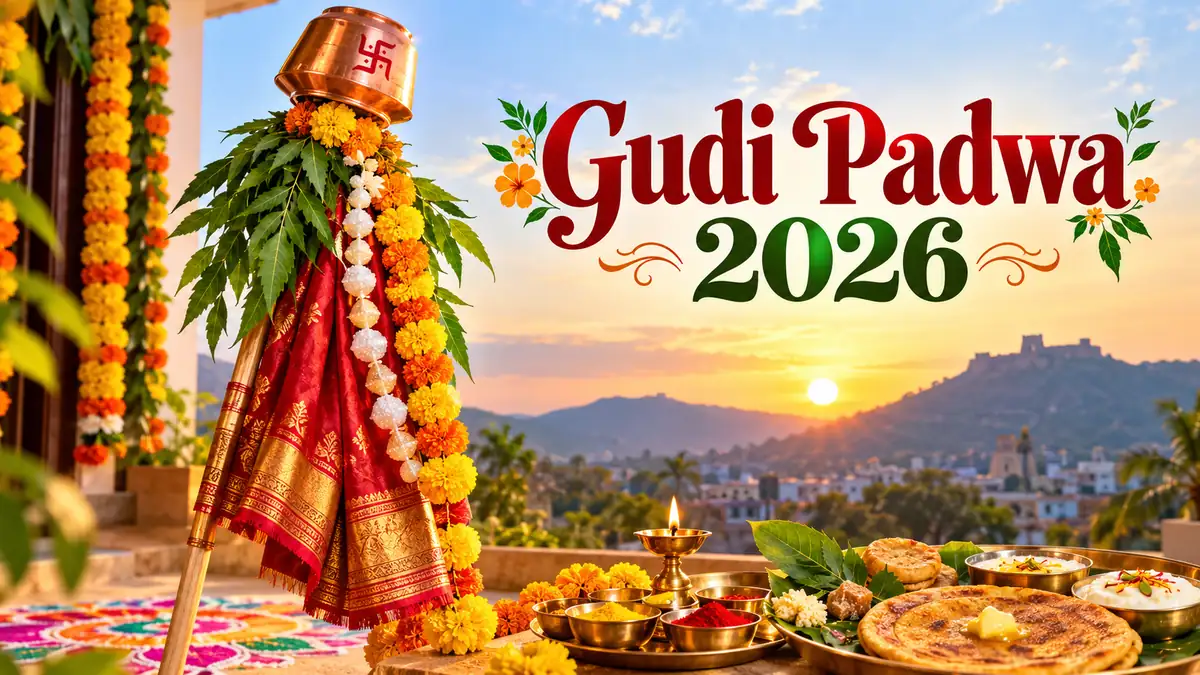
Gudi Padwa is one of Maharashtra’s most cherished festivals, marking the Marathi New Year with colorful decorations, traditional rituals, festive meals, and family gatherings. But what makes this celebration special, and why do families raise a decorated Gudi outside their homes?
gudi padwa 2026 was celebrated on Thursday, March 19, 2026. The festival marks Chaitra Shukla Pratipada, the beginning of the new year in the traditional Marathi lunisolar calendar. Celebrated primarily in Maharashtra and Goa, it represents prosperity, victory, renewal, and the arrival of spring. Its most recognizable tradition is hoisting a decorated Gudi outside the home.
When Was gudi padwa 2026 Celebrated?
Gudi Padwa fell on Thursday, March 19, 2026, coinciding with the beginning of Chaitra Navratri and the Ugadi New Year celebrations observed by Telugu and Kannada communities.
The festival’s date changes annually in the Gregorian calendar because it follows the Hindu lunisolar calendar rather than a fixed Western calendar date.
Gudi Padwa 2026 Date and Time
| Festival detail | Date and information |
|---|---|
| Festival | Gudi Padwa |
| Date | March 19, 2026 |
| Day | Thursday |
| Hindu lunar date | Chaitra Shukla Pratipada |
| Pratipada Tithi begins | March 19, 6:52 AM IST |
| Pratipada Tithi ends | March 20, 4:52 AM IST |
| Marathi Shaka Samvat | 1948 begins |
| Main celebration | Gudi Puja and Gudi hoisting |
| Next Gudi Padwa | April 7, 2027 |
The Pratipada timings above are commonly published Indian calendar timings. Local observance and auspicious periods can vary according to location and the Panchang followed by a household.
Why Does the Gudi Padwa Date Change Every Year?
Gudi Padwa follows the Hindu lunisolar calendar, which uses lunar phases alongside solar calculations.
The festival occurs on the first day of the waxing lunar fortnight, known as Shukla Paksha, in the month of Chaitra.
Because lunar months do not align perfectly with Gregorian months, Gudi Padwa usually falls in March or April.
In 2025, the festival occurred on March 30. In 2026, it occurred on March 19, while the 2027 celebration falls on April 7.
gudi padwa 2026 Puja Muhurat and Auspicious Timings
Gudi Padwa is traditionally considered an auspicious occasion for prayers, family celebrations, and meaningful new beginnings.
Many Maharashtrian households perform Gudi Puja in the morning after bathing, cleaning their homes, and preparing the decorated Gudi.
What Was the Shubh Muhurat for Gudi Padwa 2026?
The festival’s Pratipada Tithi began at approximately 6:52 AM IST on March 19 and continued until the early morning of March 20.
For New Delhi, one published Panchang listed the Abhijit Muhurat as 12:05 PM to 12:53 PM on March 19. This was a general auspicious period, not a universal or mandatory Gudi hoisting time.
Morning worship is customary, but the exact preferred time depends on local sunrise, regional traditions, and family practices.
tithi timings and vidhi · Panchangya
+1
Is Gudi Padwa an Auspicious Day to Start Something New?
Traditionally, Gudi Padwa is regarded as a favorable day for beginning a new chapter in life.
Families may choose the occasion to move into a home, begin a business venture, start educational activities, or make important personal commitments.
The belief comes from the festival’s association with renewal, prosperity, and the start of a fresh calendar year.
However, those following detailed astrological practices may still consult a local Panchang for a specific activity.
What Is Gudi Padwa and Why Is It Celebrated?
Gudi Padwa, also written as Gudhi Padwa or Gudhi Padva, is a springtime Hindu festival marking the traditional New Year for Marathi and many Konkani Hindu communities.
The name combines two meaningful terms:
- Gudi: A decorated flag-like structure raised as a symbol of victory and good fortune.
- Padwa: Derived from Pratipada, the first lunar day of a fortnight.
Together, the name refers to a celebration of the first day of the new lunar year, represented by the raising of the Gudi.
The festival is particularly important in Maharashtra, where families observe it through household worship, traditional clothing, festive foods, and community celebrations.
The Spiritual Meaning of Gudi Padwa
Gudi Padwa represents the belief that every new beginning offers an opportunity for positive change.
Its central themes include prosperity, happiness, spiritual renewal, gratitude, and the triumph of good over evil.
The festival also reflects the relationship between religious traditions and seasonal changes.
For agricultural communities, the arrival of spring and the end of the Rabi crop season connect the celebration with harvest, abundance, and hope for the coming year.
Maharashtra’s Department of Tourism recognizes both the cultural importance and agricultural significance of the festival.
History and Mythological Significance of Gudi Padwa
Gudi Padwa is associated with several Hindu religious narratives and regional historical traditions.
These stories contribute to the festival’s cultural meaning, although mythological accounts should be understood as religious beliefs rather than independently established historical events.
Lord Brahma and the Creation of the Universe
According to Hindu tradition, Gudi Padwa is associated with Lord Brahma, the deity connected with creation.
A widely held belief identifies the beginning of the new year with Brahma’s creation of the universe and the commencement of cosmic time.
This association makes the festival a symbol of creation, renewal, and the beginning of a new cycle.
Lord Rama’s Return to Ayodhya
Another traditional explanation connects Gudi Padwa with Lord Rama’s victory over Ravana.
Some accounts associate the festival with Rama’s return to Ayodhya and his coronation after completing his exile.
In this interpretation, the Gudi represents a victory banner celebrating righteousness and the defeat of evil.
King Shalivahana and the Shaka Calendar
Regional traditions also connect the festival with the legendary victory of King Shalivahana.
According to popular accounts, flags were raised to celebrate his triumph and return to Paithan, an ancient settlement in present-day Maharashtra.
The festival is also associated with the Shalivahana Shaka calendar used in traditional regional timekeeping.
The Shaka era and the stories surrounding Shalivahana are related in cultural tradition, but the legendary narrative should not be treated as a fully verified account of the calendar’s historical origin.
Chhatrapati Shivaji Maharaj and the Victory Tradition
Some popular accounts associate the raising of the Gudi with the military victories and legacy of Chhatrapati Shivaji Maharaj.
The Gudi’s appearance as a victory banner makes this connection especially meaningful in Maharashtrian cultural storytelling.
However, Gudi Padwa predates the Maratha Empire, and the claim that Shivaji Maharaj originated the custom is not established historical fact.
These different interpretations illustrate how the festival brings together religious belief, regional identity, and traditions of victory.
How Is Gudi Padwa Celebrated in Maharashtra?
The celebration generally begins early in the morning, with families preparing their homes for the New Year.
Although individual customs vary, the main traditions are remarkably consistent across many Maharashtrian households.
Cleaning Homes and Creating Rangoli
Families clean their homes and decorate entrances with colorful rangoli designs.
Traditional patterns may feature flowers, geometric shapes, diyas, and auspicious symbols.
Fresh mango-leaf torans are often placed above doorways as part of the festive decorations.
These preparations symbolize welcoming prosperity and beginning the year in a clean, positive environment.
Wearing Traditional Maharashtrian Clothes
Many women wear traditional sarees, including Paithani and Nauvari styles, accompanied by jewelry and festive accessories.
Men may wear a kurta-pajama, dhoti-kurta, or traditional Maharashtrian headwear such as a pheta.
Bright colors and festive attire contribute to the atmosphere of celebration.
Raising the Gudi Outside the Home
The most distinctive ritual is installing the Gudi near the entrance, window, balcony, or another prominent part of the home.
The decorated structure is traditionally raised high so that it remains visible.
Families offer prayers to the Gudi, treating it as a sacred symbol of victory, protection, and good fortune.
Visiting Temples and Meeting Relatives
Many devotees visit temples to offer prayers and seek blessings for the coming year.
Families also exchange greetings, share sweets, and gather for festive meals.
In some towns and cities, community groups organize processions, music, traditional performances, and cultural programs.
These activities help preserve regional customs while bringing different generations together.
How to Prepare and Hoist a Gudi at Home
Preparing a traditional Gudi is one of the most meaningful parts of the celebration. The process combines decorative materials with symbols of prosperity, victory, and protection.
Materials Required for Gudi Decoration
A traditional Gudi generally includes:
- A long, clean bamboo stick
- A bright silk cloth or traditional saree fabric
- Fresh neem leaves and mango leaves
- A garland of flowers, often marigolds
- A sugar-crystal garland known as gathi
- An inverted copper, silver, or brass kalash
- Turmeric, kumkum, rice, and flowers for worship
The precise materials and decorative styles differ between households.
Step-by-Step Gudi Hoisting Ritual
- Clean the worship area. Prepare the entrance, balcony, or other designated location before beginning the ceremony.
- Prepare the bamboo stick. Select a sturdy pole and wipe it clean.
- Tie the decorative cloth. Wrap a colorful silk cloth securely near the upper end of the bamboo.
- Attach leaves and garlands. Add neem leaves, mango leaves, flowers, and the traditional sugar garland.
- Place the kalash. Position an inverted metal pot at the top of the decorated bamboo.
- Raise the Gudi. Install the structure securely in an upright position, traditionally near the main entrance.
- Perform Gudi Puja. Offer flowers, turmeric, kumkum, incense, and prayers according to family custom.
- Offer naivedya. Present traditional food or sweets as part of the worship.
The Gudi is usually displayed during the day and respectfully taken down later, according to household tradition.
What Does Each Part of the Gudi Symbolize?
| Gudi component | Traditional significance |
|---|---|
| Bamboo pole | Strength and stability |
| Silk cloth | Celebration and auspiciousness |
| Inverted kalash | Victory and prosperity |
| Neem leaves | Purification and resilience |
| Mango leaves | Fresh beginnings and abundance |
| Flower garland | Joy, devotion, and celebration |
| Sugar garland | Sweetness and happiness |
These interpretations are traditional and may differ between communities.
For households living in apartments, a Gudi can be installed on a balcony or near a window. The structure should be firmly secured and kept away from electrical wires or locations where it could fall.
Traditional Gudi Padwa Foods and Their Meanings
Food plays an essential role in Gudi Padwa celebrations. Families prepare traditional Maharashtrian dishes that reflect hospitality, prosperity, and the enjoyment of seasonal ingredients.
Some recipes are closely associated with the festival, while others are popular across Maharashtra during religious and family celebrations.
Puran Poli
Puran Poli is among the best-known Maharashtrian festive foods.
It is a sweet flatbread made with a filling of cooked lentils, jaggery, and aromatic spices such as cardamom.
The filling is enclosed in dough, rolled into a flatbread, and cooked on a hot griddle.
It is commonly served with ghee and sometimes accompanied by milk or traditional savory dishes.
Shrikhand and Puri
Shrikhand is a creamy dessert prepared from strained yogurt, sugar, and flavorings such as cardamom or saffron.
It is often garnished with nuts and served with freshly prepared puris.
The combination is popular during festive meals and family gatherings.
Neem and Jaggery Mixture
One of the most symbolic food traditions involves consuming a small mixture of neem leaves and jaggery.
Neem contributes bitterness, while jaggery adds sweetness.
Together, they represent the idea that life contains both pleasant and difficult experiences.
The custom encourages acceptance, balance, and resilience as a new year begins.
Neem should be used only in customary food quantities where appropriate; concentrated neem preparations are not suitable for everyone, particularly during pregnancy.
Other Popular Festive Dishes
Maharashtrian families may also prepare basundi, batata bhaji, varan-bhaat, and other regional specialties.
Basundi is a rich milk-based dessert often flavored with cardamom and garnished with nuts.
Varan-bhaat, a comforting combination of dal and rice, may accompany a larger festive meal.
The Maharashtra Tourism Department identifies Puran Poli, Shrikhand, neem with jaggery, and Basundi among the traditional foods associated with the celebration.
Gudi Padwa, Ugadi, and Other Regional New Year Festivals
Gudi Padwa is part of a wider tradition of regional New Year celebrations across India.
Several communities observe the beginning of the Hindu lunisolar year around the same period, although their customs, languages, and ceremonial practices differ.
Is Gudi Padwa the Same as Ugadi?
Gudi Padwa and Ugadi occur on the same lunar calendar date, Chaitra Shukla Pratipada.
However, they are not identical in their cultural expression.
| Feature | Gudi Padwa | Ugadi |
|---|---|---|
| Main regions | Maharashtra and Goa | Karnataka, Andhra Pradesh, Telangana |
| Primary communities | Marathi and Konkani Hindus | Kannada and Telugu Hindus |
| Calendar occasion | Chaitra New Year | Chaitra New Year |
| Main tradition | Raising a decorated Gudi | Preparing Ugadi Pachadi and hearing the Panchanga |
| Symbolic food | Neem and jaggery | Ugadi Pachadi |
| 2026 date | March 19 | March 19 |
Ugadi Pachadi combines different tastes to represent the variety of experiences that life brings.
The dish commonly includes ingredients such as neem flowers, jaggery, tamarind, raw mango, salt, and a spicy component.
Both festivals emphasize renewal, gratitude, and hope for the year ahead.
How Is Gudi Padwa Related to Chaitra Navratri?
In 2026, Gudi Padwa coincided with the beginning of Chaitra Navratri.
Chaitra Navratri is a nine-night Hindu festival dedicated to the worship of Goddess Durga and her various forms.
While Gudi Padwa focuses on the Marathi New Year and Gudi worship, Chaitra Navratri follows its own devotional traditions.
Some households observe both occasions, incorporating their respective rituals into the same day.
What About Cheti Chand and Navreh?
Cheti Chand is the traditional New Year festival associated with the Sindhi community and devotion to Jhulelal. Its observance is closely connected with the beginning of Chaitra, though the exact civil date can differ according to tradition.
Navreh marks the Kashmiri Pandit New Year and also follows the traditional lunar calendar.
These celebrations share themes of renewal and cultural identity, but each retains distinct customs.
Gudi Padwa Celebrations in Mumbai, Pune, and Goa
Although Gudi Padwa is observed throughout Maharashtra, regional celebrations give the festival different expressions.
Mumbai: Community Processions and Traditional Dress
In Mumbai, many families begin the festival with Gudi Puja at home before joining community celebrations.
Some neighborhoods organize colorful processions featuring traditional clothing, music, and cultural performances.
Women dressed in Nauvari sarees and participants wearing traditional headwear contribute to the festive atmosphere.
Dombivli and other parts of the Mumbai metropolitan region are known for public celebrations of the Marathi New Year.
Pune: Cultural Heritage and Family Traditions
Pune’s strong association with Maharashtrian history and culture makes Gudi Padwa an important occasion for family and community gatherings.
Households decorate entrances with rangoli, raise the Gudi, prepare festive meals, and exchange New Year greetings.
Cultural organizations may also arrange traditional music, processions, or educational activities centered on regional heritage.
Goa: Konkani New Year Traditions
In Goa, the festival is also celebrated by Konkani Hindu communities.
It is commonly known as Samvatsar Padvo or related regional forms of the name.
Families perform household worship, prepare traditional dishes, and observe customs connected with the new year.
Although celebrations differ from those in Maharashtra, the underlying themes of prosperity and renewal remain similar.
Gudi Padwa 2026 Holiday and Public Observance
Gudi Padwa is an important regional holiday, particularly in Maharashtra.
Schools, government offices, and some businesses may remain closed depending on the official state holiday calendar and institutional policies.
Was Gudi Padwa 2026 a Bank Holiday?
Gudi Padwa was observed as a regional bank holiday in Maharashtra on March 19, 2026.
However, bank holidays in India vary by state and the applicable Reserve Bank of India holiday schedule.
A holiday in Maharashtra does not automatically mean that banks throughout India are closed.
Digital banking services such as online transfers and mobile banking may remain available even when physical branches are closed.
Is Gudi Padwa a National Holiday in India?
Gudi Padwa is not a nationwide compulsory public holiday.
Its official recognition varies across states and institutions.
In Maharashtra, it holds particular importance as the traditional Marathi New Year, while other states may observe Ugadi or related festivals according to their regional calendars.
Gudi Padwa Wishes and Traditional Greetings
Exchanging greetings is a familiar part of the festival. Families and friends share wishes for happiness, health, peace, and prosperity.
One of the most recognizable Marathi greetings is:
“गुढी पाडव्याच्या हार्दिक शुभेच्छा!”
It means “Heartfelt wishes for Gudi Padwa!”
Other meaningful greetings include:
- May the Marathi New Year bring happiness, good health, and prosperity to your family.
- Wishing you a joyful Gudi Padwa filled with peace and new opportunities.
- May the coming year bring wisdom, success, and harmony into your home.
- Happy Gudi Padwa! May every new beginning bring renewed hope and happiness.
These messages reflect the festival’s emphasis on family relationships, gratitude, and optimism.
Cultural Importance of Gudi Padwa in Modern India
Gudi Padwa continues to hold cultural importance beyond its religious ceremonies.
For many Maharashtrian families, it provides an opportunity to preserve traditions, connect younger generations with regional heritage, and celebrate a shared cultural identity.
Preserving Maharashtrian Heritage
Traditional clothing, music, rangoli, household worship, and festive recipes help maintain customs passed down through generations.
Children often learn about the festival by helping decorate the Gudi, preparing rangoli, or participating in family rituals.
These activities give cultural traditions a practical place in everyday family life.
Celebrating New Beginnings
The festival also encourages reflection on the previous year and the setting of personal goals.
Some families mark the occasion by beginning a new project, organizing their homes, or making commitments related to education, work, or family life.
The symbolic raising of the Gudi reinforces the idea of approaching the coming year with confidence and hope.
Gudi Padwa Celebrations Outside India
Marathi and Konkani communities living abroad also celebrate Gudi Padwa.
Families may arrange home worship, cultural gatherings, traditional meals, and community events.
For people living away from Maharashtra, these celebrations provide an opportunity to maintain cultural connections and introduce younger generations to their heritage.
Local lunar-calendar calculations can differ from those used in India, so families observing the festival abroad may consult a Panchang appropriate to their location.
Gudi Padwa 2026 and the Marathi Calendar
The Marathi calendar follows a traditional lunisolar system in which lunar months and solar movements contribute to calendar calculations.
Gudi Padwa begins the month of Chaitra and the new year in the Marathi Shaka calendar.
Which Marathi Year Began on Gudi Padwa 2026?
Gudi Padwa on March 19, 2026, marked the beginning of Shaka Samvat 1948 in the Marathi calendar.
The Shaka year differs numerically from the Gregorian year because the two systems use different starting epochs.
It also differs from Vikram Samvat, another traditional Indian calendar era.
The beginning of a Shaka year should therefore not be confused with the beginning of a Vikram Samvat year, even when communities celebrate their New Year around the same lunar date.
When Is the Next Gudi Padwa After 2026?
The next Gudi Padwa falls on Wednesday, April 7, 2027, according to commonly published Hindu festival calendars.
The interval between the two festivals reflects the adjustment of the lunisolar calendar, including the relationship between lunar months and the solar year.
For exact ritual timings, the relevant local Panchang should be consulted closer to the celebration.
Conclusion
gudi padwa 2026 was celebrated on Thursday, March 19, marking the beginning of Shaka Samvat 1948 and the traditional Marathi New Year.
From raising the decorated Gudi and performing morning prayers to preparing Puran Poli and sharing festive greetings, the celebration brings together spirituality, family traditions, and Maharashtrian cultural heritage.
Its enduring message is one of renewal, prosperity, gratitude, and the courage to welcome both the opportunities and challenges of a new year. Understanding the festival’s date, symbolism, and customs offers a deeper appreciation of why Gudi Padwa remains such an important occasion for Marathi and Konkani communities.