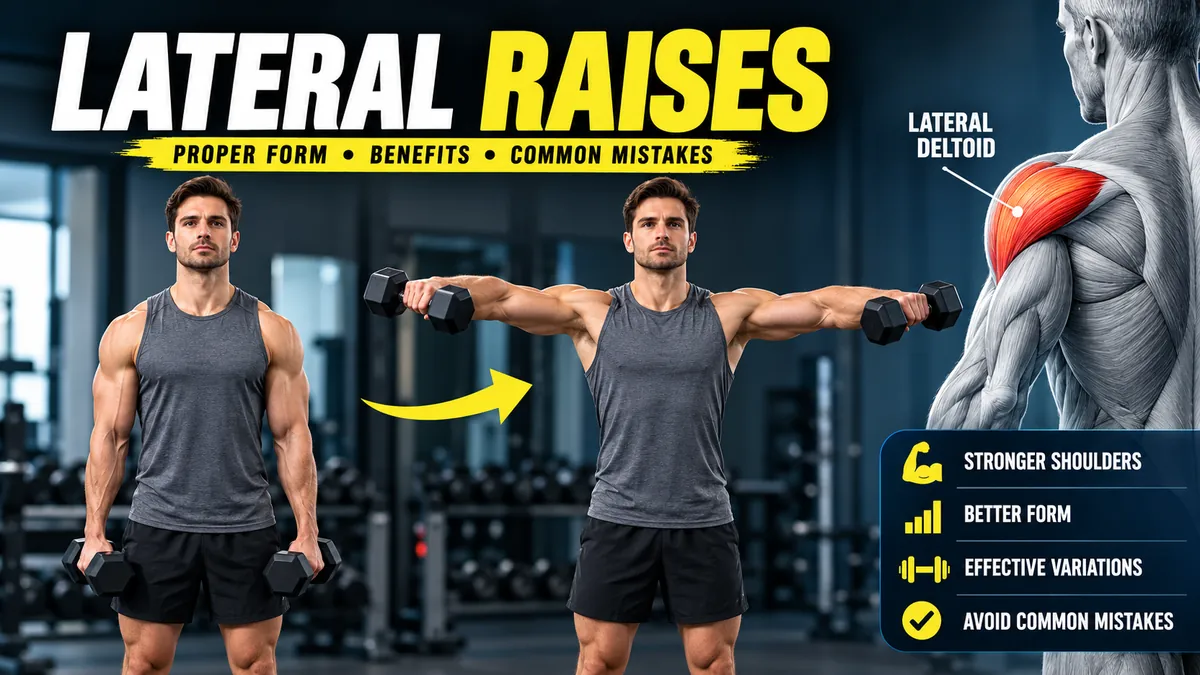
Building broader, stronger shoulders takes more than overhead pressing. One of the most effective ways to target the muscles responsible for shoulder width is through lateral raises.
This exercise looks simple: lift your arms out to the sides and lower them again. Yet small differences in elbow position, lifting angle, weight selection, and movement control can significantly affect how your shoulders respond.
Lateral raises are a shoulder isolation exercise that primarily targets the lateral deltoids, the muscles on the outer sides of your shoulders. They involve lifting dumbbells, cables, or other resistance outward from your body to approximately shoulder height. When performed with controlled technique, they help develop shoulder width, muscular strength, and balanced upper-body development.
Understanding how the exercise works makes it easier to train effectively without relying on momentum or unnecessarily heavy weights.
What Are lateral raises?
Lateral raises, also called side lateral raises or dumbbell side raises, are a resistance-training exercise designed to strengthen the shoulder muscles through arm abduction.
Shoulder abduction occurs when you move your upper arm away from the midline of your body. During a lateral raise, the deltoid muscles generate much of the force required to lift your arms against gravity or another form of resistance.
Unlike compound exercises such as the overhead press, lateral raises involve relatively little movement at the elbow. This makes them particularly useful for emphasizing the lateral deltoid.
Muscles Worked During Lateral Raises

Shoulder anatomy: the lateral deltoid contributes to the rounded appearance and width of the shoulders.
The shoulder contains three major regions of the deltoid muscle.
| Muscle | Role during the exercise |
|---|---|
| Lateral deltoid | Primary target; raises the arm outward |
| Anterior deltoid | Assists with arm elevation and stabilization |
| Posterior deltoid | Helps control and stabilize shoulder movement |
| Supraspinatus | Assists shoulder abduction |
| Upper trapezius | Helps rotate and stabilize the shoulder blade |
| Serratus anterior | Supports upward rotation of the scapula |
The lateral deltoid is especially important for creating the appearance of broader shoulders.
However, the trapezius and serratus anterior also contribute to normal shoulder-blade movement. Their involvement is not automatically a sign of poor technique.
Why Lateral Deltoids Matter
The lateral deltoid is sometimes called the middle or side delt. Developing this region contributes to the rounded shoulder appearance associated with a well-developed upper body.
Overhead presses train the deltoids, but they also heavily involve the anterior deltoids and triceps.
Lateral raises provide a more direct way to emphasize the side delts without requiring the same overall loading as heavy pressing exercises.
How to Do lateral raises With Proper Form

Dumbbell lateral raise: lift the arms outward to approximately shoulder height while maintaining a slight bend in the elbows.
Correct technique involves controlled movement, stable positioning, and an appropriate range of motion.
Step-by-Step Dumbbell Lateral Raise
- Choose light dumbbells. Select a weight you can lift without swinging or leaning backward.
- Stand upright. Position your feet approximately hip-width apart with your knees slightly bent.
- Hold the weights at your sides. Keep your palms facing inward and your elbows slightly bent.
- Brace your torso. Maintain a neutral spine and avoid excessive arching of the lower back.
- Raise your arms outward. Lift the dumbbells in a comfortable path, slightly forward of a perfectly straight side-to-side position if preferred.
- Stop around shoulder height. Your upper arms should reach approximately parallel to the floor, provided this range is comfortable.
- Lower slowly. Return the weights to the starting position without dropping them.
- Repeat with control. Keep the movement consistent throughout the set.
A useful starting tempo is approximately two seconds lifting and two to three seconds lowering.
This is a technique guideline, not a requirement for muscle growth.
Should Your Arms Be Completely Straight?
No. A slight elbow bend is generally more comfortable and makes the exercise easier to control.
Straightening the arms completely increases the distance between the weight and the shoulder joint, increasing the external torque.
A small, consistent bend can reduce the effective lever length.
Avoid turning the exercise into a bent-arm lifting movement by changing your elbow angle substantially during each repetition.
How High Should You Lift?
For most people, lifting until the upper arms reach approximately shoulder height provides a practical range of motion.
Raising the arms higher is not inherently dangerous, but it changes shoulder mechanics and increases the contribution of scapular upward rotation.
Your individual shoulder mobility, anatomy, comfort, and training goals should determine the appropriate range.
If raising your arms causes pinching or sharp pain, reduce the range and reassess your technique rather than forcing the movement.
Should Your Palms Face Down?
A neutral or slightly forward-oriented hand position is often comfortable.
Avoid deliberately rotating your thumbs sharply downward into a pronounced internally rotated position if that produces discomfort.
There is no single hand position that works best for every shoulder.
Benefits of lateral raises for Shoulder Development
Lateral raises are useful for beginners and experienced lifters because they train a specific movement pattern that complements pressing and pulling exercises.
1. Develop Wider-Looking Shoulders
The lateral deltoid contributes significantly to shoulder width.
Increasing the muscle’s size through progressive resistance training can create a broader upper-body appearance.
Actual changes depend on training consistency, genetics, nutrition, recovery, and total training volume.
2. Improve Deltoid Hypertrophy
Muscle hypertrophy refers to an increase in muscle size.
Lateral raises expose the side deltoids to mechanical tension, one of the major stimuli involved in muscle growth.
Because they isolate shoulder abduction more directly than many compound exercises, they can provide useful additional training volume for this region.
3. Complement Compound Shoulder Exercises
Exercises such as overhead presses, push-ups, and bench presses involve the shoulders but distribute the workload across several muscles.
Lateral raises can supplement those movements by emphasizing the middle deltoid.
A balanced shoulder program may include pressing, lateral raises, and rear-delt exercises rather than relying exclusively on one movement.
4. Require Minimal Equipment
Dumbbell lateral raises need only a pair of weights.
Resistance bands, cable machines, and dedicated lateral raise machines provide alternatives.
This makes the exercise adaptable to home workouts, commercial gyms, and limited-equipment training environments.
5. Support Shoulder Strength and Control
Controlled lateral raises strengthen muscles involved in arm elevation.
They can also help you practice maintaining stable torso positioning while moving the arms independently.
However, lateral raises alone do not guarantee improved shoulder stability or prevent injuries. Shoulder health depends on a broader combination of strength, mobility, load management, and individual factors.
Dumbbell vs Cable lateral raises
Both dumbbells and cables can train the lateral deltoids effectively, but their resistance profiles differ.

Dumbbell lateral raise

Cable lateral raise
| Feature | Dumbbells | Cables |
|---|---|---|
| Resistance source | Gravity | Cable tension |
| Resistance profile | Usually greater torque near shoulder height | Depends on cable angle and position |
| Equipment | Dumbbells | Cable machine |
| Setup | Simple | Requires pulley adjustment |
| Unilateral training | Possible | Particularly convenient |
| Best use | Accessible general training | Adjustable resistance angles |
Dumbbell Lateral Raises
With dumbbells, the external torque around the shoulder is generally small when the weights hang directly below the shoulder joint.
As the arms rise, the horizontal distance between the weights and the shoulder increases.
This typically makes the exercise feel more challenging near the top.
Dumbbells are practical because they are widely available and require little setup.
Cable Lateral Raises
Cable machines allow resistance to be applied from different directions.
Depending on where the pulley is positioned and how you stand, a cable can provide meaningful resistance earlier in the lifting motion.
A low-pulley cable raise may feel different from a dumbbell raise even when the target muscle is the same.
Neither variation is universally superior for hypertrophy. Appropriate effort, range of motion, progression, and training consistency matter more than choosing one implement exclusively.
Which Variation Builds More Muscle?
Both can support side-delt growth when performed with sufficient training effort and appropriate volume.
Cable lateral raises may be particularly useful when you want to change the resistance profile or perform single-arm sets.
Dumbbells are an excellent choice when convenience and simplicity matter.
Using both variations across a training program is reasonable, but not necessary.
A 2025 study involving 24 resistance-trained participants compared dumbbell and cable lateral raises over eight weeks. Both approaches increased lateral deltoid muscle thickness by approximately 3.3%–4.6%, with no clear advantage for either variation.
PubMed
+1
Best lateral raises Variations
Different variations allow you to modify body position, equipment, stability, and resistance.
Seated Lateral Raises

Seated lateral raises involve sitting upright on a bench while lifting dumbbells outward.
The seated position can make it easier to minimize lower-body momentum.
It is particularly useful for people who tend to swing their torso during standing repetitions.
Keep your feet firmly planted and avoid leaning backward to lift heavier weights.
Single-Arm Cable Lateral Raises

Single-arm cable lateral raises train one shoulder at a time.
This variation makes it easier to focus on the movement of each arm independently.
It can also help you identify differences in strength or coordination between sides.
Adjust your distance from the pulley until the resistance feels comfortable throughout the movement.
Leaning Lateral Raises
Leaning lateral raises involve holding a stable support with one hand while positioning your torso at an angle.
The altered body position changes the resistance curve of the exercise.
Depending on the setup, the movement can emphasize different portions of the range of motion.
Start with a lighter weight than you would normally use and maintain control throughout the repetition.
Machine Lateral Raises

Dedicated lateral raise machines guide the arms through a predetermined path.
They can reduce the need to balance free weights and may allow users to concentrate on controlled shoulder abduction.
However, machine designs differ, and not every machine will fit every person’s shoulder structure comfortably.
Adjust the seat and arm pads so that the machine’s movement aligns naturally with your shoulders.
Resistance Band Lateral Raises
Resistance bands provide a portable alternative to dumbbells.
Stand on the band, hold the handles or ends, and raise your arms outward.
Band resistance generally increases as the band stretches, although the exact resistance depends on the setup.
This variation works well for home workouts and situations where gym equipment is unavailable.
Common lateral raises Mistakes and How to Fix Them
Small technique problems can reduce movement consistency or create unnecessary strain.
| Common mistake | Why it matters | Correction |
|---|---|---|
| Swinging the weights | Uses momentum rather than controlled muscular effort | Reduce the weight and stabilize your torso |
| Shrugging excessively | Changes the movement and may create neck tension | Allow natural scapular movement without deliberately shrugging |
| Lifting too heavy | Makes consistent technique difficult | Choose a manageable load |
| Bending the elbows excessively | Shortens the lever and changes the exercise | Maintain a consistent slight bend |
| Dropping the weights | Reduces control during the lowering phase | Lower deliberately |
| Forcing a painful range | May aggravate an irritated shoulder | Adjust the movement or stop |
| Arching the lower back | Adds unnecessary torso movement | Brace your core and maintain a stable posture |
Why Do You Feel Lateral Raises in Your Traps?
The upper trapezius naturally participates in raising and rotating the shoulder blade.
Therefore, some trapezius activity is expected during lateral raises.
If your neck feels unusually tense or you are deliberately shrugging the dumbbells upward, try reducing the weight and concentrating on smooth arm movement.
You cannot completely isolate the lateral deltoid from every supporting muscle.
Why Do Lateral Raises Hurt Your Shoulders?
Shoulder discomfort can occur for several reasons, including excessive loading, unsuitable movement angles, fatigue, or an underlying shoulder condition.
Muscular effort and fatigue are different from sharp joint pain.
If you experience pinching, catching, or sharp pain:
- Stop the painful movement.
- Try a lighter load and a comfortable arm path.
- Avoid forcing the arms higher.
- Consider an alternative exercise if symptoms persist.
Persistent pain, weakness, or reduced shoulder movement warrants assessment by a qualified healthcare professional.
How Many Sets and Reps of lateral raises Should You Do?
The ideal number of repetitions depends on your experience, training goals, recovery, and the rest of your workout.
Lateral raises generally work well with moderate or relatively high repetitions because lighter loads allow greater control.
| Training level | Sets per session | Repetitions | Weekly frequency |
|---|---|---|---|
| Beginner | 2–3 | 10–15 | 1–2 sessions |
| Intermediate | 3–4 | 10–20 | 2 sessions |
| Advanced | 3–5 | 12–20 | 2–3 sessions |
These are practical starting guidelines, not mandatory targets. Total shoulder training volume should account for pressing and other exercises already in your program.
How Heavy Should Lateral Raises Be?
Choose a weight that allows you to complete the intended repetitions with consistent technique.
For example, if your target is 15 repetitions, the final few repetitions should feel challenging without requiring torso swinging.
There is no universal dumbbell weight for men or women. Strength varies with training history, body size, technique, and individual capability.
A useful approach is to begin conservatively and increase resistance only when you can control the movement.
How Close to Failure Should You Train?
Muscular failure occurs when you cannot complete another repetition with the required technique.
For many sets, finishing with approximately one to three repetitions in reserve provides a practical balance between training effort and fatigue.
Training to failure is not necessary on every set.
Beginners may benefit from leaving more repetitions in reserve while learning the movement.
How Long Should You Rest?
Approximately 60–120 seconds between sets is a reasonable starting point.
If your performance drops sharply because you are still fatigued, increase the rest period.
Resting long enough to maintain good technique is more useful than following an unnecessarily short interval.
How to Progress With lateral raises
Progressive overload means gradually increasing the training challenge as your strength and work capacity improve.
For lateral raises, progression does not have to mean increasing dumbbell weight every workout.
You can also improve performance by completing more controlled repetitions, increasing appropriate training volume, or using a more consistent range of motion.
Example of Double Progression
Suppose you perform three sets of lateral raises with a target range of 12–15 repetitions.
Example training progression
| Week 1 | 12, 12, 11 reps |
| Week 2 | 13, 12, 12 reps |
| Week 3 | 15, 14, 13 reps |
| Week 4 | 15, 15, 15 reps |
| Next step | Increase the weight slightly if available and repeat the progression |
Illustrative progression only; actual improvements vary.
This method provides a measurable way to progress without sacrificing technique for heavier dumbbells.
Should You Use Drop Sets?
Drop sets involve performing a challenging set, reducing the weight, and continuing with additional repetitions.
They can provide a time-efficient way to increase training effort.
However, they also increase fatigue and are not required for shoulder growth.
Traditional straight sets remain effective, especially for beginners.
Are Partial Repetitions Effective?
Partial repetitions involve training through a shorter range of motion.
Some lifters use partial lateral raises near the end of a set or to emphasize a particular part of the movement.
Their usefulness depends on the resistance profile, exercise setup, and training objective.
For most beginners, consistent repetitions through a comfortable, controlled range are the better starting point.
Where Should lateral raises Fit in Your Workout?
Lateral raises can be included in shoulder workouts, upper-body sessions, or push-day routines.
Because they are an isolation exercise, they are often performed after heavier compound movements.
For example, an upper-body workout might include:
| Exercise | Sets | Repetitions |
|---|---|---|
| Overhead press | 3 | 6–10 |
| Dumbbell lateral raises | 3 | 12–15 |
| Reverse fly | 3 | 12–15 |
| Row variation | 3 | 8–12 |
This combination trains shoulder pressing strength, side-delt development, rear deltoids, and upper-back musculature.
It is an example rather than a complete individualized program.
Should You Do Lateral Raises Before or After Shoulder Presses?
Performing overhead presses first is usually practical when pressing strength is the main priority.
However, if side-delt development is your primary objective, placing lateral raises earlier may help you perform them with less accumulated fatigue.
Exercise order should reflect your training priorities.
Can You Do Lateral Raises Every Day?
Daily lateral raises are not necessary for muscle growth.
The deltoids need sufficient recovery between challenging sessions, particularly when other workouts already involve pressing.
Training the side delts approximately twice per week is a reasonable starting approach for many people.
More frequent training can work when total volume and recovery are managed appropriately.
Are Lateral Raises Better Than Shoulder Presses?
Neither exercise is universally better because they serve different purposes.
Shoulder presses develop multi-joint pressing strength and involve the anterior deltoids, triceps, and other supporting muscles.
Lateral raises more directly emphasize shoulder abduction and the lateral deltoid.
For balanced shoulder development, the exercises complement each other.
Are lateral raises Safe for Beginners?
Lateral raises are generally accessible to beginners when performed with appropriate resistance and a comfortable range of motion.
Start with light weights and focus on movement quality before increasing the load.
A short warm-up can include gentle shoulder movements and one or two lighter practice sets.
People with a history of shoulder injury, recent surgery, persistent pain, or significant movement restrictions may need individualized guidance before performing resisted shoulder abduction.
Do You Need to Lift Above Shoulder Height?
No. Raising the arms to approximately shoulder height is sufficient for a standard lateral raise.
Moving higher may be appropriate for some individuals, but it is not required to make the exercise effective.
Can Lateral Raises Improve Posture?
Strengthening the shoulder muscles may contribute to general upper-body muscular development, but lateral raises alone are not a posture-correction exercise.
Posture is influenced by many factors, including movement habits, strength, mobility, and individual anatomy.
A broader program involving the upper back, shoulder stabilizers, and appropriate mobility work is more comprehensive.
Can You Build Shoulders Without Heavy Weights?
Yes. Muscle growth can occur with relatively light resistance when sets provide sufficient muscular challenge.
The lateral deltoid does not require extremely heavy dumbbells to receive an effective training stimulus.
Consistent effort, progression, and adequate recovery are more important than the absolute weight displayed on the dumbbell.
Final Thoughts on lateral raises
Lateral raises are a practical and effective exercise for developing the side deltoids and improving overall shoulder muscular development.
Their greatest advantage is the ability to emphasize shoulder abduction without requiring the heavy loads associated with compound pressing movements.
For the best results, choose manageable resistance, keep your torso stable, lift through a comfortable range, and lower the weights under control.
Dumbbells, cables, resistance bands, and machines can all work. The most useful variation is one that fits your equipment, feels comfortable, and allows consistent progression.
Start with two or three controlled sets, monitor your technique, and gradually increase the challenge as your shoulders become stronger.