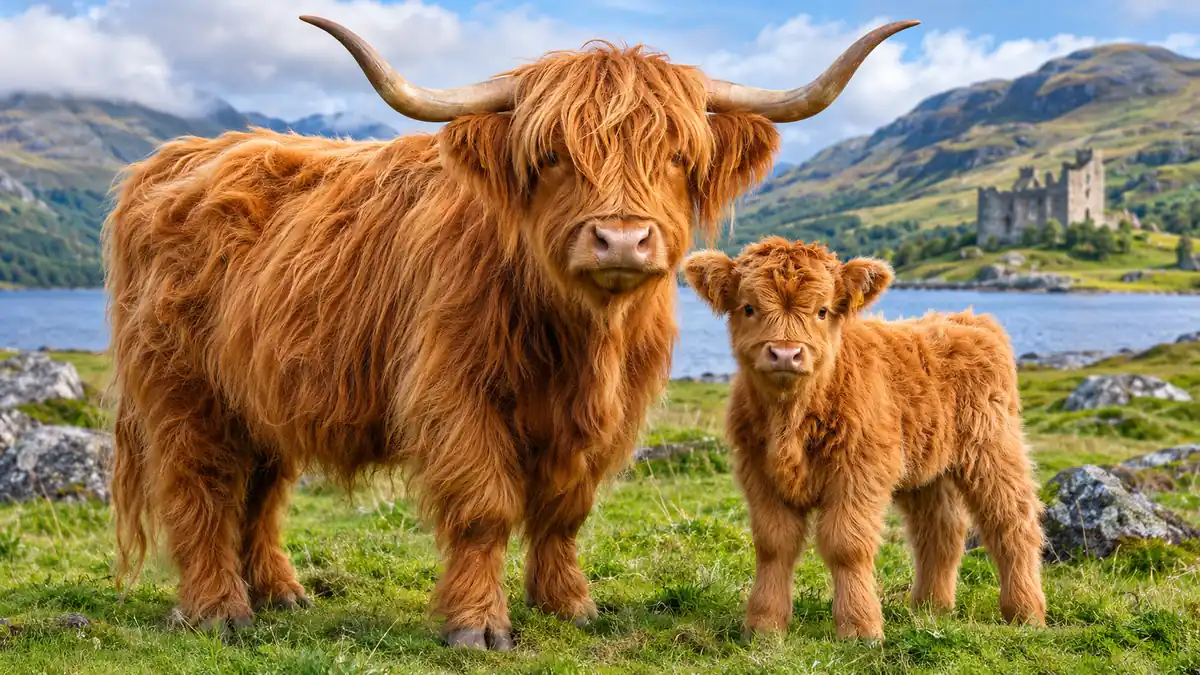
With their shaggy coats, sweeping horns, and long fringes covering their eyes, Highland cattle are among the most recognizable farm animals in the world. Their distinctive appearance is charming, but there’s much more to this hardy Scottish breed than its fluffy exterior.
A highland cow belongs to the Highland breed of cattle, a traditional Scottish breed known for its long, weather-resistant coat, prominent horns, calm disposition, and ability to thrive on rough grazing land. Highland cattle are raised for beef, conservation grazing, and small-scale farming, with proper management and suitable facilities.
These animals have survived for centuries in some of Scotland’s harshest landscapes. Understanding their history, physical characteristics, behavior, and care requirements explains why they remain valued by farmers and admired by animal lovers worldwide.
What Is a highland cow?
A highland cow is an adult female of the Highland cattle breed, although people commonly use the term to describe Highland cattle of either sex. The breed is also known as Scottish Highland cattle or, informally, Highland coos.
Highland cattle belong to the species Bos taurus, the domestic cattle species that includes breeds such as Angus, Hereford, and Holstein.
They are particularly recognizable for their thick hair, broad horns, sturdy bodies, and ability to withstand cold, wet, and windy conditions.
Unlike many modern cattle breeds developed primarily for intensive production, Highland cattle retain characteristics suited to extensive grazing systems.
Highland cattle at a glance
| Characteristic | Details |
|---|---|
| Breed name | Highland |
| Origin | Scottish Highlands and Western Isles |
| Scientific name | Bos taurus |
| Primary purpose | Beef production and conservation grazing |
| Coat colors | Red, black, yellow, dun, silver, brindle, and white |
| Adult female weight | Approximately 400–600 kg |
| Adult male weight | Approximately 650–900 kg |
| Lifespan | Often 15–20 years with suitable care |
| Temperament | Generally calm, but variable |
| Horns | Usually present in both sexes |
| Coat | Long outer hair with an insulating undercoat |
| Climate suitability | Particularly adapted to cool, wet environments |
These measurements are approximate. Genetics, nutrition, age, and management can influence an individual animal’s size and lifespan.
History and Origin of Highland Cattle
The Highland breed originated in the rugged landscapes of northern and western Scotland, where cattle had to survive difficult terrain, limited winter forage, heavy rainfall, and cold temperatures.
Their ancestry extends back centuries, making them one of the oldest established cattle breeds.
Early Highland cattle in Scotland
Historically, Highland cattle were essential to rural communities throughout the Scottish Highlands and Western Isles.
They provided meat and economic value in regions where growing crops was difficult. Their ability to graze rough vegetation made them especially useful on land unsuitable for more demanding livestock.
Cattle droving also played a significant role in Scotland’s agricultural history. Herds were driven over long distances to markets, including the famous cattle market at Falkirk.
The breed developed through generations of adaptation to its environment rather than selection for maximum milk production or rapid growth alone.
The Highland Cattle Society
The Highland Cattle Society was established in 1884 and maintains the breed’s herd book.
The society plays an important role in preserving pedigree records, supporting breeders, and maintaining breed standards.
Highland cattle have since spread beyond Scotland to countries including the United States, Canada, Australia, and parts of continental Europe.
Their popularity reflects both their agricultural usefulness and their distinctive appearance.
Physical Characteristics of a highland cow
The Highland breed has several unusual physical adaptations that distinguish it from most other cattle.
Long, shaggy double coat
Highland Cow posing center to the frame, staring into camera
One of the most striking characteristics is its thick double coat.
The outer layer consists of long, coarse hair that helps shed rain and snow. Beneath it is a softer insulating undercoat that reduces heat loss in cold weather.
This combination allows Highland cattle to tolerate challenging winter conditions without relying on the same level of subcutaneous fat insulation as some other breeds.
Their long forehead hair, often called a dossan, forms the characteristic fringe that may partially cover their eyes.
Although the coat offers substantial weather protection, it can also make the animals more vulnerable to heat stress in hot climates.
Large, distinctive horns
Both male and female Highland cattle typically develop horns.
Horn shape varies between individuals and sexes. Bulls often have thicker horns that extend outward and forward, while cows commonly develop more slender horns that sweep outward and upward.
However, horn shape alone is not a completely reliable way to determine sex.
The horns serve several purposes, including social interactions and defense. They can also help animals move vegetation or snow when foraging.
Because the horns are large and potentially dangerous, safe handling facilities and experienced management are essential.
Highland cattle coat colors
Although reddish-brown cattle are especially popular in photographs, the breed comes in several recognized colors.
Our Native Breed Cattle | Millers of Speyside
Red
Black
Highland Cow in the Isle of Skye
Yellow
White
Other colors include dun, silver, and brindle. Dun typically has a muted brownish or grayish appearance, while brindle cattle show darker streaks or stripes.
Coat color does not reliably indicate an animal’s temperament, quality, or health.
Highland Cow Size, Weight, and Lifespan
Highland cattle are substantial animals, although their long coats can make them appear even larger than their actual body size.
How big does a highland cow get?
Adult females commonly weigh approximately 400–600 kilograms (880–1,320 pounds), while mature bulls may weigh around 650–900 kilograms (1,430–1,980 pounds).
Adult cows often stand approximately 105–120 centimeters at the shoulder, with bulls generally taller.
Actual measurements depend on bloodline, age, diet, and management.
Highland cow vs. other cattle breeds
| Feature | Highland cattle | Angus cattle | Hereford cattle |
|---|---|---|---|
| Origin | Scotland | Scotland | England |
| Coat | Long, double-layered | Short | Short |
| Horns | Usually horned | Naturally polled | Horned or polled |
| Cold adaptation | Excellent | Good | Good |
| Main use | Beef, conservation grazing | Beef | Beef |
| Typical appearance | Shaggy, long fringe | Compact, muscular | Red body, white face |
Highland cattle are generally slower-maturing than many specialized commercial beef breeds.
Their growth pattern can make them less suitable for production systems focused exclusively on rapid finishing.
How long do Highland cows live?
Highland cattle are often described as long-lived, with many capable of reaching 15–20 years under favorable conditions. Some individuals live longer.
Their actual lifespan depends on nutrition, veterinary care, disease exposure, injuries, breeding demands, and environmental conditions.
A long potential lifespan should not be confused with a guarantee of good health. Like other cattle, Highland animals require preventive care and ongoing observation.
Highland Cow Temperament and Behavior
Highland cattle are generally known for their relatively calm and manageable temperament.
However, every animal has its own personality, and behavior depends heavily on handling, socialization, environment, and previous experiences.
Are Highland cows friendly?
Many Highland cattle become accustomed to regular human contact, particularly when raised with consistent, low-stress handling.
They may approach familiar caretakers and show curiosity toward people.
Nevertheless, Highland cattle are large livestock animals, not domesticated companion animals in the same sense as dogs or cats.
Even an apparently relaxed animal can react unpredictably when frightened, cornered, injured, or protecting a calf.
Their horns and body weight make close contact potentially hazardous.
Are Highland cows aggressive?
The breed is not generally considered unusually aggressive, but bulls, protective mothers, and frightened animals can be dangerous.
Aggression or defensive behavior may occur when cattle experience:
- Threats to newborn calves
- Rough or unfamiliar handling
- Competition around feed
- Pain, illness, or stress
- Confinement without a clear escape route
Visitors should never assume that a fluffy appearance indicates a safe animal to touch.
Maintaining distance, respecting barriers, and following farm safety instructions are the safest approaches.
Social behavior within a herd
Highland cattle are social animals that naturally establish herd relationships.
They communicate through body posture, vocalizations, movement, and physical contact.
Cows often maintain close relationships with their calves, and young animals learn social behavior through interaction with the herd.
Providing appropriate companionship and sufficient space supports natural behavior and welfare.
What Do Highland Cows Eat?
Highland cattle are herbivorous ruminants, meaning they obtain nutrients from plant material through a specialized digestive system.
Their four-compartment stomach allows them to digest fibrous vegetation through microbial fermentation.
Natural diet and grazing habits
Their natural diet consists mainly of grasses and other pasture plants.
Depending on the environment and availability, they may also consume:
- Grass and meadow vegetation
- Hay and haylage
- Suitable browse, including certain shrubs
- Rough pasture plants
- Conserved forage during winter
- Mineral supplements when needed
Highland cattle are particularly efficient at utilizing rough grazing compared with many more intensively selected breeds.
Their ability to browse shrubs and coarse vegetation also makes them useful in certain habitat management programs.
However, being a hardy breed does not mean they can survive indefinitely on nutritionally inadequate forage.
How much food does a Highland cow need?
Feed requirements depend on body weight, forage quality, age, pregnancy, lactation, and weather.
As a general cattle-feeding guideline, daily dry matter intake may be around 1.5–2.5% of body weight, although individual requirements vary.
For example, a 500-kilogram cow consuming 2% of her body weight in dry matter would need approximately 10 kilograms of dry matter daily.
This is not the same as 10 kilograms of fresh grass, because fresh forage contains substantial water.
A livestock nutritionist or veterinarian can help assess appropriate rations, especially during pregnancy, lactation, and winter.
Water and mineral requirements
Highland cattle need continuous access to clean drinking water.
Water consumption increases with temperature, milk production, and dry feed intake.
A balanced mineral supply is also necessary. Deficiencies or excessive mineral intake can cause serious health problems.
Mineral supplementation should reflect local forage conditions, particularly where trace elements such as selenium or copper require careful management.
Highland Cow Habitat and Climate Adaptation
Highland cattle evolved in environments characterized by cool temperatures, wind, rain, and rugged terrain.
Their physical characteristics help them remain productive in conditions that can challenge less hardy breeds.
Why Highland cows tolerate cold weather
Their double coat is central to their cold-weather adaptation.
The longer outer hair helps repel moisture, while the undercoat traps insulating air close to the body.
Their sturdy legs and strong hooves also support movement across uneven ground.
However, even cold-adapted cattle need adequate feed, dry resting areas, access to water, and protection from extreme exposure.
Young calves, sick animals, and cattle in poor body condition require particular attention.
Can Highland cows live in hot climates?
Yes. Highland cattle are kept successfully in warmer regions, including parts of the southern United States and Australia.
They can shed much of their winter coat as temperatures rise.
Nevertheless, heat and humidity create genuine welfare challenges.
Cattle exposed to prolonged heat may experience reduced appetite, increased respiratory rates, lower productivity, and potentially dangerous heat stress.
Appropriate management includes providing shade, abundant clean water, good airflow, and avoiding unnecessary handling during the hottest hours.
Humidity and overnight temperatures matter as well as daytime heat. Australian Highland Cattle Society+1
A Highland cow should never be assumed to tolerate extreme heat simply because the breed can adapt to different climates.
Highland Cow Care and Health Requirements
Despite their reputation for hardiness, Highland cattle require the same fundamental welfare protections as other domestic cattle.
Their thick coats and ability to graze rough land do not eliminate the need for regular management.
Shelter and pasture management
Highland cattle often thrive in extensive grazing systems, but suitable shelter remains important.
Natural tree cover, windbreaks, or purpose-built structures can help protect animals from extreme conditions.
Pastures should provide adequate nutrition without exposing cattle to poisonous plants, hazardous objects, or excessive mud.
Rotational grazing can support grass recovery, reduce localized overgrazing, and help manage parasite exposure.
Fencing and handling facilities
Highland cattle require secure livestock fencing and appropriately designed handling equipment.
Their horns introduce additional considerations.
Narrow passages, unsuitable head restraints, and poorly designed gates can increase the risk of injury to both cattle and handlers.
A suitable handling system should allow animals to move calmly while providing safe access for veterinary examinations and routine procedures.
Common health concerns
Highland cattle may be hardy, but they can still develop ordinary bovine diseases and health problems.
These include:
- Internal and external parasites
- Respiratory infections
- Lameness and hoof problems
- Nutritional deficiencies
- Reproductive complications
- Eye irritation or injury
- Heat stress
- Calf illnesses
Preventive veterinary care, appropriate vaccination programs, parasite monitoring, and prompt treatment are essential.
Their long coats can sometimes make changes in body condition harder to notice visually.
Hands-on body condition assessment, performed safely, can help identify animals that are losing or gaining excessive weight.
Do Highland cows need grooming?
Healthy Highland cattle naturally shed seasonal hair, and routine cosmetic grooming is generally unnecessary.
However, owners should monitor for matted or heavily soiled hair, skin problems, and parasite infestations.
Show animals may receive additional grooming, but excessive bathing or clipping is not a substitute for proper welfare management.
Any clipping for heat management should be considered in consultation with an experienced veterinarian or livestock professional, taking climate and skin protection into account.
Highland Cow Reproduction and Calves
Highland Cow Family Asks for Help Rescuing Stuck Calf in Scotland – PetHelpful
Highland cows are recognized for strong maternal instincts and relatively good calving ability.
Their reproductive characteristics have helped the breed remain productive in extensive farming environments.
Pregnancy and calving
Like most cattle, Highland cows have a gestation period of approximately 283 days, although the actual duration varies.
They typically give birth to one calf at a time.
Twins are possible but relatively uncommon.
Highland calves are often comparatively small at birth, which can contribute to easier calving.
However, difficult births can still occur, particularly when calf size, maternal condition, or fetal positioning creates complications.
What does a baby Highland cow look like?
A young Highland calf usually has a soft, fluffy coat, compact body, short legs, and a rounded face.
Its horns are not developed into the sweeping adult shape at birth.
Calves may be born in several coat colors, and their appearance changes as they mature.
Newborn calves should stand, nurse, and receive adequate colostrum soon after birth.
Colostrum provides essential antibodies that help protect young calves during their early life.
Maternal behavior
Highland cows are often attentive and protective mothers.
They may remain close to newborn calves and react defensively when unfamiliar people or animals approach.
This protective instinct contributes to calf survival but requires caution from handlers.
Never enter a calving area casually or approach a newborn calf without considering the mother’s position and behavior.
When do Highland cattle mature?
Highland cattle generally mature more slowly than many modern commercial beef breeds.
Heifers should not be bred solely because they have reached a particular age.
Breeding readiness depends on body weight, physical development, nutritional condition, and veterinary guidance.
The breed’s slower maturity can be offset by a relatively long productive breeding life. Some Highland cows continue breeding into their late teens. New Zealand Highland Cattle Society+1
Highland Cow Uses in Farming and Conservation
Highland cattle are not simply ornamental animals.
Their ability to utilize marginal grazing land gives them practical agricultural and environmental value.
Beef production
Highland cattle are primarily classified as a beef breed.
Their meat is often described as flavorful, with relatively lean carcass characteristics.
The thick insulating coat reduces the animal’s dependence on heavy external fat deposits for warmth.
However, actual meat composition depends on feeding, genetics, age, finishing conditions, and the cut of meat.
Highland cattle generally take longer to reach finishing weight than many specialized commercial beef breeds.
This makes them especially suited to production systems that value extensive grazing, breed characteristics, and particular meat qualities rather than rapid growth alone.
Conservation grazing
Conservation grazing is one of the breed’s increasingly recognized uses.
Highland cattle can consume coarse grasses and browse vegetation that some other grazing animals may avoid.
Under a carefully designed management plan, their grazing can help maintain open habitats, control certain woody plants, and create varied vegetation structures.
This may benefit biodiversity in grasslands, heathlands, and other conservation areas.
However, the environmental effect depends on stocking density, season, soil conditions, and habitat objectives.
Too many animals can damage sensitive ground, while too few may fail to control unwanted vegetation.
The The Livestock Conservancy identifies Highland cattle as a heritage breed with an established role in beef production and conservation grazing. The Livestock Conservancy
Small farms and heritage agriculture
Highland cattle also appeal to small-scale livestock keepers because of their appearance, foraging ability, and traditional heritage.
Yet keeping even a small number requires adequate land, fencing, feed, veterinary access, and suitable facilities.
They are herd animals, so keeping a single animal in isolation is generally undesirable.
A small farm should plan for companionship, winter feeding, manure management, and safe handling before introducing cattle.
Mini Highland Cow vs. Standard Highland Cattle
Highland Cow Family Asks for Help Rescuing Stuck Calf in Scotland – PetHelpful
Interest in miniature Highland cattle has increased as images of small, fluffy animals circulate online.
However, there are important distinctions between young calves, naturally smaller individuals, and animals advertised as miniature Highland cattle.
Are miniature Highland cows a separate breed?
The traditional Highland is an established cattle breed with recognized breed standards.
Terms such as mini Highland cow, micro Highland, and teacup Highland cow are commonly used in advertising, but they do not represent universally recognized size divisions within the traditional Highland breed.
Some smaller cattle may be young animals, unusually small individuals, or crosses involving other breeds.
Descriptions alone cannot establish an animal’s mature size or pedigree.
How big do miniature Highland cows get?
There is no single universally accepted adult size for animals marketed as miniature Highland cattle.
Their mature height and weight depend on genetics, age, nutrition, and whether they are purebred or crossbred.
A fluffy calf that appears tiny in a photograph may eventually grow into a substantial adult.
Photographs taken at a young age are therefore unreliable indicators of mature size.
Do miniature Highland cows need less care?
Smaller cattle still require appropriate nutrition, secure fencing, shelter, companionship, veterinary care, and livestock handling facilities.
They may also have health problems associated with particular breeding practices.
Selecting animals for extremely small size without sufficient attention to structural soundness and health can create welfare concerns.
Size should never be treated as a substitute for responsible breeding and husbandry.
Interesting Facts About Highland Cows
Highland cattle have several distinctive traits that explain their cultural and agricultural importance.
1. They are among the oldest registered cattle breeds
The Highland Cattle Society was founded in 1884, and its first herd book appeared in 1885.
The breed’s history extends much further back, although the precise date of its earliest origins cannot be established with certainty. Highland Cattle Society
2. They were historically associated with two regional types
Historical descriptions distinguish smaller, often black island cattle called Kyloes from larger mainland Highland cattle.
Over time, these populations became recognized as part of the same Highland breed. Oklahoma State University
3. A group of Highland cattle is often called a fold
Although herd is correct, the traditional Scottish term fold is frequently used for a group of Highland cattle.
4. Both males and females usually have horns
Unlike some naturally hornless cattle breeds, Highland cattle are characteristically horned.
The shape and size of their horns develop as they mature.
5. Their famous red color is not the only traditional color
Black is historically significant within the breed, while yellow, dun, brindle, white, and silver shades also occur.
6. Their coats change with the seasons
Highland cattle develop heavier winter coats and shed much of the longer hair as temperatures rise.
This seasonal adjustment helps them cope with changing conditions.
7. They can have unusually long productive lives
Some Highland cows remain reproductively active well into their teens, although this depends on health and management.
8. They are closely associated with Scottish identity
The Highland cow has become a recognizable symbol of Scotland.
Its distinctive appearance features in photography, artwork, tourism imagery, and traditional rural landscapes.
Why the Highland Cow Is So Popular
The Highland cow combines an unusual appearance with genuine agricultural qualities.
Its long hair, distinctive horns, and expressive face make it especially memorable. Yet its enduring value comes from characteristics developed through generations of adaptation to Scotland’s difficult landscapes.
For farmers, the breed offers potential advantages in extensive grazing systems and heritage livestock production. For conservation managers, it can provide a useful grazing option when managed appropriately. For animal enthusiasts, it represents an important connection to Scotland’s agricultural history.
The most useful way to appreciate a highland cow is to understand both sides of the breed: its attractive appearance and the practical responsibilities involved in caring for a large, horned farm animal.
Learning about its behavior, diet, environmental needs, and breeding history provides a fuller picture of why Highland cattle have remained valued for centuries.