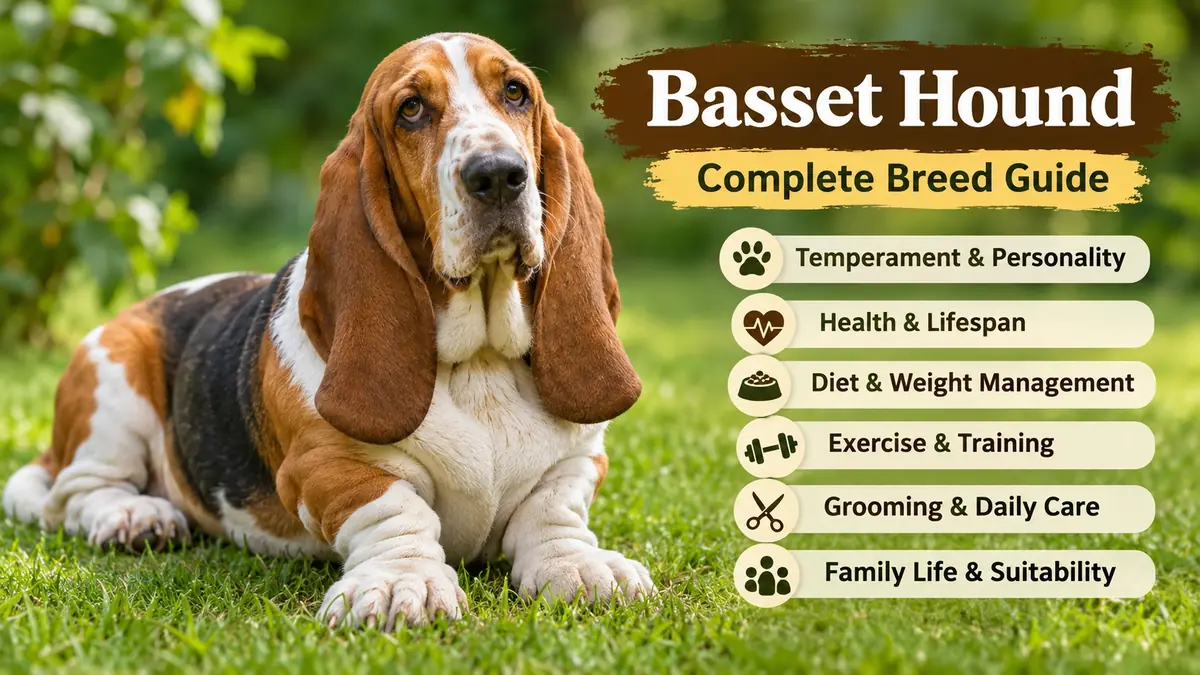
With their long, floppy ears, soulful eyes, and remarkably short legs, Basset Hounds are among the most recognizable dog breeds. Their relaxed appearance can make them seem like effortless companions, but living with one involves more than providing a comfortable couch.
The basset hound is a medium-to-large scent hound originally developed for tracking small game. Known for its affectionate temperament, powerful sense of smell, and independent personality, this breed typically lives around 10–13 years, sometimes longer. It needs moderate daily exercise, consistent training, weight management, and attentive ear and skin care.
Understanding the breed’s hunting background, physical structure, and health needs helps explain both its appeal and its challenges.
basset hound Breed Overview and Key Characteristics
The Basset Hound belongs to the hound group and was developed to follow scent trails at a pace that hunters could maintain on foot.
Although relatively short, these dogs have substantial bodies, heavy bones, and surprising strength. Their calm household behavior contrasts with the determination they display when following an interesting smell.
| Characteristic | Typical description |
|---|---|
| Breed group | Hound, scent hound |
| Origin | France; modern breed developed in Britain |
| Height | Approximately 13–15 inches (33–38 cm) |
| Weight | Approximately 40–65 pounds (18–29 kg) |
| Lifespan | Commonly 10–13 years |
| Temperament | Gentle, affectionate, patient, independent |
| Coat | Short, smooth, dense |
| Colors | Tricolor, lemon and white, red and white, and other hound colors |
| Shedding | Moderate to noticeable |
| Exercise | Approximately 30–60 minutes daily, adjusted individually |
| Trainability | Intelligent but independent |
| Vocalization | Frequent barking, baying, or howling |
| Family suitability | Often good with children and other dogs |
| Grooming | Weekly brushing plus regular ear, skin, and nail care |
These figures are general breed ranges rather than requirements for every individual dog. Veterinary guidance and body condition matter more than meeting a particular number. American Kennel Club+2
What Makes a Basset Hound Unique?
Several characteristics distinguish this breed from other companion dogs.
Its powerful nose is one of the most important. Basset Hounds were developed to identify and follow scent trails, particularly those left by rabbits and other small game.
Their long ears hang close to the ground and are traditionally considered helpful in concentrating scent near the nose. Loose skin and facial folds also contribute to the breed’s distinctive appearance.
Short legs allow the dog to move steadily through vegetation while tracking. Despite their low height, Bassets are not miniature dogs. Their substantial weight means they require careful handling, especially when being lifted.
The breed is also famous for its deep, resonant voice. A Basset’s bay can carry surprisingly far, which was useful when hunters needed to locate working hounds.
History and Origin of the basset hound
The breed’s history begins in France, where short-legged hunting hounds were developed to track game through forests and countryside.
The name Basset comes from the French word bas, meaning low or short. It describes the dog’s distinctive low-to-the-ground build.
From French Hunting Dogs to the Modern Breed
The ancestors of modern Basset Hounds included French scent hounds associated with the regions of Artois and Normandy.
During the nineteenth century, these dogs attracted interest in Britain. French hounds were imported into England during the 1860s, and British breeders began developing the modern breed’s appearance and working characteristics.
Everett Millais played an important role in this development during the 1870s. His imported hound, Model, contributed to the foundation of the British Basset Hound.
Beagle and Bloodhound ancestry also influenced the breed’s development.
The Basset Hound Club was established in Britain in 1884. Queen Alexandra later became one of the breed’s notable supporters.
The American Kennel Club recognized the Basset Hound in 1911, helping establish its formal place among recognized American dog breeds. The Kennel Club+1
Why Were Basset Hounds Originally Bred?
Their primary purpose was scent tracking and hunting small game, particularly rabbits and hares.
Unlike faster hunting dogs, Bassets could maintain a deliberate pace that allowed hunters to follow on foot.
Their combination of scenting ability, endurance, and determination remains evident in modern household pets.
A Basset that appears uninterested in ordinary commands may suddenly become highly motivated when it discovers a scent trail.
That behavior reflects generations of selective breeding rather than a lack of intelligence.
Basset Hound Temperament and Personality
Basset Hounds are widely appreciated for their gentle, patient, and sociable personalities.
The American Kennel Club’s breed standard describes them as mild-tempered and devoted, while its temperament guidance emphasizes their charming, patient, and low-key nature. American Kennel Club+1
However, individual temperament depends on genetics, early experiences, socialization, training, and the home environment.
Are Basset Hounds Good Family Dogs?
For many households, yes.
Basset Hounds often enjoy spending time with family members and generally respond well to calm, respectful interaction.
Their common personality traits include:
- Affectionate: They frequently enjoy physical closeness and family companionship.
- Patient: Many tolerate ordinary household activity without becoming easily excitable.
- Social: Their pack-hunting background often makes them comfortable around other dogs.
- Independent: They may choose to investigate smells rather than immediately follow instructions.
- Food-motivated: Treats can be particularly effective during training.
- Vocal: Barking, baying, and howling are natural behaviors.
A Basset may happily sleep beside its owner for hours and then become completely absorbed in exploring the garden.
This combination of calmness and curiosity is central to the breed’s personality.
Are Basset Hounds Good With Children?
Well-socialized Basset Hounds can be excellent companions for families with children.
Their generally patient temperament is an advantage, but children must learn how to interact appropriately with dogs.
Young children should never pull a Basset’s ears, climb onto its back, disturb it while eating, or interrupt its sleep.
Adults should supervise interactions, especially with toddlers.
Despite their short stature, Bassets are heavy dogs and can accidentally knock over smaller children.
Do Basset Hounds Get Along With Cats and Other Dogs?
Many do, particularly when introductions are gradual and positive.
The breed’s historical work in hunting packs helps explain why it often enjoys canine companionship.
Cats and other household animals may also coexist peacefully with a Basset that has been properly introduced and socialized.
However, the breed retains hunting instincts. Rabbits, rodents, and other small animals may trigger chasing or intense interest.
Interactions with smaller pets should be managed carefully, and animals should not be left together unsupervised when their compatibility is uncertain.
Can Basset Hounds Be Left Alone?
Basset Hounds usually prefer company and may struggle with prolonged isolation.
Some develop separation-related distress, which can involve persistent vocalization, destructive behavior, pacing, or inappropriate elimination.
Gradual alone-time training, predictable routines, enrichment activities, and appropriate exercise can help.
PDSA advises against leaving dogs alone for longer than four hours, and some individuals need substantially shorter periods. PDSA
A Basset is generally better suited to a household where companionship is available throughout much of the day.
Basset Hound Size, Appearance, and Physical Development
The Basset Hound’s physical proportions are unusual: a long, heavy body supported by short, strong legs.
Although it stands only about 13–15 inches tall, an adult may weigh as much as many considerably taller dogs.
Adult Height and Weight
Adult weight varies with sex, frame size, muscle development, and body condition.
| Life stage | General physical development |
|---|---|
| 0–3 months | Rapid early growth and coordination development |
| 3–6 months | Increasing body length, height, and strength |
| 6–12 months | Continued skeletal growth and substantial weight gain |
| 12–18 months | Many approach adult height and continue filling out |
| 18–24 months | Some finish developing adult muscle and body condition |
These are broad developmental stages, not precise growth milestones.
A puppy’s growth should be assessed using veterinary growth charts and body condition rather than a rigid weight target.
Why Do Basset Hounds Have Short Legs?
Their short-legged structure is associated with inherited skeletal development characteristics, including forms of disproportionate dwarfism known as chondrodysplasia.
This physical trait was historically useful for slow, ground-level scent tracking.
However, the same body proportions can contribute to orthopedic and spinal vulnerabilities.
A healthy Basset should still be capable of comfortable, coordinated movement. Extremely exaggerated features should not be treated as desirable simply because they look distinctive.
Coat Colors and Markings
Basset Hounds have a short, smooth coat that appears in several recognized hound color combinations.
Common examples include tricolor coats featuring black, white, and tan; lemon and white; and red and white.
Other combinations of recognized hound colors occur.
Their coat is relatively easy to brush, but short hair does not mean they are non-shedding.
Basset Hound Lifespan and Common Health Problems
Basset Hounds commonly live into their early teens. Some individuals live longer, although lifespan varies with genetics, body condition, disease, veterinary care, and environment.
The breed’s distinctive anatomy makes certain health problems particularly important to understand.
PDSA and veterinary breed references identify concerns involving the spine, joints, eyes, skin, ears, and digestive system. PDSA+1
Intervertebral Disc Disease (IVDD)
Intervertebral disc disease affects the discs that cushion the vertebrae of the spine.
When a disc degenerates, bulges, or ruptures, it may cause pain or compress the spinal cord.
Possible symptoms include:
- Reluctance to walk, jump, or move normally
- Back or neck pain
- Weakness or unsteady walking
- Dragging the paws
- Difficulty standing
- Loss of bladder control in severe cases
Sudden weakness, paralysis, or loss of bladder function requires immediate emergency veterinary attention.
Maintaining a healthy weight, using non-slip flooring, and reducing unnecessary high-impact activity may help limit avoidable strain, although they cannot eliminate inherited risk.
Ear Infections
The Basset’s long, hanging ears can create conditions that favor moisture retention and irritation.
Ear infections, including otitis externa, may involve bacteria, yeast, allergies, or other underlying causes.
Warning signs include head shaking, scratching, unpleasant odor, redness, discharge, and sensitivity when the ears are touched.
Ear inspection should be routine, but cleaning should follow veterinary recommendations. Excessive or aggressive cleaning can cause irritation.
Never insert cotton swabs deeply into the ear canal.
Glaucoma and Other Eye Conditions
Basset Hounds may develop inherited or acquired eye disorders, including primary open-angle glaucoma (POAG), other forms of glaucoma, eyelid abnormalities, and dry eye.
Glaucoma involves damage associated with impaired drainage of fluid inside the eye and can threaten vision.
The American College of Veterinary Ophthalmologists identifies inherited open-angle glaucoma in the breed and associates one form with the ADAMTS17 gene. OFA
A painful, red, cloudy, or suddenly enlarged eye requires urgent veterinary assessment.
Breeding dogs should undergo appropriate eye screening and relevant genetic testing.
Joint Problems and Obesity
Hip dysplasia, elbow dysplasia, arthritis, and other orthopedic conditions can affect comfort and mobility.
Excess body weight places additional stress on the spine and joints.
Because Basset Hounds often have strong appetites and relatively modest activity levels, obesity prevention is especially important.
Owners should regularly assess body condition rather than relying exclusively on the scale.
Gastric Dilatation-Volvulus (GDV)
GDV, commonly called bloat, is a potentially fatal emergency in which the stomach becomes distended and twists.
Possible warning signs include repeated unsuccessful attempts to vomit, abdominal swelling, restlessness, excessive salivation, weakness, and collapse.
Suspected GDV requires immediate emergency veterinary treatment.
It should never be managed through home remedies or by waiting to see whether symptoms improve.
Skin Fold Dermatitis and Other Conditions
Moisture and friction within skin folds can contribute to inflammation and infection.
Affected areas may become red, irritated, greasy, or unpleasant-smelling.
Other recognized breed concerns include certain bleeding disorders, such as Basset Hound thrombopathia, and inherited Lafora disease, a neurological condition.
Responsible health screening and veterinary assessment can identify some risks, although no screening program guarantees a disease-free dog.
Practical Preventive Health Checklist
| Health concern | Helpful preventive action |
|---|---|
| Obesity | Measure food, monitor body condition, maintain exercise |
| Ear infections | Inspect ears and clean only as advised |
| Skin irritation | Keep folds clean and thoroughly dry |
| Spinal problems | Reduce unnecessary impact and maintain healthy weight |
| Joint disease | Monitor gait, comfort, and activity tolerance |
| Eye disease | Arrange recommended screening and investigate symptoms promptly |
| Dental disease | Brush teeth regularly with dog-safe toothpaste |
| General illness | Maintain veterinary examinations and preventive care |
Quick takeaway: A healthy weight, appropriate exercise, regular veterinary care, and early attention to changes in mobility are especially valuable for this breed.
Basset Hound Exercise Requirements and Daily Activities
Despite their relaxed reputation, Basset Hounds need regular physical activity to maintain muscle strength, support cardiovascular health, and prevent excessive weight gain.
They are not usually suited to high-speed running or demanding athletic activities. Their preferred exercise combines steady walking with opportunities to explore scents.
How Much Exercise Does a Basset Hound Need?
For many healthy adults, approximately 30–60 minutes of daily activity is a useful starting point.
PDSA recommends at least an hour per day, including walking, play, and training, while other breed-care organizations describe 30–60 minutes as appropriate for many individuals. PDSA+1
The ideal amount depends on age, health, fitness, temperature, and veterinary recommendations.
A practical daily routine might include:
| Activity | Suggested duration |
|---|---|
| Morning sniff walk | 15–20 minutes |
| Gentle indoor play or scent games | 10–15 minutes |
| Evening walk | 15–20 minutes |
| Short training sessions | 5–10 minutes |
These activities can be adjusted according to the dog’s needs.
Puppies require shorter, age-appropriate activity periods and should avoid forced endurance exercise. Senior dogs may benefit from several gentle outings rather than one long walk.
Why Are Scent Games Important?
Scent work provides mental stimulation while allowing Basset Hounds to express natural tracking behavior.
Simple activities include hiding treats around a room, scattering part of a meal in safe grass, using a snuffle mat, or teaching the dog to locate a particular toy.
These exercises encourage concentration and can reduce boredom.
Scent games are particularly useful when weather conditions limit outdoor exercise.
Can Basset Hounds Go Hiking or Swimming?
Some healthy, conditioned Bassets enjoy longer countryside walks, but demanding hikes, steep terrain, and repeated jumping may be unsuitable.
Swimming also requires caution. Their heavy bodies and short legs can make swimming difficult, and owners should never assume a Basset can swim safely.
If swimming is attempted, use a properly fitted canine life jacket and maintain close supervision.
Why Is Leash Training Essential?
Basset Hounds can become intensely focused on scent trails.
Once following a smell, they may ignore recall commands and wander into dangerous areas.
A secure harness, sturdy leash, and properly fenced exercise area are important safety measures.
Off-leash activity should be limited to genuinely secure environments.
Basset Hound Training and Socialization
Basset Hounds are intelligent, but their independent working heritage can make training slower than owners expect.
A dog that refuses a command is not necessarily incapable of understanding it. Sometimes the surrounding smells are simply more rewarding than the requested behavior.
Are Basset Hounds Easy to Train?
They can learn household manners and obedience skills, but consistent, reward-based training is usually more successful than forceful correction.
Food rewards, praise, and short sessions work particularly well.
The American Kennel Club emphasizes positive reinforcement and acknowledges that the breed’s independent nature can make training challenging. American Kennel Club
A useful training approach is to:
- Begin in a quiet environment with few distractions.
- Reward the desired behavior immediately.
- Practice one skill at a time.
- Keep sessions short and engaging.
- Gradually introduce more challenging environments.
- Reinforce successful responses consistently.
Commands such as sit, stay, come, leave it, and wait are valuable foundations.
Recall training deserves particular attention because scent distractions can be powerful.
House Training a Basset Hound Puppy
House training requires patience, supervision, and a predictable schedule.
Take the puppy to an appropriate toilet area after waking, eating, playing, and before bedtime.
Reward successful outdoor toileting immediately.
Accidents should be cleaned thoroughly using a pet-safe enzymatic cleaner.
Punishment is counterproductive because it may cause anxiety without teaching the puppy where to eliminate.
Crate training can support a house-training routine when introduced positively, but a crate should never be used as punishment or as a substitute for regular breaks and companionship.
Early Socialization
Positive early experiences help puppies become comfortable with unfamiliar people, dogs, sounds, surfaces, and environments.
Socialization should be gradual rather than overwhelming.
Puppies can experience carefully controlled environments before completing their vaccinations, but exposure to potentially contaminated public areas should follow veterinary guidance.
The goal is to build confidence, not force interaction.
Managing Barking and Howling
Bassets are naturally vocal dogs.
They may bark when excited, howl in response to sounds, or bay when investigating something interesting.
Training can reduce excessive vocalization, but completely eliminating natural hound communication is unrealistic.
Owners should identify the cause of barking and address boredom, anxiety, environmental triggers, or unmet needs rather than relying on punishment.
Basset Hound Grooming and Everyday Care
The breed’s short coat makes brushing relatively straightforward, but its ears, skin folds, nails, and teeth require ongoing attention.
Do Basset Hounds Shed a Lot?
Basset Hounds shed throughout the year, and some individuals experience heavier seasonal shedding.
Their short hair can cling to furniture, carpets, and clothing.
Brushing once or twice weekly with a soft-bristle brush or suitable grooming tool helps remove loose hair and distribute natural skin oils.
More frequent brushing may be helpful during periods of heavier shedding.
Basset Hounds are not considered hypoallergenic. Allergens occur in saliva, dander, and other secretions, not simply in shed hair.
Ear Cleaning and Skin Care
Inspect the ears regularly for odor, discharge, redness, and irritation.
Because ear problems have several possible causes, a veterinarian should recommend suitable cleaning products and frequency.
Skin folds should also be inspected, particularly around the face, neck, and other areas where moisture collects.
Use veterinarian-approved cleaning methods and dry the skin thoroughly afterward.
Persistent redness, itching, or unpleasant odor warrants veterinary examination.
Bathing and Nail Trimming
Many Bassets only need occasional baths, depending on their activity and skin condition.
Use a gentle dog-specific shampoo and rinse thoroughly.
Dry the coat and skin folds carefully.
Nails should be checked regularly. Overgrown nails can interfere with normal walking and increase discomfort.
If owners are uncomfortable trimming nails, a veterinary professional or qualified groomer can help.
Dental Hygiene
Dental care is sometimes overlooked because the breed’s ears and skin receive so much attention.
Regular brushing with canine toothpaste helps reduce plaque accumulation.
Human toothpaste should not be used because some ingredients are unsafe for dogs.
Veterinary dental examinations and professional cleaning, when indicated, are important parts of preventive care.
Basset Hound Diet, Feeding, and Weight Management
Food management is one of the most important aspects of caring for a Basset Hound.
These dogs often enjoy eating and may readily consume more calories than they need.
Excess weight can aggravate orthopedic problems, reduce exercise tolerance, and make everyday movement uncomfortable.
What Should a Basset Hound Eat?
A complete and balanced diet appropriate for the dog’s life stage is the foundation of good nutrition.
Puppies require food formulated for growth, while adults generally need a maintenance diet matched to their energy requirements.
Senior dogs may need nutritional adjustments depending on health and body condition.
Food should be selected according to nutritional adequacy, individual tolerance, veterinary recommendations, and any existing medical conditions.
How Much Should You Feed?
There is no single correct feeding quantity for every Basset Hound.
Calorie requirements vary with body weight, age, neuter status, activity level, and metabolism.
Start with the feeding guidance on a nutritionally complete food, then adjust portions based on veterinary advice and changes in body condition.
For many adult dogs, dividing the daily food allowance into two measured meals is practical.
Training treats must count toward the daily calorie allowance. As a general guideline, treats should provide no more than 10% of daily calories. PDSA
How Can You Tell if a Basset Hound Is Overweight?
A healthy body condition generally includes ribs that can be felt beneath a light fat covering and a visible waist when viewed from above.
Because Basset Hounds have unusual proportions and loose skin, visual assessment alone can be misleading.
Veterinarians use body condition scoring systems, commonly ranging from 1 to 9, to assess fat coverage.
An ideal score is often around 4–5 out of 9, although individual assessment is essential.
Sudden weight gain, reduced mobility, or unexplained weight loss should prompt veterinary evaluation.
Foods and Feeding Habits to Avoid
Owners should avoid frequent table scraps, excessive high-calorie treats, and unrestricted feeding when the dog tends to overeat.
Chocolate, grapes, raisins, onions, garlic, and foods containing xylitol are among the substances that can be toxic to dogs.
Feeding routines should also account for the breed’s potential risk of gastric dilatation-volvulus.
Discuss appropriate meal sizes, exercise timing, and individual risk factors with a veterinarian.
Living With a Basset Hound: Home, Family, and Lifestyle
Basset Hounds can adapt to different households, but their physical needs and vocal behavior deserve consideration.
Their relaxed indoor temperament makes them appealing to people who prefer a companion that enjoys spending time at home.
However, they still require daily walks, mental stimulation, and meaningful interaction.
Can Basset Hounds Live in Apartments?
Yes, some Basset Hounds adapt successfully to apartment living.
Indoor space is not always the main challenge. Noise, access to suitable walking areas, and time spent alone can matter more.
Their barking and howling may be disruptive in buildings with shared walls.
Apartment owners should also consider stairs. Frequent climbing may be difficult for dogs with spinal or joint problems.
An elevator or accessible ground-floor home can be advantageous.
Are Basset Hounds Suitable for First-Time Owners?
They can be, provided the owner understands their training and healthcare requirements.
Their affectionate temperament is appealing, but stubborn behavior, strong scent instincts, shedding, drooling, and potential veterinary expenses can surprise inexperienced owners.
First-time owners should be prepared for consistent training and realistic expectations.
Do Basset Hounds Drool?
Many do.
Loose lips and facial anatomy can contribute to drooling, especially around meals or when excited by food.
Mild, familiar drooling is often normal for an individual dog.
However, sudden or excessive drooling, especially with distress, abdominal swelling, difficulty swallowing, or repeated retching, requires prompt veterinary attention.
How Do They Handle Hot and Cold Weather?
Basset Hounds generally do best when protected from temperature extremes.
In hot weather, provide shade, fresh water, and a cool resting environment. Avoid strenuous activity during the hottest hours.
Short legs place the body close to heat radiating from pavement.
In cold or wet weather, monitor comfort and dry the dog after walks.
Exercise plans should account for humidity, temperature, age, and underlying health conditions.
Basset Hound vs. Beagle: Understanding the Differences
Basset Hounds and Beagles share a scent-hunting background, but their physical characteristics and activity patterns differ.
| Feature | Basset Hound | Beagle |
|---|---|---|
| Body type | Long, heavy, short-legged | Compact, athletic |
| Typical height | 13–15 inches | Up to 15 inches |
| Typical weight | 40–65 pounds | Often 20–30 pounds |
| Energy level | Generally moderate | Generally higher |
| Exercise style | Steady walking and sniffing | Active walking, tracking, and play |
| Training | Independent and food-motivated | Curious, energetic, scent-driven |
| Grooming | Short coat with substantial ear and skin care | Short coat with routine grooming |
| Vocalization | Deep baying and howling | Barking, baying, and howling |
Both breeds can be affectionate family companions.
A Beagle may be a better match for someone seeking a smaller, more active dog. A Basset may suit a household that prefers a slower exercise pace.
Neither breed should be considered automatically easy to train or suitable for unrestricted off-leash walking.
Choosing a Healthy Basset Hound Puppy or Adopting an Adult
Anyone considering this breed should prioritize health, temperament, and responsible breeding practices over exaggerated physical features.
The Royal Kennel Club highlights the importance of maintaining functional movement, appropriate ground clearance, and sound physical structure in Basset Hounds. The Kennel Club
What Health Tests Should Responsible Breeders Provide?
Relevant screening may include ophthalmic examinations, genetic testing for primary open-angle glaucoma, thrombopathia testing, Lafora disease testing, and orthopedic assessments where appropriate.
Testing recommendations can vary by country and breed organization.
The presence of a genetic test does not mean every dog requires every available test, but breeders should be able to explain their screening program and provide documentation.
Health testing reduces identifiable risks; it cannot guarantee lifelong health.
What Should You Look for in a Puppy?
A healthy puppy should generally appear alert, responsive, and comfortable moving.
Its eyes should be clear, the skin should be free of obvious inflammation, and the ears should not have an unpleasant odor or abnormal discharge.
Observe how the puppy interacts with littermates, people, and its environment.
The breeder should provide vaccination and veterinary records, explain the puppy’s socialization experiences, and discuss potential breed-specific problems openly.
Avoid choosing a puppy solely because it has exceptionally long ears, extreme skin folds, or an unusually low body.
Is Adopting an Adult Basset Hound a Good Option?
Adoption can be a suitable way to welcome a Basset into the family.
Adult dogs may have more established temperaments, making it easier to assess their activity level, behavior, and compatibility with a particular household.
Ask the rescue organization about medical history, mobility, previous living arrangements, behavior around children and animals, and any separation-related difficulties.
A careful transition and predictable routine can help an adopted dog settle into its new environment.
Is a basset hound the Right Dog for You?
A Basset Hound can be a devoted companion for someone who appreciates a gentle personality and is prepared for the responsibilities that accompany its distinctive build.
The breed is often a good fit for households that enjoy relaxed companionship, moderate daily walks, and scent-based enrichment.
It may be less suitable for people seeking an athletic running partner, a consistently quiet dog, or a breed that responds instantly to commands.
Prospective owners should also consider the potential for ear infections, orthopedic conditions, eye disease, and other health expenses.
The most successful homes provide affection without neglecting exercise, establish consistent boundaries without harsh training, and monitor physical health throughout the dog’s life.
A basset hound is much more than a dog with floppy ears and a sleepy expression. It is a determined scent hound with a rich working history, a sociable temperament, and specialized care needs. Understanding those needs—and choosing a healthy, well-adjusted individual—is the foundation for a rewarding life together.