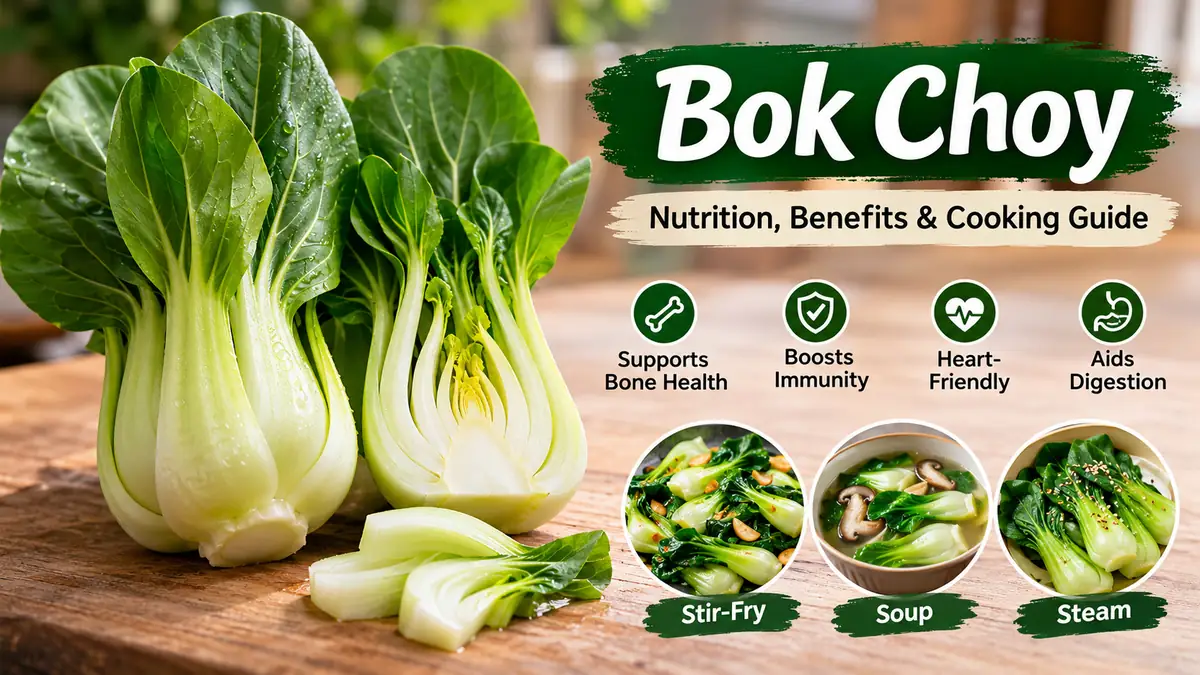
Crisp white stalks, tender green leaves, and a mild flavor make bok choy one of the most versatile vegetables in Asian cooking. It cooks quickly, works with a wide range of ingredients, and provides valuable nutrients without adding many calories.
Yet many people aren’t sure whether to eat the stems, how to clean the leaves properly, or what separates baby bok choy from mature varieties.
bok choy is a leafy green vegetable belonging to the cabbage family, Brassicaceae. Also called pak choi or Chinese cabbage, it has edible stalks and leaves and is commonly used in stir-fries, soups, and steamed dishes. It provides vitamins A, C, and K, along with folate, calcium, and antioxidant compounds.
Understanding its nutritional value, different varieties, preparation methods, and storage requirements makes it easier to include this vegetable in everyday meals.
What Is bok choy?
Bok choy is a type of Chinese cabbage scientifically classified as Brassica rapa subsp. chinensis. Unlike conventional heading cabbage, it does not form a tightly packed round head.
Instead, its leaves grow in an open cluster from a compact base. The plant typically features broad green leaves attached to thick, juicy stalks that may be white or pale green.
Bok choy belongs to the same botanical family as broccoli, kale, cauliflower, Brussels sprouts, and mustard greens. These vegetables are collectively known as cruciferous vegetables.
Where does bok choy come from?
Bok choy originated in China, where it has been cultivated and eaten for centuries. It remains an important ingredient in Chinese cuisine and is widely used throughout East and Southeast Asia.
Today, it is also grown in North America, Europe, and other regions with suitable climates.
Its popularity comes partly from its short cooking time and adaptability. The vegetable can be prepared using traditional Asian techniques or incorporated into Western-style dishes.
What does bok choy taste like?
Bok choy has a mild, slightly sweet, cabbage-like flavor with subtle mustard notes.
Its texture depends on the part of the plant:
- White or pale-green stalks: Crisp, juicy, and mildly sweet.
- Dark-green leaves: Tender, earthy, and slightly more pronounced in flavor.
- Young plants: Generally delicate, with thinner stalks and a milder taste.
- Mature plants: Firmer and sometimes more assertive, particularly when grown under stressful conditions.
Cooking softens the leaves while the stalks can retain a pleasant crunch.
This contrast makes bok choy especially suitable for quick stir-frying.
bok choy Nutrition Facts
Bok choy is a low-calorie, nutrient-dense vegetable. It contains substantial water, modest amounts of fiber, and several essential vitamins and minerals.
The following values are approximate amounts per 100 grams of raw bok choy, based on USDA food composition data.
| Nutrient | Amount per 100 g |
|---|---|
| Calories | 13 kcal |
| Water | 95.3 g |
| Protein | 1.5 g |
| Carbohydrates | 2.18 g |
| Dietary fiber | 1.0 g |
| Total fat | 0.2 g |
| Calcium | 105 mg |
| Potassium | 252 mg |
| Magnesium | 19 mg |
| Iron | 0.8 mg |
| Vitamin C | 45 mg |
| Vitamin K | 45.5 mcg |
| Folate | 66 mcg |
| Vitamin A | 223 mcg RAE |
Values are rounded and can vary with variety, growing conditions, and preparation. Source: USDA FoodData Central, raw pak-choi.
Vitamins in bok choy
Several vitamins contribute to its nutritional value.
Vitamin A: Bok choy contains carotenoids, including beta-carotene, that the body can convert into vitamin A. This nutrient supports normal vision, immune function, and cell development.
Vitamin C: An antioxidant that contributes to collagen production, normal immune function, and the absorption of non-heme iron from plant foods.
Vitamin K: Plays an essential role in normal blood clotting and supports bone metabolism.
Folate: Required for DNA synthesis, cell division, and healthy red blood cell formation. Adequate folate intake is particularly important during pregnancy.
Minerals in bok choy
Calcium, potassium, magnesium, and iron are among the minerals found in this vegetable.
Calcium supports bones and teeth, while potassium contributes to normal muscle and nerve function and helps regulate blood pressure.
Bok choy is also notable because its calcium is relatively well absorbed compared with the calcium in some high-oxalate leafy vegetables, such as spinach.
However, the amount of calcium supplied depends on the serving size. Bok choy should complement rather than replace other reliable calcium sources.
Is bok choy healthier raw or cooked?
Both forms provide nutritional benefits.
Raw bok choy retains more of its heat-sensitive vitamin C, while cooking softens its fibrous structure and can make larger portions easier to eat.
Cooking may also improve the accessibility of certain carotenoids. The outcome depends on cooking time, temperature, and whether the cooking water is consumed.
For everyday nutrition, alternating raw and lightly cooked preparations is a practical approach.
Health Benefits of bok choy
Bok choy contains nutrients and plant compounds associated with several aspects of health. Its benefits are best understood as part of an overall balanced diet rather than as treatment for any specific condition.
1. Supports bone health
Bok choy provides vitamin K and calcium, two nutrients involved in maintaining healthy bones.
Vitamin K contributes to the normal function of proteins involved in bone metabolism, while calcium is a major structural component of bone tissue.
Its relatively low oxalate content also helps make its calcium more bioavailable than calcium from some other leafy greens.
Eating bok choy alongside other calcium-rich foods can contribute to meeting daily nutritional requirements.
2. Contributes to immune function
Vitamin C supports the normal activity of immune cells and helps protect cells from oxidative damage.
Bok choy also supplies provitamin A carotenoids, which support the maintenance of healthy tissues, including those involved in immune defense.
Eating it regularly can help increase overall micronutrient intake, although no single vegetable can prevent infections.
3. Provides antioxidants
Bok choy contains vitamin C, carotenoids, and various phenolic compounds.
These substances contribute to the body’s antioxidant defenses and help counter oxidative stress.
Like other cruciferous vegetables, bok choy also contains glucosinolates. When plant tissues are chopped or chewed, these compounds can be transformed into biologically active substances, including certain isothiocyanates.
Researchers study these compounds for their potential effects on cellular processes. However, laboratory findings should not be interpreted as proof that eating bok choy prevents or treats cancer.
4. Supports cardiovascular nutrition
Bok choy provides potassium, fiber, and antioxidant nutrients.
Potassium helps maintain normal fluid balance and supports healthy blood pressure regulation, particularly when dietary sodium intake is also managed.
Because bok choy is naturally low in sodium and saturated fat, it fits well into heart-conscious eating patterns.
The nutritional effects of a dish still depend on its preparation. Large amounts of salty sauces or added fats can change its overall nutritional profile.
5. Helps maintain digestive health
The dietary fiber in bok choy contributes to normal bowel function and supports a varied, plant-rich diet.
Its high water content also contributes to hydration through food.
Although it contains less fiber per 100 grams than some other vegetables, it can help increase total vegetable consumption.
For people who experience bloating after eating cruciferous vegetables, starting with small cooked portions may improve tolerance.
6. Supports healthy weight management
With approximately 13 calories per 100 grams, raw bok choy adds volume to meals without contributing much energy.
Its water content and modest fiber content can help make meals more satisfying, particularly when combined with protein, whole grains, or legumes.
It is not a weight-loss treatment, but it can be a useful ingredient in a balanced eating pattern.
7. Contributes to eye and skin health
The carotenoids in bok choy contribute to vitamin A intake, which supports normal vision.
Vitamin C is also necessary for collagen formation, a process important for maintaining skin and connective tissues.
These benefits reflect the vegetable’s nutritional composition rather than any special anti-aging or vision-restoring effect.
Types of bok choy and How They Differ
Bok choy appears in several forms, ranging from compact baby plants to large mature varieties.
Vegetables: Bok Choy Isolated on White Background
White-stem bok choy
Broad white stalks and dark-green leaves, with a firm, crunchy texture.
Chinese Vegetables Shanghai Bok Choy Bag Nz – Fruit World | Fruit World Royal Oak
Shanghai bok choy
Pale-green stalks, rounded leaves, and a relatively delicate texture.
Baby bok choy
Young, smaller plants with tender leaves and stalks that cook quickly.
Purple bok choy
Purple-pigmented leaves containing anthocyanins, with coloring that varies by cultivar.
Baby bok choy vs. regular bok choy
Baby bok choy is generally harvested at a younger stage, rather than representing a completely separate botanical species.
| Feature | Baby bok choy | Mature bok choy |
|---|---|---|
| Size | Small, compact heads | Larger, developed heads |
| Stalk texture | Tender | Thicker and firmer |
| Flavor | Usually mild | Mild to slightly stronger |
| Preparation | Often cooked whole or halved | Frequently chopped |
| Cooking time | Generally shorter | May require more time |
| Best uses | Steaming, roasting, quick sautéing | Stir-fries, soups, braises |
The terms can overlap in markets because some compact cultivars remain relatively small even when mature.
Is bok choy the same as napa cabbage?
No. Both belong to the species Brassica rapa, but they are different cultivated forms.
Bok choy belongs to the chinensis group, while napa cabbage is associated with the pekinensis group.
Napa cabbage forms a large, elongated, tightly packed head with crinkled leaves. Bok choy grows in an open cluster with clearly defined stalks.
Both can be used in soups and stir-fries, but their textures and cooking behavior differ.
How to Choose Fresh bok choy
Fresh bok choy should have firm stalks, vibrant leaves, and no obvious signs of decay.
When selecting it at a grocery store or farmers market, examine both the leafy tops and the base.
Look for:
- Bright green leaves without extensive yellowing.
- Firm, crisp stalks that do not feel soft or slimy.
- A compact base without visible rot.
- Leaves that appear hydrated rather than severely wilted.
- A fresh, mild smell.
Small holes in leaves do not necessarily indicate poor quality, particularly in locally grown produce. However, widespread damage, mold, or sliminess suggests deterioration.
Larger bok choy is not automatically less nutritious or flavorful than smaller plants. Size primarily influences texture, preparation, and cooking time.
How to Wash and Prepare bok choy
Soil often becomes trapped where the stalks meet at the base. Washing the outer surface alone may leave dirt hidden between the leaves.
How to Cut Bok Choy – It’s a Veg World After All®
Halving bok choy lengthwise exposes the inner stalks and makes cleaning easier.
Step-by-step cleaning instructions
- Trim the base. Remove a thin slice from the bottom if it is dry or damaged.
- Separate the stalks. For large heads, pull individual leaves away from the base. Small heads can be halved lengthwise.
- Rinse thoroughly. Wash under cool running water, paying particular attention to the spaces near the stalk bases.
- Check for trapped grit. Gently spread the leaves and rinse again if necessary.
- Drain and dry. Shake away excess water or use a salad spinner.
Use clean utensils and a cutting board, particularly when preparing the vegetable for raw consumption.
Plain running water is sufficient for routine washing. Soap, detergent, and household cleaning products should not be used on fresh produce.
Can you eat the entire bok choy plant?
Yes. Both the stalks and leaves are edible.
The tough, discolored bottom portion is usually trimmed away, but the remaining stalks can be cooked or eaten raw.
There is no need to discard the white stems. They provide much of the vegetable’s characteristic crunch.
For even cooking, slice thick stalks into smaller pieces and keep the leafy portions separate until needed.
How to Cook bok choy: Five Easy Methods
Bok choy responds well to quick cooking because its leaves soften much faster than its thick stalks.
The most useful technique is to begin cooking the stalks first, then add the leaves toward the end.
Cooking times depend on plant size, thickness, heat, and the desired texture.
Chinese fried Pak Choi with garlic, sesame seeds. Healthy food
Quick stir-frying helps maintain the contrast between tender leaves and crisp stalks.
1. Stir-fried bok choy with garlic
Stir-frying is one of the simplest ways to prepare this vegetable. High heat develops flavor while keeping the stalks pleasantly firm.
Ingredients for two servings:
- 300 g fresh bok choy
- 1 tablespoon neutral cooking oil
- 2 garlic cloves, finely chopped
- 1 teaspoon reduced-sodium soy sauce
- 1–2 tablespoons water
- A small amount of sesame oil, optional
Instructions:
- Wash the bok choy and separate the stalks from the leaves.
- Heat the cooking oil in a large skillet or wok over medium-high heat.
- Add the stalks and stir-fry for approximately 2–3 minutes.
- Add garlic and cook briefly until fragrant, avoiding burning.
- Add the leaves, soy sauce, and a little water.
- Stir-fry for another 1–2 minutes until the leaves wilt and the stalks reach the desired tenderness.
- Finish with a few drops of sesame oil if desired.
The entire process generally takes less than 10 minutes, including active cooking.
Garlic can burn quickly in a very hot wok, so adding it after the thick stalks have started cooking helps preserve its flavor.
2. Steamed bok choy
Steaming is useful when a softer texture is preferred without adding much oil.
Place cleaned bok choy in a steamer basket above simmering water.
Small, halved heads may take approximately 3–5 minutes, while thick mature stalks may need longer.
Remove the vegetable once the stalks are tender enough to pierce with a fork.
A little lemon juice, ginger, or sesame oil can add flavor without overwhelming its mild taste.
3. Roasted bok choy
Roasting creates browned edges and a more concentrated flavor.
Preheat the oven to 425°F (220°C).
Halve small bok choy heads lengthwise, dry them thoroughly, and coat lightly with oil.
Arrange the pieces cut-side down on a baking sheet. Roast for approximately 10–15 minutes, checking earlier for small heads.
The leaves may become crisp while the stalks remain tender.
Avoid overcrowding the pan because excess moisture can cause steaming instead of browning.
4. bok choy in soups and noodles
Bok choy works particularly well in broth-based dishes.
It pairs with chicken broth, vegetable stock, mushrooms, tofu, ginger, garlic, and noodles.
For a simple soup, simmer the stalks for several minutes before adding the leaves.
The leafy portions generally need only a short time to wilt.
Adding bok choy near the end helps prevent it from becoming overly soft.
It is commonly included in ramen, wonton soup, hot pot, and various Chinese-style noodle dishes.
5. Raw bok choy in salads
Young bok choy can be eaten raw when properly washed.
Its crisp stalks provide a texture similar to celery, while the leaves resemble other tender salad greens.
Slice the stalks thinly and combine them with carrots, cucumber, shredded cabbage, or scallions.
A dressing made with rice vinegar, sesame oil, ginger, and citrus juice complements its flavor.
Raw mature stalks may be more fibrous, so thin slicing improves their texture.
Which cooking method is best?
| Method | Approximate time | Texture | Best use |
|---|---|---|---|
| Stir-frying | 3–6 minutes | Crisp-tender | Quick vegetable sides |
| Steaming | 3–7 minutes | Tender and moist | Light meals |
| Roasting | 10–15 minutes | Browned edges, soft stalks | Oven-cooked meals |
| Simmering | 3–8 minutes | Soft and juicy | Soups and noodles |
| Raw preparation | No cooking | Crunchy | Salads and slaws |
These times are practical estimates rather than fixed requirements. Whole mature heads may require additional cooking.
How to Store bok choy and Keep It Fresh
Proper storage helps preserve the vegetable’s crisp texture and reduces food waste.
Bok choy loses moisture relatively quickly, especially when its leaves are exposed to dry refrigerator air.
Refrigerator storage
For short-term storage, keep the vegetable unwashed until ready to use.
Wrap it loosely in a paper towel or place it in a perforated produce bag in the refrigerator’s vegetable drawer.
Avoid tightly sealing wet leaves inside a bag because trapped moisture can accelerate deterioration.
Fresh bok choy commonly keeps for around three to five days under good refrigeration conditions, although actual shelf life varies.
Purdue Extension recommends refrigerated storage in a loose plastic bag or wrapped in paper towels, with a typical storage period of up to five days. Purdue Extension
Can you freeze bok choy?
Yes, although freezing changes its texture.
The stalks and leaves become softer after thawing, making frozen bok choy more suitable for soups, stews, and cooked dishes than raw salads.
For better quality:
- Wash and trim the vegetable.
- Cut it into convenient pieces.
- Blanch briefly in boiling water.
- Cool promptly in ice water.
- Drain and dry thoroughly.
- Pack in freezer-safe containers or bags, removing excess air.
- Freeze promptly.
Blanching helps slow enzyme activity that can affect flavor, color, and texture during frozen storage.
For best quality, use frozen bok choy within several months. Keep it continuously frozen at 0°F (-18°C) or below.
How can you tell if bok choy has gone bad?
Discard bok choy if it develops a slimy surface, mold, a rotten odor, or extensive soft decay.
Slight wilting alone does not necessarily mean it is unsafe. If the leaves remain sound and show no spoilage, they may still be suitable for cooking.
Do not taste visibly spoiled produce to determine whether it is safe.
bok choy vs. Other Leafy Green Vegetables
Bok choy shares nutritional characteristics with spinach, kale, and conventional cabbage, but each vegetable offers a different combination of nutrients and textures.
| Vegetable | Main characteristics | Common uses |
|---|---|---|
| Bok choy | Mild leaves, crunchy stalks, vitamin C and calcium | Stir-fries, soups, steaming |
| Spinach | Soft leaves, folate, iron, high oxalate content | Salads, sautés, smoothies |
| Kale | Firm leaves, carotenoids, vitamins C and K | Salads, soups, roasting |
| Napa cabbage | Mild, delicate, tightly layered leaves | Kimchi, soups, stir-fries |
| Swiss chard | Large leaves, colorful stalks, earthy flavor | Sautéing, braising |
Is bok choy better than spinach?
Neither vegetable is universally healthier.
Spinach contains substantial folate and vitamin K, while bok choy provides vitamin C and calcium with comparatively low oxalate levels.
Oxalates can bind to calcium and reduce its absorption. This is one reason the calcium in bok choy is generally considered more bioavailable than calcium in spinach.
However, spinach still provides valuable nutrients.
Including both vegetables in a varied diet is more useful than relying exclusively on one.
Is bok choy a good substitute for cabbage?
Yes, in many cooked dishes.
Bok choy can replace regular cabbage in stir-fries, soups, and certain noodle recipes.
Its leaves cook faster, and its stalks have a more pronounced juicy crunch.
For recipes requiring long cooking, bok choy may become too soft if added at the beginning.
Napa cabbage is often a closer substitute in recipes requiring delicate leafy textures, while regular green cabbage is better when prolonged cooking or a firmer structure is needed.
Are There Any Side Effects or Risks of Eating bok choy?
Bok choy is generally safe for most people when consumed in normal food amounts. However, a few dietary and medical considerations are worth understanding.
Vitamin K and blood-thinning medication
Bok choy contains vitamin K, which participates in normal blood clotting.
People taking warfarin or similar vitamin K-sensitive anticoagulants should maintain a consistent intake of vitamin K rather than suddenly increasing or eliminating vitamin K-rich vegetables.
The appropriate dietary approach depends on the medication and individual treatment plan.
People taking these medications should consult their healthcare professional before making major changes to their usual vegetable consumption.
Does bok choy affect thyroid function?
Like other cruciferous vegetables, bok choy contains glucosinolates that can produce compounds with goitrogenic activity.
In extremely high quantities, particularly when eaten raw, some of these compounds may interfere with iodine utilization by the thyroid gland.
However, ordinary dietary portions are not generally considered a problem for people with adequate iodine intake.
Cooking reduces the activity of certain goitrogen-related compounds.
People with diagnosed thyroid disorders or iodine deficiency should seek individualized dietary guidance rather than automatically avoiding all cruciferous vegetables.
Can bok choy cause gas or bloating?
Some individuals experience gas or digestive discomfort after eating cabbage-family vegetables.
This can occur because certain carbohydrates and fibers are fermented by intestinal bacteria.
Cooking the vegetable, reducing portion size, and increasing intake gradually may improve tolerance.
Persistent digestive symptoms should not automatically be attributed to bok choy, particularly when other foods or medical conditions may be involved.
Food safety when eating raw bok choy
Raw leafy vegetables can carry harmful microorganisms if contaminated during growing, handling, or preparation.
Wash bok choy thoroughly under running water and prevent contact with raw meat, poultry, or seafood.
Keep cut produce refrigerated and follow normal food safety practices.
Washing reduces surface contamination but does not guarantee the removal of every pathogen.
How to Grow bok choy at Home
Bok choy is a relatively fast-growing, cool-season vegetable that can be cultivated in garden beds or containers.
It performs best in fertile, well-drained soil with consistent moisture.
Ideal growing conditions
| Growing factor | General recommendation |
|---|---|
| Sunlight | Full sun to partial shade |
| Soil | Fertile, well-drained soil |
| Soil pH | Approximately 6.0–7.5 |
| Temperature | Cool to mild conditions |
| Watering | Consistent moisture without waterlogging |
| Harvest | Often 30–60 days, depending on variety |
These are general growing guidelines. Specific cultivars may have different requirements.
Growing bok choy from seeds
Sow seeds shallowly in prepared soil, generally around ¼–½ inch deep.
Keep the soil evenly moist during germination.
Once seedlings develop, thin them according to the mature size of the selected variety. Baby types can usually be spaced more closely than full-sized plants.
Adding compost before planting can improve soil structure and provide nutrients.
Avoid excessive nitrogen fertilization, which may encourage rapid leafy growth without improving overall plant quality.
Why does bok choy bolt?
Bolting occurs when the plant shifts from leaf production to flowering.
Temperature fluctuations, prolonged cold exposure followed by warming, long days, and other growing stresses can contribute to premature flowering.
Once a plant bolts, its leaves may become more bitter or tough.
Planting at the appropriate season, maintaining consistent moisture, and choosing suitable varieties can reduce the likelihood of early bolting.
When should you harvest bok choy?
Baby bok choy can often be harvested within about a month under favorable growing conditions.
Larger varieties usually need additional time.
Harvest when the stalks are firm and the leaves are healthy, preferably before flower stalks develop.
The whole plant can be cut near the soil surface, or individual outer leaves can be harvested while leaving the central growing point intact.
Growing recommendations from the University of Florida IFAS Extension also describe bok choy as an Asian leafy green suited to several culinary uses. Ask IFAS
Common Mistakes When Preparing bok choy
Even though bok choy is easy to cook, several common mistakes affect its flavor and texture.
Overcooking the leaves: Thin leaves become limp long before thick stalks finish cooking. Separating the two portions produces a more even result.
Skipping the inner-stalk wash: Soil frequently collects near the base. Rinsing each stalk or halved head thoroughly prevents gritty bites.
Using too much water in stir-fries: Excess water lowers the pan temperature and causes the vegetable to steam rather than develop flavor.
Adding garlic too early: Finely chopped garlic can burn before thick stalks become tender. Introduce it later in the cooking process.
Storing wet leaves in sealed packaging: Excess surface moisture encourages deterioration. Dry the vegetable before refrigerated storage when it has already been washed.
Discarding the stalks: The stalks are fully edible and contribute much of the vegetable’s texture.
The simplest improvement is to match the cooking method to the size of the plant. Small heads can often be cooked whole or halved, while larger ones benefit from separating the stalks and leaves.
Easy Ways to Add bok choy to Everyday Meals
Bok choy’s mild flavor makes it suitable for dishes beyond traditional Chinese cooking.
For breakfast, finely chopped leaves can be added to scrambled eggs or a vegetable omelet.
At lunch, shredded raw bok choy can provide crunch in a salad or grain bowl.
For dinner, stir-fried stalks and leaves can accompany rice, tofu, chicken, fish, or noodles.
It also pairs naturally with mushrooms, ginger, garlic, carrots, scallions, sesame seeds, and citrus-based dressings.
Combining bok choy with a protein source and a carbohydrate-rich food creates a more complete meal than serving the vegetable alone.
For example, a bowl of brown rice topped with tofu, sautéed bok choy, mushrooms, and a ginger-garlic sauce provides a mixture of carbohydrates, protein, fats, and micronutrients.
Final Thoughts on bok choy
Bok choy is a versatile, nutrient-rich leafy vegetable that deserves a regular place in a varied diet. Its combination of vitamin C, vitamin K, carotenoids, calcium, and other nutrients makes it a useful addition to balanced meals.
Its greatest culinary advantage is the contrast between tender leaves and crisp stalks. With proper washing and careful cooking, both parts can be used in salads, soups, stir-fries, and roasted dishes.
For a simple introduction to bok choy, start with a quick garlic stir-fry. It requires few ingredients, takes only minutes to prepare, and preserves the vegetable’s naturally mild flavor and appealing texture.