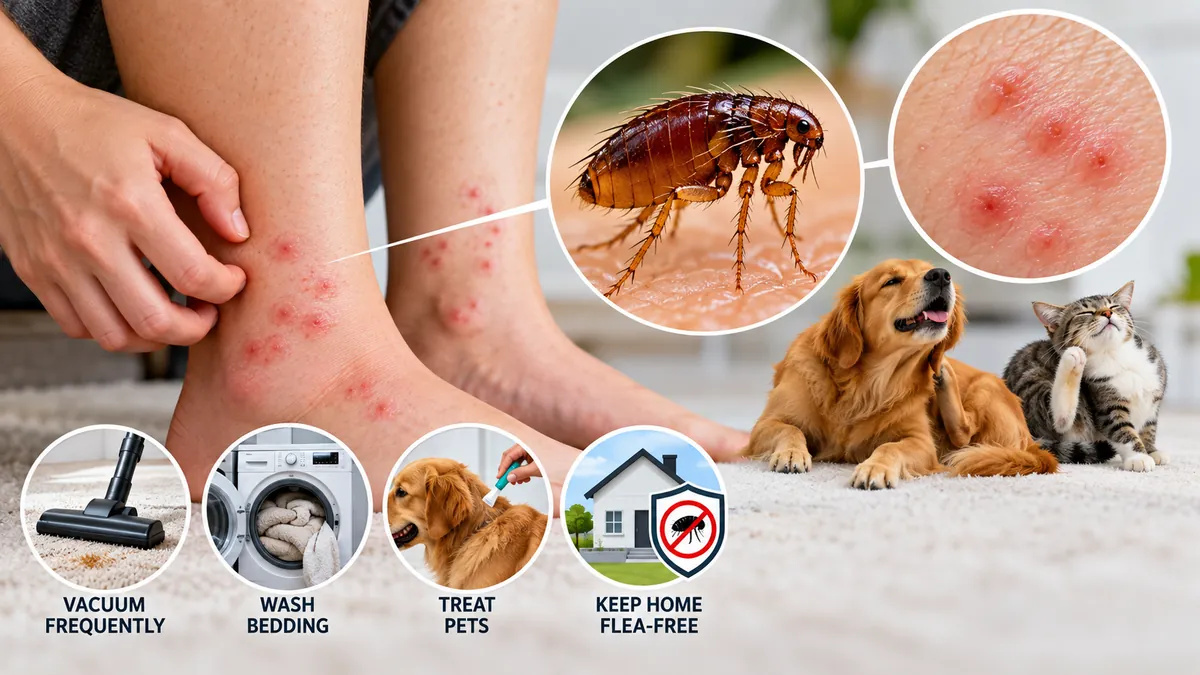
Flea bites can appear suddenly, itch intensely, and leave you wondering what is attacking your skin. They are especially common around the ankles and lower legs, although fleas can bite other exposed areas.
Flea bites are small, itchy bumps caused when fleas pierce the skin to take a blood meal. They commonly occur in groups or clusters, particularly around the feet, ankles, and lower legs. Most bites improve on their own, but controlling the flea infestation is essential to prevent new bites.
Most flea bites are uncomfortable rather than dangerous. The bigger problem is often persistent exposure: treating the skin may relieve itching, but bites can continue until fleas are eliminated from pets and the surrounding environment.
What Are Flea Bites?
Fleas are small, wingless parasitic insects that feed on blood. Species associated with humans and household animals include the human flea (Pulex irritans), cat flea (Ctenocephalides felis), and dog flea (Ctenocephalides canis).
Fleas cannot fly. Instead, their powerful hind legs allow them to jump onto animals or people. Humans are often bitten after coming into contact with an infested pet, home, carpet, bedding, furniture, yard, or other environment.
When a flea feeds, its mouthparts puncture the skin. Flea saliva is introduced during feeding and can trigger an inflammatory or allergic response. That reaction is responsible for much of the redness, swelling, and itching associated with flea bites.
Dogs and cats are frequent hosts. However, you do not necessarily need to own a pet to encounter fleas. Previous animal infestations, wildlife, rodents, stray animals, or visits to infested buildings can also expose people to them.
What Do Flea Bites Look Like?
Flea bites typically look like small, raised, intensely itchy bumps. Several bites may appear close together rather than as one isolated mark.
Common characteristics include:
- Small raised bumps
- Significant itching
- Mild swelling around the bite
- Multiple bites grouped together
- Bites concentrated around the ankles or lower legs
- Occasionally a blister or more pronounced inflammatory reaction
On lighter skin, inflammation may appear pink or red. On darker skin, redness may be less obvious, so swelling, itching, clustering, and changes in skin texture can be more useful clues.
Some people develop a stronger hypersensitivity response to flea saliva called papular urticaria. This can produce persistent, very itchy papules and sometimes blisters. Old bite sites may occasionally become inflamed again.
Appearance alone cannot always confirm that fleas caused a rash. Bed bugs, mosquitoes, mites, allergic reactions, dermatitis, and other skin conditions can produce similar-looking lesions.
Where Do Flea Bites Usually Appear?
One of the most useful clues is location.
Flea bites frequently occur on the feet, ankles, and lower legs because fleas can jump from floors, carpets, or nearby surfaces onto exposed skin. DermNet also notes that bites can occur around the waistband where fleas gain access beneath clothing.
Other exposed areas can be affected, including the arms or torso.
The NHS describes flea bites as commonly appearing in groups below the knees.
Location is helpful but not definitive. A flea can bite wherever it reaches exposed skin, so a bite above the knee does not automatically rule out fleas.
Flea Bites Symptoms
The most characteristic symptom is itching.
Symptoms can include:
- Itchy skin
- Small raised bumps
- Local redness or discoloration
- Mild swelling
- Tenderness or discomfort
- Clusters of multiple bites
- Blisters in stronger reactions
The itching may encourage repeated scratching. This creates another problem: damaged skin provides an opportunity for bacteria to enter.
Signs that a bite may have developed a secondary bacterial infection include increasing pain, worsening redness, warmth, pus, oozing, crusting, or pustules.
Why Do Flea Bites Itch So Much?
The itch is largely an immune reaction to substances introduced in flea saliva during feeding.
People respond differently. One person may develop only a small bump, while another exposed to the same fleas may experience significant inflammation and prolonged itching.
Repeated scratching tends to make the situation worse. It increases irritation and can break the protective skin barrier.
Flea Bites vs. Bed Bug Bites
Flea and bed bug bites are easy to confuse because both can produce multiple itchy bumps.
| Feature | Flea Bites | Bed Bug Bites |
|---|---|---|
| Common location | Ankles, feet, lower legs | Exposed skin during sleep |
| Typical exposure | Pets, carpets, floors, wildlife | Infested beds, mattresses, furniture |
| Appearance | Small itchy bumps | Itchy raised bumps |
| Pattern | Often clustered | May be clustered or arranged in lines |
| Main environmental clue | Fleas or flea dirt on pets | Bed bugs, shed skins, or spotting near sleeping areas |
Do not rely exclusively on the pattern of bites. Bite patterns vary significantly between people.
Environmental evidence is usually more useful. If a pet is scratching excessively and you discover tiny jumping insects or dark flea dirt in its fur, fleas become much more likely.
Flea Bites vs. Mosquito Bites
Mosquito bites commonly produce itchy raised bumps too, but they are often larger and more isolated than flea bites.
Flea bites tend to concentrate around the lower legs and may occur as several small lesions close together.
Exposure history again matters. New bites appearing after walking through an infested room, spending time around an affected animal, or noticing fleas on a pet point toward fleas.
Flea Bites vs. Mite Bites
Mites encompass many different organisms, so their skin effects vary. The NHS notes that mite bites can cause very itchy lumps and sometimes blisters.
Because several skin conditions and arthropod bites resemble one another, unexplained persistent rashes should not automatically be diagnosed as flea bites based on photographs alone.
How Long Do Flea Bites Last?
Simple flea bites generally resolve without specific medical treatment once exposure stops, although the exact healing time depends on the person’s skin reaction and whether they continue scratching.
A stronger allergic response can remain noticeable longer.
If apparently new bites keep appearing, consider the possibility that you are still being exposed. Applying creams to existing bites does not eliminate fleas living elsewhere in the home.
Persistent, worsening, painful, or infected-looking lesions deserve medical evaluation.
How to Treat Flea Bites
Treatment has two separate goals:
- Relieve the skin reaction.
- Stop further exposure by eliminating the fleas.
For a mild insect-bite reaction, washing the area gently with soap and water and applying a cold, damp cloth or wrapped cold pack for about 10 to 20 minutes can help reduce discomfort and swelling. Mayo Clinic also lists calamine, low-strength hydrocortisone, and certain oral antihistamines among options used for mild insect-bite symptoms.
DermNet similarly notes that oral antihistamines, anti-itch treatments, and topical steroids may be used to control itching and inflammation from flea bites.
Avoid Scratching
This simple recommendation matters.
Scratching temporarily satisfies the itch but can damage the skin, prolong irritation, and introduce bacteria.
Keep fingernails short, use appropriate itch-relief measures, and avoid aggressively rubbing affected areas.
Can You Use Hydrocortisone for Flea Bites?
Low-strength topical hydrocortisone is commonly used for mild inflammatory reactions to insect bites. The American Academy of Dermatology identifies hydrocortisone cream or ointment and oral antihistamines as treatments that can reduce itching from many uncomplicated bug bites.
Follow the product label and ask a healthcare professional or pharmacist if you are unsure whether it is appropriate for you, particularly for young children, pregnancy, sensitive skin areas, extensive rashes, or broken skin.
Do Flea Bites Need Antibiotics?
Ordinary flea bites do not require antibiotics.
Antibiotics may become necessary when scratching leads to a secondary bacterial infection. Increasing pain, pus, oozing, crusting, warmth, or worsening inflammation can indicate infection and should be assessed by a healthcare professional.
Do not use leftover antibiotics simply because a bite is red or itchy.
When Should You See a Doctor?
Most uncomplicated flea bites can be managed at home. Medical evaluation becomes more important when symptoms are severe, unusual, persistent, or suggest infection.
Seek medical advice for symptoms such as:
- Increasing redness, warmth, or pain
- Pus or drainage
- Open or worsening sores
- Significant swelling
- Persistent or spreading rash
- Fever or other systemic symptoms
- Bites that fail to improve
- Uncertainty about the cause of the skin reaction
Emergency symptoms after an insect bite include difficulty breathing, throat tightness, swelling of the lips, tongue, or face, significant dizziness, or other signs of a severe allergic reaction. These require immediate emergency care.
Can Flea Bites Spread Disease?
Most flea bites simply cause local skin irritation. However, fleas are medically important because certain flea species can act as vectors for infectious organisms.
For example, some rat fleas can transmit bacteria responsible for plague and flea-borne typhus. DermNet also notes an association between cat fleas and Bartonella henselae.
This does not mean an ordinary household flea bite is likely to cause one of these illnesses. Risk depends heavily on flea species, geography, animal reservoirs, and exposure circumstances.
The CDC nevertheless emphasizes that fleas can spread bacteria and parasites responsible for serious disease, making prevention worthwhile beyond simply avoiding itchy skin.
Why Do Flea Bites Keep Appearing?
If you treat the bites but wake up or return home with new ones, the problem is probably not your skin treatment.
It is the flea life cycle.
Fleas develop through four main stages:
- Egg
- Larva
- Pupa
- Adult
Adult fleas feed on hosts, while eggs and developing stages can exist in the surrounding environment. Carpets, cracks, furniture, floors, and pet bedding can therefore continue harboring parts of the flea population.
This explains why killing a few visible adult fleas may not solve an infestation.
Pupae are especially relevant because adults can emerge when environmental conditions and stimuli are suitable. A home that appears temporarily flea-free can therefore produce new adults later.
How to Get Rid of Fleas in Your Home
Effective control needs to target the environment and pets at the same time.
The CDC recommends a coordinated approach involving sanitation, treatment of every pet, home treatment, and follow-up. Moderate or severe infestations can take months to fully control because of the flea life cycle.
1. Vacuum Thoroughly
Vacuum carpets, rugs, upholstered furniture, floors, wall edges, cracks, and areas where pets spend time.
The CDC recommends vacuuming frequently and emptying the vacuum bag outside afterward.
A single vacuuming session is unlikely to solve an established infestation. Repeated cleaning helps remove different flea life stages as they become accessible.
2. Wash Bedding
Wash human bedding when relevant, along with blankets, rugs, and especially pet bedding.
Flea eggs can fall from animals into their surroundings, so repeatedly cleaning favorite pet resting areas is particularly important.
3. Treat Every Pet
Treating the house while leaving an infested dog or cat untreated allows the cycle to continue.
The CDC advises treating every pet in an infested household and consulting a veterinarian about an appropriate flea-control product.
Never assume a flea treatment that is appropriate for one animal is automatically safe for another. Follow veterinary and product guidance carefully.
4. Treat the Environment When Necessary
A significant infestation may require an appropriate household flea-control product or professional pest-management service.
Follow pesticide labels exactly and pay particular attention to precautions involving children and pets.
Severe infestations can be stubborn because treatments may kill exposed adults without immediately eliminating every developing flea.
5. Follow Up
This is the step people frequently miss.
The CDC recommends follow-up because some fleas can continue emerging after initial treatment.
Continue vacuuming, cleaning, checking pets, and following the recommended pest-control schedule even when you stop seeing adult fleas.
Quick Takeaway: Treating flea bites without treating the infestation provides only temporary relief. Successful control means addressing pets, carpets, bedding, furniture, and other flea habitats together.
How to Check Your Pet for Fleas
A pet that repeatedly scratches, bites, or licks its coat deserves closer inspection.
Use a flea comb and inspect areas such as:
- Around the neck
- Near the base of the tail
- Along the back
- Groin area
- Back of the legs
You may see adult fleas, but you may instead notice flea dirt — tiny dark particles resembling black pepper. DermNet notes that flea feces can appear reddish when placed on a damp towel because they contain digested blood.
Your veterinarian can recommend prevention or treatment appropriate for the animal.
How to Prevent Flea Bites
Preventing an infestation is considerably easier than eliminating an established one.
The CDC says the best way to prevent fleas on people is to keep pets free from fleas.
Useful prevention measures include:
- Check pets regularly.
- Use veterinarian-recommended flea prevention.
- Wash pet bedding frequently.
- Vacuum carpets, rugs, sofas, and pet resting areas.
- Limit pets’ contact with stray and wild animals.
- Keep rodents and wildlife away from the home.
- Maintain outdoor areas where pets spend time.
- Address fleas immediately when you discover them.
Fleas favor warm, humid conditions, but they can survive year-round when suitable hosts and indoor conditions are available.
Protecting Yourself in Flea-Prone Areas
When exposure is likely, covering the feet and lower legs can reduce available skin.
The CDC recommends long pants and socks and lists EPA-registered repellents containing ingredients such as DEET, picaridin, IR3535, Oil of Lemon Eucalyptus, PMD, or 2-undecanone for protection against fleas when used according to their labels.
Permethrin can also be used on certain clothing and gear according to product directions. It should not be treated as an ordinary skin repellent.
Can You Have Flea Bites Without Pets?
Yes.
Although dogs and cats are major household hosts, people without pets can still encounter fleas.
Possible sources include:
- Rodents
- Wildlife
- Stray animals
- Previous occupants’ pets
- Infested carpets or furniture
- Visits to infested buildings
- Outdoor environments
DermNet notes that entering an unoccupied building that previously housed infested animals can expose someone to fleas remaining in carpets and floorboards. Movement and vibration can stimulate adults to emerge from pupae.
So unexplained bites should not be dismissed simply because there is no dog or cat in the home.
Are Flea Bites Dangerous for Children?
Children can develop the same itchy skin reactions as adults and may be more likely to scratch the bites.
The main priorities are controlling itching, protecting the skin from scratching, and eliminating the source of the fleas.
Medication choices and doses differ by age. Parents and caregivers should follow pediatric or pharmacist guidance rather than assuming an adult anti-itch product is suitable for a young child.
Fever, significant swelling, drainage, widespread hives, breathing difficulty, or other concerning symptoms require medical assessment.
What Is Papular Urticaria?
Papular urticaria is a hypersensitivity reaction to insect bites. Fleas are among the insects that can trigger it.
Instead of a small temporary bump, affected individuals may develop recurrent groups of intensely itchy papules. Some lesions can blister, become crusted after scratching, or persist longer than an ordinary bite.
Continued exposure may cause repeated episodes, making environmental flea control especially important.
A clinician or dermatologist can help when recurrent suspected bites persist despite reasonable pest-control measures or when the diagnosis is uncertain.
What About Sand Flea Bites?
The term sand flea can be confusing because people use it for several different organisms.
One medically important example is Tunga penetrans, a flea that can burrow into human skin and cause tungiasis. This is different from an ordinary cat or dog flea biting exposed skin.
DermNet describes tungiasis as inflammatory lesions commonly affecting the feet, particularly around or between the toes.
A painful lesion after relevant travel or exposure — particularly one that appears embedded in the skin, ulcerates, or becomes infected — should be professionally evaluated rather than treated as an ordinary flea bite.
Common Mistakes When Dealing With Flea Bites
Treating Only the Skin
Anti-itch treatments can make you more comfortable, but they do not kill fleas in your carpet or on your pet.
Without environmental control, new bites can continue.
Treating Only One Pet
Every susceptible pet in the household needs appropriate evaluation and flea control. Otherwise, untreated animals can maintain the infestation.
Stopping Cleaning Too Soon
Visible adult fleas represent only part of the problem. Eggs, larvae, and pupae may remain in the environment.
Continue the recommended cleaning and treatment schedule after the obvious fleas disappear.
Scratching Until the Skin Breaks
Persistent scratching raises the risk of secondary infection. Controlling the itch and protecting damaged skin are more useful than repeatedly scratching.
Assuming Every Cluster of Bites Is Fleas
Bed bugs, mosquitoes, mites, dermatitis, and other conditions can resemble flea bites.
Look for supporting environmental evidence rather than diagnosing the problem solely from the arrangement of bumps.
Flea Bites: The Bottom Line
Flea bites are usually small, intensely itchy bumps that commonly occur in clusters around the ankles, feet, and lower legs. Most uncomplicated bites improve with basic skin care and itch relief, but scratching can lead to secondary infection.
The most effective long-term solution is not simply treating the bumps. It is breaking the flea life cycle by treating affected pets, washing bedding, vacuuming thoroughly, controlling fleas in the home, and following up until the infestation is eliminated.
If the bites become increasingly painful, warm, swollen, infected, or are accompanied by fever or other systemic symptoms, seek medical advice. Difficulty breathing or swelling of the face, lips, tongue, or throat after an insect bite requires immediate emergency care.