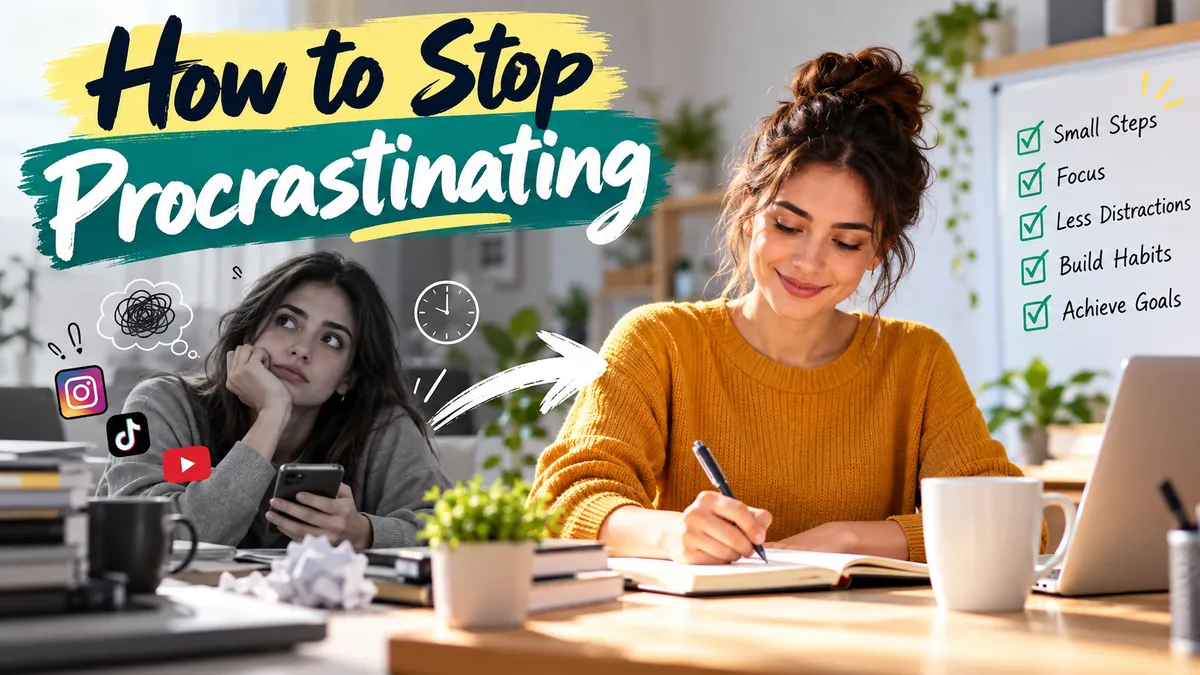
You know the task needs to get done. You may even care deeply about the outcome. Yet somehow you check your phone, answer an unimportant email, clean your desk, or promise yourself you will start tomorrow.
Learning how to stop procrastinating begins with understanding that procrastination is usually more complicated than laziness. The American Psychological Association defines it as unnecessarily and voluntarily delaying an intended task despite knowing that the delay may have negative consequences. Research increasingly connects this behavior with emotion regulation: avoiding a task can temporarily help you escape boredom, anxiety, frustration, uncertainty, or self-doubt. American Psychological Association
Quick answer: To stop procrastinating, make the first step extremely small, identify the uncomfortable feeling driving avoidance, remove obvious distractions, decide exactly when and where you will work, and focus on starting rather than finishing. Consistent small starts reduce the emotional barrier surrounding difficult tasks and make productive behavior easier to repeat.
Why Do We Procrastinate?
Procrastination often looks like a time-management problem from the outside.
You have three hours available. The assignment requires two. You wait until only 45 minutes remain.
It seems irrational—and in many cases it is. But the behavior makes more sense when you consider what happens emotionally.
Suppose you need to prepare an important presentation. Opening the blank document triggers uncertainty:
- What if my ideas aren’t good enough?
- Where should I begin?
- What will my manager think?
- What if this takes hours?
You close the document and watch a video instead.
Immediately, the discomfort decreases.
That relief matters. Your brain has effectively learned:
Difficult task → uncomfortable feeling → avoidance → temporary relief
Psychologist Fuschia Sirois describes procrastination as closely connected with emotion regulation rather than simply poor time management. Avoidance can provide short-term mood repair, even though it creates additional stress for your future self. American Psychological Association
Research also supports the broader connection. Studies have found relationships between difficulties regulating emotions and greater procrastination, including among students. ScienceDirect
This explains why buying another planner does not always solve the problem.
If anxiety is making you avoid a task, a better calendar alone cannot remove the anxiety.
Procrastination Is Not the Same as Laziness
The distinction is useful.
Someone who is procrastinating generally intends to complete the task but delays acting on that intention.
You might desperately want to finish your thesis while repeatedly avoiding it.
You might care about exercising while postponing your workout every afternoon.
You might want a clean house while staring at the mess and feeling unable to begin.
That conflict between intention and action is a central feature of procrastination.
Calling yourself lazy can actually distract you from discovering the real obstacle.
Instead, ask:
“What makes starting this particular task uncomfortable?”
The answer gives you something you can work with.
How to Stop Procrastinating: 10 Strategies That Actually Help
There is no single anti-procrastination technique that works for every situation. The right strategy depends on why you are avoiding the task.
Someone overwhelmed by a huge project needs a different solution from someone constantly distracted by social media.
Start with these practical approaches.
1. Make the First Step Ridiculously Small
“Write my dissertation” is not an actionable first step.
Neither is:
“Finish presentation.”
“Study biology.”
“Get fit.”
“Clean the house.”
These describe outcomes rather than immediate actions.
Convert the project into something you could physically do right now.
Instead of:
Study for the exam
Try:
Open chapter four and read pages 62–64.
Instead of:
Write the report
Try:
Open the document and write three bullet points.
Instead of:
Clean the kitchen
Try:
Put the dishes in the dishwasher.
Breaking tasks into manageable pieces is also among the practical strategies recommended in current clinical guidance on procrastination. Understood
The smaller the first action, the less motivation you need to begin.
2. Use the Five-Minute Start
Tell yourself:
“I’ll work on this for five minutes.”
Not an hour.
Not until completion.
Five minutes.
This changes the psychological question from:
“Can I finish this?”
to:
“Can I tolerate five minutes of this?”
Usually, the second question feels much easier.
After five minutes, you can choose whether to continue.
The goal is not to trick yourself into secretly working for three hours. The technique works because it separates starting from finishing.
You only need enough motivation for the first action.
3. Identify the Emotion Behind the Delay
When you notice yourself procrastinating, stop and name what you are experiencing.
Maybe the task feels:
| Feeling | What may be happening |
|---|---|
| Boring | The immediate reward is too small |
| Overwhelming | The task feels too large or unclear |
| Frustrating | Progress feels difficult |
| Anxiety-provoking | You fear making a mistake |
| Meaningless | You cannot see the value |
| Uncertain | You don’t know what to do next |
| Intimidating | Your expectations are extremely high |
Then solve the actual problem.
If you are confused, clarify the next step.
If you are overwhelmed, shrink the task.
If you are bored, add a short work sprint or immediate reward.
If you are anxious, lower the standard for the first draft.
If you are uncertain, spend 10 minutes gathering the missing information.
Experimental research has found that strengthening skills for tolerating and modifying unpleasant emotions can reduce procrastination, reinforcing the value of addressing the emotional component rather than relying exclusively on time-management techniques. ScienceDirect
4. Stop Waiting for Motivation
One of the most persistent procrastination traps sounds reasonable:
“I’ll start when I feel motivated.”
Unfortunately, motivation does not always arrive before action.
Think about ordinary habits.
You probably don’t need inspiration to brush your teeth. The behavior happens because it has a predictable place in your routine.
Try giving important work the same structure.
Instead of:
“I’ll study tonight.”
Decide:
“At 7:00 p.m., I’ll sit at my desk and review chapter five for 25 minutes.”
Now you have defined:
When: 7:00 p.m.
Where: desk
What: chapter five
Duration: 25 minutes
Vague intentions leave room for negotiation.
Specific plans reduce it.
How to Stop Procrastinating by Removing Distractions
Sometimes the emotional barrier is only half the problem.
Your environment may be designed for interruption.
A smartphone can provide messages, videos, news, games, social media, shopping, and entertainment within seconds. Meanwhile, your important project may offer no reward for weeks or months.
Trying to resist every temptation through willpower creates unnecessary difficulty.
Change the environment instead.
5. Add Friction to Your Distractions
Make distracting behaviors slightly harder.
You can:
- Put your phone in another room.
- Turn off unnecessary notifications.
- Log out of distracting websites.
- Close unused browser tabs.
- Remove social apps from your home screen.
- Use website blockers during focused work.
- Keep only the materials needed for the current task visible.
You do not necessarily need perfect discipline.
Sometimes you need your distraction to require 20 seconds more effort.
That tiny barrier creates an opportunity to notice what you are doing before automatically continuing.
6. Make Productive Behavior Easier
Friction works in both directions.
Make distractions harder and important actions easier.
If you want to exercise tomorrow morning, prepare your clothes tonight.
If you want to write, leave your document open.
If you need to study, place your book and notebook on your desk beforehand.
If you repeatedly avoid an administrative task, bookmark the exact page you need rather than forcing yourself to find it every time.
The goal is simple:
Reduce the number of decisions between you and starting.
How to Stop Procrastinating When You Feel Overwhelmed
Large projects create a special problem.
Your brain sees:
“Launch website.”
“Write thesis.”
“Find new job.”
“Plan wedding.”
“Start business.”
These aren’t individual tasks. They’re collections of dozens or hundreds of tasks.
When the path forward is unclear, avoidance becomes attractive.
7. Find the Next Physical Action
Ask:
“What is the next action I can actually perform?”
Imagine you need to apply for a job.
“Get a new job” cannot be completed this afternoon.
But these can:
- Find three relevant job listings.
- Choose one.
- Read the requirements.
- Open your résumé.
- Update the professional summary.
- Draft the application.
- Proofread it.
- Submit it.
Now the project has a path.
If you are still avoiding step one, make it smaller:
Open the job website.
When procrastination appears, keep shrinking the next step until resistance falls.
8. Use Time Blocks Instead of Giant To-Do Lists
Long to-do lists can become collections of guilt.
You write down 17 tasks, finish four, and spend the evening thinking about the 13 you missed.
A time block answers a different question:
When will I actually do this?
For example:
| Time | Task |
|---|---|
| 9:00–9:30 | Answer important emails |
| 9:30–10:30 | Work on presentation |
| 10:30–10:45 | Break |
| 10:45–11:30 | Continue presentation |
| 11:30–12:00 | Administrative tasks |
The schedule does not have to be rigid.
Its purpose is to turn an abstract intention into a concrete appointment.
Build in breaks and extra time. If every minute is allocated, one unexpected interruption can destroy the entire plan.
How Perfectionism Can Cause Procrastination
Perfectionism and procrastination can coexist surprisingly well.
Consider two goals:
Goal A: Write a rough introduction.
Goal B: Write an intelligent, original, beautifully structured introduction that impresses everyone who reads it.
Which one is easier to start?
The second goal creates much more emotional pressure.
Perfectionism can turn an ordinary task into a judgment of your ability or worth. Avoidance then becomes a convenient way to postpone that judgment.
9. Give Yourself Permission to Produce a Bad First Draft
Separate creation from evaluation.
During the first pass, your job is to produce material.
During the second, your job is to improve it.
Writers can write messy drafts.
Students can make imperfect notes.
Designers can create ugly sketches.
Entrepreneurs can test incomplete ideas.
You cannot edit a blank page.
When perfectionism appears, replace:
“I need to do this extremely well.”
with:
“I need to create something I can improve.”
That small change can dramatically lower the emotional cost of starting.
How to Stop Procrastinating on Studying
Academic procrastination deserves particular attention because students constantly deal with distant deadlines.
An exam three weeks away has little immediate urgency.
A video on your phone offers an immediate reward.
Waiting until the night before the exam reverses the equation: suddenly the consequences are immediate, so motivation rises sharply.
This can accidentally teach students that pressure is necessary for productivity.
A better approach is to create earlier, smaller deadlines.
Instead of:
“Study chemistry before Friday’s exam.”
Try:
Monday: Review chapter 4 for 30 minutes.
Tuesday: Complete 15 practice questions.
Wednesday: Review incorrect answers.
Thursday: Complete a practice test.
Each session has a visible finish line.
Research on academic procrastination continues to show meaningful links between procrastination and difficulties with emotion regulation, suggesting students may benefit from addressing both study habits and the feelings associated with academic tasks. ScienceDirect
Try Active Work Instead of Passive “Studying”
Another source of avoidance is ambiguity.
“Study” doesn’t explain what you should actually do.
Choose measurable actions:
- Answer practice questions.
- Test yourself with flashcards.
- Explain a concept without looking at your notes.
- Solve problems.
- Create questions from your reading.
- Review mistakes from previous tests.
At the end of a session, you should be able to say exactly what you completed.
What If You Procrastinate at Work?
Workplace procrastination often hides behind productive-looking activities.
You might answer emails, reorganize folders, update spreadsheets, schedule meetings, or research minor details while avoiding the one difficult task that actually matters.
This is sometimes called productive procrastination: you are busy, but your busyness protects you from the higher-priority task.
At the beginning of the day, identify:
What task would make today meaningfully successful if I completed it?
Then protect time for it before low-value work expands.
If possible, avoid beginning the day with endless email or notifications. Those activities allow other people’s priorities to determine your attention.
Use Accountability When Necessary
Some people work more consistently when another person knows what they intend to accomplish.
You might tell a colleague:
“I’ll send you the first draft by 3 p.m.”
A student might arrange a study session with a friend.
A remote worker might use a virtual coworking session.
The accountability does not need to involve punishment. Its value comes from turning a private intention into a visible commitment.
Why Self-Criticism Often Makes Procrastination Worse
After procrastinating, people commonly attack themselves:
“I’m so lazy.”
“I’ve wasted another day.”
“Why can’t I just be disciplined?”
This may feel like accountability, but shame does not necessarily make the next attempt easier.
Remember the emotional cycle:
Unpleasant emotion → avoidance → temporary relief
If procrastination is followed by intense guilt and self-criticism, the task becomes associated with even more unpleasant emotion.
That can increase resistance the next time you face it.
The alternative isn’t pretending the delay doesn’t matter.
Acknowledge it accurately:
“I avoided this task for two hours. What made me avoid it, and what can I change for the next attempt?”
That response contains accountability without turning the mistake into an identity.
Sirois also highlights self-compassion as relevant to breaking the guilt-and-shame cycle surrounding procrastination. American Psychological Association
The Procrastination Cycle and How to Break It
Procrastination often follows a predictable pattern:
- You encounter a difficult or unpleasant task.
- The task creates boredom, anxiety, uncertainty, frustration, or another uncomfortable emotion.
- You avoid the task.
- Avoidance produces immediate relief.
- The deadline gets closer.
- Stress increases.
- You eventually complete the task under pressure.
- You promise yourself next time will be different.
- The cycle repeats.
Breaking the cycle is easiest near the beginning.
You do not have to eliminate discomfort.
You need to learn:
“I can feel uncomfortable and still take the next small action.”
That is why emotion regulation matters. Research involving both behavioral interventions and neuroscience continues to support a meaningful relationship between emotion regulation and procrastination. PubMed
10. Build a System Instead of Relying on Willpower
Willpower changes.
Some mornings you feel energetic. Other days you are tired, distracted, stressed, or frustrated.
A reliable system should still help you begin.
Build one around a few simple rules:
Define the next action.
Never leave important projects as vague goals.
Schedule important work.
Decide when you will do it.
Reduce distractions beforehand.
Don’t wait until you’re distracted to create boundaries.
Start small.
Lower the activation energy required to begin.
Track completion.
Visible progress reinforces consistency.
Review failures without judgment.
If your system fails repeatedly, change the system.
Habits and systems are also part of the practical framework described in professional guidance on procrastination. Harvard Business Review
What to Do When Nothing Seems to Work
Occasional procrastination is common.
Persistent procrastination is different.
If you repeatedly miss deadlines, cannot begin important tasks despite serious consequences, or procrastination substantially interferes with school, work, relationships, finances, or daily responsibilities, it may be worth looking deeper.
Procrastination itself is not automatically evidence of a mental health condition.
However, difficulties with attention, executive functioning, anxiety, mood, stress, and other factors can affect someone’s ability to initiate or complete tasks. For example, executive-function difficulties associated with ADHD can make planning, focusing, starting, and completing tasks more challenging. Understood
Rather than diagnosing yourself based on procrastination alone, consider discussing persistent difficulties with a qualified healthcare or mental health professional.
A Simple Anti-Procrastination Plan You Can Use Today
You don’t need to redesign your entire life tonight.
Pick one task you’ve been avoiding and do this:
- Name the task. Write down exactly what you are postponing.
- Name the emotion. Ask what feels uncomfortable about it.
- Shrink the task. Find an action that takes five minutes or less.
- Choose a start time. Put it on your schedule.
- Remove one distraction. Move your phone, close the tab, or silence notifications.
- Work for five minutes. Starting is the immediate goal.
- Continue if you want. If momentum develops, use it.
- Record the progress. Make the completed action visible.
- Choose the next action. Don’t leave yourself another vague project.
- Repeat tomorrow.
Suppose you’ve been avoiding a 20-page report.
Do not tell yourself:
“Tonight I’m finally finishing this report.”
Try:
“At 7:00 p.m., I’ll put my phone in the other room, open the report, and outline the first section for five minutes.”
That is specific enough to execute.
How Long Does It Take to Stop Procrastinating?
There isn’t a universal number of days.
Procrastination is behavior influenced by the task, environment, habits, emotions, motivation, and individual circumstances. Someone may procrastinate heavily on writing but never on exercise. Another person may work efficiently yet constantly delay household tasks.
That means progress is better measured by behavior than by counting days.
Ask:
- Am I starting important tasks earlier?
- Are my delays becoming shorter?
- Can I work despite feeling uncomfortable?
- Do I recover faster after getting distracted?
- Am I meeting more of my deadlines?
- Do large projects feel easier to break down?
Those changes matter more than maintaining a perfect streak.
Final Thoughts on How to Stop Procrastinating
Understanding how to stop procrastinating does not require discovering a magical productivity trick. It requires recognizing what happens between intending to do something and actually beginning.
Procrastination frequently offers an immediate reward: relief from an unpleasant task or the emotions connected to it. Unfortunately, that relief transfers the problem—and usually additional stress—to your future self. Research on emotion regulation helps explain why simply telling yourself to “try harder” is often inadequate. American Psychological Association
Make the alternative easier.
Shrink the task. Define the next physical action. Remove distractions. Schedule a specific starting point. Accept that the first attempt can be imperfect. And when you slip, investigate the obstacle instead of spending your energy criticizing yourself.
You don’t need to feel completely motivated before you begin.
Choose one task you’ve been postponing, reduce it to a five-minute action, and start there.