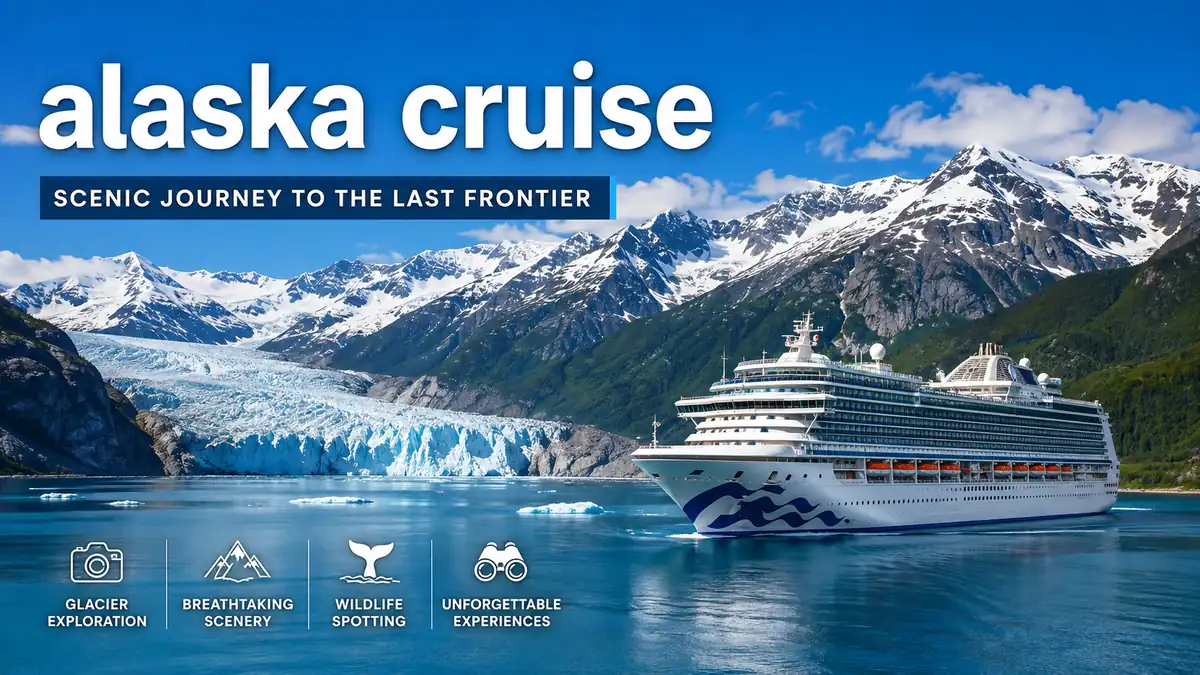
An alaska cruise is not the kind of trip where the ship is simply transportation between destinations. Much of the experience happens while you are sailing: forested islands slide past the windows, whales surface in cold coastal waters, and glaciers appear at the ends of enormous fjords.
That also makes choosing an itinerary more complicated than it first appears. Two seven-night cruises can visit different glaciers, spend different amounts of time in port, and follow noticeably different routes.
An alaska cruise typically sails between May and September, with popular itineraries exploring Southeast Alaska’s Inside Passage and ports such as Juneau, Ketchikan, Skagway, Sitka, and Icy Strait Point. Travelers can experience tidewater glaciers, whale watching, Alaska Native culture, Gold Rush history, rainforest landscapes, and scenic cruising, often during a seven-night voyage.
This guide explains how the major routes differ, when to travel, which ports deserve your attention, how glacier viewing works, what to pack, and what first-time passengers often overlook.
What Is an alaska cruise Really Like?
Cruising Alaska feels very different from a warm-weather island cruise.
The destination is the main event. Passengers often spend long stretches outside watching mountains, waterfalls, forests, wildlife, and glaciers rather than treating sea days simply as downtime.
Southeast Alaska’s Inside Passage stretches roughly 500 miles along the Pacific coast. Much of the region is covered by the Tongass National Forest, and its landscape includes islands, fjords, temperate rainforest, mountains, and tidewater glaciers.
The region is also the traditional homeland of Alaska Native peoples including the Tlingit, Haida, and Tsimshian. Their history and living cultures remain an important part of communities throughout Southeast Alaska.
A typical cruise combines three types of experiences:
- Port days: exploring communities such as Juneau, Ketchikan, and Skagway.
- Scenic cruising: sailing through fjords, channels, and glacier areas.
- Sea days: traveling between Alaska and the embarkation port while enjoying the ship and surrounding landscape.
That combination makes Alaska accessible to travelers who want substantial scenery and wildlife without changing hotels every few days.
Best Time for an alaska cruise
The main Alaska cruise season runs from May through September.
There isn’t one universally perfect month. Your best choice depends on what matters most: weather, wildlife, daylight, crowds, or shoulder-season conditions.
| Period | Typical Advantages | Things to Consider |
|---|---|---|
| May | Long daylight, early-season scenery, often fewer peak-season crowds | Cooler temperatures are possible |
| June | Very long days and excellent sightseeing time | Popular travel period |
| July | Peak summer season and broad excursion availability | Busy ports and higher demand |
| August | Strong wildlife opportunities and full-season operations | Rain becomes an important consideration |
| September | Autumn atmosphere and late-season travel | Cooler, wetter weather and shorter days |
Is May a good time to cruise Alaska?
Yes, particularly if you don’t mind cooler conditions.
May offers increasingly long daylight hours, snow remaining on surrounding mountains, and the beginning of the main visitor season. Pack proper layers because temperatures can feel significantly colder when you’re standing outside on a moving ship.
Is July the best month?
July is popular for good reason. It’s the heart of summer, excursions are operating extensively, and travelers get plenty of daylight.
That doesn’t guarantee sunshine.
Southeast Alaska is a temperate rainforest region, so even a midsummer voyage can include fog, drizzle, wind, sunshine, and rain within the same trip.
What about September?
September can appeal to travelers who enjoy cooler autumn conditions. The tradeoff is greater potential for wet, chilly weather and reduced daylight compared with June or July.
Quick Takeaway: Choose your month based on priorities rather than chasing a supposedly perfect forecast. Alaska’s coastal weather is too variable for any month to guarantee clear skies.
Inside Passage vs. Gulf of Alaska Routes
One of the biggest decisions is choosing the route.
Most first-time travelers encounter two broad categories: Inside Passage round trips and Gulf of Alaska one-way cruises.
Inside Passage cruises
The Inside Passage is the classic introduction to Southeast Alaska.
Cruises commonly depart from Seattle or Vancouver and visit several communities along Alaska’s southeastern coastline. Travel Alaska describes the Inside Passage as the state’s most popular cruise route.
Possible stops include:
- Ketchikan
- Juneau
- Skagway
- Sitka
- Hoonah/Icy Strait Point
Depending on the itinerary, scenic cruising may include Glacier Bay, Tracy Arm, Endicott Arm, or another glacier destination.
Round-trip itineraries are particularly convenient because passengers begin and end in the same city.
Gulf of Alaska cruises
Cross-Gulf itineraries continue farther north and commonly operate one way between Vancouver and Southcentral Alaska.
Seward and Whittier are important endpoints. Travelers can then connect toward Anchorage or extend their trip into Interior Alaska. Travel Alaska highlights seven-day routes that travel through Southeast Alaska before ending in Whittier or Seward.
This format makes sense if you want to combine cruising with a land trip.
For example:
- Cruise north through Southeast Alaska.
- Arrive in Seward or Whittier.
- Continue to Anchorage.
- Add destinations in Interior Alaska.
Which route is better for a first cruise?
For simplicity, a seven-night Inside Passage round trip works very well.
For a more extensive Alaska vacation, a one-way Gulf itinerary can provide a natural bridge between Southeast Alaska and a land journey.
The key is not simply counting ports. Compare the actual scenic cruising and hours ashore.
Seattle vs. Vancouver Departure
Seattle and Vancouver are two major gateways, but the experience isn’t identical.
Cruising from Seattle
Seattle offers a large selection of mainstream cruise options. Many are seven-night round trips visiting ports such as Juneau, Ketchikan, and Skagway, often with a Canadian call such as Victoria.
Seattle can be particularly convenient for U.S.-based travelers because of its extensive flight network.
Some Seattle itineraries travel on the western side of Vancouver Island, meaning passengers can experience more exposed Pacific waters.
That matters if you are sensitive to motion.
Cruising from Vancouver
Vancouver is exceptionally well positioned for Inside Passage cruising.
Ships departing Vancouver can travel through the protected waterways between mainland British Columbia and Vancouver Island. Vancouver also offers round-trip and one-way options, including itineraries designed to connect with Alaska land travel.
Seattle or Vancouver?
| Consideration | Seattle | Vancouver |
| Round-trip choices | Excellent | Excellent |
| One-way options | More limited | Strong |
| Inside Passage sailing | Depends on itinerary | Often stronger |
| U.S. flight convenience | Excellent | Requires international arrival for U.S. travelers |
| Land-tour combinations | Less convenient | Excellent |
| Open-Pacific exposure | Possible | Often less |
Don’t choose purely by airfare. Look at the entire itinerary first.
The Alaska Cruise Ports You Should Know
Ports may look similar on a map, but they offer distinctly different experiences.
Juneau
Juneau combines mountains, glaciers, marine wildlife, hiking, and the amenities of Alaska’s capital.
Whale-watching excursions are especially popular, while glacier-related activities are another major attraction.
The surrounding landscape means you can go from downtown streets to dramatic wilderness surprisingly quickly.
If your port day is short, avoid trying to squeeze several major excursions into a few hours. Pick the experience you care about most and leave some margin for transportation.
Ketchikan
Ketchikan is usually among the southernmost major Alaska ports visited on Inside Passage itineraries.
It is closely associated with salmon, Alaska Native culture, historic Creek Street, and access to Misty Fjords National Monument. Totem Bight State Historical Park and Saxman Native Village are among the places where visitors can learn more about regional Native art and culture.
Ketchikan is also located in a very wet climate.
A waterproof jacket is much more useful than an umbrella when you’re walking, boating, or taking an outdoor excursion.
Skagway
Skagway’s identity is closely connected with the Klondike Gold Rush.
The surrounding region contains reminders of the thousands of prospectors who traveled north during the late 1890s. The historic White Pass route and Chilkoot Trail are major parts of that story.
The White Pass & Yukon Route railway has become one of the area’s best-known visitor experiences.
Even travelers who aren’t particularly interested in trains often appreciate the mountain scenery.
Sitka
Sitka offers a somewhat different cultural mix.
The community reflects both Alaska Native history and the period of Russian influence in Alaska. Sitka National Historical Park provides opportunities to learn about Tlingit culture and local history, while the Alaska Raptor Center is another well-known attraction.
Sitka can be particularly rewarding for travelers interested in history, wildlife, and cultural experiences.
Icy Strait Point and Hoonah
Hoonah and nearby Icy Strait Point have become increasingly familiar stops on Alaska itineraries.
The area is strongly associated with Tlingit culture and wildlife experiences. Whale watching is a major draw, and the surrounding landscape feels noticeably different from a conventional urban cruise port.
Glacier Bay National Park: Why It Matters
For many travelers, glaciers are the defining image of Alaska cruising.
Glacier Bay National Park & Preserve is particularly significant.
Cruise ships visiting Glacier Bay do not dock in the national park. Instead, the ship spends much of the day traveling through the bay. The National Park Service says cruise visits typically last around nine to ten hours and include time near a major tidewater glacier.
National Park Service naturalists may board participating ships and provide interpretation about the park’s ecology, geology, wildlife, and history.
Wildlife can include:
- humpback whales
- sea otters
- brown bears
- harbor seals
- seabirds
Glacier viewing itself requires patience.
A ship may approach a glacier and remain nearby while passengers watch for movement. Calving occurs when ice breaks from the glacier and falls into the water, but it isn’t a scheduled performance.
Bring binoculars and spend time outside rather than watching entirely through cabin glass.
Do all Alaska cruises visit Glacier Bay?
No.
This is one of the most common planning mistakes.
The National Park Service specifically advises travelers to examine itineraries carefully because many Alaska cruises do not visit Glacier Bay National Park.
If Glacier Bay matters to you, confirm it on the itinerary before choosing the sailing.
Glacier Bay vs. Tracy Arm and Endicott Arm
Glacier Bay isn’t the only worthwhile glacier destination.
Tracy Arm is a narrow fjord surrounded by steep cliffs, waterfalls, floating ice, and mountain scenery. Ships may sail toward Sawyer Glacier when conditions allow.
Endicott Arm provides another dramatic fjord experience and leads toward Dawes Glacier.
Conditions matter.
Ice, weather, navigation requirements, wildlife protections, and other operational considerations can affect how close ships get to particular glaciers.
This is why it’s better to think in terms of a glacier experience rather than expecting one exact photograph.
Wildlife You Might See
Wildlife watching starts on the ship, not when you step onto a tour bus.
The waters and forests of Southeast Alaska support an extraordinary range of animals.
Possible sightings include:
- humpback whales
- orcas
- sea otters
- seals
- sea lions
- bald eagles
- black bears
- brown bears
- mountain goats
- deer
Travel Alaska notes that passengers traveling the coastline may encounter orcas and humpback whales at sea while bears, mountain goats, moose, and other animals can sometimes be spotted along the coast or during land travel.
But wildlife is wild.
No ethical excursion operator can guarantee that a bear will stand in exactly the right place or a whale will breach beside your boat.
How do you improve your chances?
Spend time looking.
Many passengers miss wildlife because they’re indoors when the ship is passing through productive waters.
Bring binoculars and periodically scan:
- the water ahead of the ship,
- shorelines,
- rocky islands,
- areas where seabirds are actively feeding.
Binoculars are among the most useful items you can pack for distant wildlife and glacier viewing.
Choosing Alaska Cruise Excursions
Excursions can transform the trip, but booking an expensive activity in every port isn’t necessary.
Start by deciding what you genuinely want to experience.
Whale watching
Juneau and Icy Strait Point/Hoonah are popular areas for marine wildlife excursions.
Smaller boats can provide a different perspective than watching from a large cruise ship.
Flightseeing
Small aircraft and helicopters can reveal the enormous scale of Alaska’s mountains, glaciers, and icefields.
These experiences can be spectacular, but weather may affect operations.
Glacier experiences
Depending on the destination, options can include:
- glacier viewpoints
- boat tours
- helicopter landings
- guided hikes
- paddling excursions
Pay close attention to mobility requirements rather than assuming every “glacier tour” involves the same level of activity.
Railway trips
Skagway’s White Pass railway combines historical context with mountain scenery, making it particularly useful for visitors who want substantial sightseeing without strenuous hiking.
Fishing
Ketchikan and other Southeast Alaska communities have deep fishing traditions, and salmon or halibut excursions are widely available.
Hiking
You don’t need to spend hundreds of dollars to experience Alaska.
Several ports offer hiking opportunities, museums, historic areas, waterfront walks, and cultural attractions that can be explored independently.
Quick Takeaway: Spend excursion money on experiences you cannot easily recreate by walking off the ship. A flight over an icefield may justify the expense; a basic downtown sightseeing tour may not.
What to Pack for an alaska cruise
Packing for Alaska is less about bringing a huge winter coat and more about building adaptable layers.
Weather can change quickly, particularly in the Inside Passage.
A practical clothing system includes:
- Base layer – comfortable shirt or moisture-managing layer.
- Mid layer – fleece, sweater, or light insulated jacket.
- Outer layer – genuinely waterproof shell.
Waterproof clothing is especially useful around Ketchikan, Juneau, and glacier-viewing areas.
Essential items
Bring:
- waterproof jacket
- comfortable walking shoes
- warm mid layer
- long pants
- hat or beanie
- light gloves
- sunglasses
- sunscreen
- binoculars
- small daypack
- reusable water bottle
- camera or smartphone
- charging equipment
- any needed motion-sickness medication
A pair of waterproof shoes or boots can be valuable if you plan significant outdoor activities.
Don’t overpack heavy winter clothing
A common first-timer mistake is packing as though every day will involve Arctic conditions.
Summer temperatures can be relatively mild. The bigger challenge is rapidly changing combinations of wind, rain, sunshine, and cool air.
Several lighter layers provide much more flexibility than one enormous coat.
Do You Need a Balcony Cabin?
This question comes up constantly.
A balcony is wonderful in Alaska because the scenery frequently comes to you. You can step outside when you spot a whale, waterfall, mountain, or floating ice.
But it isn’t essential.
Ships usually have multiple outdoor observation areas, and those public decks can actually offer better viewing because you can switch sides quickly.
Balcony advantages
- private outdoor space
- convenient early-morning viewing
- easy photography
- no need to leave your cabin when something appears outside
Inside-cabin advantages
- generally lower cost
- dark sleeping environment
- leaves more money for excursions
If the choice is between an inside cabin plus several memorable excursions and a balcony that consumes most of the activity budget, the inside cabin can be the smarter compromise.
Which Side of the Ship Is Best?
For round-trip Inside Passage itineraries, don’t obsess over port versus starboard.
The ship changes direction, and worthwhile scenery can appear on both sides.
For one-way voyages, some travelers prefer a cabin facing the mainland during particular portions of the route. Even then, the exact sailing path matters more than a simple “always book this side” rule.
When serious wildlife or glacier viewing begins, head to an open observation deck where you can move around.
What Does an Alaska Cruise Cost?
The advertised cruise fare is only part of the trip.
Your total budget may include:
- cruise fare
- taxes and port fees
- flights
- hotel before departure
- transfers
- gratuities
- specialty dining
- drinks
- Wi-Fi
- shore excursions
- travel insurance
- souvenirs
Excursions can be a particularly significant expense.
Helicopter trips and flightseeing experiences can cost substantially more than walking tours or independent sightseeing.
Instead of asking only, “How much is the cruise?” calculate the approximate door-to-door trip cost.
That gives you a much more realistic budget.
Alaska Native Culture Deserves More Than a Quick Photo
Southeast Alaska isn’t simply wilderness surrounding cruise ports.
The Inside Passage is home to Tlingit, Haida, and Tsimshian peoples whose cultures remain deeply connected to the region. Totem poles, carving, dance, storytelling, art, language, and community traditions have meaning beyond their role as visitor attractions.
Look for cultural programs led by Native organizations and interpreters.
When buying artwork, ask about the artist and where the piece was made. Authentic locally produced work offers a far more meaningful connection with the destination than mass-produced souvenirs.
Common First-Time Alaska Cruise Mistakes
A little preparation prevents surprisingly common problems.
Choosing the ship before the itinerary
For Alaska, reverse the normal cruise-planning process.
Start with:
- route,
- glacier destination,
- ports,
- port times,
- ship.
A beautiful ship cannot compensate for an itinerary that misses the places you wanted to see.
Assuming every cruise visits Glacier Bay
They don’t. Confirm the exact itinerary.
Packing for a tropical cruise
Shorts and casual clothes may still be useful, but waterproof layers matter far more than a suitcase filled with beachwear.
Staying indoors on scenic cruising days
The landscape is part of what you’ve traveled to see.
Get outside.
Booking too many excursions
Three activities crammed into a single port call can turn an extraordinary destination into a race against the clock.
One excellent experience is often better.
Ignoring embarkation logistics
Arriving in Seattle or Vancouver on the morning of departure leaves little margin for flight delays.
Traveling at least one day earlier can make the start of the trip far less stressful.
Expecting guaranteed wildlife
You are visiting natural ecosystems, not a zoo.
Treat every close wildlife encounter as a privilege rather than something owed by the excursion price.
How to Choose the Right alaska cruise
Ignore the temptation to compare dozens of ships immediately.
Start with the itinerary.
Step 1: Choose round trip or one way
Select a round trip if convenience matters most.
Consider a one-way cruise if you want to combine Southeast Alaska with Anchorage, Seward, or an extended land journey.
Step 2: Pick your departure city
Compare Seattle and Vancouver based on flights, travel documents, route, and the itinerary you actually want.
Step 3: Check glacier destinations
If Glacier Bay is a priority, verify that it is explicitly listed.
Otherwise compare alternatives such as Tracy Arm and Endicott Arm.
Step 4: Compare ports and time ashore
A port name alone tells you very little.
A longer visit may give you enough time for an excursion plus independent exploration, while a shorter call requires tighter planning.
Step 5: Compare ships
Now look at:
- observation areas
- indoor viewing spaces
- cabin types
- dining
- enrichment programs
- family facilities
- ship size
Step 6: Budget for excursions
Identify your two or three highest-priority experiences before deciding how much cabin you can afford.
Step 7: Check documentation
International travel rules depend on your citizenship, itinerary, embarkation point, and ports visited. Check the current requirements that apply to your specific voyage rather than relying on general cruise advice.
Large Ship or Small Ship?
Not every Alaska voyage needs to involve a huge resort-style vessel.
Large ships generally provide:
- more restaurants
- extensive entertainment
- larger children’s programs
- numerous cabin categories
- broad onboard facilities
Smaller ships may emphasize:
- wildlife
- expedition-style activities
- remote locations
- naturalist interpretation
- closer access to less-developed destinations
Travel Alaska notes that while Ketchikan is a major large-ship port, smaller ships also visit communities such as Petersburg and Wrangell.
Neither approach is inherently superior.
Someone traveling with children may value entertainment and flexible dining. A traveler primarily interested in ecosystems and remote landscapes may prefer a smaller vessel.
How Far in Advance Should You Plan?
Popular Alaska sailings operate during a limited May-to-September season, so planning early provides a wider selection of itineraries, cabins, and excursions.
Early planning becomes especially valuable when you have specific requirements, such as:
- a particular Glacier Bay itinerary
- connecting cabins
- limited travel dates
- a specific cabin category
- a popular wildlife excursion
- a land extension
You can plan later, but flexibility becomes more important.
What Happens on a Glacier Viewing Day?
Glacier day deserves different preparation from an ordinary sea day.
Wake up early enough to see the approach through the fjord. Dress in layers before heading outside and bring binoculars, gloves, your camera, and rain protection.
Then stay patient.
In Glacier Bay, ships typically spend much of the day traveling through the national park and may spend time near a major tidewater glacier. National Park Service interpretation helps passengers understand what they are seeing.
Don’t spend the entire experience looking through your camera.
Take your photos, then put the device down for a while.
The scale is difficult to understand until you’re standing outside and watching an enormous ship look small against the mountains and ice.
Environmental Change Is Part of the Story
Alaska’s glaciers aren’t static attractions.
They are dynamic systems responding to snowfall, temperature, geography, ocean conditions, and long-term climate trends. Some glaciers advance during certain periods, while many have experienced substantial retreat.
That means photographs from decades ago may show a landscape that looks noticeably different today.
Glacier Bay itself tells an extraordinary story of glacial retreat and ecological succession. The landscape passengers see from cruise ships is part of an evolving ecosystem rather than a frozen museum.
Responsible travel also means respecting wildlife, following park and excursion rules, keeping appropriate distances, and recognizing that protected areas such as Glacier Bay are managed for conservation as well as visitor enjoyment.
Is an alaska cruise Worth It?
An alaska cruise works particularly well for travelers who want to experience dramatic coastal landscapes without dealing with the logistics of independently traveling between remote communities.
Within one voyage you can encounter temperate rainforest, Alaska Native culture, Gold Rush history, whales, fjords, glaciers, and communities that are difficult or impossible to connect by road.
It isn’t the ideal way to see all of Alaska. The state is enormous, and cruising primarily introduces you to its coastal regions. Travelers who want substantial time in Southcentral or Interior Alaska should consider combining a one-way cruise with a land trip.
But as an introduction to Southeast Alaska, cruising is remarkably effective.
Final Thoughts
The best alaska cruise isn’t necessarily the one with the newest ship, biggest balcony, or longest list of onboard attractions. It’s the itinerary that matches what you actually traveled north to experience.
Start with the route. Compare Seattle and Vancouver carefully. Look at Juneau, Ketchikan, Skagway, Sitka, and Icy Strait Point rather than simply counting the number of ports. If Glacier Bay matters to you, confirm that the itinerary actually enters the national park.
Then prepare for Alaska rather than for a conventional beach cruise: pack waterproof layers, carry binoculars, leave room in your schedule, and spend plenty of time outside.
When mountains fill the horizon and a humpback whale surfaces somewhere beyond the ship, you’ll understand why the scenery—not the vessel—is the real destination.