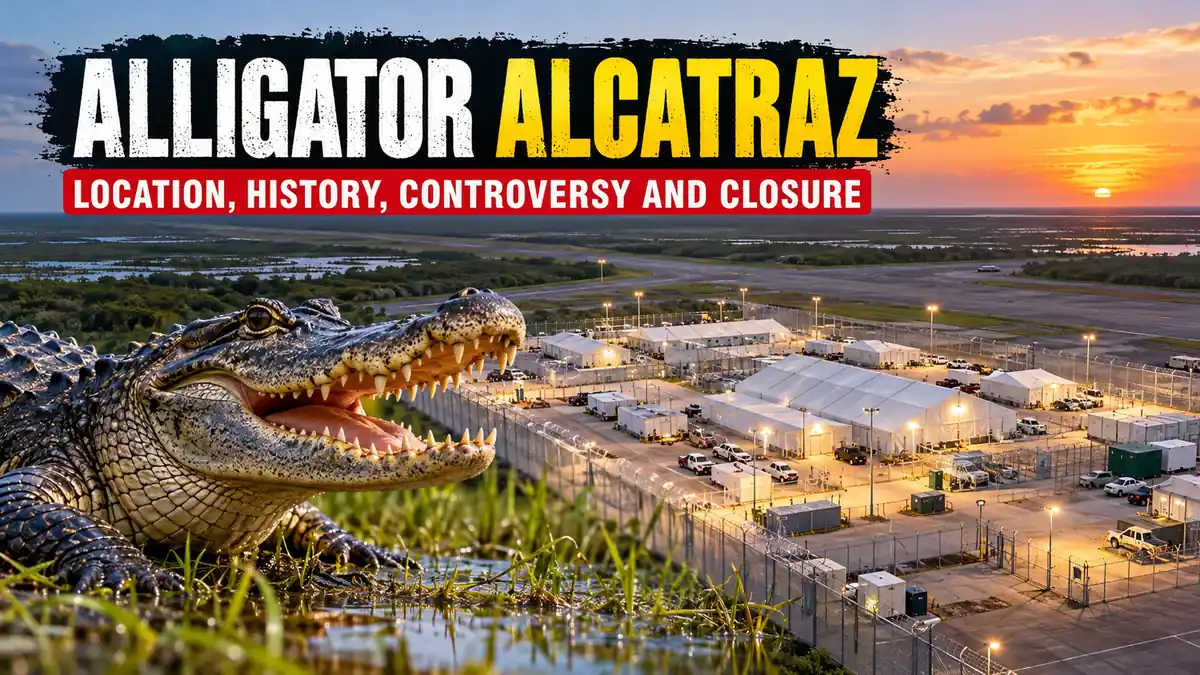
Deep in Florida’s Everglades, a remote airport became the site of one of America’s most controversial immigration detention facilities. Known as alligator alcatraz, the center attracted national attention for its unusual location, rapid construction, detention conditions, environmental impact, and legal challenges.
The facility opened in July 2025 as part of an expanded immigration enforcement effort. Less than a year later, Florida officials announced that its detention operations would end, leaving questions about government spending, detainee treatment, environmental damage, and accountability.
Alligator Alcatraz was a temporary immigration detention facility built at the Dade-Collier Training and Transition Airport in the Florida Everglades. Operated by Florida authorities in cooperation with federal immigration agencies, it opened in July 2025 and ceased detention operations in June 2026 following mounting legal, humanitarian, environmental, and financial controversy.
WPTV News Channel 5 West Palm
+2
What Was alligator alcatraz?
Alligator Alcatraz was the informal name for the South Florida Detention Facility, sometimes called the Everglades Detention Facility. It was established to hold people detained under federal immigration law while their cases, transfers, or deportation proceedings were handled.
Unlike conventional detention centers built in permanent correctional buildings, the facility used temporary structures, including large tents and modular infrastructure, on an existing airport site.

Key facts
Official name: South Florida Detention Facility
Location: Ochopee, Florida
Opened: July 2025
Detention operations ended: June 25, 2026
Purpose: Immigration detention
Temporary detention infrastructure was installed at an isolated airport in South Florida.
The center was unusual because Florida’s Division of Emergency Management took a leading operational role in housing federal immigration detainees. The arrangement raised questions about oversight, applicable detention standards, funding, and responsibility for conditions inside the facility.
Why Was It Called Alligator Alcatraz?
The nickname combined two recognizable references.
Alligator referred to the American alligators living in the wetlands surrounding the airport. The Everglades are also home to other wildlife, including snakes and numerous bird species.
Alcatraz referred to the former federal prison on Alcatraz Island in San Francisco Bay, famous for its isolation and reputation as a difficult place to escape.
The comparison was primarily symbolic. Florida’s facility was not a historic island prison, and alligators were not an official security system.
The name became part of the political messaging surrounding the project. Supporters emphasized the remote landscape as a security advantage, while critics argued that portraying wildlife as a deterrent trivialized the treatment of people held in immigration custody.
Was Alligator Alcatraz a Prison?
It was an immigration detention center, not a conventional prison for people serving criminal sentences.
That distinction matters because immigration detention is generally a civil administrative process, although some detainees may also have criminal histories or separate criminal proceedings.
People can be held in immigration custody while authorities determine whether they may remain in the United States or must be removed.
Detention itself does not establish that someone has been convicted of a crime.
Where Was alligator alcatraz Located?
The facility was constructed at the Dade-Collier Training and Transition Airport, an isolated airfield along the Tamiami Trail corridor in southern Florida.
The site lies within the broader Big Cypress landscape, west of Miami, in an environmentally sensitive area connected to the Everglades ecosystem.
📍
Use two fingers to move the map
Use ctrl + scroll to zoom the map
Why Was the Everglades Location Chosen?
Florida officials pointed to several practical advantages of the airport site.
- An existing paved runway and developed airfield reduced the need to construct an entirely new access network.
- The remote location offered physical separation from densely populated communities.
- Large open areas could accommodate temporary detention structures.
- The airport could potentially support transportation and logistical operations.
However, the same characteristics also created difficulties.
The facility was far from major urban services, including hospitals, legal offices, and conventional detention infrastructure.
Its location exposed the site to heavy rainfall, high humidity, insects, flooding risks, and seasonal storms.
These factors complicated sanitation, medical access, infrastructure maintenance, and emergency planning.
Is Alligator Alcatraz Inside Everglades National Park?
The facility was located at Dade-Collier Airport in the Big Cypress area, rather than within the boundaries of Everglades National Park itself.
This distinction is important when evaluating environmental protections and jurisdiction.
The surrounding landscape is nevertheless ecologically connected to the greater Everglades system, and environmental organizations argued that development could affect sensitive habitats, water systems, and nearby protected areas.
Why Was alligator alcatraz Built?
The detention center emerged during President Donald Trump’s second administration, when federal authorities were expanding immigration enforcement and detention capacity.
Florida Governor Ron DeSantis supported the project as a way to accommodate immigration detainees and strengthen cooperation between state and federal authorities.
The facility was developed rapidly in June 2025, with temporary infrastructure installed at the airport.
President Trump and federal officials toured the site on July 1, 2025. Detention operations began in early July.
What Was the Facility’s Planned Capacity?
The project was designed to hold thousands of immigration detainees.
Early public descriptions discussed capacity of approximately 3,000 people, with potential expansion toward 5,000. Actual occupancy changed throughout its operation and should not be confused with maximum proposed capacity.
The center used a network of temporary detention structures rather than permanent prison housing.
Its rapid development was presented by supporters as an example of how detention capacity could be expanded quickly.
Critics questioned whether such a compressed construction schedule allowed sufficient preparation for medical services, sanitation, emergency response, and legal access.
Who Operated the Facility?
The Florida Division of Emergency Management coordinated the state-run operation, working with federal authorities, including the Department of Homeland Security (DHS) and U.S. Immigration and Customs Enforcement (ICE).
Private contractors also provided services associated with facility construction, security, transportation, and operations.
The unusual state-federal arrangement became a central issue in subsequent legal and oversight disputes.
What Were Conditions Like Inside Alligator Alcatraz?
Living conditions became one of the most heavily scrutinized aspects of the facility.
Former detainees, attorneys, journalists, and human rights organizations described problems involving sanitation, drinking water, medical care, insects, sleeping arrangements, and access to legal representation.
Some early accounts were disputed by officials. However, a September 2026 report from the Department of Homeland Security’s Office of Inspector General documented significant health and safety problems.
The inspector general reported that some detainees had been confined in small metal enclosures measuring approximately 18 square feet. The investigation also identified problems involving drinking water, insects, showers, and other detention conditions.
ABC News
+1
Sanitation and Drinking Water
Temporary detention structures require reliable systems for toilets, showers, drinking water, sewage collection, and waste disposal.
At Alligator Alcatraz, these systems became a source of repeated complaints.
Reporting from July 2025 described backed-up toilets, sewage transportation difficulties, water shortages, and rain entering temporary housing structures.
The remote location increased the logistical burden because supplies and waste had to be transported over considerable distances.
The Washington Post
Medical Care and Health Risks
Detainees and advocates raised concerns about access to medical treatment, particularly for people with chronic illnesses or urgent medical needs.
The Everglades climate introduced additional challenges, including heat, humidity, mosquito exposure, and the possibility of flooding.
Amnesty International investigated detention conditions in South Florida and documented accounts of inadequate sanitation, difficult living conditions, and obstacles to medical and legal services.
Its December 2025 report examined both the Everglades facility and the Krome North Service Processing Center.
Amnesty International
+1
Access to Lawyers and Family Members
One of the most consequential complaints involved the ability of detained people to contact attorneys.
Immigration cases can involve asylum claims, removal proceedings, bond requests, and challenges to detention.
Legal representation can be especially important when someone faces removal from the United States.
Attorneys and advocacy groups alleged that restrictions at the facility prevented meaningful access to legal counsel.
In March 2026, a federal court issued a preliminary injunction requiring improved access to attorneys for people detained there.
ACLU of Florida
The dispute demonstrated that detention conditions involve more than physical housing. Communication, legal information, and procedural safeguards are also essential components of lawful detention.
Why Was alligator alcatraz So Controversial?
The controversy extended beyond the physical conditions of the detention center.
It involved immigration policy, environmental protection, government authority, financial oversight, and the treatment of people in civil custody.
Different groups evaluated the project through different priorities.
| Issue | Supporters’ position | Critics’ concerns |
|---|---|---|
| Immigration enforcement | Expanded detention capacity | Risk of excessive or unnecessary detention |
| Remote location | Physical isolation improved security | Isolation complicated legal and medical access |
| Rapid construction | Demonstrated emergency responsiveness | Insufficient planning and oversight |
| Government spending | Supported enforcement objectives | High costs and questions about accountability |
| Environmental impact | Existing airport reduced some development needs | Sensitive habitats and water systems faced risks |
Environmental Concerns in the Everglades
The Everglades is one of North America’s most distinctive wetland ecosystems.
Its interconnected wetlands support alligators, wading birds, fish, mammals, and numerous threatened or endangered species.
Environmental organizations argued that operating a large detention center in this landscape could affect water quality, drainage, wildlife movement, and surrounding habitats.
Organizations including Friends of the Everglades, the Center for Biological Diversity, and Earthjustice challenged the project.
The Miccosukee Tribe of Indians also participated in litigation, bringing attention to Indigenous interests and the cultural significance of the surrounding lands.
A major legal question concerned compliance with the National Environmental Policy Act (NEPA), which requires federal agencies to evaluate environmental consequences for covered federal actions.
The extent of federal involvement and funding became central to arguments over whether environmental review requirements applied.
Immigration Rights and Due Process
Civil immigration detention is subject to legal protections, including constitutional and statutory requirements.
The Fifth Amendment’s Due Process Clause is particularly relevant when government action deprives individuals of liberty.
Attorneys argued that limited access to legal representation and information interfered with detainees’ ability to challenge detention or participate meaningfully in immigration proceedings.
The ACLU of Florida and other legal organizations pursued litigation addressing these issues.
The resulting court orders showed that the facility’s legal disputes were not limited to environmental regulation.
ACLU of Florida
Why Did the Name Cause Criticism?
The nickname itself became controversial because it associated an immigration detention facility with a notorious prison and dangerous wildlife.
Supporters used the name to communicate toughness and deterrence.
Opponents argued that such language encouraged the public to view detainees as criminals regardless of their individual legal circumstances.
The dispute reflected a broader disagreement over how immigration enforcement should be described and administered.
How Much Did Alligator Alcatraz Cost?
The facility became a major subject of financial scrutiny because of its substantial operating expenses and short lifespan.
Florida records discussed in February 2026 indicated an operating expenditure rate of approximately $1.2 million per day.
By May 2026, public reporting described a projected total cost approaching $1.1 billion by June. The figures reflected different accounting periods and categories, so they should not be treated as interchangeable totals.
Why Was Operating the Facility Expensive?
Several factors contributed to the cost structure.
- Temporary infrastructure: Large-scale tents, climate control, utilities, and security systems required installation and maintenance.
- Remote logistics: Food, drinking water, medical supplies, and waste services required transportation.
- Security and staffing: Detention operations required guards, supervisors, administrative personnel, and support services.
- Transportation: Moving detainees between facilities and legal proceedings created additional expenses.
- Environmental conditions: Heat, rain, flooding, and storm preparation increased operational complexity.
Was the Facility Cost-Effective?
Cost-effectiveness depends on more than the daily operating budget.
A proper evaluation would compare total spending, actual occupancy, length of detention, operational outcomes, and the cost of alternative facilities.
It would also distinguish between construction costs, recurring operations, federal reimbursements, and contracts that continued after detention operations ended.
A facility with thousands of planned beds does not necessarily achieve a low per-person cost if occupancy is substantially below capacity.
Because accounting and funding disputes continued, a single daily expenditure figure cannot fully establish the project’s cost-effectiveness.
What Happened to alligator alcatraz in 2026?
The facility’s final months were marked by legal developments, questions about future operations, and preparations to transfer detainees.
Key timeline
- June–July 2025 — Construction and openingFlorida developed the temporary detention site, and federal officials visited as operations began.
- August–September 2025 — Environmental court rulingsA federal judge issued restrictions affecting the facility, but an appeals court later paused the preliminary injunction.
- March–April 2026 — Major legal developmentsA federal court ordered improved access to legal counsel. An appellate ruling allowed environmental litigation to continue without the earlier construction restrictions.
- May–June 2026 — Closure preparationsReports emerged that contractors were preparing to wind down operations and detainees would be moved elsewhere.
- June 25, 2026 — Detention operations endGovernor Ron DeSantis publicly announced the end of the facility’s detention operations.
- August–September 2026 — Continued scrutinyEnvironmental litigation continued, and a federal inspector general report documented serious deficiencies in detention conditions.
Timeline based on court developments, official announcements, and reporting through October 2026.
Is Alligator Alcatraz Still Open?
No. As of October 2026, Alligator Alcatraz is no longer operating as an immigration detention center.
In June 2026, the Department of Homeland Security confirmed that detainees had been transferred to other facilities, citing safety concerns associated with hurricane season.
On June 25, Governor DeSantis announced that the detention facility would cease operations.
Environmental and immigration rights organizations subsequently confirmed that the site was no longer holding detainees.
The end of detention operations should not be confused with the resolution of every legal, financial, or environmental question involving the property.
Why Did Alligator Alcatraz Close?
No single explanation captures every factor surrounding the closure.
State officials characterized the center as a temporary measure that had served its intended purpose.
Federal officials cited hurricane-season safety concerns when discussing detainee transfers.
At the same time, the facility faced mounting scrutiny over costs, detention conditions, access to attorneys, and environmental litigation.
Contractors were reportedly instructed to begin demobilization before the formal closure announcement.
These developments occurred together, but it would be inaccurate to attribute the closure exclusively to one lawsuit or one operational problem without stronger evidence.
What Happened to the Detainees?
People remaining at the facility were transferred to other immigration detention centers.
DHS confirmed the transfers but did not initially provide a complete public breakdown of every destination.
For detainees, a transfer did not necessarily mean release from immigration custody or termination of their immigration cases.
Transfers could also disrupt communication with attorneys and relatives, particularly when families did not immediately know the new detention location.
What Did the September 2026 Investigation Reveal?
One of the most significant developments after the closure was a report from the Department of Homeland Security’s Office of Inspector General.
Released in September 2026, the investigation described conditions that presented substantial risks to detainee health and safety.
Inspectors found that some individuals had been held in metal enclosures with very limited floor space.
The report also documented concerns involving sanitation, insects, drinking water, and compliance with detention standards.
The findings were particularly significant because they came from a federal oversight office rather than solely from former detainees or advocacy organizations.
Why Does Independent Oversight Matter?
Detention facilities exercise extensive control over people’s daily lives.
Individuals held in custody cannot freely leave to obtain medical treatment, find alternative housing, or resolve unsafe conditions themselves.
Independent inspections help determine whether detention practices meet established standards and whether reported problems are isolated or systemic.
Oversight can also establish documentary evidence for policymakers, courts, and the public.
In this case, the inspector general’s findings gave additional weight to concerns that had circulated since the facility opened.
What Was the Environmental Impact of Alligator Alcatraz?
The end of detention operations did not automatically resolve concerns about the surrounding environment.
Temporary construction can still leave long-term effects, particularly in wetland ecosystems.
Potential impacts include disturbed soil, altered drainage, infrastructure debris, pollution risks, and damage to vegetation.
However, the extent of actual ecological harm must be established through environmental assessment rather than assumed from the facility’s location alone.
What Happens to the Site After Closure?
Environmental groups have called for remediation, restoration, and protections against similar development.
A responsible restoration process may involve:
- Removing temporary detention structures and unused infrastructure.
- Inspecting soil and water for contamination.
- Assessing drainage changes and disturbed habitat.
- Restoring affected vegetation where appropriate.
- Monitoring the site for longer-term environmental effects.
Friends of the Everglades submitted a restoration and protection proposal following the closure announcement.
The organization and its partners also continued litigation concerning environmental review and government disclosures.
Why Is the Everglades Ecosystem So Sensitive?
The greater Everglades functions as an interconnected water system.
Water movement influences vegetation, wildlife habitat, nutrient distribution, and the health of nearby wetlands.
The region supports species such as the American alligator, Florida panther, and numerous wading birds.
Development can affect ecosystems beyond the immediate construction footprint, particularly when it changes drainage or introduces pollutants.
That is why environmental review can matter even when construction occurs on previously developed land.
How Did Alligator Alcatraz Compare With Traditional Immigration Detention Centers?
The Florida facility differed from conventional ICE detention centers in its construction, administration, and setting.
| Feature | Alligator Alcatraz | Conventional detention center |
|---|---|---|
| Main infrastructure | Temporary tents and modular facilities | Usually permanent buildings |
| Location | Remote Everglades airport | Varies; often closer to established services |
| Operational arrangement | State-led, with federal cooperation | Federal or contracted operation |
| Intended role | Rapid expansion of detention capacity | Ongoing detention capacity |
| Utility systems | Relied heavily on temporary infrastructure | Typically integrated building systems |
| Main challenges | Remote logistics, weather, legal access, sanitation | Staffing, medical care, overcrowding, oversight |
These are general differences, not universal rules. Traditional facilities can also experience serious problems involving overcrowding, sanitation, healthcare, and legal access.
The American Immigration Council’s January 2026 research described the broader expansion of temporary immigration detention infrastructure and concerns about conditions in large tent-based facilities.
Did Alligator Alcatraz Change Immigration Detention Policy?
The facility became a prominent example of efforts to expand detention capacity rapidly through state-federal cooperation.
It also demonstrated the practical and legal complications that can arise when temporary infrastructure is used for large-scale civil detention.
Its experience raised questions about whether emergency-style construction models can consistently satisfy requirements for safety, medical care, legal access, and environmental protection.
Those questions remain relevant to other detention proposals, even though this particular facility stopped holding detainees.
What Is the Lasting Significance of alligator alcatraz?
Alligator Alcatraz became more than a detention center in the Florida Everglades.
It was a high-profile test of rapid immigration detention expansion, state and federal cooperation, and the use of temporary infrastructure in a remote environment.
Its history illustrates several broader lessons.
First, rapid construction does not eliminate the need for adequate sanitation, healthcare, and safe living conditions.
Second, remote detention sites can create practical barriers to legal representation and family communication.
Third, development in environmentally sensitive areas requires careful consideration of ecological consequences and applicable laws.
Finally, public accountability depends on accurate financial records, independent inspections, and meaningful judicial oversight.
The facility’s closure in June 2026 ended its detention operations, but it did not erase the disputes surrounding its cost, conditions, or environmental legacy.
For anyone researching alligator alcatraz, the essential distinction is between its original purpose, what investigators and detainees reported during its operation, and what courts and oversight bodies subsequently established.
Understanding those differences provides a clearer picture of why this short-lived facility became a nationally significant controversy in American immigration policy.