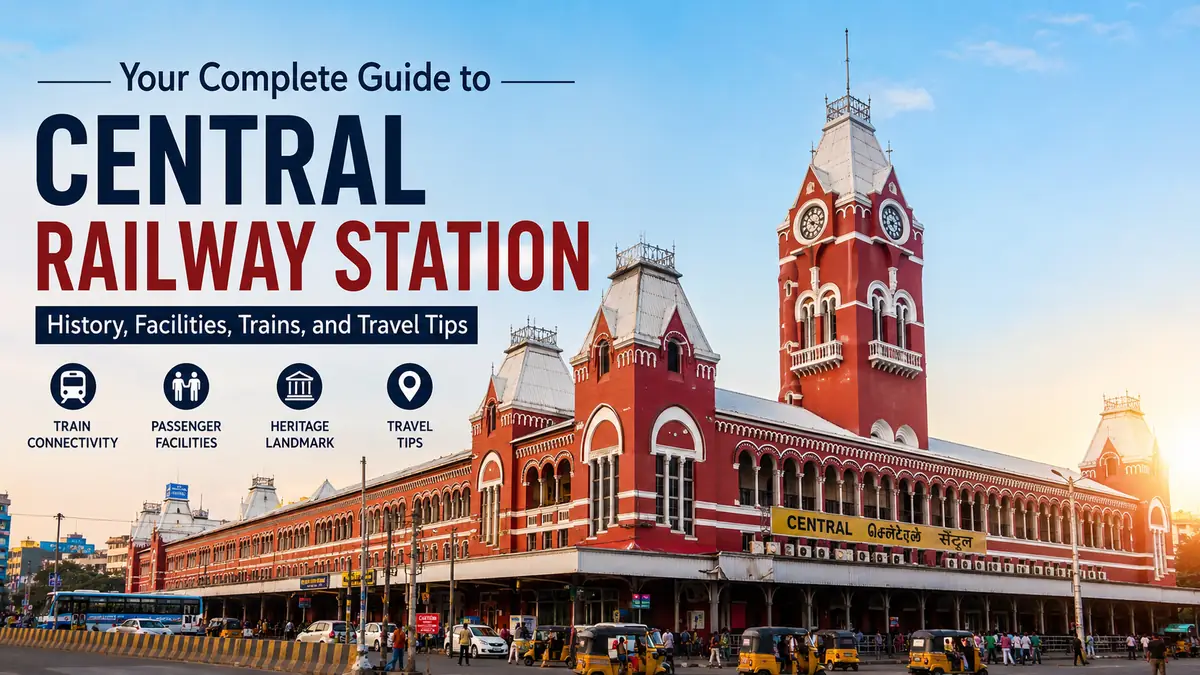
Sydney’s central railway station is much more than a place to catch a train. Sitting at the southern edge of Sydney’s CBD in Haymarket, Central is the largest railway station and transport interchange in New South Wales, linking suburban trains, regional and intercity rail, Sydney Metro, light rail, buses and coaches.
For a first-time visitor, though, Central can feel complicated. There are multiple concourses, numbered platforms, six main exits and several transport modes operating from different parts of the precinct.
Quick answer: Sydney Central Station is the city’s principal rail and public-transport hub, located around Eddy Avenue, Haymarket. It serves Sydney Trains, NSW TrainLink, the M1 Metro line, light rail, buses and coaches. The present main terminal opened in 1906 and remains one of Sydney’s most important transport landmarks.
This guide explains how Central works, which platforms and exits to use, how to transfer between services, what facilities are available and why the station has such an important place in Sydney’s history.
Where Is central railway station in Sydney?
Central Station is at Eddy Avenue, Haymarket, NSW 2000, immediately south of Sydney’s central business district. The precinct also borders or connects with Pitt Street, Chalmers Street, Railway Square and the surrounding Haymarket and Surry Hills areas.
Its position makes it particularly useful for reaching destinations around the southern CBD.
Nearby places include:
- Haymarket
- Chinatown and Dixon Street
- Paddy’s Markets
- Capitol Theatre
- Railway Square
- Surry Hills
- Prince Alfred Park
- University of Technology Sydney (UTS)
- TAFE NSW Ultimo
- Moore Park
Transport for NSW’s local area guide directs passengers to different exits depending on their destination. For example, Chinatown can be reached via Exit 1 or Exit 2, while UTS is approached through Exit 1 or Exit 7.
This is worth checking before leaving the station. Choosing the right exit can save a surprisingly long walk around such a large interchange.
Why Is Sydney Central Station So Important?
Central functions as the main meeting point between several layers of Sydney and New South Wales public transport.
Sydney Trains suburban services pass through the station, while NSW TrainLink uses Central for Intercity and Regional services. The station also connects directly with Sydney Metro and light rail and sits beside major bus and coach facilities.
That combination makes Central useful for several very different journeys.
A commuter might change trains here on the way across Sydney. A visitor arriving from regional NSW may step off an NSW TrainLink service and transfer to Metro. Someone heading to Sydney Airport can use the suburban rail network. Another passenger might walk directly to Chinatown or transfer to light rail.
Central is therefore better understood as a multimodal transport interchange rather than simply a railway station.
Transport available at Central
| Transport mode | Main location or platforms | Typical use |
|---|---|---|
| Sydney Trains | Platforms 16–25 and other designated platforms | Suburban Sydney travel |
| Intercity/Regional trains | Primarily Grand Concourse platforms | Longer-distance travel |
| Sydney Metro M1 | Platforms 26–27 | Fast metro connections |
| L1 Light Rail | Grand Concourse | Inner West/Dulwich Hill direction |
| L2/L3 Light Rail | Chalmers Street | CBD, Randwick and Kingsford corridors |
| Buses | Eddy Ave, Elizabeth St, Devonshire St and Railway Square | Local Sydney connections |
| Coaches | Western Forecourt/Pitt Street area | Longer-distance coach travel |
Platform allocations and services can change, so passengers should always check station departure screens or live journey information before travelling.
central railway station Platforms and Concourses Explained
The easiest way to understand Central is to divide it into its main concourse levels.
Transport for NSW identifies three primary concourse areas:
- Grand Concourse
- Concourse
- Lower Concourse
Each serves a somewhat different purpose.
Grand Concourse
The Grand Concourse is the historic heart of Central.
It is especially important for passengers using longer-distance rail services. Transport for NSW places Regional and Intercity services on platforms associated with this area, while facilities here include the NSW TrainLink information point, luggage services, waiting facilities, food outlets and coach connections.
If you are catching a regional train, arriving early and starting at the Grand Concourse is generally the simplest approach.
Concourse and Lower Concourse
These areas provide access to the suburban platforms used by Sydney Trains.
The current Transport for NSW station information identifies platforms 16–23 with the Concourse and platforms 12–25 as accessible through the Lower Concourse.
Because Central handles so many services, do not assume that a train always leaves from the same platform.
Check the electronic departure boards when you arrive.
Platforms 26 and 27: Sydney Metro
The Metro platforms are particularly important for modern-day Central.
Platforms 26 and 27 serve Sydney Metro’s M1 Line. They can be accessed through the Chalmers Street entrance and connected station areas, including links from the Grand Concourse.
The M1 extension through central Sydney opened in August 2024, creating a direct metro connection through the CBD and beneath Sydney Harbour. Central immediately became one of the busiest stations on the expanded line.
Metro services generally operate frequently; Transport for NSW’s station guide indicates services every 4–10 minutes throughout the day.
Which platform goes to Sydney Airport?
Airport-bound train services depart from Platform 23 according to current Transport for NSW Central Station information. The platform can be reached through the Concourse and Lower Concourse.
Still, always check the departure screen before boarding. Platform arrangements can change because of operational requirements, special events or trackwork.
Quick takeaway: Don’t navigate Central solely by memorising platform numbers. Use the departure screens first, then follow the platform and concourse signs.
Sydney Central Station Train Lines
Central sits at the core of Sydney’s rail network.
The current local station guide lists services including:
- T1
- T2
- T3
- T4
- T8
- T9
- Intercity trains
- Regional trains
- M1 Metro
This extensive coverage explains why many Sydney journeys naturally involve changing at Central.
Sydney Trains
Suburban services connect Central with destinations across metropolitan Sydney.
Depending on the line and service pattern, passengers can travel toward areas such as the Eastern Suburbs, western Sydney, northern Sydney, the airport and southern suburbs.
Because stopping patterns and service arrangements can vary, Transport for NSW’s Trip Planner is more reliable than memorising a particular train. It provides route suggestions, real-time information, timetables, service updates and fare estimates.
NSW TrainLink Intercity and Regional services
Central is also the major Sydney gateway for longer-distance rail travel.
NSW TrainLink connects Sydney with destinations throughout New South Wales and beyond. Its wider train-and-coach network serves more than 365 destinations across NSW, Victoria, Queensland and the ACT.
Popular longer-distance routes include connections between Sydney and places such as:
- Canberra
- Melbourne
- Brisbane
- Dubbo
- Coffs Harbour
- Armidale
- Grafton
Unlike ordinary suburban travel, some Regional services require advance bookings and allocated seating.
If you are taking one of these trains, allow extra time to locate the correct platform and complete any necessary luggage or boarding arrangements.
Sydney Metro at Central Station
The addition of Metro significantly changed the role of the central railway station precinct.
Central now provides direct access to the M1 Metro line from platforms 26 and 27. This connects the station with major destinations through the Sydney CBD and north of the harbour.
For passengers transferring between heavy rail and Metro, the important point is that the Metro platforms are below the traditional station complex. Follow the clearly marked Metro signage rather than looking for them beside the conventional Sydney Trains platforms.
The Chalmers Street entrance is particularly useful for direct Metro access.
For someone arriving at Central on another train, internal pedestrian connections make the transfer possible without treating Metro as an entirely separate station.
Light Rail Connections at Central
Central also connects to Sydney’s light rail network.
There are two key light rail locations to understand.
L1 Dulwich Hill Line
The L1 Dulwich Hill Line serves the Central Grand Concourse area.
It provides a useful connection between Central and parts of the Inner West. Transport for NSW states that L1 services between Central and Dulwich Hill operate frequently from approximately 5am to 1am, including weekends and public holidays.
L2 and L3 services
For the L2 and L3 lines, passengers should follow signs toward Central Chalmers Street.
These services provide connections along the CBD and toward the southeastern parts of Sydney, including the Randwick and Kingsford corridors.
The distinction matters because Central’s light rail services do not all depart from exactly the same stop.
Central Station Exits: Which One Should You Use?
Central has six main numbered exits in current Transport for NSW passenger information.
Choosing the correct one is one of the easiest ways to make the station less confusing.
Exit 1 — Grand Concourse
Useful for:
- Railway Square
- coach bays
- taxi rank
- kiss-and-ride area
- L1 light rail
- Pitt Street
- nearby Haymarket destinations
Passengers can also walk toward L2/L3 services from this side.
Exit 2 — Eddy Avenue
Use this for Eddy Avenue and buses at Stands A–D.
This exit is also important for passengers requiring level access toward Eddy Avenue, because the direct Grand Concourse approach to Eddy Avenue Plaza involves stairs and escalators.
Exit 3 — Elizabeth Street
This provides access toward Elizabeth Street and bus Stands E–F.
It is also useful when heading toward the eastern side of the station precinct.
Exit 5 — Chalmers Street
This is particularly useful for Metro and light rail connections and for reaching the Surry Hills side of Central.
Transport for NSW notes that the nearby Eastern Stairs route is stairs-only, while Exit 5 provides lift access.
Exit 6 — Devonshire Street
Use this side for Devonshire Street and bus Stand G.
It can also be convenient when walking toward Surry Hills or Prince Alfred Park.
Exit 7 — Railway Square
This exit provides access to Railway Square and bus Stands J–N.
It is a useful choice for destinations toward Broadway, UTS and TAFE NSW Ultimo.
How to Get From Central Station to Sydney Airport
One of the most common questions visitors have is whether they can travel directly from Central to Sydney Airport.
Yes.
Airport train services run from Central, with Transport for NSW currently directing airport passengers to Platform 23.
For a smoother trip:
- Check the live departure board or Trip Planner.
- Follow signs toward Platform 23.
- Confirm that your service stops at the required airport station.
- Tap on correctly before travelling.
- Allow extra time if carrying luggage.
Sydney Airport has separate rail stations serving the domestic and international terminal areas, so confirm which stop you need before boarding.
Buses and Coaches at Central
Central’s role as a transport hub extends beyond rail.
Bus stops are distributed around several sides of the station rather than concentrated in one single terminal.
Current Transport for NSW guidance identifies:
- Stands A–D: Exit 2
- Stands E–F: Exit 3
- Stand G: Exit 6
- Stands J–N: Exit 7
This arrangement is another reason to check your bus stand before leaving the station.
Coach connections
Longer-distance coach facilities are located around the Western Forecourt and Pitt Street side.
The current station guide identifies coach bays 1–9 at the Western Forecourt and 15–18 on Pitt Street, reached via Exit 1.
Allow additional transfer time when changing from a train to a coach, especially if you have luggage.
Tickets, Opal Cards and Contactless Payment
Most ordinary Sydney public transport journeys use the Opal fare system.
Passengers must tap on at the start of their trip and tap off at the end where required. Contactless cards and compatible devices can also be used on supported services.
Central’s current peak fare periods are Monday to Thursday, 6:30am–10am and 3pm–7pm. Transport for NSW states that off-peak discounts apply outside these periods and on Fridays, weekends and public holidays for eligible Opal-network travel.
Regional NSW TrainLink journeys work differently from normal suburban trips and may involve reserved tickets rather than simply tapping an Opal card.
Check the requirements for the particular service you are taking.
Facilities at central railway station
A major station needs more than platforms, and Central has facilities spread across its concourses.
Current passenger information identifies:
- toilets
- food and drink outlets
- secure luggage storage
- NSW TrainLink information
- regional luggage check-in and collection
- regional waiting facilities
- customer information screens
- transport information
- lifts and escalators
- ticketing facilities
Toilets
Toilets are available at several points, including the Grand Concourse, lower concourse and areas near Chalmers Street and Eddy Avenue.
Luggage storage
Secure luggage lockers are available for hire on the Grand Concourse.
This can be useful if you arrive before hotel check-in or have several hours between services.
Regional luggage services
NSW TrainLink luggage check-in and collection facilities are associated with Platform 1, along with a waiting room for Regional passengers.
Staffing
Central is a major staffed station. Transport for NSW currently lists station staff as being on duty 24 hours a day on weekdays, weekends and public holidays.
That is particularly helpful for passengers who are unfamiliar with the complex.
Accessibility at Sydney Central Station
Central has lifts and accessible routes connecting important station areas, but the size and age of the precinct mean that choosing the right route matters.
Transport for NSW recommends checking accessibility information and current disruptions before travelling, especially because lift outages or temporary works can affect an otherwise accessible route.
A good example is the eastern side of Central.
The Eastern Stairs provide access toward Chalmers Street but, as the name suggests, are stairs-only. Passengers needing lift access should use Exit 5 at Chalmers Street instead.
Similarly, Exit 2 should be used for level access toward Eddy Avenue rather than relying on the stairs/escalators between the Grand Concourse and Eddy Avenue Plaza.
Travellers using wheelchairs, mobility aids or prams should allow a little extra transfer time.
A Short History of Sydney Central Station
Central’s story stretches much further back than the current building.
The railway precinct represents more than 150 years of railway operations in this part of Sydney. Heritage NSW records the first Sydney railway station and yards as opening in 1855.
There have effectively been three Sydney terminal stations associated with the area.
The first Sydney terminal
Sydney’s first railway terminus opened in 1855, farther south than today’s main Central building.
Railways were still new to New South Wales, and the station marked the beginning of a transport system that would profoundly influence Sydney’s growth.
The second terminal
As passenger and railway traffic increased, the original facilities became inadequate.
A second, more substantial terminal opened in 1874. Designed by engineer-in-chief John Whitton, it initially had two platforms but expanded as railway demand increased.
Eventually, even this enlarged station could no longer handle Sydney’s growing rail traffic.
The present Central Station
The current terminal moved approximately one block north and officially opened in August 1906.
The building was designed by NSW Government Architect Walter Liberty Vernon.
Its construction was a major urban project, involving not only a new station but significant changes to the surrounding road network and public space.
The Devonshire Street Cemetery Beneath Central’s History
One of the most unusual parts of Central’s history concerns the land on which the present station was built.
The site had previously contained the Devonshire Street Cemetery, along with several other institutional and government uses. Heritage records also associate the wider site with facilities including the Benevolent Asylum, Carters Barracks, Sydney Mounted Police and Sydney Female Refuge.
Before construction of the new terminal, graves from the cemetery were exhumed and remains were reinterred elsewhere.
Records describe remains being transferred to cemeteries including Rookwood, Waverley and Botany.
This archaeological history adds another layer of significance to a location most people now experience simply as a busy transport interchange.
Architecture and Heritage Significance
Central is notable not only for transportation but also for its architecture.
Its grand sandstone buildings create a monumental entrance to the southern side of central Sydney. Heritage NSW describes the station as a landmark of historical, aesthetic and technical importance.
The design was unusually ambitious for its era.
Central’s planners had to manage trains, passengers, luggage, mail, trams, pedestrians and road traffic through a constrained urban location.
Later railway development introduced sophisticated infrastructure such as flyovers that allowed trains to cross between suburban lines with fewer conflicting movements. Heritage NSW notes that, when constructed, this collection of flyovers was the largest of its kind in the world.
The result is a precinct where multiple generations of railway engineering remain visible.
Central Station Clock Tower
One of Central’s most recognisable architectural elements is its clock tower.
The tower rises above the historic sandstone station buildings and has become a visual landmark for the surrounding Haymarket and Railway Square area.
For generations of passengers, the tower has served as a symbol of arrival in central Sydney. It also reinforces the difference between Central and a purely functional suburban station: the precinct was deliberately designed as an important civic gateway.
Together with the Grand Concourse, sandstone façades and historic platforms, it contributes strongly to Central’s heritage character.
What Is Near Sydney Central Station?
Central’s location makes it possible to reach a surprising number of attractions on foot.
Chinatown
Sydney’s Chinatown is a short walk north through Haymarket.
Transport for NSW recommends Exit 1 or Exit 2 for Chinatown and Dixon Street.
Paddy’s Markets
Paddy’s Markets is another nearby Haymarket destination. Exit 1 or Exit 7 can be useful depending on your route.
Capitol Theatre
The historic Capitol Theatre is close to Central and can be approached through Exit 1 or Exit 2.
Surry Hills
The neighbourhood begins immediately east of the station.
Exit 3, Exit 5 or Exit 6 may be useful depending on your exact destination.
UTS and TAFE NSW Ultimo
For the education precinct west of Central, Railway Square is generally the most useful side of the station. Transport for NSW recommends Exit 1 or Exit 7 for both UTS and TAFE NSW Ultimo.
How to Navigate Central Station Without Getting Lost
Central looks intimidating on a map, but a few habits make it much easier.
1. Find your service before your platform
Don’t start by wandering toward a platform number you remember from an earlier journey.
Check the departure board first.
2. Identify the transport mode
Ask yourself whether you need:
- Sydney Trains
- NSW TrainLink
- Metro
- light rail
- bus
- coach
Each has its own logical part of the precinct.
3. Follow the signs, not the crowd
Central handles commuters travelling in many different directions. Following a crowd can easily take you toward the wrong concourse.
4. Check your exit before reaching street level
If your destination is Surry Hills but you emerge near Railway Square, you have added an unnecessary walk.
Look for the numbered exit signs while still inside.
5. Allow extra time for transfers
Central is large.
A transfer between adjacent suburban platforms can be quick, while moving between a Regional platform, Metro and an external bus stop can take considerably longer.
6. Check for disruptions
Trackwork, maintenance and special-event arrangements can change normal service patterns.
Transport for NSW’s Trip Planner provides current service information, route suggestions and travel alerts.
Quick takeaway: At Central, knowing your platform is only half the job. Know your concourse, transport mode and exit as well.
Common Mistakes First-Time Visitors Make
The most common problems at Central are usually navigation mistakes rather than complicated transport rules.
One is assuming that Central Station means a single hall with all trains departing nearby. In reality, it is a large interconnected transport precinct.
Another is confusing Sydney Trains with Metro. Metro uses its dedicated underground platforms 26 and 27, while conventional trains operate from other platforms.
A third mistake is leaving through the first available exit. Central’s entrances face several different streets, and the wrong exit can put you on the opposite side of the precinct from your destination.
Regional passengers sometimes make the opposite mistake: treating an NSW TrainLink journey like an ordinary suburban trip. Reserved Regional services may involve different ticketing, luggage and boarding procedures.
Finally, avoid planning an extremely tight connection if you have never used the station before. A few extra minutes can make the difference between an easy transfer and a stressful sprint through several concourses.
Is Sydney Central the Same as Sydney Terminal?
The names can be confusing.
Central Station is the common name for the overall transport hub. Sydney Terminal is historically associated with the terminal portion of the railway complex, particularly the main long-distance terminus.
Heritage NSW formally lists the wider heritage precinct as the Central Railway Station and Sydney Terminal Group.
In everyday travel, however, passengers generally use “Central” or “Central Station.”
If a timetable or railway reference mentions Sydney Central, it is referring to this principal station complex in Haymarket.
Is Central Station the Same as Mumbai Central?
No.
This distinction matters because central railway station is a generic-sounding search term used in connection with stations in several cities.
Sydney Central is in Haymarket, New South Wales, Australia.
Mumbai Central, by contrast, is a major Indian Railways and Mumbai suburban station in Maharashtra. Its station code is MMCT, and it belongs to the Western Railway system.
It should also not be confused with Mumbai’s Chhatrapati Shivaji Maharaj Terminus (CSMT), another major historic railway terminus and a UNESCO World Heritage Site.
Likewise, Chennai has its own major Central station, officially named Puratchi Thalaivar Dr. M.G. Ramachandran Central Railway Station, which retains the station code MAS.
For searches specifically referring to “Central Railway Station” without a city, Sydney is one prominent interpretation, but adding the city name is always wise when planning an actual journey.
Practical Tips Before Travelling Through Central
A little preparation makes using Central significantly easier.
- Check live information: Timetables and platforms can change.
- Arrive early for Regional services: Give yourself time for boarding and luggage requirements.
- Know your exit: Check whether your destination is closer to Eddy Avenue, Chalmers Street or Railway Square.
- Allow transfer time: Metro, suburban, Regional and coach services may be in different parts of the complex.
- Use departure screens: They are more reliable than remembering a previous platform.
- Check accessibility routes: Particularly if you need lifts or step-free access.
- Tap correctly: Remember to tap on and off where the Opal system requires it.
- Check travel alerts: Trackwork can substantially change weekend journeys.
For unfamiliar journeys, Transport for NSW’s live planning tools are particularly useful because they combine route, timetable, fare estimate and disruption information.
central railway station: A Historic Station That Still Defines Sydney Travel
Sydney’s central railway station has evolved from a nineteenth-century railway terminus into one of Australia’s most significant multimodal transport hubs.
Its history reaches back to Sydney’s first railway terminal in 1855, while the present grand station opened in 1906. Today the same precinct brings together Sydney Trains, NSW TrainLink, the M1 Metro, light rail, buses and coaches, while serving as a gateway to Haymarket, Chinatown, Surry Hills and the wider CBD.
The station’s size is its greatest strength and the main reason newcomers sometimes find it confusing. The simplest approach is to identify your service first, check the live departure information, follow signs to the correct concourse or platform, and choose your street exit before leaving the building.
Once those basics are understood, Central becomes much easier to navigate—and its combination of modern transport infrastructure, sandstone architecture and more than a century of railway history makes it far more interesting than an ordinary station.