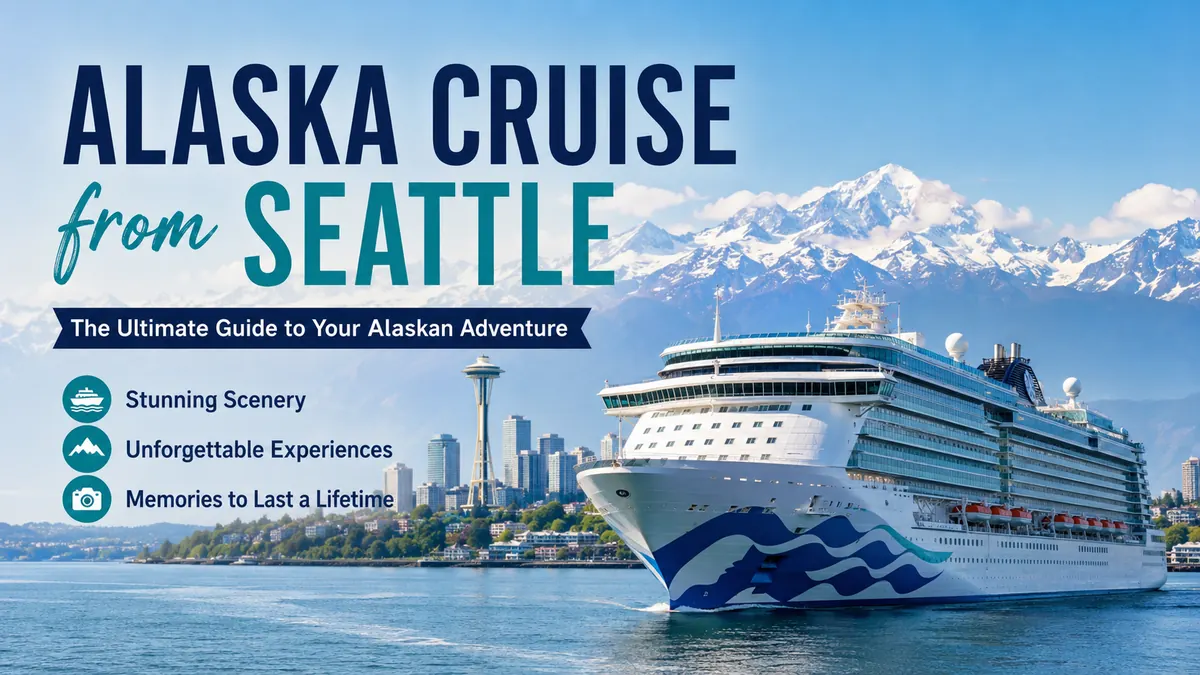
An alaska cruise from seattle combines one of North America’s easiest cruise gateways with glaciers, wildlife, historic coastal towns, and the dramatic waterways of Southeast Alaska. Most Seattle departures are seven-night round trips, making them particularly straightforward for travelers who want to start and finish their vacation in the same U.S. city.
Seattle is also a major Alaska cruising hub. The Port of Seattle projected a record 2026 season with 330 vessel calls and 2.1 million revenue passengers, reflecting just how important the city has become as a gateway to Alaska.
Quick answer: An alaska cruise from seattle usually lasts seven nights and follows a round-trip route through Southeast Alaska. Typical itineraries visit Juneau, Ketchikan and Skagway, include scenic cruising near Glacier Bay, Endicott Arm, Dawes Glacier or Tracy Arm, and make a Canadian port call before returning to Seattle.
Why Take an alaska cruise from seattle?
Seattle’s biggest advantage is simplicity.
Instead of flying into one city and returning home from another, most Alaska cruises departing Seattle operate as closed-loop voyages. You board in Seattle, spend approximately a week exploring Alaska and nearby Canadian waters, then disembark back in Seattle.
That structure makes transportation and flight planning considerably easier.
Seattle is also well connected through Seattle-Tacoma International Airport, commonly called SEA Airport, while the city’s cruise terminals sit directly on its waterfront.
The Port of Seattle describes the city as a natural gateway to Alaska and operates two primary cruise facilities: Bell Street Cruise Terminal at Pier 66 and Smith Cove Cruise Terminal at Pier 91.
Seattle cruises are usually round trip
A standard Seattle itinerary typically includes:
- Departure from Seattle
- A sea or scenic-cruising day
- Several Southeast Alaska ports
- A glacier or fjord experience
- A Canadian port
- Return to Seattle
Seven nights is the dominant format, although longer and occasional shorter itineraries exist. Current cruise listings show numerous seven-night Seattle round trips across several major cruise lines.
Seattle vs. Vancouver for an Alaska cruise
Seattle and Vancouver are both important gateways, but their itineraries aren’t identical.
| Feature | Seattle | Vancouver |
|---|---|---|
| Common itinerary | Round trip | Round trip or one way |
| Typical duration | 7 nights | 7 nights or longer |
| Convenient for U.S. flights | Excellent | Requires Canadian arrival for many travelers |
| Canadian stop | Common | Already begins in Canada |
| One-way Alaska options | Less common | Much more common |
| Best for | Simple round-trip vacation | Deeper itinerary flexibility |
Seattle is generally the easier choice when convenience matters most.
Vancouver becomes particularly interesting when you want a one-way voyage connecting British Columbia with Seward or Whittier and potentially an Alaska land tour afterward.
What Does a Typical Seattle to Alaska Cruise Itinerary Look Like?
No single itinerary applies to every ship.
Port order, time ashore and scenic cruising locations can vary considerably. Weather, ice conditions and operational decisions can also affect a voyage.
Still, many seven-night routes follow a recognizable pattern.
| Day | Typical Experience |
| Day 1 | Depart Seattle |
| Day 2 | Sea/scenic cruising |
| Day 3 | Juneau or another Alaska port |
| Day 4 | Skagway, Sitka or scenic cruising |
| Day 5 | Ketchikan or another Alaska port |
| Day 6 | Sea/scenic cruising |
| Day 7 | Victoria or another Canadian call |
| Day 8 | Return to Seattle |
Princess, for example, lists Seattle itineraries featuring combinations of Juneau, Ketchikan, Skagway, Victoria, Endicott Arm and Glacier Bay National Park.
The itinerary deserves more attention than the ship name alone. Two cruises leaving Seattle on the same weekend can offer noticeably different experiences because one includes Glacier Bay while another visits Endicott Arm or Tracy Arm.
Best Alaska Cruise Ports from Seattle
The classic Southeast Alaska ports each provide a different side of the state.
Rather than treating them as interchangeable cruise stops, think about what you actually want to experience ashore.
Juneau
Juneau is Alaska’s state capital and one of the most recognizable ports on Seattle cruise itineraries.
Its unusual geography is part of the appeal: there is no conventional highway connecting Juneau with the rest of Alaska’s road network.
Popular experiences include:
- Mendenhall Glacier
- Whale watching
- Hiking
- Mount Roberts
- Salmon-related experiences
- Flightseeing
- Wildlife tours
For travelers whose priority is whales, glaciers and mountain scenery, Juneau can be one of the strongest port days.
Ketchikan
Ketchikan offers a different landscape.
The town sits beside the vast Tongass National Forest and is strongly associated with fishing, Indigenous cultures, rainforest scenery and colorful waterfront architecture.
Common attractions and activities include Creek Street, salmon viewing, kayaking, rainforest excursions and cultural experiences.
Rain is part of Ketchikan’s coastal environment, so waterproof outerwear is worth carrying even when the morning forecast appears favorable.
Skagway
Skagway’s identity is closely connected to the Klondike Gold Rush.
Historic buildings preserve the atmosphere of the late-19th-century boom period, while the mountains surrounding town make the port visually impressive before passengers even leave the ship.
Many visitors use their day for railway journeys, scenic drives, hiking and Gold Rush history.
Sitka
Not every Seattle itinerary stops in Sitka, but routes that do offer a different cultural and geographical experience.
Sitka sits on Baranof Island and combines Tlingit heritage, Russian colonial history, forests, mountains and marine wildlife.
It can be particularly appealing to travelers who want something beyond the standard Juneau-Skagway-Ketchikan combination.
Victoria, British Columbia
Many round-trip Seattle itineraries include a Canadian call, often Victoria, British Columbia.
The stop may occur toward the end of the cruise and can sometimes be relatively short.
Victoria’s Inner Harbour, historic architecture, gardens and walkable downtown create a sharp contrast with Alaska’s smaller coastal communities.
Don’t dismiss the stop simply because it isn’t in Alaska. It is also an important reason travelers need to pay close attention to international travel-document requirements.
Glacier Bay, Endicott Arm or Tracy Arm: What’s the Difference?
For many travelers, the defining memory of an Alaska cruise isn’t a port at all.
It’s the glacier day.
The major scenic experiences offered from Seattle include Glacier Bay National Park, Endicott Arm and Dawes Glacier, and Tracy Arm Fjord.
They should not be treated as identical.
Glacier Bay National Park
Glacier Bay National Park and Preserve is one of Alaska cruising’s headline destinations.
Cruise ships do not dock inside Glacier Bay. Instead, they spend hours navigating the national park while passengers watch the scenery from decks, lounges and balconies.
The National Park Service says cruise visits typically last nine to ten hours and include time near a major tidewater glacier. Park rangers board visiting cruise ships to provide interpretation, presentations, information and Junior Ranger activities.
Wildlife can include humpback whales, sea otters, seabirds and brown bears, although sightings are never guaranteed.
Glacier Bay access is controlled, so don’t assume that every Alaska sailing visits the park simply because “glacier” appears somewhere in its itinerary.
Endicott Arm and Dawes Glacier
Endicott Arm is another spectacular glacial fjord frequently included on Seattle routes.
The approximately 30-mile waterway leads toward Dawes Glacier, with steep cliffs, waterfalls and floating ice contributing to the scenery. Princess describes harbor seals and icebergs among the features passengers may encounter along the route.
The experience is narrower and more fjord-like than Glacier Bay.
Tracy Arm Fjord
Tracy Arm is known for steep rock walls, waterfalls, ice and dramatic confined waterways.
Some Seattle itineraries specifically advertise Tracy Arm scenic cruising rather than Glacier Bay. Current Carnival Seattle itineraries, for example, include Tracy Arm alongside ports such as Skagway, Juneau, Ketchikan and Victoria.
Weather and ice can influence how close ships get to glaciers in these fjords.
Quick Takeaway: Don’t book based on the phrase “Alaska glacier cruise.” Read the actual itinerary and identify whether your scenic day is Glacier Bay, Endicott Arm/Dawes Glacier, Tracy Arm or another glacier destination.
Which Cruise Lines Sail from Seattle to Alaska?
Seattle hosts a broad selection of Alaska operators.
The Port of Seattle’s 2026 home-port lineup includes major names such as Princess Cruises, Holland America Line, Norwegian Cruise Line, Royal Caribbean International, Celebrity Cruises, Carnival Cruise Line, MSC Cruises, Oceania Cruises and Cunard, among others.
The right choice depends less on finding a universally “best” cruise line and more on matching the ship and itinerary to your priorities.
Princess Cruises
Princess has a long-established Alaska program and operates Seattle Inside Passage itineraries featuring destinations such as Juneau, Ketchikan, Skagway, Glacier Bay and Endicott Arm.
It is worth examining when scenic cruising and traditional Alaska itineraries are priorities.
Holland America Line
Holland America also has a substantial Alaska presence and is commonly associated with destination-focused itineraries and Glacier Bay opportunities.
Its style tends to appeal to travelers who place ports and scenery ahead of high-energy onboard attractions.
Norwegian Cruise Line
Norwegian operates major ships from Seattle and is especially convenient because its Seattle operations use Pier 66, directly on the downtown waterfront.
The Port of Seattle identifies Norwegian and Oceania as the cruise lines operating from Bell Street Cruise Terminal at Pier 66.
Royal Caribbean
Royal Caribbean can make sense for families and travelers who want Alaska outside the ship and extensive entertainment when they’re back onboard.
That distinction matters on sea days, especially for multigenerational families.
Celebrity Cruises
Celebrity combines Alaska scenery with a more contemporary premium-ship atmosphere.
Its current Seattle information describes seven-day round-trip itineraries that can include Ketchikan, Juneau, Skagway, Endicott Arm, Dawes Glacier, the Inside Passage and Victoria.
Carnival and MSC
Carnival offers Seattle routes featuring ports such as Skagway, Juneau and Ketchikan alongside scenic cruising.
MSC has also expanded the choices available from Seattle. Its Alaska program highlights the Inside Passage, Endicott Arm, Dawes Glacier and excursions around Juneau and other destinations.
Rather than selecting solely by brand, compare four things:
glacier destination → port combination → time in port → ship experience.
That order prevents a common mistake: choosing an impressive ship and only afterward discovering that the itinerary misses the places you most wanted to see.
When Is the Best Time for an alaska cruise from seattle?
Seattle’s Alaska cruise season generally runs from spring into early fall.
For 2026, the Port of Seattle announced its cruise season beginning April 17, with Alaska-focused activity continuing through the main summer travel period.
For most vacationers, May through September is the practical planning window.
May
May can offer fewer peak-season crowds and attractive early-season conditions.
Temperatures remain cool, especially on deck and near glaciers. Snow remains visible at higher elevations, which can make mountain landscapes particularly dramatic.
June
June brings very long daylight hours.
More daylight means more time to watch for wildlife and enjoy scenery from the ship, which is a significant advantage in Alaska.
July
July sits in the heart of peak season.
Families are traveling during school vacations, excursions are running extensively and daylight remains generous.
The trade-off is demand. Popular shore excursions can fill well before sailing.
August
August remains a prime Alaska cruising month.
Wildlife opportunities continue, but Southeast Alaska can be wet, so travelers should prepare for rapidly changing conditions rather than expecting predictable summer sunshine.
September
September marks the shoulder season.
It can offer a quieter atmosphere and sometimes lower cruise fares, but cooler temperatures, shorter days and increased weather variability should be expected.
| Month | Main Advantage | Main Trade-Off |
| May | Early-season scenery, often less crowded | Cooler conditions |
| June | Very long daylight | Rising demand |
| July | Peak summer experience | Crowds and higher demand |
| August | Strong all-around season | Greater chance of rain |
| September | Shoulder-season atmosphere | Cooler, shorter days |
There isn’t one universally best month.
Choose June or July if daylight and peak-season operations matter most. Look at May or September if you value shoulder-season travel and can tolerate greater weather variability.
How Much Does an Alaska Cruise from Seattle Cost?
There is no reliable single price for an Alaska cruise.
Cruise fares are dynamic and depend on the sailing date, ship, cabin, demand and promotions. Current 2026–2027 listings illustrate substantial variation even among seven-night Seattle departures.
More importantly, the advertised cruise fare isn’t the entire vacation budget.
Your total may include:
- Base cruise fare
- Taxes and port charges
- Gratuities
- Specialty dining
- Beverage packages
- Wi-Fi
- Shore excursions
- Flights
- Seattle hotel
- Airport transportation
- Travel insurance
- Souvenirs and personal spending
Shore excursions can change the budget dramatically
This is one area where first-time cruisers frequently underestimate costs.
Walking around a port independently may cost almost nothing. Helicopter glacier landings, flightseeing, railway trips, whale-watching tours and specialized wildlife excursions can add hundreds of dollars per person.
Set your excursion budget before comparing cabins.
A slightly cheaper cruise can become the more expensive vacation if its port schedule encourages several costly excursions.
Interior vs. balcony cabin
Alaska creates an unusually strong argument for balcony cabins because the scenery continues between ports.
That doesn’t mean a balcony is essential.
Modern ships have open decks and observation areas, so an interior cabin can still work perfectly well for budget-conscious travelers who are willing to spend scenic cruising days in public spaces.
A balcony becomes more valuable if you:
- Have limited mobility
- Prefer quiet viewing
- Spend considerable time in your cabin
- Travel with children who nap
- Want immediate access to scenery
If the upgrade would force you to skip the excursions you really want, the interior cabin plus better experiences ashore may deliver more value.
Seattle Cruise Terminals: Pier 66 vs. Pier 91
Knowing your terminal before arriving in Seattle prevents a surprisingly common embarkation-day mistake.
Seattle has two principal cruise terminals.
Bell Street Cruise Terminal at Pier 66
Address: 2225 Alaskan Way, Seattle
Pier 66 sits directly on Seattle’s downtown waterfront and is home to Norwegian Cruise Line and Oceania during the cruise season. The Port of Seattle notes that Pike Place Market, Seattle Aquarium and the Great Wheel are within easy reach.
Smith Cove Cruise Terminal at Pier 91
Pier 91 is farther north on the waterfront.
The Port’s 2026 information places Carnival, Celebrity, Royal Caribbean, Princess, Holland America and several other home-port operations at Seattle’s cruise facilities, with Pier 91 handling many of the major lines outside Norwegian and Oceania.
Taxis, shuttles, private vehicles and app-based rideshare services are available at the terminals.
Practical tip: Check the Port of Seattle’s current ship schedule shortly before traveling. Cruise schedules and terminal assignments can change.
Do You Need a Passport for an Alaska Cruise from Seattle?
This question deserves a careful answer because citizenship and itinerary matter.
For U.S. citizens on qualifying closed-loop cruises that begin and end at the same U.S. port, U.S. Customs and Border Protection says travelers may be able to use proof of citizenship, such as an eligible government-issued birth certificate, together with qualifying government photo identification instead of a passport.
That does not mean everyone cruising from Seattle can travel without a passport.
Rules differ for non-U.S. citizens, permanent residents, one-way itineraries and travelers with other immigration circumstances.
And even when a passport isn’t technically required, carrying a valid passport book is the safer approach.
Why?
Imagine becoming ill in Canada and needing to fly home, or missing the ship and having to cross an international border independently. The documentation requirements for air travel are different from the closed-loop cruise exception.
Before departure, verify requirements with your cruise line and the relevant U.S. and Canadian authorities for your citizenship and exact itinerary.
What Wildlife Can You See?
Wildlife is one reason Alaska rewards people who keep looking outside even during sea days.
Potential sightings include:
- Humpback whales
- Orcas
- Sea otters
- Harbor seals
- Sea lions
- Bald eagles
- Brown and black bears
- Mountain goats
- Salmon
Glacier Bay’s National Park Service guidance specifically notes opportunities to see animals including brown bears, sea otters, humpback whales and seabirds.
But no ethical operator can guarantee wild-animal sightings.
Bring binoculars and spend time on open decks. Scan shorelines as well as open water, particularly early in the morning when many passengers are still inside.
What Should You Pack for an Alaska Cruise?
Packing for Alaska is mostly about layers, not simply bringing the heaviest coat you own.
A sunny afternoon in Juneau can feel completely different from an early morning standing outside near a glacier.
A practical clothing system includes:
- Moisture-wicking base layer
- Warm mid-layer or fleece
- Waterproof outer shell
- Comfortable walking shoes
- Warm socks
- Hat
- Light gloves
- Casual onboard clothing
Then add a few Alaska-specific items:
Binoculars: One of the most useful things you can carry for wildlife and glacier viewing.
Waterproof day bag: Helps protect electronics and documents during wet port days.
Sunglasses: Glare around water, snow and ice can be intense.
Sunscreen: Cool temperatures don’t eliminate UV exposure.
Portable charger: Long excursion days can drain a phone quickly.
Small backpack: Useful for layers, water and camera equipment.
Don’t pack exclusively for cold weather. Ships are climate-controlled, and some summer port days can feel surprisingly mild.
How to Choose the Right Shore Excursions
The best excursion isn’t necessarily the most expensive one.
Start by identifying what would make the trip feel incomplete if you missed it.
If that is seeing whales, prioritize a whale-watching trip.
If it is standing near a glacier, build around a glacier experience.
If you care most about history, Skagway’s Gold Rush heritage may deserve more of your budget.
Book limited-capacity experiences first
Helicopter flights, small-group wildlife trips, specialized boat tours and popular railway departures have finite capacity.
Reserve high-priority experiences earlier than simple sightseeing tours.
Leave breathing room
A mistake that looks efficient on paper is scheduling every port hour.
Alaska’s towns themselves are part of the experience. Give yourself enough time to walk the waterfront, eat locally and look around without constantly checking a departure time.
Consider weather flexibility
Flightseeing and helicopter trips can be canceled because of weather.
If a particular experience is central to your vacation, understand the operator’s cancellation and refund policy and have a backup idea for that port.
Common First-Time Alaska Cruise Mistakes
A few planning errors repeatedly reduce the quality of otherwise excellent trips.
Choosing the ship before the itinerary
A beautiful ship can’t take you to a glacier that isn’t on its schedule.
Compare routes first.
Assuming every cruise visits Glacier Bay
They don’t.
Some sail Glacier Bay; others use Endicott Arm, Dawes Glacier, Tracy Arm or another scenic destination.
Packing one giant winter coat instead of layers
Weather can change several times during a single port day.
Layering is far more adaptable.
Ignoring the Canadian stop
A Canadian call has travel-document implications. Verify your documents well before departure rather than discovering an issue at check-in.
Flying into Seattle on embarkation morning
A delayed or canceled flight can cause you to miss the ship.
Arriving at least the day before provides a valuable buffer and gives you time to see Seattle.
Waiting too long for priority excursions
High-demand excursions can sell out.
Reserve the experiences that matter most and leave flexible activities for later.
Staying inside during scenic cruising
Some of Alaska’s best moments happen between ports.
Glacier days, narrow passages, waterfalls and unexpected wildlife sightings are reasons to treat sea time as part of the destination.
Is an Alaska Cruise from Seattle Good for Families and First-Time Cruisers?
For many travelers, yes.
A round-trip Seattle itinerary removes much of the logistical complexity associated with one-way Alaska voyages. You don’t need separate arrival and departure cities, and the standard seven-night structure fits comfortably into a typical vacation schedule.
Families may prefer larger ships with extensive children’s programming and indoor entertainment.
Couples may prioritize dining, quieter ships and balcony cabins.
Older travelers may care more about accessible viewing areas, shorter walking distances and manageable excursions.
The itinerary remains the common denominator.
Regardless of age, the strongest Alaska cruise usually combines enough port time with at least one memorable scenic-cruising day.
How Far in Advance Should You Plan?
Start early when your requirements are specific.
Travelers who need a particular week, connecting cabins, accessible accommodations or a specific glacier itinerary benefit most from advance planning.
The same applies to large families.
If you’re flexible about ship, cabin and sailing date, later availability may provide more options—but relying on last-minute availability also means accepting whatever cabins and excursions remain.
A sensible planning sequence is:
- Choose your travel month.
- Compare Seattle itineraries.
- Identify the glacier or fjord experience.
- Compare time in each port.
- Select the cruise line and ship.
- Choose a cabin.
- Verify travel documents.
- Arrange flights and a pre-cruise Seattle stay.
- Reserve priority excursions.
- Finalize packing and transportation.
This keeps the destination at the center of the decision instead of allowing cabin promotions or ship features to dictate the entire trip.
Final Thoughts on Planning an alaska cruise from seattle
An alaska cruise from seattle is one of the simplest ways to experience Southeast Alaska without sacrificing the scenery that makes the region extraordinary. Most travelers can leave from a major U.S. city, spend about a week exploring ports such as Juneau, Ketchikan and Skagway, experience a glacier or fjord, visit Canada and return to the same Seattle waterfront.
The most important decision isn’t simply which cruise line has the biggest ship or lowest advertised fare.
Look closely at the actual itinerary.
Compare Glacier Bay with Endicott Arm, Dawes Glacier and Tracy Arm. Check how many hours you receive in each Alaska port. Confirm whether the ship uses Pier 66 or Pier 91, verify your travel documents, budget separately for shore excursions and prepare for changing weather.
Do those things before focusing on smaller details, and you’ll have a much clearer picture of what your Alaska cruise will actually be like—not just what the brochure promises.