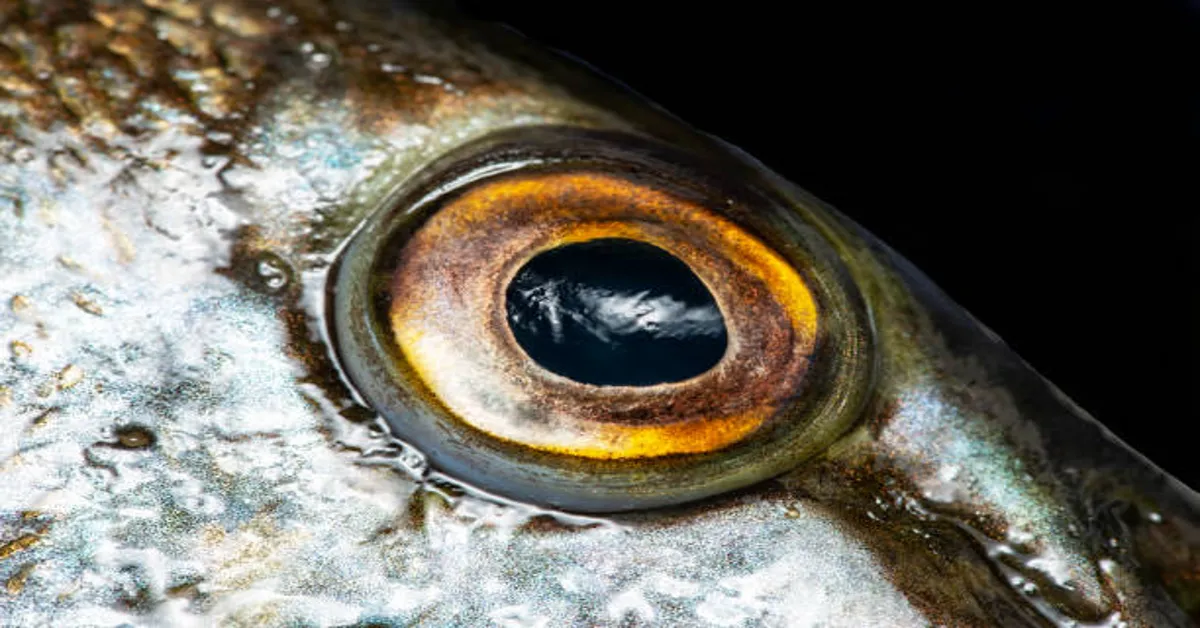
Pick up a whole fish at the market and the first thing that catches your attention probably isn’t the scales or the fins — it’s the fish eyes. They’re glassy, oddly perfect spheres, and they stare back at you in a way that feels almost unsettling. But those little orbs are doing some genuinely impressive biological work, and in plenty of kitchens around the world, they’re also dinner.
This guide covers both sides of the story: the science of how fish actually see underwater, and the long culinary tradition of eating their eyes. By the end, you’ll know how fish vision differs from ours, why some cultures consider the eyeball the best bite on the plate, and whether you should ever eat one yourself.
How a Fish Eye Is Built
At a glance, a fish eye looks a lot like ours — there’s a cornea, an iris, a pupil, and a retina lined with light-sensing cells. But the resemblance ends pretty quickly once you look closer.
The biggest difference is the lens. Where our lens is somewhat flattened and flexible, a fish’s lens is almost perfectly round and noticeably denser. It actually bulges into the pupil. And instead of changing shape to bring things into focus — which is how your eyes work — a fish’s lens stays rigid and simply slides forward or backward, pulled by small muscles, the same way a camera lens racks focus.
The retina tells its own story too. It’s packed with rods (which pick up light and motion) and cones (which detect color), but the ratio between the two shifts dramatically depending on where a fish lives:
- Deep-water species lean heavily on rods — sometimes outnumbering cones by hundreds to one — because there’s barely any light to work with down there.
- Shallow-water and reef species carry far more cones, giving them sharp, vivid color vision.
- Some reef fish, like damselfish, even have cones tuned to ultraviolet light, letting them see patterns and markings that are completely invisible to us.
In short: a fish’s eye isn’t a worse version of ours. It’s a purpose-built tool, shaped entirely by the water it swims in.
How Fish Actually See Underwater
Water treats light very differently than air does. As light travels deeper, it loses red and yellow wavelengths first, leaving everything bathed in blue and green. So a fish living 50 feet down isn’t just dealing with less light — it’s dealing with a completely shifted color palette.
Fish have adapted in a few clever ways:
- Bigger pupils and rod-heavy retinas help them gather what little light is available in deep or murky water.
- Cone-rich eyes in shallow-water species allow for genuinely vivid color perception — arguably better than ours in some species.
- UV and polarized-light sensitivity in certain fish helps them spot camouflaged prey, find mates, or navigate by sunlight angles, even in cloudy water.
Here’s the part that surprises most people: underwater, the cornea barely does any focusing work at all. On land, your cornea handles most of the bending of light before it even reaches your lens. But submerged in water — which has a refractive index nearly identical to the eye’s own fluids — the cornea becomes almost optically useless. All the real focusing falls on that dense spherical lens.
That’s also why a fish doesn’t need goggles and you do. Pop your head underwater and everything blurs because your cornea, built for air, stops doing its job. A fish’s eye was never relying on the cornea in the first place.
One more quirk worth knowing: many fish have eyes set on opposite sides of their head, giving them close to 360-degree awareness. This setup makes them nearsighted directly in front (handy for snapping up nearby food) and farsighted to the sides (handy for spotting a predator before it gets too close).
Fish Eyes vs. Human Eyes: The Real Differences
| Feature | Human Eyes | Fish Eyes |
|---|---|---|
| Primary focusing structure | Cornea + flexible lens | Rigid spherical lens that moves |
| Focusing method | Lens changes shape | Lens shifts forward/backward |
| Eyelids | Yes, blink regularly | No eyelids, no blinking |
| Field of view | Roughly 180° (forward-facing) | Up to 360° in many species |
| Color vision | Red, green, blue cones | Often RGB cones, sometimes UV too |
The eyelid difference is an easy one to overlook but it makes total sense once you think about it: a fish’s eyes are constantly bathed in water, so there’s no need to blink for moisture or to clear away debris the way we do in open air.
Because the spherical lens bends light so strongly, fish vision tends to have a distorted, wide-angle quality — not unlike what you’d see through a fisheye camera lens (yes, that’s literally where the name comes from). Objects can appear curved or compressed, especially toward the edges of their visual field. It’s a tradeoff: less precision at the center, in exchange for an enormous field of awareness.
Why People Around the World Eat Fish Eyes
If the idea of eating an eyeball makes you wince, you’re not alone — but it’s worth knowing this is a long-standing, widely respected practice in many food cultures, not a shock-value stunt.
China: Serving a whole steamed fish, head and eyes intact, is a traditional gesture at banquets and during Lunar New Year. It’s meant to symbolize abundance and good fortune, and offering the fish head (eyes included) to a guest is a sign of respect.
Japan: Bluefin tuna eyes are sometimes simmered in a savory broth. The fatty tissue surrounding the eye melts down as it cooks, enriching the sauce with a deep, umami flavor that chefs specifically prize for its thickening quality.
Russia: In ukha, the classic fish-head soup, the eyes often stay in the pot. Cooks say they contribute to a clearer, richer broth.
Eastern Europe and the Caribbean: Smaller fried fish are sometimes eaten whole, eyes included, almost as a snack.
What does it actually taste like? Food writers who’ve tried it describe a burst of intensely fatty, umami-rich fish flavor with a gelatinous, slightly chewy texture — similar to the experience of eating a soft, savory custard wrapped in a thin casing. The technique most people use: bite gently, let the eye release its juices, then eat around the firmer, “chalky” core much the way you’d work around an olive pit.
Quick tip if you want to try it yourself: stick to fresh, clear-looking eyes (cloudiness is a sign of age), and cook them thoroughly — simmering, grilling, or pan-frying all work. Treat it as a zero-waste ingredient: the fatty globe melts into flavor, and whatever’s left over can simply be discarded.
Are Fish Eyes Healthy to Eat?
Fish eyes are nutritionally similar to other organ meats — they carry a good dose of omega-3 fatty acids and vitamin A, both of which support eye and brain health. Some nose-to-tail eating advocates argue this is reason enough to stop wasting them.
That said, there’s a real caveat: eyes and other fatty tissues can accumulate environmental toxins, particularly methylmercury. Research has shown that fish lenses tend to retain mercury at higher concentrations than muscle tissue, especially in larger, longer-lived predator species like tuna, swordfish, and shark.
Practical guidance:
- Favor eyes from smaller, shorter-lived, or farmed fish over large predatory species.
- Always cook fish eyes thoroughly to eliminate any risk of parasites.
- Treat eyes from big predator fish as an occasional treat, not a regular habit — the same advice that applies to eating their flesh in large quantities.
- Pregnant women and young children should be especially cautious with any high-mercury seafood, including eyes from large fish.
Final Thoughts
Fish eyes sit at this interesting intersection of biology and food culture. Scientifically, they’re a masterclass in adaptation — a rigid, sliding lens and a retina precisely tuned to whatever light (or lack of it) a species has evolved to live in. Culturally, they represent something many modern diets have lost: the instinct to use the whole animal and find value, not waste, in every part of it.
Whether you’re curious about how fish actually perceive their underwater world, or you’re standing at a fish market wondering whether to try that simmered tuna eye, the answer in both cases is the same — there’s more going on in that small, glassy sphere than most people ever stop to consider.
FAQs
Can fish see color underwater?
Yes. Most fish have both rod and cone cells in their retinas, and many — especially reef species — see a full range of color. Some can even detect ultraviolet patterns invisible to humans. Deep-sea fish, by contrast, rely mostly on rods for low-light vision rather than color detection.
Why don’t fish blink?
Fish don’t have eyelids, so blinking isn’t part of their biology. Since their eyes are permanently submerged, they stay naturally moist and clean without needing to blink the way land animals do.
Why do fish eyes look so large or bulging?
A larger, more protruding eye widens a fish’s field of view, which matters a lot underwater where visibility is often limited. Paired with the spherical lens, it helps maximize light capture and, in many species, allows for close to 360-degree vision.
Are fish eyes safe and nutritious to eat?
Generally yes, especially from smaller, non-predatory fish, and as long as they’re cooked thoroughly. They offer omega-3s and vitamin A, but can also accumulate mercury — so it’s best to limit eyes from large predator species like tuna or swordfish.
What does a fish eyeball actually taste like?
Most people describe it as rich, fatty, and intensely savory (umami), with a gelatinous, slightly chewy texture. The flavor is most pronounced when you let it sit in your mouth for a moment before eating.