Budapest has earned many nicknames over the centuries. “Pearl of the Danube.” “Paris of the East.” But ask anyone who’s sunk into a steaming outdoor pool at sunrise while snow drifts through the air, and they’ll tell you the one that sticks most: the City of Spas.
Terme Budapest — the collective name for Budapest’s legendary network of thermal bathhouses — isn’t a single attraction. It’s an entire culture built atop more than 100 natural hot springs that bubble up through the Buda Hills, pumping millions of liters of mineral-rich water to the surface every single day. Romans soaked here in the 2nd century. Ottoman pashas built domed hammams in the 16th century. Habsburg aristocrats commissioned Neo-Baroque palaces in the 20th. And today, locals still treat a midweek bath visit the way Americans treat a coffee run — a routine, a ritual, and a reset.
Whether you’re a first-time visitor trying to choose between Széchenyi and Rudas, or a returning traveler looking for the 2026 updates (Gellért is closed, Király is shuttered — more on that below), this guide covers everything you need to plan the perfect Budapest spa day.
A Brief History of Terme Budapest’s Thermal Bath Culture
Few cities on earth are built on top of such a geological gift. Budapest sits at the collision point of the Buda Hills and the Great Hungarian Plain, where a thinned Earth crust allows geothermal heat to push hot, mineral-laden water close to the surface. There are over 100 thermal springs within the city limits — more than any other capital city in the world.
The first people to seriously tap this resource were the Romans. In the 2nd century AD, Roman settlers established Aquincum — a fully developed provincial capital in what is now the Óbuda district — and built public thermal baths (thermae) that served both military and civilian populations. You can still visit the ruins today.
Then came the Ottomans. When the Turks captured Buda in 1541, they didn’t destroy what they found — they built on top of it. Ottoman governors commissioned a series of classic domed hammams along the Danube, several of which survive (in heavily restored form) to this day. Rudas Bath, originally constructed between 1566 and 1572, is the most intact example of this era.
The third great chapter was the Habsburg period. As Budapest blossomed into the co-capital of the Austro-Hungarian Empire in the late 1800s, bathing became an architectural statement. Grand spa palaces went up across the city: Széchenyi opened in 1913 in a blaze of Neo-Baroque yellow; Gellért arrived in 1918 with Art Nouveau mosaics and stained glass. Budapest was officially designated a “City of Spas” in the 1930s, and the reputation has only deepened since.
For locals, the baths have never just been about wellness. They’re community centers, political debate halls (there’s a reason the chess tables at Széchenyi are famous), and social gathering spots. Arriving in Budapest without visiting a bath is a bit like visiting Paris without seeing the Eiffel Tower — except the baths are considerably more relaxing.
The Best Thermal Baths in Budapest Right Now
2026 Important Update: Two of Budapest’s historic baths are currently inaccessible. Gellért Bath closed October 1, 2025 for a full renovation and will not reopen until 2028. Király Bath is shuttered indefinitely for restoration work. Plan your visit around the four excellent alternatives below.
Széchenyi Thermal Bath — Europe’s Largest Spa
Best for: First-time visitors, photography, winter bathing, Sparty nightlife Location: City Park (Városliget), District XIV Hours (2026): Mon–Fri 7am–8pm | Sat–Sun 8am–8pm (last entry 2 hrs before close) Minimum Age: 14 years (enforced since August 2025)
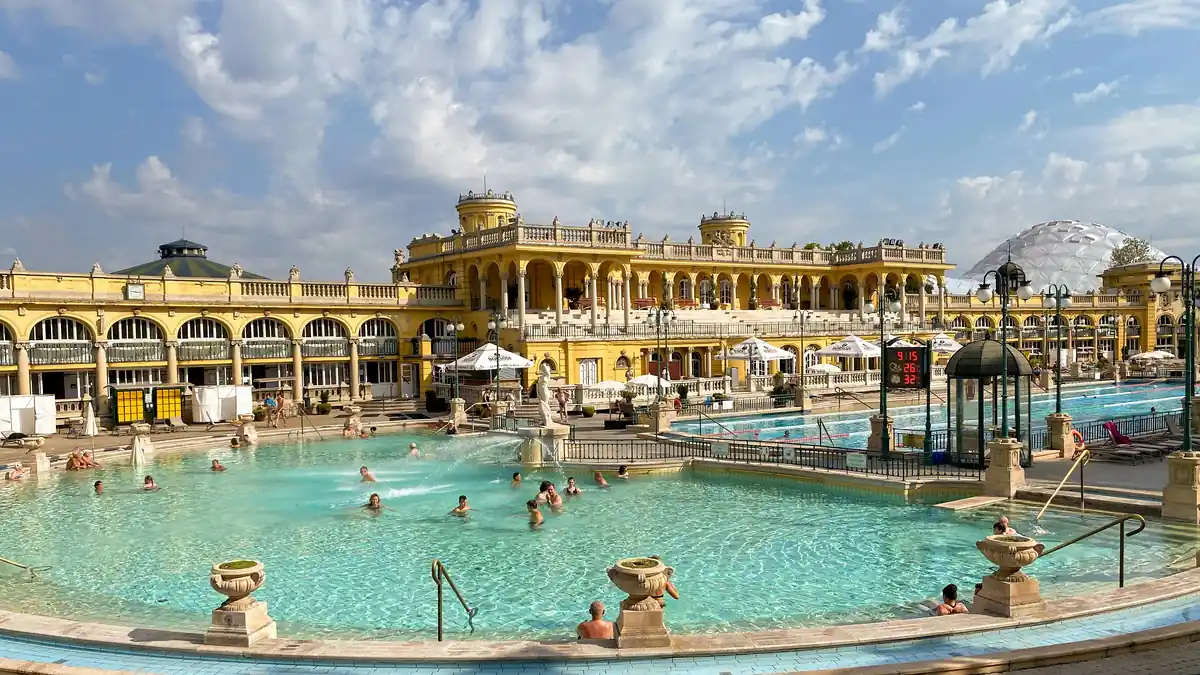
If you only have time for one bath in Budapest, Széchenyi makes the decision easy. Opened in 1913 in a strikingly beautiful Neo-Baroque palace — all yellow stone, triple domes, and grand colonnades — it remains the largest medicinal spa complex in Europe, with 18 pools (15 indoor, 3 outdoor), 10 saunas, and 12 steam rooms.
The three outdoor pools are what you’ve seen in every Budapest photo: clouds of steam rising above warm turquoise water while snow falls or early-morning mist drifts across. The most iconic is the Adventure Pool at 30°C, where a rotating whirlpool operates and, most famously, locals play chess on submerged boards. The hottest outdoor option, a semicircular sitting pool at 38°C, is where you’ll want to park yourself and not move for an hour.
Indoors, the pools range from a bracing cold plunge at 16°C all the way up to a scalding 40°C hot plunge (five minutes maximum, per the staff’s recommendation). Each pool is labeled with its mineral content and temperature — a useful feature for therapeutic visitors.
One practical note: Széchenyi’s popularity is both its greatest selling point and its biggest drawback. On weekend afternoons in summer, the outdoor pools can feel like a very warm theme park. Go early — the bath opens at 7am on weekdays, and the first two hours before 9am are genuinely magical. For evening energy, Saturday night Sparty events (DJ sets and light shows in the pools, adults-only) run from February through December and are unlike anything else in European spa culture.
Insider Tip: Book tickets online in advance. During peak season, Széchenyi frequently sells out weeks ahead. Fast-track entry tickets with a private cabin start around 13,576 HUF (~$36 USD).
Rudas Turkish Bath — 500 Years of Atmosphere
Best for: History lovers, couples, night owls, architecture enthusiasts Location: Döbrentei tér 9, District I (Buda, foot of Gellért Hill) Hours (2026): Daily 6am–8pm | Night bathing Fri–Sat until 4am Minimum Age: 14 years
If Széchenyi is a grand imperial party, Rudas is a 500-year-old meditation. Originally built by Ottoman Pasha Sokoli Mustafa between 1566 and 1572, its heart is an octagonal central pool beneath a massive stone dome pierced by star-shaped colored glass skylights. On a bright morning, shafts of light cut through the steam and hit the water in a way that’s genuinely mesmerizing. There’s nothing else quite like it in Budapest, and arguably nowhere else in the world you can soak under a 16th-century Ottoman dome.
Beyond the historic core, a 2014 renovation added a sleek modern wellness wing, a 20-meter swimming pool, and — the showstopper — a rooftop thermal pool at 36°C with panoramic views over the Danube toward the Parliament and the Pest skyline. It may be the single best view from any thermal bath on earth.
2026 Schedule Update: Rudas updated its gender policy significantly. The historic octagonal Turkish section follows a modified segregated schedule — men-only on Monday, Wednesday, Thursday, and Friday mornings (6am–11am); women-only on Tuesday mornings. From 11am daily, and all day Saturday and Sunday, the entire complex including the Turkish section operates co-ed. This is excellent news for couples who previously couldn’t experience the Ottoman dome together.
One word of warning about the water: it’s heavily sulfate-rich and can smell strongly of rotten eggs near certain pools. It’s entirely normal and reportedly therapeutic, but worth knowing before your first visit.
Lukács Thermal Bath — The Local’s Choice
Best for: Visitors seeking a quieter, more authentic local experience; Budapest Card holders Location: Frankel Leó út 25–29, District II (Buda bank, near Castle District) Hours (2026): Daily 6am–8pm Budapest Card: Free entry included
While Széchenyi gets the tourist crowds and Rudas gets the architecture lovers, Lukács is where locals actually go. Tucked along the Buda bank of the Danube in a quieter residential district, this bath has been in continuous use since the medieval period, though the current building dates largely from 1894. The springs here have a distinct mineral profile particularly associated with treatment of rheumatism, arthritis, and chronic joint conditions — and the clientele reflects that: you’ll find a mix of neighborhood regulars, older locals doing their weekly soak, and savvy travelers who read beyond the headline attractions.
Lukács offers a thoughtful mix of indoor thermal pools, an outdoor courtyard pool, saunas, and steam rooms, all in a pleasant, unhurried atmosphere. Prices are notably lower than Széchenyi — typically 6,000–9,000 HUF ($16–$25 USD) — and if you hold a Budapest Card, entry is completely free, making it exceptional value.
For anyone who finds Széchenyi too loud and crowded but still wants a genuine Budapest bath experience, Lukács is the right answer.
Palatinus Bath — Summer’s Big Open-Air Alternative
Best for: Families, summer visitors, outdoor swimming enthusiasts Location: Margaret Island, District XIII Season: Open May through September (closed in winter)
Palatinus isn’t quite the same category as the thermal baths above — it leans more toward a water park than a spa — but with wave pools, slides, and dedicated thermal soaking areas set within the green lawns of Margaret Island, it’s one of Europe’s largest outdoor bathing complexes and a genuine summertime institution. Families in particular will appreciate the age-appropriate facilities here that don’t exist at Széchenyi, Rudas, or Lukács (all of which enforce 14+ minimum ages on thermal pools). On a hot Budapest summer day, Palatinus is where locals actually go.
Gellért Bath — Breathtaking, But Currently Closed
Status: ❌ Closed October 1, 2025 — Reopening Planned 2028
No guide to Budapest’s thermal baths would be complete without Gellért, even if — frustratingly for current visitors — you can’t visit it right now.
Part of the historic Gellért Hotel complex on the Buda side of the Danube, Gellért Bath is arguably the most beautiful bathhouse in Europe. Eight thermal pools sit beneath painted mosaic ceilings and stained-glass windows. A main indoor swimming pool features ornate sculpted columns and a vaulted glass roof that floods the space with light. An outdoor wave pool — installed in 1927, one of the first in Europe — rounds out the complex. On a busy morning before it closed, the bath drew 1,500 to 1,800 visitors daily.
Construction on the renovation is slated to begin by the end of 2026, with the restored Gellért Bath expected to reopen in 2028. The renovation will restore original Art Nouveau tilework and add a new panoramic sauna and expanded wellness facilities. When it reopens, it will almost certainly be worth the wait.
Until then: The closest alternative in the same Buda neighborhood is Rudas Bath, a 10-minute walk along the Danube. For the pure Art Nouveau architectural experience, note that no current replacement exists — Gellért was genuinely in a class of its own.
Budapest Thermal Baths: Quick Comparison Table
| Bath | Vibe | Key Feature | Price Range (USD) | Open? |
|---|---|---|---|---|
| Széchenyi | Lively, grand, iconic | 18 pools; outdoor year-round; Sparty | $25–$45 | ✅ Yes |
| Rudas | Historic, moody, atmospheric | Ottoman dome + rooftop Danube views | $32–$55 | ✅ Yes |
| Lukács | Quiet, local, medicinal | Best value; Budapest Card accepted | $16–$25 | ✅ Yes |
| Palatinus | Fun, outdoor, family-friendly | Wave pools; slides; green island setting | $12–$20 | ✅ Summer only |
| Gellért | Exquisite, Art Nouveau | Most beautiful bath in Budapest | N/A | ❌ Until 2028 |
| Király | Historic Ottoman | Ancient Turkish dome | N/A | ❌ Indefinitely |
Health Benefits of Budapest’s Mineral Waters
The thermal springs under Budapest aren’t just warm — they’re chemically complex in ways that matter for your health. The water carries dissolved calcium, magnesium, sodium bicarbonate, sulfates, chlorides, and trace metaboric acid. These aren’t marketing claims; they’re the product of geothermal water traveling through limestone and dolomite rock over centuries.
What does soaking in this water actually do? Research published in peer-reviewed complementary medicine journals supports several of the traditional claims: regular thermal bathing shows measurable benefits for chronic joint pain, arthritis symptoms, and musculoskeletal conditions. Improved circulation is a consistent finding — the combination of heat, hydrostatic pressure, and mineral absorption causes blood vessels to dilate and blood flow to increase. Many visitors also report genuinely improved sleep quality for days after a long soak, likely due to the body-temperature regulation effect of extended thermal immersion.
The traditional Hungarian bath routine — warm pool, sauna, cold plunge, rest, repeat — is designed to maximize these effects. The hot-cold cycle causes repeated vasodilation and vasoconstriction, which some balneologists compare to passive cardiovascular exercise. Even if you’re not there for treatment, the physiological effect of 90 minutes properly cycling through Budapest’s waters is unmistakable. You’ll feel it the next morning.
A practical note: the waters at most Budapest baths are not chlorinated in the traditional way — mineral content itself acts as a natural sanitizer, and the baths use UV and ozone systems for hygiene. This is gentler on skin and eyes, though it means small open cuts or wounds should be protected or avoided.
Practical Tips for Visiting Budapest Baths
What to Pack
Pack light but smart. The essentials: a swimsuit (mandatory at all baths — nude bathing is not permitted in public areas), flip-flops or sandals (mandatory; buying them at the bath costs 4,000–6,000 HUF, which is unnecessary), a microfiber travel towel (far easier than renting at extra cost), and a refillable water bottle. Thermal soaking is surprisingly dehydrating, and the water coolers inside the baths are easy to miss.
Bring a swim cap if you plan to lap-swim — it’s required in designated swimming pools at Lukács and was previously required at Gellért. A small dry bag or zip-lock is useful for your wet swimsuit on the way home.
Booking and Timing
Online booking is no longer just a convenience — for Széchenyi especially, it’s close to essential during summer weekends, when the bath frequently sells out weeks in advance. Book directly through the official bath websites to avoid third-party markups.
The best time to visit any Budapest bath is early morning, when the pools are peaceful and (at Széchenyi) genuinely atmospheric. Széchenyi opens at 7am on weekdays; arriving at 7:30am in winter, when mist rises from the outdoor pools into cold air, is one of the finest spa experiences in Europe.
Late afternoon on weekdays is the second-best window. Midday on weekends is the worst — large crowds, long locker queues, and a less relaxing atmosphere overall.
What to Expect On-Site
When you enter, you’ll receive a digital RFID wristband. This locks your locker or private cabin and serves as your payment method for food, drinks, and spa services inside the bath — everything settles when you leave. Don’t lose it.
Showers before entering the pools are mandatory (not optional, and staff enforce it). Most baths have clear signage; follow it and you’ll be fine. Tone and voices should be kept moderate — the baths are social places, but they’re also places of relaxation. People do talk, chess games happen, friends catch up over the whirlpool. But shouting, running on wet surfaces, and taking phone calls poolside are universally frowned upon.
If you’re getting a massage (available at Széchenyi, Rudas, and Lukács from around 8,000–25,000 HUF depending on length), tip the therapist. It’s expected and appreciated.
Health Precautions
Limit soaking in the hottest pools (38–42°C) to 15–20 minutes at a stretch. If you feel dizzy, lightheaded, or overheated, move to a cooler pool or sit on a bench in the fresh air — this is normal and not alarming, but pushing through it is not smart. The hot-cold cycle isn’t just tradition; it’s the safest way to spend extended time in thermal water.
People with cardiovascular conditions, hypertension, or pregnancy should consult a doctor before bathing in the highest-temperature pools. The baths are deeply relaxing, not rigorously medically supervised environments.
2026 Pricing Guide
Prices below reflect 2026 rates converted to USD at approximate exchange rates. Expect minor fluctuation.
| Bath | Weekday Ticket | Weekend Ticket | Private Cabin Upgrade |
|---|---|---|---|
| Széchenyi | ~$25–$30 (locker) | ~$30–$36 (locker) | +$5–$8 |
| Rudas | ~$32 (all-zone access) | Slightly higher | Cabin available |
| Lukács | ~$16–$22 | Similar | Available |
| Palatinus | ~$12–$18 | ~$15–$20 | N/A |
Additional services: massages run $22–$65 depending on duration. Sparty (Saturday night event at Széchenyi) tickets are separately priced, typically $30–$45. The Budapest Card covers free entry at Lukács and discounted entry at Széchenyi and Rudas — genuinely good value if you’re also using it for public transit and museums.
The Bottom Line
Budapest’s thermal bath culture is one of the genuinely irreplaceable experiences in European travel — not a tourist trap layered on top of something historic, but an actual living tradition that locals participate in every week. The city built its identity on these waters, and spending a morning or afternoon in one of the great baths is the fastest way to understand why.
For 2026, your shortlist is clear: Széchenyi for the iconic experience and variety, Rudas for history and drama, Lukács for quiet authenticity and value. Skip the outdated advice about Gellért and Király — both are closed — and book ahead for Széchenyi if you’re visiting between June and August.
Whatever you choose, bring a towel, arrive early, and plan to stay longer than you think you need. The waters have a way of adjusting your schedule.
Frequently Asked Questions
What are the best thermal baths in Budapest in 2026?
The top options currently open are Széchenyi (Europe’s largest bath, iconic outdoor pools year-round), Rudas (Ottoman dome and rooftop Danube views), and Lukács (quieter, local favorite with Budapest Card access). Gellért Bath is closed for renovation until 2028, and Király Bath is indefinitely shuttered.
Is Gellért Bath open in 2026?
No. Gellért Bath closed on October 1, 2025 for a comprehensive restoration and is not expected to reopen until 2028. The renovation will preserve its Art Nouveau architecture while modernizing facilities and adding a new panoramic sauna. The best nearby alternative is Rudas Bath, a 10-minute walk along the Danube.
What should I bring to a Budapest thermal bath?
Bring a swimsuit (mandatory), flip-flops or sandals (mandatory), a microfiber towel, a refillable water bottle, and optionally a swim cap for lap pools. Towels and robes can be rented on-site but cost extra and often involve long queues — packing your own is easier.
How much do Budapest thermal baths cost?
Entry ranges from roughly $16–$36 USD depending on the bath and day. Széchenyi weekday locker tickets run approximately $25–$30; Rudas all-zone access starts around $32; Lukács is the most affordable at $16–$22. Private changing cabins cost an extra $5–$8. The Budapest Card includes free Lukács entry and discounts at Széchenyi and Rudas.
What is the minimum age for Budapest thermal baths?
As of August 2025, Széchenyi, Rudas, and Gellért (when it reopens) all enforce a minimum age of 14 for thermal pool access. Children between 3 and 13 should not use thermal pools. Lukács also has age restrictions on thermal areas. For families with younger children, Palatinus Bath on Margaret Island (open May–September) offers appropriate pools and slides.
When is the best time to visit Budapest’s thermal baths?
Early morning on weekdays is the best window at every bath. Széchenyi opens at 7am weekdays — arriving between 7 and 9am gives you peaceful pools, dramatic steam effects in cooler months, and no queuing. Late afternoon on weekdays is the second-best option. Midday weekends are peak crowding. Off-season visits (November through March) offer a dramatic and atmospheric winter bathing experience at outdoor pools.
Why is Budapest called the City of Spas?
Budapest sits atop more than 100 natural thermal springs — more than any other capital city in the world — the result of geothermal activity along a geological fault between the Buda Hills and the Hungarian Plain. Bathing culture here spans Roman, Ottoman, and Habsburg eras, and today locals still visit the baths weekly for health, socializing, and ritual. The city earned its official “City of Spas” designation in the 1930s and has maintained it ever since.
Is the Rudas Bath co-ed in 2026?
Yes, partially. From 11am daily and all day Saturday and Sunday, Rudas operates co-ed throughout, including in the historic Ottoman dome section. Early morning hours (6–11am) remain segregated by gender on most weekdays: men-only on Monday, Wednesday, Thursday, and Friday; women-only on Tuesday. Friday and Saturday nights offer late-night co-ed bathing until 4am.
Sources: Official bath websites (Széchenyi, Rudas, Lukács, Gellért); Time Out Budapest; Budapest Tourism Organization; The Better Vacation; Visit City Travel. Prices and hours reflect 2026 data and should be verified before your visit as they are subject to change.