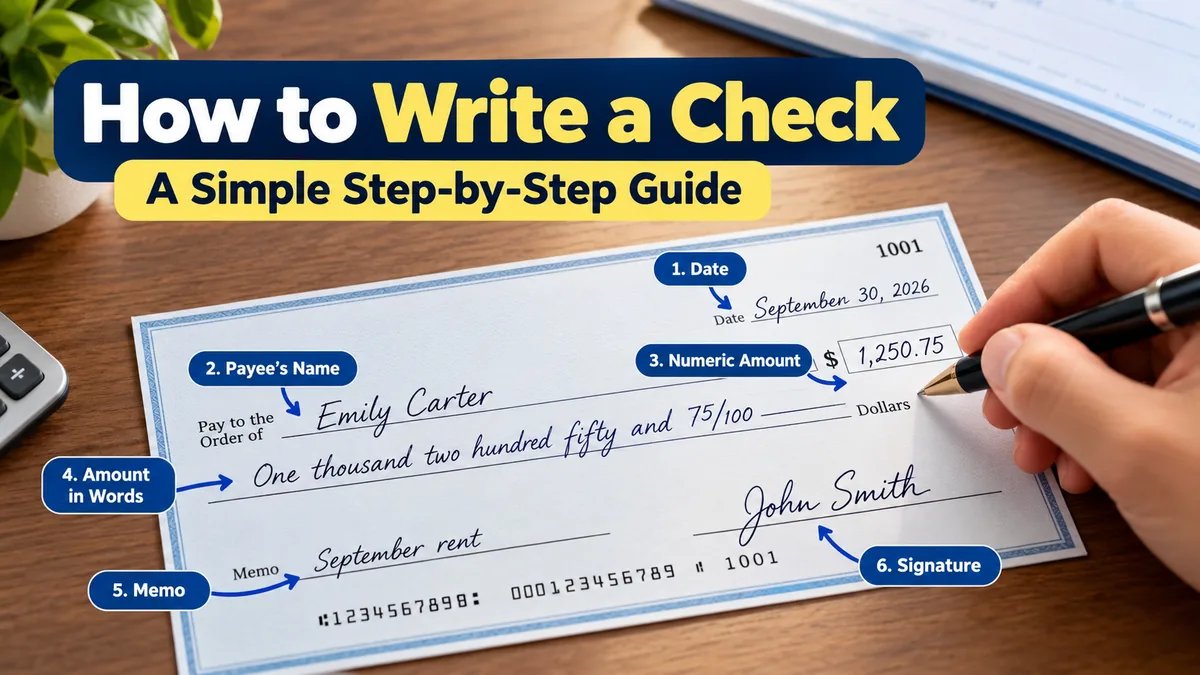
Writing a paper check may feel unfamiliar if you normally pay with a debit card, mobile wallet, or online banking. But checks are still used for rent, bills, contractors, gifts, deposits, and other payments. Knowing how to write a check correctly can help prevent payment delays, errors, and avoidable fraud risks.
To write a check, enter the date, write the recipient’s name, add the payment amount in numbers, spell out the same amount in words, complete the memo line if needed, and sign the check. Before handing it over, confirm that the payee and both versions of the amount are correct.
Parts of a Check You Should Know
Before filling anything out, it helps to understand what you’re looking at.
A standard personal check generally contains both preprinted information and blank fields that you complete yourself. The exact design varies between financial institutions, but the essential components are similar.
| Part of the check | What it means |
|---|---|
| Account holder information | Usually shows the account owner’s name and address |
| Date line | Shows when the check was written or dated |
| Payee line | Identifies the person or organization being paid |
| Amount box | Shows the payment amount numerically |
| Written amount line | States the payment amount in words |
| Memo line | Records the reason or reference for the payment |
| Signature line | Authorizes the payment |
| Routing number | Identifies the financial institution |
| Account number | Identifies the checking account |
| Check number | Helps identify and track the individual check |
The routing number, account number, check number, and account-holder information are generally already printed on a personal check. You normally shouldn’t need to write these numbers yourself.
How to Write a Check in 6 Steps
The basic process is straightforward. Accuracy matters, though, because an incorrectly completed check may be delayed or rejected.
1. Write the Date
Find the date field in the upper-right corner of the check.
Enter the date using a standard format, such as:
September 30, 2026
or:
09/30/2026
Using the current date is generally the simplest approach.
You may have heard of a postdated check, which means putting a future date on the check. Don’t assume that postdating guarantees the check won’t be processed early. Capital One notes that a postdated check could potentially be deposited before its listed date.
If timing matters, check your bank’s policies rather than relying solely on the date written on the check.
2. Write the Payee’s Name
Find the line that says something similar to:
Pay to the Order of
Write the full name of the person, company, or organization receiving the money.
For example:
John Smith
or:
Greenwood Apartments LLC
Use the recipient’s correct legal or business name whenever possible. Misspellings or incomplete payee information can create problems when the recipient tries to deposit or cash the check.
Avoid leaving the payee line blank.
You can technically encounter checks made payable to “Cash,” but this offers much less protection. If such a check is lost or stolen, someone who possesses it may potentially be able to cash it. Capital One specifically warns about this risk.
For most payments, naming a specific recipient is safer.
3. Write the Dollar Amount in Numbers
Next, find the small amount box on the right side of the check.
Enter exactly how much you’re paying using numbers.
For example, if you’re paying $125:
125.00
If you’re paying $1,275.50:
1,275.50
Include cents even when the payment is an exact dollar amount. So rather than simply writing “125,” write:
125.00
Writing the amount clearly and using the available space can also make unauthorized alterations more difficult.
Double-check the number before moving on because you’ll need to write the same amount in words in the next field.
4. Write the Amount in Words
This is the part of writing a check that often causes the most confusion.
Below the payee line, you’ll normally find a longer line for spelling out the payment amount.
Suppose your check is for:
$125.00
You could write:
One hundred twenty-five and 00/100 dollars
For a check worth:
$125.75
write:
One hundred twenty-five and 75/100 dollars
The fraction represents cents because there are 100 cents in one dollar.
Capital One gives the same basic convention: for example, $44.99 can be expressed as “Forty-four and 99/100.”
How do you write a check with no cents?
If there are no cents, use 00/100.
For example:
$500.00
becomes:
Five hundred and 00/100 dollars
This makes the intended amount clear.
How do you write cents on a check?
Write the whole-dollar portion normally and express the cents as a fraction over 100.
For:
$86.42
write:
Eighty-six and 42/100 dollars
Another accepted style may spell the cents out, but using the fraction format is simple and widely understood. Chase describes both approaches when explaining how cents can be written.
Fill unused space on the amount line
Start writing the amount near the left side of the line.
After the amount, draw a line through the unused portion of the field.
For example:
One hundred twenty-five and 00/100 —————
This helps reduce the opportunity for someone to add extra words or numbers.
Most importantly, make sure the numeric amount and written amount match.
5. Complete the Memo Line
The memo line is normally located near the lower-left portion of the check.
Unlike the payee, amount, and signature fields, completing a memo is generally optional. But it can provide a useful record of why you made the payment.
You might write:
- September rent
- Invoice #1045
- Tuition payment
- Birthday gift
- Plumbing repair
- Account #1234
Suppose you’re paying a contractor $850 for a repair. Writing something like “Kitchen repair – Invoice 204” can make the transaction easier to recognize later.
When paying a company, follow its payment instructions if it specifically asks you to put an invoice number, customer number, or another reference in the memo field.
Avoid unnecessarily placing sensitive personal information on a check.
6. Sign the Check
The final step in how to write a check is adding your signature.
Find the signature line at the bottom-right of the check and sign it using the signature associated with the account.
Your signature authorizes the payment. An unsigned check generally can’t be successfully cashed or deposited.
Don’t sign the check until the important fields—especially the payee and payment amount—have been completed.
A signed blank check could allow someone else to fill in a recipient or amount you never intended to authorize.
Example of a Completed Check
Suppose you’re paying Emily Carter $1,250.75 for September rent.
The completed fields would look roughly like this:
| Field | Example |
|---|---|
| Date | September 30, 2026 |
| Pay to the Order of | Emily Carter |
| Numeric amount | $1,250.75 |
| Written amount | One thousand two hundred fifty and 75/100 dollars |
| Memo | September rent |
| Signature | Your normal signature |
Before giving the check to Emily, compare the numeric amount with the written amount.
Both must represent $1,250.75.
That quick review catches one of the easiest check-writing mistakes to make.
How to Write a Check for Different Amounts
Writing the dollar amount becomes easier once you understand the cents-as-a-fraction convention.
Here are several examples:
| Numeric amount | Amount written in words |
|---|---|
| $20.00 | Twenty and 00/100 dollars |
| $50.25 | Fifty and 25/100 dollars |
| $105.50 | One hundred five and 50/100 dollars |
| $500.00 | Five hundred and 00/100 dollars |
| $1,250.75 | One thousand two hundred fifty and 75/100 dollars |
| $2,005.08 | Two thousand five and 08/100 dollars |
| $10,000.00 | Ten thousand and 00/100 dollars |
The key is consistency: the amount in words needs to represent the same payment as the numeric amount.
Common Mistakes When Writing a Check
Even experienced check writers can make mistakes. A quick review before signing can prevent most of them.
Leaving blank spaces
Don’t leave unnecessary space before the payee or written amount.
Starting close to the beginning of the field and drawing a line through unused space makes later additions more difficult.
Writing different amounts
Suppose the amount box says:
$150.00
but the written line says:
One hundred fifty-five and 00/100 dollars
You now have conflicting information.
Check both fields carefully before signing.
Forgetting to sign
A signature is an essential part of authorizing the check. Without it, the recipient may not be able to deposit or cash the payment.
Signing a blank check
Never give someone a check that you’ve signed but haven’t otherwise completed.
Both Chase and Capital One advise against signing blank checks because another person could potentially enter an unintended amount.
Using pencil
Use permanent ink rather than pencil. Chase recommends blue or black pen and notes that pencil and some other writing materials can create acceptance or tampering concerns.
Making the check payable to “Cash”
Although this is possible, it increases risk if the check is lost.
Naming the actual person or business you’re paying provides clearer control over the intended recipient.
What Should You Do If You Make a Mistake?
If you notice a significant mistake while writing the check, the safest simple approach is generally to void that check and start with a fresh one rather than trying to make confusing corrections.
Write:
VOID
clearly across the check.
Chase advises writing “VOID” across the face while avoiding obstruction of the routing and account numbers when those numbers are needed for purposes such as providing a voided check. Capital One similarly recommends voiding a check when correcting a writing mistake.
Don’t simply throw an incorrectly written check into the trash if it still contains usable banking information. Dispose of unwanted checks securely, such as by shredding them.
Can You Write a Check to Yourself?
Yes.
Put your own name on the payee line and complete the rest of the check normally.
For example:
Pay to the Order of: Michael Johnson
You could then deposit the check into another eligible account.
Both Chase and Capital One describe writing a check to yourself as possible, although electronic transfers may now be a more convenient way to move money between accounts.
What Are the Routing and Account Numbers on a Check?
At the bottom of a personal check, you’ll typically see several groups of numbers.
Two particularly important ones are the routing number and account number.
Routing number
A routing number identifies the financial institution associated with the account.
Account number
The account number identifies the specific bank account from which the payment will be drawn.
You’ll also usually see a check number, which helps distinguish one check from another and can make recordkeeping easier.
These details are generally preprinted on your checks, so you don’t enter them every time you make a payment.
Because checks contain financial information, store unused checks securely and avoid unnecessarily sharing images of them.
Should You Record Every Check You Write?
It’s a good habit.
When you write a check, the money doesn’t necessarily leave your checking account immediately. The recipient first has to deposit or cash it.
That delay means your online balance could temporarily appear higher than the amount you can actually spend safely.
Record:
- Check number
- Date
- Payee
- Payment amount
- Purpose of payment
Then account for outstanding checks when tracking your available money.
This can reduce the chance of spending funds that you’ve already committed through checks.
For businesses, accurate records become even more important. Chase recommends recording business checks in a check register or accounting software so payments aren’t forgotten while waiting to clear.
What Happens After You Write a Check?
After you give the check to the payee, that person or business can generally deposit or cash it according to its financial institution’s policies.
When the check is processed, the payment is drawn from the checking account associated with it.
Recipients may deposit checks:
- At a bank or credit union
- Through an eligible ATM
- Through mobile check deposit
- Through other methods supported by their financial institution
If using mobile deposit, the recipient may have to follow specific endorsement instructions. For example, Capital One tells eligible mobile-deposit customers to sign the back and add wording indicating that the check is for Capital One mobile deposit. Requirements can differ between financial institutions.
That means the person writing the check normally signs the front, while the person receiving the check generally endorses the back when preparing to deposit or cash it.
What Does It Mean to Endorse a Check?
Endorsement happens primarily on the recipient’s side of the transaction.
If someone writes a check payable to you, you may need to sign the designated endorsement area on the back before depositing or cashing it.
Chase recommends waiting until you’re ready to deposit or cash a check before endorsing it, reducing the opportunity for misuse if the check is lost.
Mobile deposit may require additional wording, so follow your bank or credit union’s instructions rather than assuming every institution has identical requirements.
Are Paper Checks Still Useful?
Digital payments have reduced how often many people use checks, but that doesn’t make check-writing knowledge obsolete.
Checks can still be useful when:
- A landlord accepts checks
- A contractor requests one
- You’re paying certain bills
- You need a physical payment record
- Electronic payment isn’t available
- You’re dealing with an organization that prefers checks
- You need to provide a voided check for banking purposes
Some online bill-pay systems even generate paper checks behind the scenes. Capital One, for example, explains that some bill-pay recipients may receive mailed paper checks rather than electronic payments.
Safety Tips for Writing Checks
A check contains enough financial information that basic security precautions are worthwhile.
Use permanent blue or black ink and write clearly. Complete the payee and amount before signing, and don’t leave large blank spaces where information could be added later. Both Chase and Capital One recommend writing checks in pen, avoiding blank signed checks, and reviewing the information before handing a check over.
Also keep your checkbook in a secure location.
If you mail a check, verify the recipient’s address before sending it. Monitor your bank account afterward so you know when the payment clears.
If a check is lost, stolen, altered, or deposited for an amount you didn’t authorize, contact your financial institution promptly for guidance.
How to Write a Check Correctly: Final Checklist
Before handing over or mailing your check, verify these six fields:
- Date: Enter the appropriate date.
- Payee: Write the recipient’s correct name.
- Numeric amount: Enter dollars and cents clearly.
- Written amount: Spell out the dollar amount and include cents.
- Memo: Add a useful payment reference when appropriate.
- Signature: Sign the check after confirming everything else.
Learning how to write a check comes down to accuracy. Make sure the numeric and written amounts match, identify the recipient clearly, use permanent ink, and sign only after the payment information is complete.
Once you’ve followed those steps and reviewed the check for mistakes, it’s ready to give or send to the intended recipient.