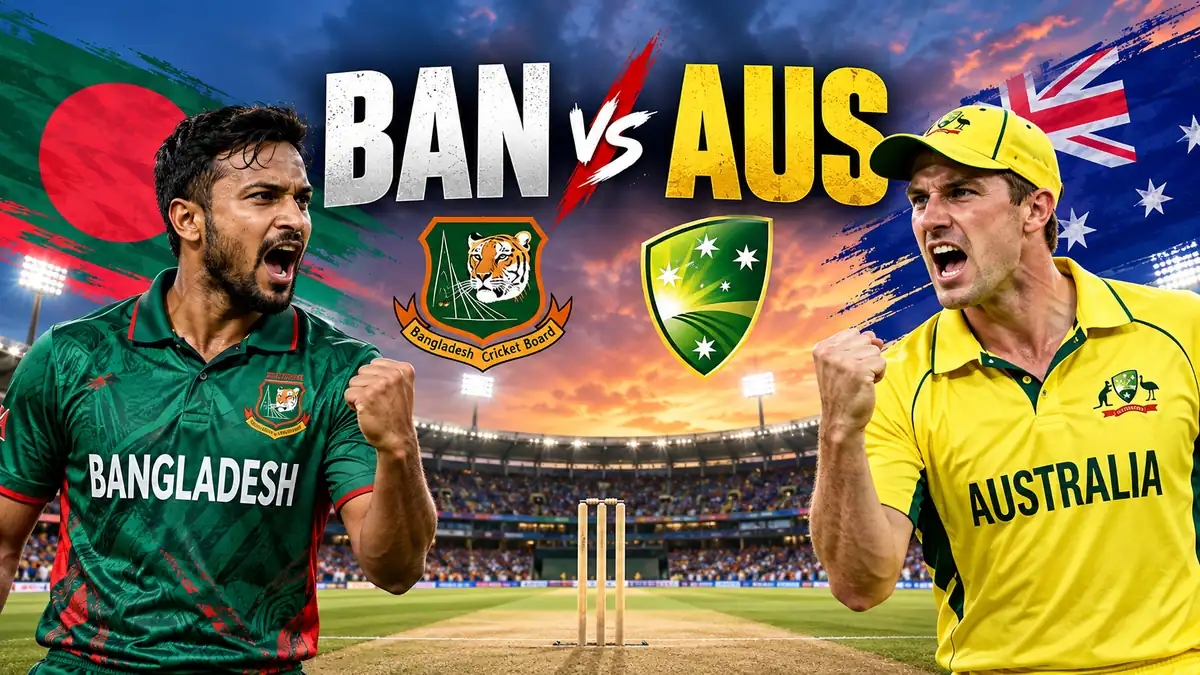
The ban vs aus cricket matchup refers to international matches between Bangladesh and Australia. Although Australia have historically held the stronger overall record, Bangladesh have become a much tougher opponent, particularly in home conditions where slower pitches and spin can significantly change the balance of a contest.
Quick answer: ban vs aus means Bangladesh vs Australia in international cricket. The teams meet in Tests, One Day Internationals (ODIs), and Twenty20 Internationals (T20Is). Their rivalry includes bilateral tours and major ICC tournaments, with Bangladesh producing several notable home victories despite Australia’s stronger long-term record.
The matchup gained fresh attention in 2026 when Australia toured Bangladesh for three ODIs and three T20Is. Bangladesh won the ODI series 2–1, while Australia responded by sweeping the T20I series 3–0.
What Does ban vs aus Mean in Cricket?
The abbreviation is straightforward:
| Abbreviation | Team |
|---|---|
| BAN | Bangladesh national cricket team |
| AUS | Australia national cricket team |
| BAN vs AUS | Bangladesh vs Australia |
Cricket websites, score applications, broadcasters, and fans commonly use shortened team codes because they fit easily into scorecards, schedules, fixtures, and live-score interfaces.
A search for ban vs aus can therefore refer to several things: a live score, completed match result, full scorecard, upcoming fixture, head-to-head statistics, squad information, or historical Bangladesh vs Australia matches.
The important detail is the format. Bangladesh and Australia compete across Tests, ODIs, and T20Is, and their records vary considerably depending on which format is being discussed.
ban vs aus Head-to-Head Overview
Australia have historically been the more successful team in Bangladesh-Australia international cricket, particularly in ODIs and major ICC competitions. Bangladesh’s strongest period in this matchup has generally come at home, where conditions can reduce some of Australia’s traditional advantages.
The 2026 ODI numbers illustrate the wider historical gap. Before the third ODI of Australia’s Bangladesh tour, the teams’ ODI head-to-head figures listed 25 matches, with Australia winning 21 and Bangladesh winning three, alongside one no-result.
T20 cricket has been more competitive. Ahead of the first T20I in June 2026, the T20I head-to-head record showed 12 meetings, with Australia winning eight and Bangladesh four.
That difference between formats matters. Looking only at the overall rivalry can hide how competitive individual series have become.
Why Australia’s historical record is stronger
Australia have spent decades among international cricket’s leading teams. Their success has been built around batting depth, fast bowling, fielding standards, and the ability to adapt across different countries.
Bangladesh entered Test cricket much later and spent years developing the depth required to consistently challenge established international teams.
The competitive gap has narrowed, however, particularly when Bangladesh play at home.
Why Bangladesh are difficult to beat at home
Bangladesh’s home advantage is not simply about familiarity.
Slower surfaces can reward accurate spin bowling, cutters, changes of pace, and batters who rotate strike effectively. Visiting players accustomed to faster or more predictable bounce may need time to adjust.
That makes conditions one of the most important factors when interpreting Bangladesh vs Australia results.
ban vs aus 2026 ODI Series
Australia toured Bangladesh in June 2026 for three ODIs followed by three T20Is. The ODI matches were played at the Shere Bangla National Stadium in Mirpur, Dhaka.
Bangladesh won the ODI series 2–1.
| Match | Bangladesh | Australia | Result |
|---|---|---|---|
| 1st ODI | 284/8 | 191/9 | Bangladesh won by 86 runs (DLS) |
| 2nd ODI | 195/5 | 187/8 | Bangladesh won by 5 wickets (DLS) |
| 3rd ODI | 274/5 | 277/9 | Australia won by 1 wicket |
Weather affected the first two matches, bringing the Duckworth-Lewis-Stern method into the results.
First ODI: Bangladesh win by 86 runs
The opening ODI on June 9 produced one of Bangladesh’s strongest recent results against Australia.
Bangladesh made 284/8 from their 50 overs before Australia finished on 191/9 after 42.2 overs. Bangladesh won by 86 runs under the DLS method.
Mosaddek Hossain delivered the defining all-round performance. He scored an unbeaten 86 from 70 balls and took 2/37, earning Player of the Match recognition.
Najmul Hossain Shanto contributed 67, while Cameron Green made an unbeaten 52 for Australia.
The result gave Bangladesh an immediate advantage in the three-match series.
Second ODI: Bangladesh secure the series
The second ODI took place on June 11 at the same Mirpur venue.
Australia scored 187/8 from 42 overs. Bangladesh reached 195/5 after 35 overs and won by five wickets under the DLS method.
The victory gave Bangladesh an unassailable 2–0 lead with one ODI remaining.
Mustafizur Rahman was named Player of the Match, highlighting how important Bangladesh’s bowling resources were during the series.
Third ODI: Australia edge a thriller
Australia prevented a series whitewash in the third ODI on June 14.
Bangladesh posted a competitive 274/5 from 50 overs. Australia reached 277/9 in 49.3 overs, winning by just one wicket.
Cooper Connolly played the decisive innings, scoring 149 from 134 balls and earning Player of the Match. Mosaddek Hossain was named Player of the Series.
The match demonstrated why individual Bangladesh-Australia contests can be considerably closer than the historical head-to-head record suggests.
ban vs aus 2026 T20I Series
After losing the ODI series, Australia responded strongly in the T20Is.
Australia won all three matches to take the series 3–0.
| Match | Bangladesh | Australia | Result |
|---|---|---|---|
| 1st T20I | 131 | 133/6 | Australia won by 4 wickets |
| 2nd T20I | 189/6 | 196/5 | Australia won by 7 runs |
| 3rd T20I | 109/8 | 112/3 | Australia won by 7 wickets |
The contrasting ODI and T20I results made the tour particularly interesting: Bangladesh controlled the ODI series, while Australia were clearly stronger in the shorter T20 format.
First T20I: Australia win by four wickets
Bangladesh were dismissed for 131 in 19 overs in the first T20I.
Australia chased the target with 133/6 in 18.2 overs, winning by four wickets. Adam Zampa was Player of the Match after taking 3/18.
The match also demonstrated Australia’s ability to manage a modest chase despite losing wickets.
Second T20I: Seven-run margin
The second T20I was considerably more competitive.
Bangladesh scored 189/6, but Australia reached 196/5 and won by seven runs.
A seven-run margin in a match where both teams approached 200 shows how different the conditions and scoring patterns can be from one fixture to another, even during the same tour.
Third T20I: Australia complete the sweep
Bangladesh managed 109/8 from 20 overs in the final T20I.
Australia responded with 112/3 in only 11 overs, completing a seven-wicket victory. Mitchell Marsh scored 60 from 28 balls and was named Player of the Match, while Matt Renshaw received Player of the Series recognition.
The result completed Australia’s 3–0 T20I series victory.
Bangladesh vs Australia in ODI Cricket
ODIs have traditionally been Australia’s strongest part of the matchup.
Australia’s advantage comes from a long history of success in 50-over cricket and greater experience in high-pressure international tournaments.
Bangladesh, however, have recorded increasingly meaningful ODI performances against established teams.
The 2026 series was particularly significant because Bangladesh did not simply win an isolated match. They won consecutive ODIs to secure the bilateral series before Australia claimed the final match.
Notable World Cup meetings
Bangladesh and Australia have also met at the ICC Cricket World Cup.
One notable encounter came at Trent Bridge in 2019. Australia scored 381/5, while Bangladesh replied with 333/8. Australia won by 48 runs.
Their 2023 World Cup meeting produced another Australian victory. Bangladesh made 306/8 before Australia successfully chased the target with 307/2, winning by eight wickets.
Those games illustrate Australia’s historical ODI strength while also showing that Bangladesh have been capable of producing substantial totals against them.
Bangladesh vs Australia in T20 Cricket
T20Is tell a more competitive story.
Bangladesh’s most memorable stretch against Australia came during Australia’s 2021 tour of Bangladesh.
The hosts won the five-match T20I series 4–1.
Bangladesh won the first three matches before Australia took the fourth. Bangladesh then produced a dominant performance in the fifth T20I, scoring 122/8 before dismissing Australia for only 62 to win by 60 runs.
That series remains important when discussing ban vs aus because it demonstrated how dramatically home conditions can influence the matchup.
Australia hit back in major tournaments
Australia subsequently produced convincing victories at global events.
At the 2021 T20 World Cup, Bangladesh were bowled out for 73. Australia reached 78/2 and won by eight wickets.
The teams met again during the 2024 T20 World Cup Super Eight stage. Bangladesh made 140/8 before Australia reached 100/2, with Australia winning by 28 runs under the DLS method.
These results highlight an important distinction: Bangladesh have often been more dangerous against Australia in bilateral matches at home than at neutral ICC tournament venues.
Bangladesh vs Australia in Test Cricket
Test cricket adds another layer to the rivalry because conditions have an even greater influence over five days.
Australia traditionally thrive on surfaces offering pace and bounce. Bangladesh’s home strategy has frequently relied more heavily on spin, control, and pressure created by deteriorating pitches.
One of Bangladesh’s landmark Test achievements came against Australia in Dhaka in 2017, when the hosts recorded their first Test victory over Australia.
That breakthrough demonstrated that Bangladesh could challenge elite Test opposition when their bowlers were able to exploit home conditions effectively.
Australia remain historically stronger in the format, but the 2017 result changed the perception that this matchup was automatically one-sided.
Key Players Who Can Shape ban vs aus Matches
The exact squads change from series to series, so player comparisons should always be tied to the relevant match.
During the 2026 Bangladesh tour, several names played significant roles.
Bangladesh
Mosaddek Hossain was central to the ODI series. His unbeaten 86 and two wickets in the first ODI helped Bangladesh establish early control, and he eventually earned Player of the Series recognition.
Mustafizur Rahman remained an important part of Bangladesh’s bowling attack and was Player of the Match in the second ODI.
Other players involved in the ODI squad included Mehidy Hasan Miraz, Najmul Hossain Shanto, Litton Das, Towhid Hridoy, Taskin Ahmed, Tanzid Hasan, Shoriful Islam, Nahid Rana and Rishad Hossain.
Australia
Cooper Connolly produced one of the standout innings of the ODI series, scoring 149 in Australia’s one-wicket victory in the third match.
Adam Zampa demonstrated Australia’s spin threat with 3/18 in the opening T20I.
Mitchell Marsh then made 60 from 28 balls in the third T20I as Australia completed their series sweep.
Australia’s 2026 ODI squad also featured players such as Josh Inglis, Cameron Green, Marnus Labuschagne, Alex Carey, Matthew Short, Matt Renshaw, Nathan Ellis and Xavier Bartlett.
Why Conditions Matter So Much in BAN vs AUS
Venue and pitch conditions deserve attention whenever these teams meet.
Australia’s domestic cricket is associated with surfaces that can offer pace and bounce. Bangladesh’s home venues can create a very different challenge.
That changes how teams construct an innings.
On slower surfaces, batters may have to wait longer for the ball, rotate strike rather than relying exclusively on boundaries, and read spin directly from the bowler’s hand.
Bowlers also change their approach. Pace alone may be less valuable than cutters, slower deliveries, accuracy, and variations.
Shere Bangla National Stadium
The Shere Bangla National Stadium in Mirpur, Dhaka, has hosted numerous Bangladesh-Australia matches, including all three ODIs during the 2026 series.
Bangladesh’s familiarity with the venue gives their players practical experience with how the surface can behave across different stages of an innings.
That does not guarantee victory, but it can reduce the adjustment period that visiting teams often face.
How to Read a ban vs aus Scorecard
Someone new to cricket may encounter a result such as:
BAN 284/8 (50)
AUS 191/9 (42.2)
The first number is the number of runs scored, while the number after the slash shows wickets lost.
So 284/8 means Bangladesh scored 284 runs while losing eight wickets.
The number in parentheses represents overs.
A standard ODI innings can last up to 50 overs, while a T20I innings normally lasts up to 20 overs.
If a score reads 277/9 (49.3), it means the team scored 277 runs for nine wickets after 49 overs and three legal deliveries of the next over.
What does DLS mean?
DLS stands for the Duckworth-Lewis-Stern method.
It is used in limited-overs cricket when interruptions, usually rain, prevent the match from continuing under its original conditions.
Instead of simply comparing raw totals, DLS recalculates the target based on resources such as overs remaining and wickets available.
This mattered during the 2026 ODI series because Bangladesh’s victories in both the first and second ODIs were recorded under the DLS method.
What Usually Decides Bangladesh vs Australia Matches?
Several recurring factors can shape the contest.
Conditions come first. Australia may be more comfortable when pace and bounce dominate, while Bangladesh can become particularly difficult to handle on slower home surfaces.
Spin can change the game quickly. Bangladesh have historically used spin-friendly conditions as a tactical advantage, while Australia also possess high-quality spin options such as Adam Zampa in limited-overs cricket.
Powerplay wickets matter. Early dismissals can prevent either side from establishing the platform needed for a large total.
Middle-over control is crucial. In ODIs, this phase often determines whether a team reaches an average score or a match-winning one.
Adaptability matters more than reputation. Historical head-to-head statistics provide context, but they cannot account for the specific pitch, squad, weather, injuries, and current form involved in an individual match.
That is why a useful ban vs aus analysis should combine historical records with the circumstances surrounding the actual fixture.
Why the Rivalry Has Become More Competitive
Bangladesh and Australia have not played each other as frequently as some other international pairings, so individual series can have an outsized influence on how the rivalry is perceived.
Australia’s historical advantage remains substantial in formats such as ODI cricket. Yet Bangladesh’s 2021 T20I series victory and 2026 ODI series win show that historical dominance does not necessarily translate into an easy contest in Bangladesh.
The pattern is increasingly clear.
Australia retain significant experience, depth, and a strong international record. Bangladesh become far more dangerous when conditions suit their bowling attack and their batters successfully manage the middle overs.
That contrast gives the matchup its character.
ban vs aus: What the Record Tells Us
The simplest interpretation of the Bangladesh-Australia rivalry is that Australia have been the stronger team historically, while Bangladesh have steadily created more competitive periods—especially at home.
Recent results demonstrate both sides of that story.
Bangladesh won the 2026 ODI series 2–1, including consecutive victories in the opening two matches. Australia then immediately reversed the momentum by winning the T20I series 3–0.
That makes format, venue, conditions, and team composition essential context whenever looking at ban vs aus results.
For readers checking a Bangladesh vs Australia fixture, the most useful approach is to identify the format first, then examine the venue, recent form, playing XI, pitch conditions, and current head-to-head record rather than relying on historical reputation alone.