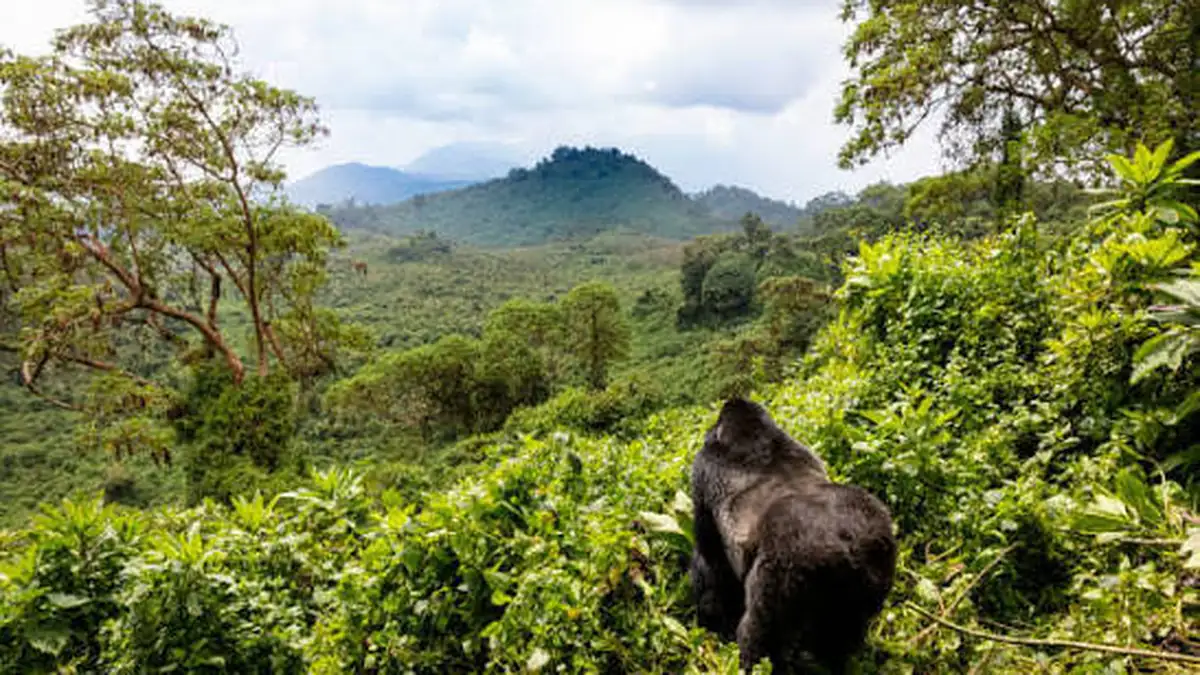
You’re standing in wet grass at 7:30 a.m., listening to a park ranger explain what to do if a 200-kilogram silverback decides to walk straight at you. (Answer: crouch, look down, don’t run.) That’s the moment most people realize gorilla trekking isn’t a wildlife photo op — it’s a genuine expedition, and it’s worth every bit of the effort.
Mountain gorillas in Uganda live wild in Bwindi Impenetrable National Park and Mgahinga Gorilla National Park, home to roughly half the world’s remaining population. A trekking permit costs $800 USD in 2026 (with $600 low-season rates in April, May and November), grants one hour with a habituated family, and typically requires a 2–6 hour forest hike through steep, muddy terrain.
What Makes Mountain Gorillas in Uganda Special
Mountain gorillas aren’t a zoo animal you drive up to. There are only a few hundred left on the planet, and they exist in exactly two wild populations: the Virunga Massif spanning Uganda, Rwanda, and the Democratic Republic of Congo, and Bwindi Impenetrable Forest, which sits apart from the volcanoes entirely. Uganda holds the largest share of the world’s mountain gorillas, split across more than a dozen habituated families that rangers have spent years acclimating to human presence.
That habituation process matters more than most articles mention. A “habituated” family isn’t tame — it’s simply used to quiet, non-threatening humans standing a respectful distance away. Every family you’re allowed to trek has gone through years of patient, repeated contact with trackers before tourists were ever introduced.
Bwindi itself is a UNESCO World Heritage Site, and it earns the name “impenetrable” honestly — it’s ancient rainforest, tangled with vines, moss-covered trees, and terrain that hasn’t been flattened for anyone’s convenience.
Bwindi vs. Mgahinga — Where You’ll Actually Trek
Uganda splits gorilla trekking across two parks, and where you’re assigned changes the whole shape of your day.
Bwindi Impenetrable National Park is divided into four trekking sectors — Buhoma, Ruhija, Rushaga, and Nkuringo — each with its own habituated families and its own character. Buhoma, in the north, has gentler terrain and suits older trekkers or first-timers. Rushaga and Nkuringo, in the south, are steeper but offer more families and access to the gorilla habituation experience.
Mgahinga Gorilla National Park is smaller and quieter. It has a single habituated family, the Nyakagezi group, which roams the slopes of the Virunga volcanoes — Mount Muhavura, Mount Gahinga, and Mount Sabyinyo. Because there’s only one family, permits here are limited, but you also get volcanic scenery and golden monkey trekking that Bwindi doesn’t offer.
Quick takeaway: choose Bwindi for the widest choice of families and sectors; choose Mgahinga if you want fewer crowds and don’t mind a smaller trekking pool.
2026 Gorilla Permit Prices (And What’s Changing on July 1)
Every trek starts with a permit issued by the Uganda Wildlife Authority (UWA), and this is the one cost you can’t negotiate away.
| Permit Type | 2026 Price | Duration | Notes |
|---|---|---|---|
| Standard trekking permit (foreign non-resident) | $800 | 1 hour with gorillas | Peak season rate |
| Standard permit, low season (Apr, May, Nov) | $600 | 1 hour with gorillas | Non-reschedulable |
| Foreign resident permit | $700 | 1 hour with gorillas | Requires proof of residency |
| East African citizen permit | 300,000–350,000 UGX | 1 hour with gorillas | Regional rate |
| Gorilla habituation experience | $1,500 | Up to 4 hours | Only in select Bwindi sectors, very limited spots |
Your permit covers park entry, an armed ranger escort, a trained guide, and trackers — but not transport, meals, accommodation, or tips. Roughly 75% of what you pay goes directly toward conserving the gorilla population, with the remainder split between government administration and community projects around the parks.
One detail worth flagging clearly: prices are confirmed through June 30, 2026, but UWA has signaled a revised tariff structure for most primate experiences starting July 1, 2026. If your trip falls in the second half of the year, confirm current rates with UWA or your operator before you book — don’t rely on last year’s screenshots.
How to Book a Permit — and the Rule That Just Changed
Booking used to be simple: reserve a permit, hold it for seven days, then pay. That’s no longer the case. As of March 2026, UWA suspended the 7-day reservation window. Permits must now be paid in full at the time of booking to be secured, which means you need your budget and travel dates locked in before you reserve anything — there’s no more “hold my spot while I think about it.”
Permits are genuinely limited: across Bwindi’s four sectors, roughly 152–184 standard permits are issued per day, plus 8 for the habituation experience, and just 8 for Mgahinga’s single family. Book 4–6 months ahead for shoulder season, and 6–12 months ahead if you want June, July, August, or December through February — those months sell out first.
Permits are also non-refundable in most circumstances, so buy travel insurance that covers trip cancellation if that’s a real risk for you.
Best Time to Go
Gorilla trekking happens year-round, but the calendar changes what your day feels like.
- June–September and December–February (peak/dry season): firmer trails, easier footing, clearer forest visibility. Also the busiest booking window — permits sell out furthest in advance.
- March–May and October–November (low/wet season): heavier rain, muddier and more physically demanding trails, but a quieter forest, lusher scenery, and — in April, May, and November — the discounted $600 permit.
If mud doesn’t bother you and you’d rather skip the crowds, low season is genuinely underrated. If you want the most predictable conditions, book dry season as early as you can.
How Fit Do You Actually Need to Be?
This is the question people undersell the most. Bwindi sits at elevations between roughly 1,500 and 2,600 meters, with some accounts citing up to 4,300m in parts of the wider gorilla trekking region, and the trails aren’t graded paths — they’re steep, root-tangled, and often slick with rain. A trek can take anywhere from 30 minutes to 7 hours round trip, depending entirely on where the gorillas nested the night before, and nobody knows that in advance.
That said, “fit” doesn’t mean “athlete.” Rangers assign trekkers to gorilla families based on stated fitness level — shorter, gentler routes tend to go to older visitors or those with physical limitations, while longer, steeper assignments go to fitter groups. Porters are available for around $15–20 plus tip, and hiring one is worth it even if you feel strong: they carry your pack, steady you on slopes, and the fee supports local families, many of them former poachers now working in conservation-linked jobs. Sedan chairs and additional porter support exist for visitors who can’t complete the full hike unassisted.
Practical prep that actually helps: a few weeks of regular walking, hiking, or cardio before you travel; a day or two at altitude before your trek to acclimatize; and a practice walk with a loaded daypack so your shoulders aren’t surprised on the day.
What to Pack (Quick Checklist)
- Sturdy, broken-in waterproof hiking boots
- Long-sleeved shirt and long trousers in neutral tones (khaki, olive, brown — bright colors stand out and can agitate insects)
- Gardening-style gloves for gripping vines and thorny brush
- Lightweight rain jacket — forest weather turns fast, even in dry season
- Gaiters or trousers tucked into socks (safari ants are relentless)
- Camera with a working zoom and the flash disabled
- Small daypack, water, and energy snacks
- Insect repellent, sunscreen, and a hat
- Your permit documentation and passport
Porters can be hired locally at the trailhead if you’d rather keep your hands free.
Trek Day: The Briefing, the Hike, and the Rules That Protect the Gorillas
Trek day starts early. You’ll arrive at your assigned sector’s headquarters around 7:30–8:00 a.m., sometimes greeted by a local community welcome performance, before a ranger runs a 30–45 minute briefing covering conduct, safety, and what to expect. This is also when you’re assigned to a specific family — not something you choose yourself, though your stated fitness level influences the decision.
The rules exist because these are wild, endangered animals, not performers, and they’re strictly enforced:
- The one-hour rule. Once the gorillas are located, your clock starts and stops at exactly 60 minutes.
- No flash photography. It can startle the animals; adjust your ISO instead.
- Maintain distance — typically several meters — and never touch a gorilla, even a curious youngster.
- Turn away if you cough or sneeze, and stay home if you’re feeling unwell before the trek — gorillas share enough DNA with humans to catch our illnesses.
- Keep your voice down, avoid sudden movement, and don’t hold direct eye contact if a gorilla looks at you.
- Pack out everything you bring in — no litter left on the trail.
Then comes the part no packing list can prepare you for: the moment your guide raises a hand, points into the undergrowth, and you realize a silverback is watching you from ten meters away. Most visitors describe the hour that follows as quiet, intense, and oddly emotional — not what they expected from a “wildlife encounter.”
Uganda vs. Rwanda — Which Should You Choose?
Both countries offer mountain gorilla trekking in the same Virunga ecosystem, but the trade-offs are real.
| Factor | Uganda | Rwanda |
|---|---|---|
| Permit price (2026) | $800 (from $600 low season) | $1,500 |
| Habituated families | 19+ across Bwindi and Mgahinga | 12+ in Volcanoes National Park |
| Travel time from capital | ~8–9 hrs Entebbe–Bwindi by road, or ~4–5 hrs via Kigali | ~2–3 hrs Kigali–Volcanoes NP |
| Terrain | Steeper, denser, more physically demanding | Generally shorter, more accessible treks |
| Extra wildlife | Chimps, tree-climbing lions, Big Five savanna parks | Golden monkeys, volcano scenery |
Neither answer is objectively “better.” Rwanda wins on convenience and polish — you can fly into Kigali and be trekking within a few hours. Uganda wins decisively on price and on the sheer range of habituated families and sectors, and many travelers now fly into Kigali anyway and cross the border to trek in Uganda for less money, using the East African Tourist Visa that covers both countries.
What a Full Trip Actually Costs
The permit is just the anchor cost. A realistic 5-day Uganda gorilla safari — permit, mid-range lodging, meals, transport, and a guide — typically runs $2,400 to $4,500 per person, climbing higher for luxury lodges or fly-in transfers. Budget lodges near Bwindi start around $100/night; mid-range options with pools and forest views run $150–$400/night; ultra-luxury eco-lodges can exceed $1,000/night.
Other costs to budget for: local transport or a 4×4 vehicle hire, porter fees ($15–20 plus tip), meals if not bundled ($30–40/day), and guide/ranger tips (an informal but expected part of the culture — $10–20 per guide, $5–10 per ranger is a common range).
Quick takeaway: treat the permit as roughly a third of your total trip cost, not the whole budget.
Pairing Gorillas With the Rest of Uganda
Most visitors don’t fly all the way to Uganda for one hour with gorillas and nothing else. Kibale Forest National Park offers chimpanzee tracking for around $150 per permit, and Kyambura Gorge in Queen Elizabeth National Park has a cheaper chimp option near $50. Mgahinga adds golden monkey trekking to the itinerary if you’re already in the southwest. Many trekkers also add a Batwa cultural visit — a chance to learn from the indigenous forest community that lived in Bwindi before it became a protected park — or continue north to Murchison Falls for classic savanna game viewing. Combining activities isn’t just good value; it also spreads your travel days across Uganda’s varied terrain instead of one long haul in and out.
For more safari planning guides and wildlife trip ideas, explore our travel guide library.
FAQ
How much is a gorilla trekking permit in Uganda in 2026?
Standard permits cost $800 for foreign non-residents, with a discounted $600 rate in April, May, and November. Rates are confirmed through June 30, 2026, with a new tariff structure expected from July 1.
How many mountain gorillas are left in the world?
Just over 1,000 mountain gorillas remain globally, with Uganda hosting roughly half of them across Bwindi and Mgahinga.
Is Uganda or Rwanda better for gorilla trekking?
Uganda offers lower permit costs and more habituated families; Rwanda offers shorter travel time from Kigali and generally easier terrain. Neither is universally “better” — it depends on budget versus convenience.
What is the minimum age for gorilla trekking?
Visitors must be at least 15 years old, a rule applied consistently across Uganda, Rwanda, and DRC to protect gorillas from disease transmission.
How long does the actual trek take?
Anywhere from 30 minutes to 7 hours round trip, depending on where the gorilla family moved overnight, plus a fixed one hour once you find them.
Do I need to be very fit to trek gorillas?
Moderate fitness helps, but porters, flexible family assignments, and even sedan chairs for visitors with mobility limits mean most reasonably healthy adults can complete a trek.
Can I get a refund if I cancel my permit?
Generally no — permits are non-refundable, which is why travel insurance covering trip cancellation is worth considering.
What’s the biggest mistake first-time trekkers make?
Underestimating the terrain and skipping a porter. Even fit hikers find Bwindi’s steep, muddy slopes tougher than expected, and porters make the day meaningfully easier while directly supporting local livelihoods.