Search visibility normally takes time. You publish useful content, improve technical SEO, earn authority, and wait for search engines to crawl, understand, and evaluate your pages. So when an SEO service talks about improving visibility within hours, it naturally gets attention.
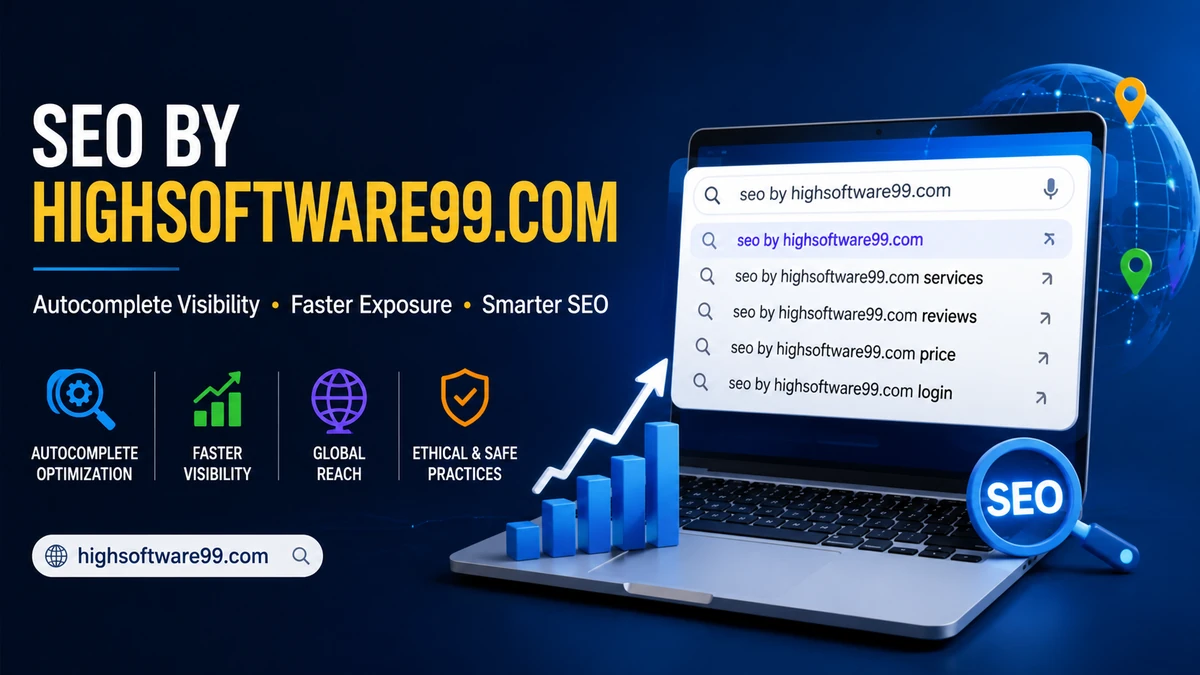
That is a major reason people are searching for seo by highsoftware99.com. The phrase is associated with HighSoftware99.com and, more specifically, its promotion of Google Autocomplete or ATC services. The company’s public website describes services intended to boost selected keywords in autocomplete within roughly 3–12 hours.
But autocomplete visibility and ordinary organic Google rankings are not the same thing. Understanding that distinction is essential before evaluating the service, its claims, or its potential usefulness.
Quick answer: seo by highsoftware99.com refers primarily to SEO and Google Autocomplete visibility services promoted by HighSoftware99.com. Its most distinctive offering focuses on getting targeted phrases noticed in Google’s predictive search suggestions. This should be evaluated separately from conventional organic SEO, where rankings depend on broader content, technical, relevance, and authority signals.
What Is seo by highsoftware99.com?
The term seo by highsoftware99.com is used online to describe the search optimization services associated with HighSoftware99.com.
Search results currently contain numerous third-party guides interpreting the term as a broader SEO methodology involving keyword research, technical optimization, content structure, internal linking, and authority building.
However, the company’s own public material gives much greater prominence to something more specific: Google Autocomplete optimization, sometimes described as ATC.
The site promotes autocomplete services for keywords and demonstrates examples involving searches such as “seo” in the United States and “seo service” in India.
That distinction matters.
Traditional SEO usually tries to improve where a webpage appears after someone submits a search.
Autocomplete optimization attempts to gain visibility while someone is still typing the search.
These are two different stages of the search journey.
How Google Autocomplete Actually Works
To understand the HighSoftware99 concept, you first need to understand Google Autocomplete.
Autocomplete is the prediction system that displays possible queries underneath Google’s search box while someone types.
For example, a person entering:
best seo
may see several predicted searches before finishing the query.
According to Google, these predictions are generated automatically and are influenced by factors including:
- real searches performed on Google;
- the language of the query;
- the searcher’s location;
- trending interest;
- previous searches in personalized circumstances; and
- words and phrases found across the web.
Google also makes clear that autocomplete is complex and should not simply be treated as a list of the most popular searches.
This explains why suggestions can vary between users, countries, languages, and different points in time.
Autocomplete Is Not an Organic Ranking Position
This is probably the most important point for anyone researching seo by highsoftware99.com.
Appearing as an autocomplete prediction does not mean that your website ranks #1 for that keyword.
Consider the search process:
- A user begins typing.
- Google displays autocomplete predictions.
- The user selects or finishes a query.
- Google loads the search results.
- Organic webpages compete for positions on that results page.
Autocomplete operates mainly around steps 1–3.
Traditional SEO concentrates heavily on steps 4–5.
A brand could theoretically become associated with a search prediction without its website holding the top organic position for the underlying query.
Why seo by highsoftware99.com Has Attracted Attention
The appeal is easy to understand.
Traditional SEO can be slow.
Google itself says that SEO changes may take anywhere from a few hours to several months to produce an observable effect. It also explicitly warns that there are no hidden techniques that automatically guarantee a #1 Google ranking.
HighSoftware99.com’s public messaging takes a dramatically faster angle for its autocomplete offering, advertising keyword boosts through autocomplete within approximately 3–12 hours.
That creates an attractive proposition for marketers interested in early-search visibility.
But it also creates a question that deserves careful consideration:
What exactly does the promised result represent?
A buyer should distinguish between:
| Result | What It Means |
|---|---|
| Autocomplete visibility | A phrase appears among Google’s predicted searches |
| Indexing | Google has discovered and stored a webpage |
| Organic ranking | A webpage appears in search results for a query |
| Organic traffic | People actually click the webpage from search results |
| Conversion | Visitors complete a meaningful business action |
These outcomes are related to search visibility, but they are not interchangeable.
What Does “Instant” SEO Mean Here?
Some pages discussing the brand use phrases such as “instant appear” or “instant SEO.” Those descriptions can easily create the impression of instant organic rankings.
That interpretation should be avoided unless evidence specifically demonstrates it.
HighSoftware99.com’s prominent claim concerns autocomplete visibility rather than a universal guarantee that arbitrary webpages will instantly occupy top organic positions.
Google’s own SEO documentation reinforces the difference. Google says there is no secret capable of automatically ranking a website first, and the effects of optimization can require significant time.
So a more accurate interpretation is:
Fast autocomplete visibility is not equivalent to instant organic SEO rankings.
This distinction prevents unrealistic expectations.
seo by highsoftware99.com vs Traditional SEO
The two approaches are easier to understand side by side.
| Area | Autocomplete-Focused Approach | Traditional Organic SEO |
|---|---|---|
| Primary target | Search predictions | Search result rankings |
| User stage | Before query submission | After query submission |
| Typical focus | Keyword/brand suggestion visibility | Pages, content and website authority |
| Main measurement | Prediction appearance | Clicks, impressions, rankings and conversions |
| Location sensitivity | Potentially significant | Also significant for many searches |
| Long-term objective | Search awareness/discovery | Sustainable organic search traffic |
| Replacement for full SEO? | No | Forms the broader search strategy |
This is why autocomplete optimization makes more sense when considered as a specialized visibility technique rather than a complete substitute for SEO.
Potential Benefits of Autocomplete Visibility
There are legitimate reasons marketers might find autocomplete interesting.
Greater Brand Exposure
Autocomplete occupies highly visible space directly below the search box.
If a relevant brand or branded phrase appears while people search, it can expose that name before users even reach the search results.
That can potentially support brand recognition.
Influence Earlier in the Search Journey
Most conventional search marketing begins after a query has already been selected.
Autocomplete appears earlier.
It can therefore influence which query a person chooses to search.
That makes the search box itself an interesting discovery environment.
Geographic Search Opportunities
Google confirms that location is one factor its autocomplete systems consider.
Consequently, a prediction visible in one country may not necessarily appear identically somewhere else.
For businesses evaluating an autocomplete campaign, geographic testing therefore matters. A screenshot from one location does not automatically demonstrate equivalent visibility everywhere.
Branded Search Discovery
Autocomplete may be especially interesting when the target combines a topic with a recognizable brand.
For example, someone typing a broad service could potentially encounter a branded variation and become aware of a company they had not previously considered.
The value here is primarily discovery and visibility, not proof of an organic ranking improvement.
Important Limitations to Understand
The unusual speed associated with autocomplete marketing makes verification especially important.
1. Predictions Can Change
Google says autocomplete considers factors such as location, language, trends, previous searches, and actual search activity.
A prediction should therefore not be assumed to be permanent.
Always distinguish between:
- appearing once;
- appearing consistently;
- appearing across target locations; and
- remaining visible over time.
Those are very different performance standards.
2. Visibility Does Not Guarantee Clicks
Even if a phrase appears in autocomplete, users still have to select it.
Afterward, they still encounter a normal search results page.
Your actual website must then compete for attention.
That means autocomplete exposure alone does not guarantee:
visibility → click → visitor → lead → customer
Each stage requires separate measurement.
3. It Does Not Fix Weak SEO
Suppose your website has:
- poor content;
- confusing navigation;
- serious crawlability problems;
- weak topical coverage;
- irrelevant pages;
- poor mobile usability; or
- pages that fail to satisfy search intent.
Autocomplete exposure does not automatically solve those issues.
Google describes SEO as helping search engines understand content while helping users discover relevant websites. Its documentation emphasizes crawlability, indexing, useful content, site accessibility, security, speed, and usability across devices.
Those fundamentals remain necessary.
Can seo by highsoftware99.com Replace Traditional SEO?
It should not be treated as a replacement for a complete organic SEO program.
A durable strategy normally requires several connected layers.
Technical SEO
Search engines need reliable access to your content.
Technical work commonly includes checking:
- crawlability;
- indexing;
- canonicalization;
- redirects;
- mobile usability;
- page performance;
- HTTPS;
- site architecture; and
- structured data where appropriate.
Google specifically recommends building sites that are secure, fast, accessible, and functional across devices.
Search Intent and Keyword Research
Keywords are useful only when they represent the right audience and purpose.
A good strategy asks what the searcher actually wants.
Someone searching “how does autocomplete work” needs educational content.
Someone searching a company name may want its website.
Someone searching “SEO agency near me” may be comparing providers.
Those searches require different pages and different answers.
Helpful Content
Google’s SEO guidance repeatedly returns to a simple principle: build pages primarily around users and make their content understandable to search engines.
Strong content should answer the main question quickly, explain related questions thoroughly, use descriptive headings, and provide genuinely useful information rather than merely repeating keywords.
Internal Linking
Internal links connect related pages and help create logical site architecture.
For example, a comprehensive SEO site might connect pages covering:
Keyword Research → On-Page SEO → Technical SEO → Content Optimization → Link Building → Analytics
This creates meaningful topical relationships rather than isolated articles.
Authority and Reputation
Useful content alone does not guarantee competitive rankings.
Websites also benefit from genuine mentions, relevant links, recognizable expertise, and an established reputation within their subject area.
These signals develop over time, which is another reason any “instant” visibility concept should be separated from long-term organic authority.
How to Evaluate HighSoftware99.com’s Claims
You do not need to automatically accept or reject the service.
Evaluate measurable evidence.
Define the Promised Outcome
Before judging any campaign, establish exactly what is being promised.
Is the objective:
- autocomplete appearance;
- organic ranking;
- indexing;
- traffic;
- branded searches; or
- leads?
Without defining the metric, almost any visibility result can be presented as an SEO success.
Test From the Correct Market
Because Google says location can affect autocomplete predictions, verify results from the country or region being targeted.
Testing only from your personal browser may also be misleading because personalization can affect predictions.
Check Organic Performance Separately
Use Google Search Console to evaluate what happens to the website itself.
Its Performance report provides metrics such as:
- clicks;
- impressions;
- click-through rate;
- queries;
- pages; and
- search performance over time.
Google specifically recommends Search Console for understanding which queries generate visibility and traffic and which pages achieve stronger or weaker click-through rates.
This allows you to separate a visible autocomplete prediction from measurable organic website growth.
A Practical Measurement Framework
If you are testing seo by highsoftware99.com, measurement should happen at several levels.
| Metric | Question to Ask |
|---|---|
| Autocomplete presence | Does the intended phrase actually appear? |
| Geographic consistency | Does it appear in the target market? |
| Persistence | Is it still present days or weeks later? |
| Search impressions | Are relevant queries generating more impressions? |
| Organic clicks | Is actual Google traffic increasing? |
| CTR | Are searchers clicking the website more frequently? |
| Rankings | Are important pages improving organically? |
| Conversions | Is the additional visibility producing useful actions? |
This prevents one metric from being mistaken for the entire SEO outcome.
What About Automated Search Activity?
This area deserves particular caution.
Google’s current spam policies explicitly identify machine-generated traffic, including automated queries sent to Google without express permission, as violating its spam policies and Terms of Service.
That does not by itself establish how a particular provider creates autocomplete visibility.
It does mean that anyone considering an autocomplete optimization service should ask how the result is generated.
Useful questions include:
- What methods create the autocomplete signal?
- Does the process involve automated Google searches?
- Which countries and devices are targeted?
- How long is the prediction expected to remain visible?
- What happens if the suggestion disappears?
- How is success independently verified?
- Is autocomplete visibility being sold separately from organic ranking?
A reputable explanation should clearly distinguish methods, metrics, and limitations.
Does Autocomplete Affect SEO Rankings?
Autocomplete can influence what users search for, but that is different from saying autocomplete placement directly causes higher organic rankings.
Google describes autocomplete as a system designed to help users complete searches more quickly. Its predictions depend on real searches alongside contextual factors such as language, location, trends, and personalization.
Organic search, meanwhile, involves crawling, indexing, understanding content, and deciding what results are relevant to a query.
The safest way to think about the relationship is:
Autocomplete can affect search discovery and query selection; organic SEO determines how well your pages compete once that search takes place.
One may complement the other, but they solve different problems.
Common Mistakes When Assessing seo by highsoftware99.com
One common mistake is assuming that an autocomplete screenshot proves a #1 Google ranking. It doesn’t. Always run the actual search and inspect the organic results separately.
Another mistake is evaluating only the promised speed. Fast visibility sounds attractive, but durability matters more. A prediction appearing for several hours is different from sustained search visibility that generates qualified traffic for months.
Businesses can also make the mistake of abandoning conventional SEO after seeing autocomplete results. Technical health, useful content, search intent, internal linking, and authority remain important for organic growth.
Finally, do not rely entirely on branded case studies or third-party promotional articles. Verify performance using independent observations and your own analytics.
What Actually Works for Sustainable Search Visibility?
For long-term SEO, the fundamentals are less exciting than “instant rankings,” but they are far more measurable.
Start with a technically accessible website.
Create pages around real search intent rather than simply high-volume keywords.
Build meaningful topical coverage instead of publishing dozens of disconnected articles.
Keep page titles, headings, internal links, images, and descriptive text understandable.
Improve pages when Search Console data shows high impressions but weak clicks or when a page ranks for relevant queries without adequately satisfying them.
Google’s Performance report is particularly useful here because it lets site owners examine search queries, clicks, impressions, CTR, pages, countries, and other dimensions.
SEO becomes much more reliable when decisions come from measurable performance rather than assumptions.
Is seo by highsoftware99.com Worth Considering?
That depends on the objective.
If the objective is specifically Google Autocomplete visibility, the concept deserves to be evaluated according to autocomplete metrics: target phrases, target geography, visibility duration, consistency, methodology, and resulting search behavior.
If the objective is sustainable organic rankings and traffic, autocomplete alone is insufficient.
A website still needs strong technical foundations, useful content, logical architecture, appropriate keyword targeting, genuine authority, and ongoing measurement.
The strongest approach is therefore to evaluate autocomplete as a specialized visibility channel, not automatically treat it as a substitute for conventional SEO.
Final Thoughts on seo by highsoftware99.com
seo by highsoftware99.com has gained attention largely because it connects SEO marketing with a compelling promise: rapid visibility through Google Autocomplete. The company’s own public material prominently promotes autocomplete or ATC services and claims keyword visibility can occur within hours.
The underlying concept becomes much easier to evaluate once autocomplete and organic rankings are separated.
Autocomplete happens while users formulate searches. Organic SEO determines how effectively pages compete after those searches are submitted.
Google itself says autocomplete predictions depend on real searches and contextual signals such as location, language, trends, and previous activity. Google also makes clear that ordinary SEO offers no secret route to guaranteed first-place rankings and that optimization changes can take hours to months to show effects.
For that reason, evaluate the service through evidence rather than speed claims alone. Verify the prediction independently, measure its persistence and geographic reach, watch Search Console for genuine impressions and clicks, and continue investing in technical SEO and useful content.
That provides a much clearer picture of what seo by highsoftware99.com can—and cannot—contribute to search visibility.