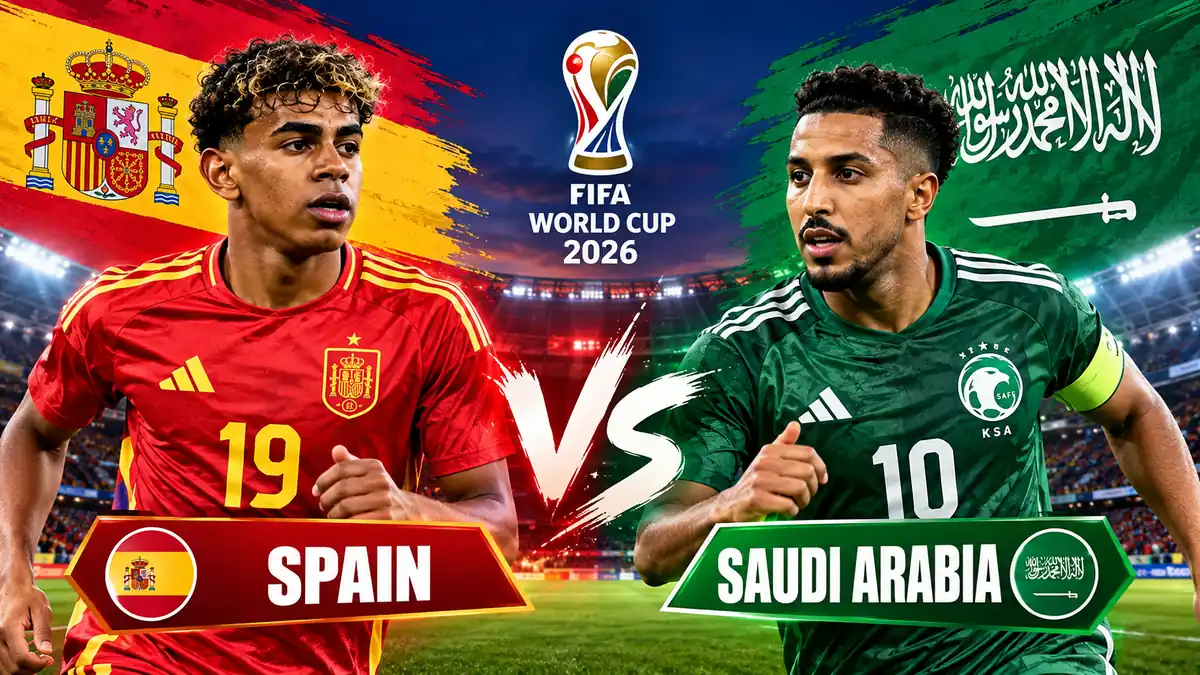
Spain and Saudi Arabia represent two different football traditions, but their meetings on the international stage offer an interesting comparison of European technical excellence and the growing competitiveness of Asian football.
The search for spanyol vs arab saudi focuses on the national teams’ head-to-head history, previous FIFA World Cup encounters, playing styles, notable players, and their upcoming meeting at the 2026 tournament.
Spain have historically dominated this matchup, winning their previous senior men’s international encounters. Saudi Arabia, however, have demonstrated that they can challenge elite opponents, most famously by defeating Argentina at the 2022 FIFA World Cup. Their 2026 meeting offers another opportunity to measure the gap between the teams.
spanyol vs arab saudi: Head-to-Head Record
Spain and Saudi Arabia have faced each other in senior men’s international football on several occasions, including a World Cup group-stage match and international friendlies.
Their historical results favor Spain, who have generally controlled possession and created more scoring opportunities.
| Date | Competition | Match | Result |
|---|---|---|---|
| June 23, 2006 | FIFA World Cup | Saudi Arabia vs Spain | 0–1 |
| May 29, 2010 | International friendly | Spain vs Saudi Arabia | 3–2 |
| September 7, 2012 | International friendly | Spain vs Saudi Arabia | 5–0 |
Spain won all three encounters, scoring nine goals and conceding two.
The results reveal more than a simple difference in goals. Spain’s performances reflected their technical quality, midfield organization, and ability to control matches through possession.
Saudi Arabia’s narrow defeat in 2006 and competitive performance in 2010 nevertheless showed that the team could remain organized against stronger opposition.
Which team has won more matches?
Spain lead the historical head-to-head record with three victories from three meetings.
Saudi Arabia have yet to record a senior men’s international victory against Spain in these encounters.
What was the biggest victory?
Spain’s 5–0 win in September 2012 remains the largest margin of victory in this head-to-head series.
The match demonstrated Spain’s attacking depth during an era when the national team was among the strongest in world football.
Spain vs Saudi Arabia at the 2006 FIFA World Cup
The most significant competitive meeting between the teams took place at the 2006 FIFA World Cup in Germany.
Spain entered the match having already secured qualification for the knockout stage, while Saudi Arabia were seeking a positive result in their final Group H fixture.
Spain won 1–0 through a first-half goal from Juanito Gutiérrez.
Match summary
Spain
Group H · June 23, 2006
Saudi Arabia

1 – 0
Full time

Goalscorer: Juanito, 36th minute · Fritz-Walter-Stadion, Kaiserslautern, Germany
Spain made several changes to their starting lineup, providing opportunities for players who had not featured prominently in the opening group matches.
Despite the changes, Spain maintained their organizational structure and secured the victory.
Saudi Arabia defended with determination but struggled to create enough clear opportunities to equalize.
Why was this match significant?
The result completed Spain’s perfect group-stage record, with three wins from three matches.
For Saudi Arabia, the defeat confirmed their elimination from the competition after a difficult campaign.
Spain subsequently lost to France in the round of 16, while Saudi Arabia returned home without a victory.
spanyol vs arab saudi: The 2026 FIFA World Cup Matchup
The 2026 FIFA World Cup creates another important chapter in the football relationship between Spain and Saudi Arabia.
The expanded tournament, hosted by the United States, Canada, and Mexico, features 48 national teams and provides greater opportunities for countries from the Asian Football Confederation.
Spain and Saudi Arabia were drawn into Group H alongside Uruguay and Cape Verde.
Their scheduled meeting brings together two teams with contrasting football identities.
Group H overview
| Team | Confederation | Football identity |
|---|---|---|
| Spain | UEFA | Possession, technical passing, high pressing |
| Saudi Arabia | AFC | Compact defending, transitions, quick attacks |
| Uruguay | CONMEBOL | Physical intensity, tactical discipline |
| Cape Verde | CAF | Athleticism, counterattacking opportunities |
Group H presents different tactical challenges for each team.
Spain will aim to impose their possession-oriented approach, while Saudi Arabia will seek to compete through defensive organization, quick transitions, and efficient finishing.
Why does this matchup matter?
For Spain, the objective is to demonstrate that their talented generation can translate international success into a strong World Cup campaign.
Saudi Arabia will look to build on their growing international experience and show that their memorable victory over Argentina in 2022 was not an isolated achievement.
The result could influence the standings and qualification scenarios in Group H.
Spain 4–0 Saudi Arabia: 2026 World Cup Result
Spain and Saudi Arabia met again on June 21, 2026, at Mercedes-Benz Stadium in Atlanta, United States.
Spain delivered a commanding 4–0 victory in their second Group H match, extending their unbeaten head-to-head record against Saudi Arabia.
2026 FIFA World Cup · Group H
Full time

Spain
4 – 0

Saudi Arabia
June 21, 2026 · Atlanta Stadium · Attendance: 68,239
Spain’s attacking quality proved decisive, with Lamine Yamal opening the scoring and Mikel Oyarzabal adding two goals. An own goal by Hassan Tambakti completed the scoring.
Sports Mole
+1
Goals and major match events
| Minute | Event |
|---|---|
| 10′ | Lamine Yamal scores for Spain |
| 21′ | Mikel Oyarzabal doubles Spain’s lead |
| 24′ | Oyarzabal scores his second |
| 49′ | Hassan Tambakti own goal makes it 4–0 |
Spain led 3–0 at halftime, effectively deciding the contest before the second half began.
The fourth goal further emphasized the difference in attacking execution between the teams.
Updated head-to-head record
Following the 2026 meeting, Spain’s record against Saudi Arabia stands at:
4
Spain wins
0
Draws
0
Saudi wins
Across four meetings, Spain have scored 13 goals and conceded two. Their largest victory remains the 5–0 friendly win in 2012.
11v11
+1
Spain National Football Team: Strengths and Playing Style
The Spain national football team has long been associated with technical football, intelligent movement, and possession-based tactics.
Spain won the 2010 FIFA World Cup and the UEFA European Championship in 1964, 2008, 2012, and 2024.
Their success reflects a football system built around player development, positional awareness, and technical consistency.
Possession and positional play
Spain traditionally use short passing sequences to control the rhythm of matches.
Their approach involves creating passing triangles, occupying spaces between opposition lines, and moving the ball quickly when defensive openings appear.
Modern Spain have also become more direct, particularly through wide attackers who can beat defenders individually.
Important Spanish players

Lamine Yamal
A technically gifted winger whose dribbling, creativity, and ability to cut inside create significant problems for defenders.

Pedri
A midfielder known for close control, passing accuracy, spatial awareness, and intelligent movement under pressure.

Rodri
A defensive midfielder who provides positional stability, ball recovery, and control of possession.
Other influential Spanish players include Nico Williams, Dani Olmo, Fabián Ruiz, and Mikel Oyarzabal.
Under coach Luis de la Fuente, Spain have combined their established passing philosophy with faster attacking transitions and more aggressive pressing.
Saudi Arabia National Football Team: Strengths and Development
The Saudi Arabia national football team is one of Asia’s historically successful national teams.
Saudi Arabia have won the AFC Asian Cup three times, in 1984, 1988, and 1996.
Their international achievements include reaching the round of 16 at the 1994 FIFA World Cup and recording memorable results against stronger-ranked opponents.
The historic victory over Argentina in 2022
Saudi Arabia’s 2–1 victory over Argentina at the 2022 FIFA World Cup remains one of the biggest surprises in modern World Cup history.
Argentina took the lead through Lionel Messi, but Saudi Arabia responded with second-half goals from Saleh Al-Shehri and Salem Al-Dawsari.
The result demonstrated Saudi Arabia’s ability to execute a disciplined tactical plan against world-class opposition.
Despite eventually exiting the group stage, the victory increased international recognition of Saudi football.
Important Saudi Arabian players

Salem Al-Dawsari
An experienced attacker recognized for dribbling, movement, and decisive goals in important international matches.

Mohamed Kanno
A physically strong midfielder who contributes to defensive coverage, aerial contests, and transitions.

Hassan Tambakti
A central defender whose positioning, tackling, and recovery work are important to Saudi Arabia’s defensive organization.
Saudi Arabia’s domestic football structure, particularly the Saudi Pro League and clubs such as Al-Hilal, Al-Nassr, and Al-Ittihad, has helped raise the visibility of football in the country.
However, stronger domestic competition does not automatically translate into international success. National-team performance also depends on tactical cohesion, player development, and experience against different footballing styles.
Tactical Comparison: Spain vs Saudi Arabia
The tactical contrast between Spain and Saudi Arabia is one of the most interesting aspects of this matchup.
Spain generally prefer to dominate possession and dictate where the game is played. Saudi Arabia have often relied on compact defensive positioning and opportunities to attack quickly after winning the ball.
| Tactical factor | Spain | Saudi Arabia |
|---|---|---|
| Preferred approach | Possession and positional play | Defensive organization and transitions |
| Passing | Short combinations and controlled buildup | Direct passing when space opens |
| Attacking strengths | Wing play, creativity, movement | Counterattacks, pace, individual skill |
| Midfield | Technical control and pressing | Ball recovery and defensive support |
| Defensive strategy | High press and territorial control | Compact lines and selective pressing |
| Main challenge | Breaking down deep defenses | Maintaining shape under pressure |
How Spain break down defensive teams
Spain use width to stretch compact defenses.
When opponents defend with two closely positioned lines, Spain’s midfielders circulate the ball to create openings between defenders.
Wide players then attack one-on-one situations or deliver passes into the penalty area.
Against Saudi Arabia, this approach can force defenders into difficult decisions: move toward the ball and leave space behind, or remain compact and allow Spain more possession.
How Saudi Arabia can challenge possession-based opponents
Saudi Arabia’s most effective opportunities often come from winning possession and attacking before the opposition reorganizes.
A successful counterattack requires quick decisions, accurate forward passes, and coordinated movement.
Defensive discipline is equally important. Leaving too much space between midfield and defense allows technically strong teams to create dangerous chances.
Why midfield control matters
Midfield is central to this matchup because it determines how frequently each team can attack.
Spain’s technical midfielders aim to control possession and create passing options.
Saudi Arabia’s midfield must limit space, disrupt passing combinations, and support forward transitions.
When Spain consistently win second balls and recover possession quickly, Saudi Arabia can struggle to move out of their defensive third.
What the 2026 Result Revealed
Spain’s 4–0 victory illustrated the effectiveness of their attacking approach when opportunities are converted early.
The opening goal changed the tactical situation by forcing Saudi Arabia to respond while still trying to maintain defensive stability.
Spain’s two additional first-half goals increased the pressure and made a comeback extremely difficult.
Three lessons stand out.
- Early goals matter: Scoring quickly can disrupt an opponent’s defensive strategy and force tactical adjustments.
- Attacking efficiency separates teams: Possession becomes more valuable when it produces clear chances and goals.
- Defensive concentration must last throughout the match: Strong opponents can punish even brief lapses in positioning.
The result reinforced Spain’s historical advantage but should not be interpreted as proof that Saudi Arabia cannot compete with European teams.
International football involves different opponents, tactical circumstances, and levels of performance.
Spain and Saudi Arabia in International Football
Spain and Saudi Arabia compete in different continental systems, which influence their development pathways and competitive experiences.
Spain are members of UEFA and regularly compete against European national teams in European Championship qualification, the UEFA Nations League, and World Cup qualification.
Saudi Arabia belong to the Asian Football Confederation and compete in the AFC Asian Cup and Asian World Cup qualification.
Major achievements compared
| Achievement | Spain | Saudi Arabia |
|---|---|---|
| FIFA World Cup titles | 1 (2010) | 0 |
| Continental titles | 4 European Championships | 3 AFC Asian Cups |
| Best World Cup finish | Champions | Round of 16 (1994) |
| Confederation | UEFA | AFC |
| First World Cup appearance | 1934 | 1994 |
These achievements reflect different histories of international competition.
Spain’s 2008–2012 generation is especially notable because the team won three consecutive major international tournaments: Euro 2008, the 2010 World Cup, and Euro 2012.
Saudi Arabia’s achievements are particularly significant within Asian football, where they established themselves as a major force during the 1980s and 1990s.
Why Spain Have Historically Dominated Saudi Arabia
Spain’s success against Saudi Arabia is the result of several overlapping factors rather than a single tactical advantage.
Technical development
Spain’s football development system emphasizes passing technique, decision-making, and movement from an early age.
Academies associated with clubs such as Barcelona, Real Madrid, and Athletic Club have produced players capable of competing at the highest international level.
Experience against elite opposition
Spanish internationals frequently compete in major European club competitions.
This exposure helps players become accustomed to intense pressing, tactical adjustments, and high-pressure matches.
Saudi Arabian players also compete in demanding domestic and international competitions, but the teams have historically had different levels of exposure to European club football.
Squad depth
Spain’s ability to rotate players without significantly reducing technical quality is another advantage.
This was evident in their 2006 World Cup meeting, when Spain won despite changing several regular starters.
Squad depth becomes especially important during major tournaments, where injuries, fatigue, and fixture congestion can influence results.
Tactical adaptability
Spain’s modern teams can alternate between patient possession and quicker attacking movements.
That flexibility makes it difficult for opponents to defend using one strategy throughout a match.
Saudi Arabia’s challenge is to combine defensive stability with enough attacking threat to prevent stronger opponents from controlling the entire game.
What Makes This Football Rivalry Interesting?
Although Spain and Saudi Arabia do not share a traditional geographic or political football rivalry, their meetings offer a useful comparison of different football systems.
Spain represent a country with an established record of European and world success.
Saudi Arabia represent an ambitious Asian football nation with a strong domestic following and a history of surprising major opponents.
The 2006 meeting was decided by one goal, the 2010 friendly was competitive, and the 2012 and 2026 encounters produced convincing Spanish victories.
This variety of results demonstrates how individual matches can differ even when one team holds a clear historical advantage.
The matchup also highlights how football continues to develop internationally, with Asian teams gaining more opportunities to face established European opponents through expanded global competitions.
Final Thoughts on spanyol vs arab saudi
The history of spanyol vs arab saudi clearly favors Spain, who have won all four recorded senior men’s international meetings through October 2026.
Their 4–0 victory at the 2026 FIFA World Cup strengthened that record and demonstrated the effectiveness of Spain’s attacking quality, technical control, and tactical organization.
Saudi Arabia have yet to defeat Spain, but their wider international history—including the famous victory over Argentina in 2022—shows that they are capable of producing competitive performances against elite opposition.
For football followers, this matchup offers more than a comparison of scores. It provides insight into contrasting tactical philosophies, international development, and the qualities required to succeed at the highest level.