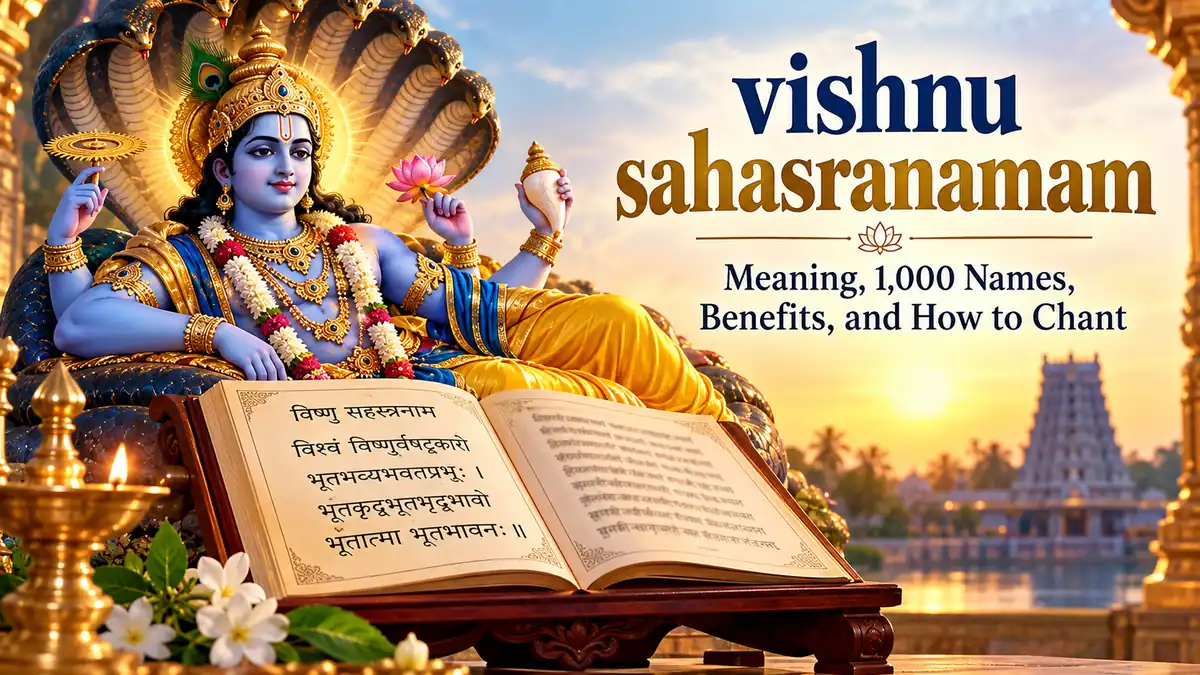
The vishnu sahasranamam is one of the most revered sacred hymns in Hinduism. For centuries, devotees have recited its thousand names of Lord Vishnu as an expression of devotion, a form of meditation, and a way to reflect on the divine qualities associated with preservation, compassion, wisdom, and cosmic order.
Rooted in the ancient Sanskrit epic Mahabharata, this hymn holds an important place in Vaishnava worship while also being respected across many Hindu traditions.
vishnu sahasranamam is a Sanskrit hymn containing 1,000 names of Lord Vishnu, traditionally found in the Anushasana Parva of the Mahabharata. Each name expresses a divine quality, action, or philosophical aspect of Vishnu. Devotees chant or listen to the hymn during daily prayers, meditation, and religious observances to cultivate devotion, concentration, and inner peace.
What Is vishnu sahasranamam?
The term Vishnu Sahasranamam comes from three Sanskrit words:
- Vishnu: The Hindu deity associated with preservation, protection, and the sustaining of cosmic order.
- Sahasra: One thousand.
- Nama: Name.
Together, the expression means “the thousand names of Vishnu.”
The hymn presents a thousand divine names in a poetic sequence. Rather than functioning as an ordinary list, these names communicate theological ideas about the nature of the Supreme Being.
In many Vaishnava traditions, Vishnu is regarded as the supreme divine reality, while other Hindu philosophical traditions interpret his attributes within their own theological frameworks.
Why Are There 1,000 Names of Lord Vishnu?
In Hindu devotional literature, a divine name often represents more than a form of identification. It may describe a quality, cosmic function, spiritual principle, or relationship between the divine and the devotee.
For example, names associated with Vishnu express his roles as the protector of living beings, the foundation of existence, the source of knowledge, and the indwelling presence within creation.
The number one thousand also conveys spiritual abundance and completeness. The traditional hymn is understood to contain one thousand names, although some names repeat and commentators may interpret repeated names differently according to their context.
Origin and History of Vishnu Sahasranama
The most widely recited Vishnu Sahasranama appears in the Mahabharata, one of the foundational Sanskrit epics of Hindu civilization.
Its setting is especially meaningful because the hymn emerges from a conversation about morality, duty, suffering, and spiritual liberation.
The Conversation Between Bhishma and Yudhishthira
Following the devastating Kurukshetra War, Yudhishthira seeks guidance from Bhishma, the respected elder of the Kuru dynasty.
Bhishma lies on a bed of arrows, awaiting the appropriate time to leave his mortal body. Despite his physical suffering, he continues to offer teachings about dharma, kingship, ethics, and spiritual life.
Yudhishthira asks several fundamental questions, including who is the supreme deity, what is the highest spiritual refuge, and what practice can help human beings overcome suffering and attain auspiciousness.
Bhishma responds by praising Vishnu and teaching the thousand names.
This dialogue is traditionally located in the Anushasana Parva, commonly identified as Chapter 149 in widely used editions. Chapter numbering can vary between editions and translations.
Why Is Bhishma’s Teaching Important?
Bhishma’s instruction connects devotion with ethical living.
The hymn is not presented merely as a ritual formula. It forms part of a broader discussion about the highest good and the responsibilities of human life.
This context helps explain why Vishnu Sahasranama is traditionally associated with both spiritual contemplation and righteous conduct.
Traditional Sanskrit Commentaries
Several influential Hindu scholars have interpreted the hymn.
Adi Shankaracharya, associated with Advaita Vedanta, composed a celebrated commentary explaining the names through philosophical and scriptural interpretation.
Parashara Bhattar, an important Sri Vaishnava theologian, wrote the Bhagavad Guna Darpana, a commentary emphasizing the divine qualities of Vishnu.
These commentaries demonstrate how the same sacred text can support different theological perspectives while remaining central to devotional practice.
Meaning of Important Names in vishnu sahasranamam
Each name in the hymn reveals an aspect of Vishnu’s nature. Understanding their meanings can make recitation more reflective, particularly for people unfamiliar with Sanskrit.
Here are some of the important names that appear in the traditional hymn.
| Sanskrit name | Common English meaning |
|---|---|
| Vishvam | The universe; the all |
| Vishnuh | The all-pervading one |
| Vashatkarah | The one invoked through the Vedic sacrificial formula |
| Bhuta-bhavya-bhavat-prabhuh | Lord of the past, future, and present |
| Bhuta-krit | Creator of beings |
| Bhuta-bhrit | Sustainer of beings |
| Bhavah | Existence; the source of becoming |
| Bhutatma | The inner self of all beings |
| Paramatma | The supreme self |
| Pavitram | The purifier |
| Mangalam Param | The supreme auspiciousness |
| Purushottamah | The supreme person |
| Keshavah | A traditional name of Vishnu or Krishna |
| Narayanah | The supreme refuge or ground of beings |
| Madhavah | A name associated with Lakshmi and Vishnu |
| Govindah | The protector or knower of beings |
| Damodarah | The one whose waist was bound with a cord, referring to Krishna |
Meanings can vary between Sanskrit commentaries. Some names have several valid interpretations based on grammar, Vedic usage, and theological tradition.
The First Verse and Its Meaning
The opening verse of the main thousand-name sequence is commonly transliterated as:
Vishvam Vishnur Vashatkaro Bhuta-bhavya-bhavat-prabhuh
Bhuta-krid Bhuta-bhrid Bhavo Bhutatma Bhuta-bhavanah.
This verse presents Vishnu as the all-pervading divine reality, the lord of time, the creator and sustainer of beings, and the inner presence within existence.
Its philosophical scope is striking: the hymn begins not with a physical description of a deity, but with concepts of the universe, time, creation, and being.
Why Do Some Names Repeat?
Certain names appear more than once in the thousand-name sequence.
Traditional commentators often explain these repetitions by assigning different contextual meanings to the same Sanskrit word.
Consequently, the thousand names should not be understood as one thousand completely unrelated words. The hymn is a structured devotional composition whose meanings unfold through repetition, association, and interpretation.
Spiritual Significance of the 1,000 Names
The spiritual importance of Vishnu Sahasranama extends beyond the act of repeating sacred words. In Hindu devotional practice, remembering divine names is a form of nama smarana, or remembrance of God.
The hymn combines several important spiritual ideas.
Bhakti: Devotion to Lord Vishnu
Bhakti refers to loving devotion toward the divine.
Reciting the thousand names allows devotees to express reverence, gratitude, surrender, and trust in Vishnu.
Unlike elaborate temple ceremonies, devotional recitation can be practiced at home with relatively simple preparation.
Dharma: Living According to Righteous Principles
Vishnu is closely associated with the preservation of dharma, a Sanskrit concept encompassing duty, righteousness, ethical conduct, and cosmic order.
Names that emphasize protection, justice, compassion, and truth encourage reflection on how these qualities can influence everyday decisions.
The original Mahabharata dialogue also places the hymn within a wider discussion of righteous living.
Sanatana
+1
Moksha: Liberation From the Cycle of Rebirth
In Hindu philosophy, moksha means liberation from samsara, the cycle of birth, death, and rebirth.
Traditional interpretations of the hymn connect devotion to Vishnu with spiritual liberation.
However, different philosophical schools explain the relationship between devotion, divine grace, knowledge, and liberation in different ways.
The Relationship Between Vishnu, Narayana, and Krishna
Vishnu is worshipped in several forms and understood through many names.
Narayana is an important designation of the supreme divine reality in Vaishnava theology.
Krishna and Rama are widely revered as avatars, or divine manifestations, of Vishnu. Some Vaishnava traditions, particularly certain Krishna-centered schools, regard Krishna as the original supreme form of God.
These theological distinctions explain why devotees of Vishnu, Krishna, Rama, and Venkateswara may all include Vishnu Sahasranama in their religious practices.
Benefits of Chanting vishnu sahasranamam
The traditional benefits of chanting Vishnu Sahasranama are described in the hymn’s concluding passages, known as the Phalashruti.
These passages praise the spiritual fruits of remembering Vishnu’s names and connect recitation with well-being, auspiciousness, and liberation.
Abmantra.com
+1
It is useful to distinguish religious beliefs about these benefits from outcomes that can be established scientifically.
1. Encourages Mental Calmness
Slow, rhythmic recitation can provide a structured opportunity to sit quietly and direct attention toward a single activity.
Some practitioners find this calming, especially when chanting is accompanied by steady breathing.
The experience varies between individuals, and reciting the hymn is not a guaranteed treatment for anxiety or other mental health conditions.
2. Develops Concentration and Discipline
Learning Sanskrit verses requires attention, repetition, and patience.
A regular chanting routine can help practitioners develop consistency in their devotional practice.
Following the text while listening to an accurate recording may also strengthen familiarity with the language and its sounds.
3. Strengthens Spiritual Devotion
For believers, the central benefit is a deeper relationship with Lord Vishnu.
Repeating names associated with divine protection, wisdom, and compassion encourages contemplation of those attributes.
Understanding even a few names can make recitation more meaningful than repeating unfamiliar sounds without reflection.
4. Promotes Reflection on Positive Qualities
The hymn repeatedly describes qualities such as truthfulness, compassion, patience, courage, and steadfastness.
Reflecting on these concepts may encourage devotees to apply similar values in their daily lives.
5. Provides a Sense of Spiritual Comfort
In traditional Hindu practice, devotees often recite sacred hymns during periods of uncertainty, grief, or difficulty.
Vishnu Sahasranama can serve as a source of spiritual reassurance because its verses emphasize divine protection and refuge.
6. Connects Families With Religious Tradition
The hymn is frequently learned through family recitation, temple worship, and religious instruction.
Its continued use helps preserve Sanskrit devotional literature and connects younger generations with longstanding cultural practices.
What Does the Phalashruti Promise?
The concluding verses traditionally associate devoted recitation with freedom from fear, auspiciousness, prosperity, knowledge, and spiritual progress.
These are scriptural promises understood within a religious framework, not scientifically established guarantees of wealth, physical healing, or protection from misfortune.
The most meaningful approach is to regard chanting as a devotional and contemplative practice rather than a substitute for practical responsibilities or medical care.
How to Chant vishnu sahasranamam Correctly
A beginner does not need to memorize all one thousand names before starting.
A gradual approach makes the hymn easier to learn and helps prevent pronunciation mistakes from becoming habitual.

Step 1: Prepare a peaceful space
Choose a clean, quiet place where you can sit comfortably. Some devotees place an image or murti of Vishnu, Krishna, or Rama nearby. A lamp, flowers, or tulsi leaves may be included according to family tradition.

Step 2: Begin with a short prayer
Sit upright and take a few natural breaths. You may begin with a familiar invocation such as Om Namo Narayanaya or the opening prayers used in your tradition.

Step 3: Recite slowly and clearly
Read from a reliable Sanskrit text or English transliteration. Focus on correct pronunciation and a comfortable pace rather than completing the hymn quickly.

Step 4: Reflect and conclude
After recitation, spend a moment contemplating one or two names. Some traditions conclude with the Phalashruti, a closing prayer, or an offering of gratitude.
Best Time to Chant Vishnu Sahasranama
Many devotees prefer early morning, when the surroundings are quiet and distractions are limited.
The period known as Brahma Muhurta, traditionally associated with the time before sunrise, is considered especially suitable for spiritual practice in many Hindu traditions.
However, the hymn can also be recited in the evening or at another convenient time.
Consistency and devotion are generally more useful for a beginner than following a demanding schedule that is difficult to maintain.
Can Vishnu Sahasranama Be Chanted Daily?
Yes. Daily recitation is a widespread devotional practice.
Some devotees chant the complete hymn every morning, while others recite it on selected days or listen to a recording during prayer.
Ekadashi, the eleventh lunar day of each fortnight, is particularly associated with Vishnu worship. Saturday is also traditionally associated with Vishnu Sahasranama recitation in some communities.
Practices differ by region, lineage, and household.
Stotradhwani
+1
How Long Does the Complete Recitation Take?
The main thousand-name hymn is traditionally arranged in 108 verses.
A complete recitation often takes approximately 25–45 minutes, depending on the pace, pronunciation, and whether introductory and concluding verses are included.
Beginners may take longer, particularly when following word meanings or learning unfamiliar Sanskrit sounds.
VedicBirth
+1
Vishnu Sahasranamam Lyrics, Sanskrit Text, and English Translation
Vishnu Sahasranama is traditionally recited in Sanskrit, although it is available in several Indian scripts and Roman transliteration.
Understanding the difference between the original text, transliteration, and translation helps readers choose the most useful learning format.
Sanskrit and English Transliteration
The opening words of the main hymn are:
Original Sanskrit
ॐ विश्वं विष्णुर्वषट्कारो भूतभव्यभवत्प्रभुः ।
भूतकृद्भूतभृद्भावो भूतात्मा भूतभावनः ॥
IAST Transliteration
Viśvaṃ viṣṇur vaṣaṭkāro bhūta-bhavya-bhavat-prabhuḥ
Bhūtakṛd bhūtabhṛd bhāvo bhūtātmā bhūtabhāvanaḥ
A simplified English transliteration is easier for some beginners to read, but it may not preserve every distinction between Sanskrit sounds.
For example, Sanskrit distinguishes between short and long vowels and between several consonants that English speakers may pronounce similarly.
Vishnu Sahasranamam Stotram vs Namavali
Two common formats are used in devotional practice.
| Feature | Stotram | Namavali |
|---|---|---|
| Structure | Names arranged in Sanskrit verses | Names presented individually |
| Main purpose | Continuous hymn recitation | Individual name repetition or worship |
| Typical format | Metrical shlokas | Each name commonly followed by Namah |
| Common use | Daily chanting and group recitation | Archana and ritual offerings |
| Learning style | Requires attention to verse rhythm | Allows focus on individual names |
Both formats are connected to the same thousand names, but their recitation styles differ.
The stotram is especially suitable for learning the traditional poetic composition. The namavali is frequently used during archana, a form of worship in which names are recited while offerings are made.
Why Do Different English Versions Look Different?
Romanized Sanskrit texts may use different spelling systems.
For example:
- Vishnu and Viṣṇu represent the same Sanskrit name.
- Narayana and Nārāyaṇa refer to the same divine name.
- Hrishikesha and Hṛṣīkeśa represent the same name with different transliteration conventions.
The International Alphabet of Sanskrit Transliteration, or IAST, uses diacritical marks to represent Sanskrit sounds more precisely.
For readers learning pronunciation, an IAST version accompanied by audio is often more useful than simplified English spelling alone.
Vishnu Sahasranama Pronunciation Guide for Beginners
Sanskrit pronunciation can seem challenging because the language contains sounds and vowel distinctions that do not exist in everyday English.
The goal should be steady improvement, not immediate perfection.
Understand Long and Short Vowels
In Sanskrit, vowel length can distinguish words and affect the rhythm of recitation.
| Sanskrit symbol | Basic pronunciation guidance |
|---|---|
| a | Short vowel, approximately like the vowel in “about” |
| ā | Long “aa” sound |
| i | Short “i” sound |
| ī | Long “ee” sound |
| u | Short “u” sound |
| ū | Long “oo” sound |
| ṛ | Sanskrit syllabic vowel, best learned through audio |
The written marks above certain letters are important in formal transliteration.
Pay Attention to Consonants
Sanskrit distinguishes dental and retroflex consonants.
Dental sounds are formed with the tongue near the upper teeth, while retroflex sounds involve curling the tongue backward.
Aspirated consonants such as kh, gh, th, and bh also include a noticeable release of breath.
The visarga, written as ḥ, is another sound frequently encountered in Sanskrit recitation.
These distinctions are easier to learn by listening to an experienced Sanskrit teacher or a carefully pronounced recording.
Meaning, Pronunciation & Practice
+1
Common Mistakes to Avoid
Beginners sometimes rush through unfamiliar words, misread vowel lengths, or attempt to memorize long passages without understanding their structure.
A more effective method is to learn one verse at a time, repeat it slowly, and compare your pronunciation with a trusted recording.
It also helps to understand that Sanskrit words change their pronunciation slightly when joined through sandhi, the grammatical process by which neighboring sounds combine.
A printed text that separates individual names may therefore look different from the continuous verses of the hymn.
How to Learn Vishnu Sahasranamam in 30 Days
Memorizing all one thousand names within a month may be unrealistic for many beginners. However, thirty days is enough to establish a useful learning routine.
| Period | Learning goal | Suggested practice |
|---|---|---|
| Days 1–5 | Become familiar with the hymn | Listen to a complete recitation and follow the text |
| Days 6–10 | Learn opening verses | Practice a few verses slowly each day |
| Days 11–15 | Improve pronunciation | Repeat difficult sounds and review earlier verses |
| Days 16–20 | Understand meanings | Study selected divine names and their interpretations |
| Days 21–25 | Build continuity | Recite longer sections without frequent pauses |
| Days 26–30 | Establish a sustainable routine | Combine reading, listening, and reflection |
This schedule is a learning framework rather than a traditional religious requirement.
Someone with prior Sanskrit experience may progress faster, while a complete beginner may prefer to spend several months learning the hymn.
Is It Necessary to Memorize All 1,000 Names?
No. Memorization is respected in many devotional traditions, but reading from a book or following a digital text is also a common way to practice.
Memorization can develop gradually through repeated recitation.
For beginners, accuracy, comprehension, and consistency are more practical initial goals.
Can You Listen Instead of Chanting?
Yes. Listening to Vishnu Sahasranama is a widespread devotional activity.
It can be particularly helpful for people learning Sanskrit pronunciation or those unable to complete the entire hymn themselves.
Listening and active recitation are not identical practices, however. Recitation involves producing the sounds, while listening emphasizes attention and receptive contemplation.
Some practitioners combine both by following the written verses while listening to a recording.
Religious Observances and Traditional Chanting Rules
Different Hindu communities follow different customs concerning the recitation of sacred hymns.
Understanding which practices are widespread and which are specific to certain traditions helps prevent unnecessary confusion.
Ekadashi and Vishnu Worship
Ekadashi occurs twice in a typical lunar month and is widely associated with devotion to Vishnu.
Many devotees observe the day through prayer, fasting according to their circumstances, temple worship, and scriptural reading.
Reciting Vishnu Sahasranama on Ekadashi is a common devotional practice.
Fasting is a separate observance and is not a prerequisite for reading or learning the hymn.
Tulsi, Lamps, and Offerings
Tulsi, also called holy basil, is especially sacred in Vaishnava traditions.
Devotees may offer tulsi leaves, flowers, water, or a lit lamp during Vishnu worship.
Such offerings can enrich a traditional puja, but the practical requirements vary by family and religious lineage.
The core activity of Sahasranama recitation remains the remembrance and praise of Vishnu.
Can Women Chant Vishnu Sahasranama?
Women participate in Vishnu Sahasranama recitation across many Hindu communities, including individual prayer, family worship, and group chanting.
Some households or religious lineages maintain additional customs concerning ritual purity, initiation, or specific forms of recitation.
These customs are not universal across Hinduism. Anyone seeking guidance about a particular tradition can consult a knowledgeable teacher within that lineage.
Is a Guru Required to Begin?
Many people learn the hymn through family members, devotional books, temple classes, or recordings without undergoing a formal initiation.
A qualified teacher can nevertheless be valuable for correcting Sanskrit pronunciation and explaining the theological meaning of the names.
Certain specialized ritual practices may have additional requirements, but ordinary devotional study is commonly accessible.
Vishnu Sahasranamam Compared With Other Hindu Prayers
Hindu devotional literature contains numerous hymns, mantras, and collections of divine names.
Although these practices share certain features, they differ in structure, theological focus, and customary use.
| Prayer or hymn | Primary focus | Distinguishing feature |
|---|---|---|
| Vishnu Sahasranama | Lord Vishnu | One thousand divine names in a Sanskrit hymn |
| Lalita Sahasranama | Goddess Lalita Tripurasundari | One thousand names associated with Shakta worship |
| Shiva Sahasranama | Lord Shiva | Thousand-name traditions dedicated to Shiva |
| Bhagavad Gita | Krishna’s teachings to Arjuna | Philosophical dialogue on duty, devotion, knowledge, and yoga |
| Om Namo Narayanaya | Lord Narayana | Short devotional mantra |
| Hare Krishna Mahamantra | Krishna and Rama | Repeated divine names central to several bhakti traditions |
Vishnu Sahasranama vs Lalita Sahasranama
Both are thousand-name devotional compositions, but they belong to different theological and worship traditions.
Vishnu Sahasranama centers on Vishnu, while Lalita Sahasranama praises the goddess Lalita Tripurasundari and is especially significant in Sri Vidya traditions.
Their religious significance should be understood within their respective scriptural and philosophical contexts.
Vishnu Sahasranama vs Bhagavad Gita
Both texts are associated with the Mahabharata, but they have different literary forms.
The Bhagavad Gita is a dialogue in which Krishna teaches Arjuna about duty, action, devotion, knowledge, and spiritual liberation.
Vishnu Sahasranama is a hymn taught by Bhishma to Yudhishthira, centered on praising the divine through a thousand names.
Both are important to Vaishnava devotional and philosophical life.
The Role of Vishnu Sahasranama in Hindu Culture
The hymn has an especially visible place in Indian devotional traditions, including South Indian temple culture.
It is recited in Sanskrit while being printed and taught through several regional scripts.
Vishnu Sahasranamam in Tamil, Telugu, Kannada, and Malayalam
Many devotees encounter the hymn through editions written in Tamil, Telugu, Kannada, or Malayalam scripts.
These editions often preserve the original Sanskrit verses while representing their sounds through regional writing systems.
A Tamil-script edition, for example, is not necessarily a Tamil translation. It may simply present Sanskrit words in a script familiar to Tamil readers.
Translations and explanatory commentaries are also available in regional languages.
Recitation in Temples and Homes
Vishnu Sahasranama is frequently included in household prayer routines, devotional gatherings, and temple-related activities.
It may be associated with worship of Vishnu in forms such as Venkateswara, Ranganatha, Narayana, Krishna, and Rama.
In some communities, groups gather regularly to chant the hymn together.
Collective recitation also serves an educational purpose by helping participants learn the verses through repetition.
Why the Hymn Remains Relevant
One reason for the hymn’s continuing importance is its combination of accessible devotion and philosophical depth.
A person may begin by learning a few names, then gradually explore their Sanskrit meanings and the interpretations offered by traditional commentators.
This allows the same text to support simple prayer, detailed scriptural study, and sustained spiritual contemplation.
How to Choose a Reliable Vishnu Sahasranamam Text or Recording
The accuracy of the source matters, particularly when learning pronunciation or comparing meanings.
A useful edition should identify its scriptural basis, present the Sanskrit clearly, and distinguish the original verses from introductory prayers and later devotional additions.
What to Look for in a Written Edition
Choose a version that includes the complete thousand-name hymn, a readable transliteration, and preferably a translation or commentary.
An edition that explains the names individually can be particularly helpful for readers interested in the philosophical meaning.
Be aware that traditional compilations may include dhyana shlokas (meditation verses), nyasa instructions (ritual placement practices), the main hymn, and the Phalashruti.
These sections are related to the recitation tradition but should not all be confused with the main thousand-name sequence.
What Makes a Good Audio Recording?
A useful learning recording has clear Sanskrit pronunciation, a steady pace, and enough separation between verses to allow the listener to follow the text.
Recordings performed in different regional styles may vary in musical presentation or recitation speed.
For study purposes, clarity and fidelity to the Sanskrit text are more important than elaborate musical accompaniment.
Helpful Textual Resources
Readers can consult the English transliteration and recitation guide or the guided chanting and Sanskrit learning resources to begin comparing formats.
For a deeper understanding, traditional commentaries associated with Adi Shankaracharya and Parashara Bhattar offer different approaches to interpreting the names.
Conclusion
The vishnu sahasranamam is more than a collection of sacred names. It is a devotional and philosophical hymn that connects the worship of Lord Vishnu with ideas of cosmic order, compassion, spiritual knowledge, and liberation.
Its place in the Mahabharata, its thousand meaningful names, and its longstanding use in Hindu worship explain why it continues to be recited across generations.
For someone beginning the practice, the simplest approach is to start with a reliable text, listen to clear Sanskrit pronunciation, learn a few verses at a time, and gradually explore their meanings. Regular, attentive practice allows the hymn to become not merely something recited, but something understood and reflected upon.