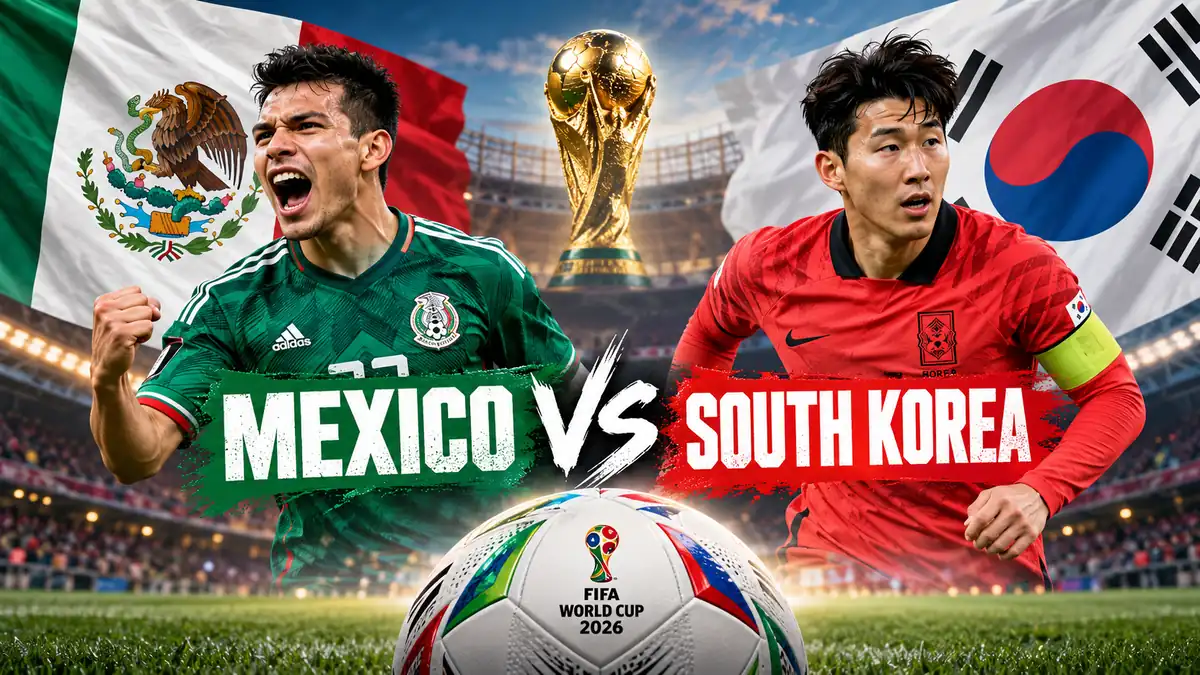
Mexico and South Korea have built an intriguing international football rivalry, shaped by FIFA World Cup encounters, contrasting playing styles, and memorable performances. Both nations are established forces in their respective confederations and have repeatedly demonstrated their ability to compete against elite international teams.
The mexico vs south korea rivalry includes Mexico’s victories at the 1998 and 2018 FIFA World Cups, South Korea’s remarkable run to the 2002 semifinals, and another World Cup meeting scheduled for 2026. Their encounters highlight the development of football in North America and Asia.
Mexico and South Korea have met in competitive international football for decades. Mexico won their World Cup group-stage encounters in 1998 and 2018, while South Korea has produced competitive performances in other meetings. Their next major showdown is scheduled for the 2026 FIFA World Cup, making this fixture particularly relevant to supporters of both teams.
mexico vs south korea: Head-to-Head Record
Mexico holds the historical advantage over South Korea in senior men’s international football. The teams have faced each other in FIFA World Cup matches, international friendlies, the FIFA Confederations Cup, and the CONCACAF Gold Cup.
According to the historical records compiled by 11v11, their 15 senior international meetings through June 2026 produced the following results.
11v11
+1
HEAD-TO-HEAD — 15 MATCHES
9
Mexico wins
2
Draws
4
South Korea wins*
*Includes South Korea’s 2002 Gold Cup penalty-shootout advancement, which followed a 0–0 draw. Statistical conventions may differ.
Notable Mexico vs South Korea results
| Date | Competition | Result |
|---|---|---|
| June 13, 1998 | FIFA World Cup | Mexico 3–1 South Korea |
| June 1, 2001 | Confederations Cup | South Korea 2–1 Mexico |
| January 27, 2002 | CONCACAF Gold Cup | 0–0; South Korea won on penalties |
| January 29, 2014 | International friendly | Mexico 4–0 South Korea |
| June 23, 2018 | FIFA World Cup | Mexico 2–1 South Korea |
| November 14, 2020 | International friendly | Mexico 3–2 South Korea |
| September 9, 2025 | International friendly | Mexico 2–2 South Korea |
| June 18, 2026 | FIFA World Cup | Mexico 1–0 South Korea |
The results show that Mexico has generally been more successful in this matchup, particularly at the World Cup. South Korea, however, has recorded important victories in other competitions and has repeatedly challenged Mexico in closely contested games.
11v11
+1
mexico vs south korea at the FIFA World Cup
The FIFA World Cup provides the most important chapter in the rivalry. Mexico and South Korea have now met three times at the men’s tournament, with Mexico winning all three encounters.
1998 FIFA World Cup: Mexico 3–1 South Korea

June 13, 1998 — Lyon, France
Mexico defeated South Korea 3–1 in their opening Group E match. Ricardo Peláez scored twice, while Luis Hernández added another goal.
South Korea initially took the lead through Ha Seok-ju, whose first-half goal put Mexico under pressure. However, Ha was subsequently sent off, leaving South Korea with ten players.
Mexico used its numerical advantage to control possession, increase attacking pressure, and turn the match around.
The result helped Mexico establish momentum in a group that also included Belgium and the Netherlands. Mexico ultimately advanced to the Round of 16, while South Korea failed to progress beyond the group stage.
This encounter demonstrated Mexico’s attacking strength and South Korea’s vulnerability when forced to defend with fewer players.
FIFA
2018 FIFA World Cup: South Korea 1–2 Mexico

June 23, 2018 — Rostov-on-Don, Russia
Mexico secured a 2–1 victory in Group F through goals from Carlos Vela and Javier Hernández.
Carlos Vela opened the scoring from the penalty spot in the first half after a South Korean handball.
Javier Hernández doubled Mexico’s lead in the second half following a counterattack, demonstrating the team’s ability to transition quickly from defense to attack.
Son Heung-min scored a spectacular long-range goal during stoppage time, but South Korea could not find an equalizer.
Mexico entered the match after a surprising 1–0 victory over defending champions Germany. Their win against South Korea placed them in a strong position to reach the knockout stage.
South Korea subsequently defeated Germany 2–0 in their final group match, although that result was not enough to secure qualification.
The 2018 tournament illustrated the competitive potential of both sides: Mexico demonstrated tactical organization and clinical finishing, while South Korea showed resilience and individual attacking quality.
FB Ref
2026 FIFA World Cup: Mexico 1–0 South Korea

June 18, 2026 — Guadalajara, Mexico
Mexico won the third World Cup meeting 1–0, with Luis Romo scoring the decisive goal in the 50th minute.
The match took place at Estadio Akron, also known during the tournament as Guadalajara Stadium.
Both teams arrived with three points after winning their opening Group A matches. Mexico had defeated South Africa 2–0, while South Korea had beaten Czechia 2–1.
With the score tied at halftime, Romo broke the deadlock five minutes into the second half. Mexico protected its narrow lead to claim another victory against the Taegeuk Warriors.
The result extended Mexico’s perfect World Cup record against South Korea to three victories from three matches.
It also highlighted how tightly contested the fixture had become: unlike the 1998 meeting, which produced four goals, the 2026 encounter was decided by a single moment.
FB Ref
+1
Mexico vs South Korea: Playing Styles and Tactical Differences
Although both teams value technical football, their tactical approaches have traditionally differed.
Mexico has often emphasized ball retention, combinations through midfield, and controlled buildup. South Korea has generally combined disciplined team organization with quick transitions, aggressive pressing, and direct attacking runs.
| Tactical aspect | Mexico | South Korea |
|---|---|---|
| Traditional approach | Possession-oriented | High-energy transitions |
| Attacking strength | Short passing and combinations | Pace and movement |
| Midfield priority | Control and distribution | Pressing and ball recovery |
| Defensive approach | Compact positioning | Coordinated pressure |
| Main attacking threat | Creative buildup | Counterattacks and wide attacks |
| Potential weakness | Exposure during transitions | Space behind advanced players |
These are broad tendencies rather than fixed rules. Both teams have adapted their formations and playing styles under different coaches.
How Mexico creates scoring opportunities
Mexico’s attacking play often begins with patient buildup from the defensive line.
Central midfielders provide passing options, allowing the team to progress into advanced positions through controlled possession.
Wide players stretch opposing defenses, creating space for attacking midfielders and forwards.
When Mexico is successful, the team combines midfield control with quick attacking movements inside the penalty area.
However, possession alone does not guarantee scoring opportunities. Mexico can struggle when opponents maintain compact defensive formations and limit access to central attacking spaces.
How South Korea attacks
South Korea’s attacking strength frequently comes from quick ball recovery and rapid forward movement.
The team can press opponents high up the pitch before exploiting defensive gaps through direct passes.
Players such as Son Heung-min have historically provided the pace, finishing ability, and movement needed to turn defensive situations into dangerous counterattacks.
South Korea can also create chances through overlapping fullbacks and wide combinations.
The tactical challenge is balancing attacking intensity with defensive protection, especially against opponents capable of passing through the first line of pressure.
Which playing style has been more successful?
Mexico’s record in this fixture suggests that its tactical approach has generally been effective against South Korea.
Nevertheless, the results cannot be explained by playing style alone. Individual quality, match conditions, disciplinary incidents, substitutions, and finishing efficiency have all influenced outcomes.
For example, Mexico’s 1998 victory was significantly affected by South Korea’s red card, while the 2018 meeting demonstrated the importance of counterattacking efficiency.
The 2026 encounter was much tighter, requiring Mexico to defend a one-goal advantage.
Key Players in the Mexico vs South Korea Rivalry
Several internationally recognized footballers have contributed to the history and development of this matchup.
Mexico’s influential players

Raúl Jiménez
A center-forward known for intelligent movement, aerial ability, and link-up play. Jiménez scored against South Korea in the 2020 and 2025 friendlies.

Javier Hernández
Nicknamed Chicharito, Hernández scored Mexico’s second goal against South Korea at the 2018 World Cup.

Guillermo Ochoa
An experienced goalkeeper recognized for his shot-stopping ability and extensive international tournament experience.
Other notable Mexican players include Carlos Vela, Edson Álvarez, Luis Romo, and Gilberto Mora. Their different attributes illustrate Mexico’s combination of established experience and emerging talent.
South Korea’s influential players

Son Heung-min
One of South Korea’s most accomplished footballers, Son scored against Mexico at the 2018 World Cup and has been central to the team’s international attack.

Lee Kang-in
A technically gifted attacking midfielder known for close control, creative passing, and the ability to operate between defensive lines.

Kim Min-jae
A physically strong central defender recognized for his positioning, aerial ability, and effectiveness in defensive duels.
Other important South Korean footballers include Hwang In-beom, Hwang Hee-chan, and Oh Hyeon-gyu.
Their technical ability and international experience have helped South Korea remain competitive against strong opponents from Europe, Asia, and the Americas.
2026 World Cup Match Analysis: Mexico 1–0 South Korea
The June 2026 encounter provides a useful example of how match statistics and the final score can tell different stories.
Although South Korea enjoyed more possession, Mexico produced more shots on target and capitalized on a defensive error.
Mexico vs South Korea 2026 match statistics

Mexico
1 – 0
Full time

South Korea
42%
Possession
58%
8
Total shots
9
4
Shots on target
2
0
Corner kicks
2
9
Fouls
7
Match statistics: FBref, June 18, 2026.
FB Ref
What decided the match?
The decisive incident occurred in the 50th minute. South Korean goalkeeper Kim Seung-gyu failed to secure the ball after a collision with a teammate, allowing Luis Romo to score into an exposed goal.
South Korea attempted to respond by increasing attacking pressure, but Mexico maintained its defensive organization.
Goalkeeper Raúl Rangel made two important late saves to preserve the clean sheet. Captain Edson Álvarez also contributed defensively while César Montes was unavailable through suspension.
The victory secured Mexico’s progression to the Round of 32 and first place in Group A.
Concacaf
+1
Mexico and South Korea’s World Cup Achievements
Both national teams have established substantial World Cup histories, although their greatest achievements differ.
Mexico has participated in more editions of the tournament, while South Korea has reached a later stage.
| Achievement | Mexico | South Korea |
|---|---|---|
| Confederation | CONCACAF | AFC |
| First World Cup | 1930 | 1954 |
| Best finish | Quarterfinals | Fourth place |
| Best-finish year | 1970, 1986 | 2002 |
| Hosted World Cup | 1970, 1986, 2026 (co-host) | 2002 (co-host) |
| Continental championship | CONCACAF Gold Cup | AFC Asian Cup |
Mexico’s international football history
Mexico is one of the most established national teams in North American football.
The country has hosted the men’s World Cup three times, including its role as a co-host alongside the United States and Canada in 2026.
Its strongest historical World Cup performances came in 1970 and 1986, when Mexico reached the quarterfinals.
Mexico has also enjoyed considerable success in the CONCACAF Gold Cup, reinforcing its position among the leading national teams in its region.
However, despite repeated World Cup appearances, Mexico has not reached the men’s tournament semifinals.
The team’s long-term challenge remains translating regional success into deeper World Cup runs.
FIFA
South Korea’s international football history
South Korea is among Asia’s most accomplished football nations.
Its most famous achievement came at the 2002 World Cup, which South Korea co-hosted with Japan.
The team defeated Italy and Spain during the knockout rounds before finishing fourth.
That performance remains a landmark achievement for Asian men’s football.
South Korea has also won the AFC Asian Cup twice, in 1956 and 1960.
The nation’s football development has been supported by a competitive domestic league, overseas-based players, and sustained investment in international competition.
Why Mexico vs South Korea Matters in International Football
This fixture represents more than a comparison of two national teams.
Mexico and South Korea are major representatives of CONCACAF and the Asian Football Confederation, respectively.
Their meetings provide opportunities to assess how teams from different football regions approach high-level international competition.
A comparison of football development
Mexico benefits from a long-established football culture, strong domestic support, and Liga MX, one of the most prominent professional leagues in the Americas.
South Korea’s football system includes the K League and a history of developing players who compete in major European competitions.
Both nations have invested in youth development, coaching infrastructure, and international experience.
Their national teams demonstrate that competitive international football extends well beyond the traditional powers of Europe and South America.
The importance of international friendlies
Not every significant meeting between Mexico and South Korea has taken place at the World Cup.
Their 2020 friendly ended 3–2 in Mexico’s favor, while the September 2025 encounter finished 2–2.
Such matches allow coaches to evaluate formations, experiment with squad combinations, and prepare players for major tournaments.
They also reveal how the competitive balance between the nations changes across generations.
What can South Korea learn from previous defeats?
South Korea’s World Cup losses against Mexico highlight several recurring challenges.
The team must maintain defensive concentration, particularly when opponents create chances from turnovers or second balls.
Its attacking players also need to convert promising opportunities into goals.
The 2026 match offered a clear example. South Korea enjoyed more possession and attempted more shots overall, but Mexico was more effective at testing the goalkeeper.
For South Korea, improved finishing and defensive decision-making could make future encounters more competitive.
What can Mexico improve?
Mexico’s victories should not obscure areas requiring improvement.
The team can become vulnerable when opponents press aggressively or move the ball quickly through midfield.
Against South Korea in 2026, Mexico had less possession and relied on important defensive interventions to protect its lead.
Improving attacking creativity, maintaining defensive balance, and developing young players remain important for Mexico’s future international competitiveness.
Final Thoughts on mexico vs south korea
The mexico vs south korea rivalry reflects the competitive growth of international football across North America and Asia.
Mexico has the stronger overall head-to-head record and has won all three men’s FIFA World Cup meetings, including the 1–0 victory in Guadalajara in June 2026.
South Korea, meanwhile, has demonstrated its international credentials through major tournament performances, particularly its historic semifinal appearance in 2002.
The key lesson from their encounters is that possession, reputation, and attacking potential do not always determine results. Defensive concentration, efficient finishing, and decisive individual moments can have a greater influence.
For supporters following future Mexico vs South Korea matches, the most useful factors to examine are squad development, midfield control, defensive organization, and how effectively each team converts its opportunities.