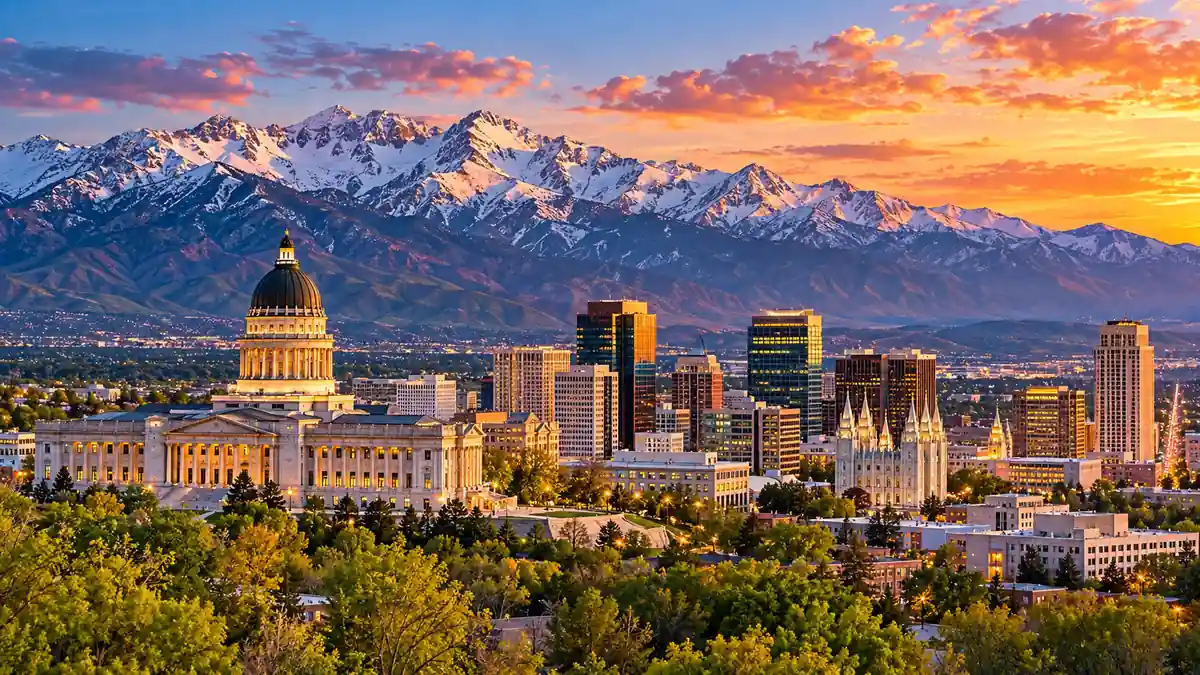
Salt Lake City is more than a gateway to Utah’s mountains. It is a state capital with a distinctive history, a growing metropolitan economy, diverse neighborhoods, and access to some of the most dramatic landscapes in the American West.
From the historic buildings surrounding Temple Square to the hiking trails of the Wasatch Mountains, the city combines urban experiences with outdoor recreation. Understanding its geography, weather, attractions, and transportation makes it easier to appreciate what makes this destination distinctive.
Salt Lake City is the capital and most populous city of Utah, located in the Salt Lake Valley between the Wasatch Range and the Oquirrh Mountains. Founded by Mormon pioneers in 1847, it is known for Temple Square, the Great Salt Lake, nearby ski resorts, outdoor recreation, and its role as a cultural and economic center of the Intermountain West.
Where Is salt lake city Located?
Salt Lake City is situated in north-central Utah in the western United States. It lies near the southeastern shore of the Great Salt Lake, with the Wasatch Mountains rising to the east and the Oquirrh Mountains to the west.
The city’s location creates a striking geographical contrast. Downtown streets, office buildings, museums, and residential communities occupy the valley floor, while alpine forests, mountain trails, and ski areas are accessible through nearby canyons.
Salt Lake City at a Glance
| Feature | Details |
|---|---|
| State | Utah |
| Country | United States |
| State capital | Yes |
| County | Salt Lake County |
| Founded | July 1847 |
| Elevation | Approximately 4,226 feet (1,288 meters) downtown |
| Time zone | Mountain Time (MST/MDT) |
| Population | 199,723 (2020 U.S. Census) |
| Major mountain range | Wasatch Range |
| Nearby lake | Great Salt Lake |
| Main airport | Salt Lake City International Airport |
| Winter Olympics | Hosted in 2002; scheduled to host again in 2034 |
Salt Lake City is also part of a much larger urban region extending through the Wasatch Front, which includes communities such as West Valley City, Sandy, Murray, South Jordan, and nearby cities farther north and south.
How Far Is Salt Lake City From Other Major Cities?
Approximate driving distances include:
| Destination | Distance |
|---|---|
| Park City, Utah | 30–35 miles |
| Provo, Utah | 45 miles |
| Ogden, Utah | 40 miles |
| Logan, Utah | 85 miles |
| Moab, Utah | 235 miles |
| Las Vegas, Nevada | 420 miles |
| Boise, Idaho | 340 miles |
Actual travel distances and times depend on the route, weather, and traffic conditions.
History of Salt Lake City
The history of Salt Lake City begins long before the establishment of the modern city. Indigenous peoples, including the Shoshone and Ute, lived in and traveled through the region for generations.
The Salt Lake Valley and surrounding landscapes formed part of broader Indigenous networks of seasonal movement, trade, hunting, and cultural traditions.
The Arrival of Mormon Pioneers in 1847
On July 24, 1847, pioneers belonging to the Church of Jesus Christ of Latter-day Saints entered the Salt Lake Valley under the leadership of Brigham Young.
They had traveled westward seeking a place where they could establish a religious community after facing persecution elsewhere in the United States.
The settlement initially became known as Great Salt Lake City.
Its early development involved irrigation canals, agricultural communities, religious institutions, and a planned street grid that continues to influence the city’s layout.
Why Is Salt Lake City Called Salt Lake City?
The city takes its name from the nearby Great Salt Lake, a large saline lake that is one of the region’s most recognizable natural landmarks.
The lake has no outlet to the ocean. Water enters through rivers and streams, while evaporation leaves dissolved minerals and salts behind.
This process produces the lake’s unusually high salinity, although salt concentrations vary significantly between different parts of the lake.
Utah Statehood and Urban Growth
Utah became the 45th U.S. state on January 4, 1896, with Salt Lake City serving as its capital.
Mining, railroad development, commerce, and population growth helped transform the settlement into a major regional center.
The completion of the first transcontinental railroad at Promontory Summit in 1869 also strengthened transportation and economic connections across the region.
Over time, Salt Lake City developed a broader economy and a more diverse population while retaining many of its historical landmarks.
The 2002 Winter Olympics
Salt Lake City hosted the 2002 Winter Olympic Games, bringing international attention to Utah’s skiing facilities and mountain environment.
The event contributed to improvements in transportation, sporting venues, and regional infrastructure.
Salt Lake City and the surrounding Utah region are also scheduled to host the 2034 Olympic and Paralympic Winter Games.
Best Things to See in salt lake city
Salt Lake City offers historical landmarks, museums, public parks, cultural institutions, and natural attractions.
Many of its most recognizable destinations are concentrated around downtown, making the central area relatively convenient to explore.
Temple Square


Temple Square is among the city’s most famous landmarks.
The historic complex occupies several blocks in downtown Salt Lake City and is closely associated with the Church of Jesus Christ of Latter-day Saints.
Its centerpiece is the Salt Lake Temple, a monumental granite building whose construction began in 1853 and was completed in 1893.
The surrounding area includes religious buildings, gardens, historic sites, and visitor facilities.
The temple and parts of Temple Square have undergone extensive renovation, so visitors should check current access arrangements before planning a visit.
Utah State Capitol
The Utah State Capitol stands on Capitol Hill, overlooking downtown Salt Lake City.
Completed in 1916, the building features classical architecture, a prominent dome, and landscaped grounds.
It houses important functions of Utah’s state government and offers views across the Salt Lake Valley.
The surrounding grounds are especially attractive during spring when ornamental trees bloom.
Natural History Museum of Utah
The Natural History Museum of Utah is located in the Rio Tinto Center near the University of Utah.
Its exhibitions explore the region’s geology, dinosaurs, ecosystems, archaeology, and Indigenous cultures.
Utah’s fossil record is particularly significant, and the museum presents prehistoric life through specimens and educational displays.
The building itself is notable for its architecture, which draws inspiration from the surrounding geological landscape.
Red Butte Garden
Red Butte Garden is a botanical garden and arboretum near the University of Utah.
Its landscaped gardens, walking paths, and natural areas provide opportunities to explore plant collections and seasonal flowers.
Spring and early summer are particularly popular periods for visiting, although different sections of the garden offer interest throughout the growing season.
Liberty Park
Liberty Park is one of the city’s major urban green spaces.
The park features walking and jogging paths, open lawns, sports facilities, mature trees, and the Tracy Aviary.
It is a popular destination for families, runners, cyclists, and residents seeking a quieter outdoor setting.
City Creek Center and Downtown
Downtown Salt Lake City combines commercial streets, public spaces, restaurants, theaters, and historic architecture.
City Creek Center is a prominent shopping development near Temple Square, while Main Street and the surrounding blocks offer additional dining and entertainment opportunities.
Visitors interested in architecture can also explore the historic Salt Lake City and County Building and the Salt Lake City Public Library.
Hogle Zoo
Utah’s Hogle Zoo is located near the mouth of Emigration Canyon.
The zoo features animal habitats, educational programs, and exhibits designed to introduce visitors to wildlife from different regions of the world.
It is particularly popular with families.
Clark Planetarium
The Clark Planetarium in downtown Salt Lake City focuses on astronomy, space science, and interactive learning.
Its exhibits explore planets, stars, space exploration, and the broader universe.
It provides an indoor educational option, especially during cold or unusually hot weather.
The Great Salt Lake: Utah’s Most Famous Natural Landmark


13
The Great Salt Lake is one of the largest saline lakes in the Western Hemisphere and the largest natural lake west of the Mississippi River in the United States.
It is a remnant of ancient Lake Bonneville, a much larger prehistoric lake that once covered extensive portions of Utah and neighboring states.
Why Is the Great Salt Lake So Salty?
The Great Salt Lake is a terminal lake, meaning it has no natural outlet to the ocean.
Rivers, including the Bear, Weber, and Jordan, deliver water and dissolved minerals into the lake. As water evaporates, salts remain.
Over long periods, this process has created high salinity.
Unlike freshwater lakes, the Great Salt Lake supports specialized organisms adapted to salty environments, including brine shrimp and brine flies.
These organisms form a vital food source for millions of migratory birds.
Can You Swim in the Great Salt Lake?
Swimming is possible in designated accessible areas, and the high salt concentration makes floating easier than in ordinary freshwater.
However, conditions can be challenging because of shallow water, changing shorelines, insects, strong sunlight, and limited facilities.
Visitors should avoid getting lake water in their eyes or swallowing it, and rinse thoroughly afterward.
Antelope Island State Park
Antelope Island State Park is one of the best-known places to experience the Great Salt Lake.
The island features open grasslands, hiking trails, shoreline scenery, and wildlife.
American bison are particularly famous here, although visitors should maintain a safe distance from all wild animals.
Other wildlife may include pronghorn, mule deer, and numerous bird species.
Environmental Challenges Facing the Lake
The Great Salt Lake faces serious environmental pressures from drought, water diversions, warming temperatures, and declining water levels.
As exposed lakebed expands, wind can carry dust containing naturally occurring minerals and other accumulated substances into surrounding communities.
Reduced lake levels also threaten wetlands, bird habitats, and industries that depend on the lake.
Utah has developed conservation initiatives focused on improving water availability and supporting the lake’s long-term ecological health.
Great Salt Lake
+1
Outdoor Activities and Ski Resorts Near Salt Lake City
The Wasatch Mountains make Salt Lake City a major destination for outdoor recreation.
Within a relatively short distance of the urban area, visitors can access mountain trails, ski resorts, climbing areas, and scenic drives.
Skiing and Snowboarding


11
Four major ski areas are located in the nearby Cottonwood Canyons.
| Ski resort | Location | Known for |
|---|---|---|
| Alta Ski Area | Little Cottonwood Canyon | Ski-only terrain and powder snow |
| Snowbird | Little Cottonwood Canyon | Steep terrain and aerial tram |
| Brighton Resort | Big Cottonwood Canyon | Snowboarding and varied terrain |
| Solitude Mountain Resort | Big Cottonwood Canyon | Mountain scenery and quieter terrain |
Alta does not permit snowboarding, while the other three resorts accommodate both skiing and snowboarding.
Utah’s dry mountain snow has helped establish the region’s international reputation for winter sports.
Snowfall, road conditions, avalanche hazards, and resort operations vary throughout the season.
Hiking Trails Near the City
Salt Lake City offers hiking opportunities ranging from short urban walks to demanding alpine routes.
Popular destinations include:
- Ensign Peak: A relatively short climb offering panoramic views of downtown and the Salt Lake Valley.
- Living Room Lookout: A popular foothill trail with distinctive rock formations and city views.
- Mount Olympus: A strenuous mountain hike involving steep elevation gain and exposed terrain.
- Big Cottonwood Canyon: A mountain recreation corridor with trails, forests, and alpine scenery.
- Bell Canyon: A scenic hiking area near Sandy featuring reservoirs, rocky terrain, and waterfall routes.
Higher-elevation trails may remain snow-covered well into spring or early summer.
Mountain Biking and Cycling
Cyclists can explore urban bike routes, foothill trails, and mountain biking networks throughout the Wasatch Front.
The Bonneville Shoreline Trail is particularly notable because it follows portions of the ancient shoreline of Lake Bonneville.
Its segments offer opportunities for hiking, trail running, and mountain biking, depending on local trail rules.
Outdoor Recreation Beyond the City
Salt Lake City also serves as a starting point for exploring other Utah destinations.
Park City is known for mountain recreation and the Sundance Film Festival’s historical association with the region. Other destinations include the Bonneville Salt Flats, Utah Lake, and national parks farther south.
Zion, Bryce Canyon, Arches, Canyonlands, and Capitol Reef are all in Utah, but they require substantial travel from Salt Lake City and should not be treated as nearby city attractions.
Salt Lake City Weather and Climate
Salt Lake City has a four-season climate with hot summers, cold winters, and relatively low annual precipitation.
Its inland location, elevation, and surrounding mountains contribute to considerable seasonal temperature differences.
The Great Salt Lake and Wasatch Range also influence local weather patterns.
NOAA Institutional Repository
+1
Average Seasonal Weather
| Season | Typical conditions | General temperature pattern |
|---|---|---|
| Spring (March–May) | Variable, mild to cool, occasional rain | Cool mornings and increasingly warm afternoons |
| Summer (June–August) | Hot, sunny, generally dry | Daytime highs often reach 85–95°F (29–35°C) |
| Fall (September–November) | Mild early, cooler later | Warm September days followed by colder conditions |
| Winter (December–February) | Cold, occasional valley snow | Daytime temperatures commonly near 35–45°F (2–7°C) |
These figures are broad seasonal descriptions rather than a current forecast. Actual conditions can differ substantially, especially between downtown and nearby mountain areas.
Does It Snow in Salt Lake City?
Yes. Salt Lake City receives snowfall during winter, although the amount varies from year to year.
Snowfall in the nearby Wasatch Mountains is generally much heavier than on the valley floor.
The region also experiences lake-effect snow when cold air moves across the relatively warmer waters of the Great Salt Lake under suitable atmospheric conditions.
What Is a Temperature Inversion?
A temperature inversion occurs when warmer air above traps colder air near the valley floor.
In winter, inversions can prevent pollutants from dispersing, contributing to poor air quality.
Because Salt Lake City is surrounded by mountains, stagnant atmospheric conditions can allow pollution to accumulate.
People with respiratory sensitivities should pay attention to air-quality forecasts, particularly during prolonged winter inversions.
Best Time to Visit Salt Lake City
The ideal season depends on the activities you want to experience.
Spring and fall generally provide comfortable conditions for exploring downtown, parks, and lower-elevation trails.
Summer is suitable for mountain recreation, festivals, and longer daylight hours, although valley temperatures can become very hot.
Winter attracts skiing and snowboarding enthusiasts.
For visitors interested mainly in sightseeing and walking around the city, late spring and early autumn often provide a pleasant balance of weather and activities.
Neighborhoods and Local Life in Salt Lake City
Salt Lake City is made up of neighborhoods with distinct histories, architectural styles, and community identities.
Understanding these areas helps explain the city’s development beyond its best-known tourist attractions.
Downtown Salt Lake City
Downtown is the main commercial and cultural center.
It includes Temple Square, government buildings, shopping streets, hotels, theaters, sports venues, and public transportation connections.
The central street grid makes many downtown attractions accessible on foot.
Sugar House
Sugar House, Salt Lake City is known for its established residential streets, local restaurants, shops, and parks.
Sugar House Park is a prominent green space featuring walking paths, open lawns, and views toward the Wasatch Mountains.
The neighborhood combines older residential architecture with newer mixed-use development.
The Avenues
The Avenues is a historic residential neighborhood north and east of downtown.
Its hillside streets feature Victorian-era homes, mature trees, and views across the valley.
The area is also close to foothill hiking trails and the Utah State Capitol.
Central City and 9th & 9th
Central City contains a mixture of residential streets, historic properties, local businesses, and cultural spaces.
The 9th & 9th district is especially recognized for its independent shops, restaurants, and neighborhood atmosphere.
University and Foothill Areas
The eastern part of Salt Lake City includes the University of Utah, medical institutions, museums, and residential communities near the mountains.
Its proximity to research facilities and recreational trails gives the area a combination of academic and outdoor influences.
Granary District and Ballpark
The Granary District has evolved from an industrial area into a neighborhood associated with creative businesses, restaurants, and adaptive reuse of older buildings.
The Ballpark area has its own residential and commercial identity.
Together, these neighborhoods demonstrate how former industrial and transportation corridors are being transformed into new urban spaces.
Events, Restaurants & Things to Do
+1
Economy, Education, and Culture
Salt Lake City functions as an important employment, educational, and cultural center for Utah and the broader Intermountain West.
Its economy extends beyond tourism and winter sports.
Major Industries
Important economic sectors include healthcare, education, government, financial services, logistics, technology, and professional services.
The city’s transportation connections and central location within the western United States support regional distribution and business activity.
Utah’s technology industry is often associated with the Silicon Slopes corridor, which extends through several communities along the Wasatch Front rather than being confined to Salt Lake City itself.
University of Utah
The University of Utah is a major public research university located on the city’s eastern side.
It contributes to education, healthcare, scientific research, athletics, and cultural programming.
The university’s healthcare and research institutions are significant components of the regional economy.
Arts and Performing Culture
Salt Lake City supports a diverse arts scene through museums, performing arts organizations, galleries, and theaters.
Notable institutions include the Utah Museum of Fine Arts, Utah Symphony, Ballet West, and the Eccles Theater.
The city also hosts concerts, film screenings, exhibitions, and community festivals throughout the year.
Religion and Cultural Diversity
Salt Lake City’s history is closely associated with the Church of Jesus Christ of Latter-day Saints.
However, the contemporary city includes residents of many religious traditions, cultural backgrounds, and lifestyles.
Its identity reflects both its pioneer-era history and the development of a modern, increasingly diverse urban community.
Sports in Salt Lake City
Professional and collegiate sports contribute to local entertainment and civic culture.
The Utah Jazz compete in the NBA, while the Utah Mammoth represent the region in the NHL.
Real Salt Lake plays Major League Soccer in nearby Sandy.
The University of Utah’s athletic programs also attract substantial regional support.
Getting Around Salt Lake City
Salt Lake City has a combination of public transportation, road networks, cycling infrastructure, and walkable downtown streets.
Transportation options differ depending on whether someone is exploring central attractions or traveling into the mountains.
Salt Lake City International Airport
Salt Lake City International Airport (SLC) is the region’s primary commercial airport.
It is located west of downtown and provides domestic and international flight connections.
The airport is connected to the city by TRAX light rail, roads, taxis, and other ground transportation.
TRAX Light Rail
The Utah Transit Authority (UTA) operates the TRAX light rail system.
Its lines connect important areas such as downtown, the airport, the University of Utah, and communities farther south in the valley.
A designated downtown Free Fare Zone allows qualifying trips within its boundaries without a fare.
Visitors should check current UTA maps, schedules, and fare rules before traveling.
Transportation
+1
FrontRunner Commuter Rail
FrontRunner is a commuter rail service connecting communities along the Wasatch Front.
It provides connections between areas such as Ogden, Salt Lake City, and Provo, with transfers available to other transit services.
Driving in Salt Lake City
Driving is useful for reaching mountain trailheads, canyon destinations, and attractions outside the central urban area.
Major transportation routes include Interstate 15, Interstate 80, and Interstate 215.
Winter storms can create difficult driving conditions, especially in Big and Little Cottonwood Canyons.
Seasonal traction requirements and road restrictions may apply.
Is Salt Lake City Walkable?
Downtown Salt Lake City is relatively walkable because many attractions are concentrated within its grid-pattern street network.
However, the wider metropolitan area is spread across a large valley, and some neighborhoods or recreational destinations require public transportation or a vehicle.
The city’s unusually wide streets and long blocks can also make distances feel greater than they initially appear on a map.
Practical Things to Know Before Visiting
A few details can make exploring Salt Lake City easier, particularly for first-time visitors.
Understanding the Street Grid
Salt Lake City’s street numbering system is centered around Temple Square.
Addresses such as 300 South or 400 East generally indicate a position relative to the city’s central reference point.
For example, 300 South is approximately three numbered blocks south of the downtown origin.
This system becomes intuitive once visitors understand the relationship between street numbers and directions.
Adjusting to the Elevation
Downtown Salt Lake City sits at roughly 4,200 feet above sea level.
Visitors arriving from lower elevations may notice the dry air or become tired more easily during physical activity.
Drinking water, allowing time to adjust, and taking strenuous hikes gradually can help.
Mountain destinations may be several thousand feet higher than the city itself.
Sun Exposure and Hydration
Utah’s relatively dry climate and high elevation can increase dehydration risk during outdoor activities.
Visitors should carry drinking water, use sunscreen, and prepare for changing mountain weather.
Even on cool days, strong sunlight can be noticeable at higher elevations.
Planning Mountain Excursions
Mountain conditions can change rapidly.
A warm day downtown does not guarantee similar temperatures or safe trail conditions at higher elevations.
Before hiking or skiing, check forecasts, road restrictions, trail conditions, and avalanche information where relevant.
Temple Square Access in 2026
Temple Square has been undergoing extensive renovation and seismic upgrades.
The new Temple Square Visitors’ Center opened in May 2026, while the Salt Lake Temple renovation and associated work have continued. The public Salt Lake Temple Celebration is scheduled for April through October 2027.
Some facilities remain subject to construction-related restrictions, so current access should be verified through official visitor information.
Church Newsroom
+2
Why Is Salt Lake City Famous?
Salt Lake City is internationally recognized for several interconnected reasons.
Its founding history and association with the Church of Jesus Christ of Latter-day Saints give it a distinctive place in American religious and cultural history.
Its location beside the Great Salt Lake and near the Wasatch Mountains makes it geographically unusual among major U.S. cities.
The nearby ski resorts have established the region as an important winter sports destination.
The 2002 Winter Olympics introduced Salt Lake City to a broader international audience, and preparations for the 2034 Olympic and Paralympic Winter Games continue to shape regional planning and infrastructure discussions.
Utah 2034
+1
Perhaps the city’s most defining characteristic is how closely its urban life is connected to the surrounding natural landscape.
Few American state capitals combine a major metropolitan center, alpine recreation, saline lake ecosystems, and significant historical landmarks within such a concentrated region.
Is Salt Lake City a Good Place to Live?
Salt Lake City offers advantages for people who value access to outdoor recreation, educational institutions, employment opportunities, and urban amenities.
Its proximity to the Wasatch Mountains is particularly attractive for hikers, skiers, cyclists, and other outdoor enthusiasts.
The city also offers museums, performing arts, professional sports, restaurants, and established residential neighborhoods.
However, living in Salt Lake City involves trade-offs.
Housing affordability has become a concern across much of the Wasatch Front. Winter air pollution, summer heat, traffic congestion, and water-related environmental challenges also affect quality of life.
The experience of living in the city depends heavily on neighborhood, household needs, commuting patterns, and personal preferences.
For someone considering relocation, comparing housing costs, local schools, transportation access, and seasonal air quality is more useful than relying on general city rankings.
The Future of Salt Lake City
Salt Lake City continues to change through redevelopment, transportation investments, housing construction, and efforts to improve public spaces.
One significant initiative is the Green Loop, a proposed network of greener, more pedestrian-friendly downtown corridors.
City leaders have also discussed improvements to public gathering spaces and transportation connections as part of longer-term planning for the 2034 Winter Games.
SLC.gov
+1
At the same time, the region faces important environmental questions.
Population growth increases pressure on water supplies, housing, infrastructure, and natural ecosystems.
The future health of the Great Salt Lake is especially important because the lake supports migratory birds, regional industries, and environmental conditions throughout the surrounding valley.
Balancing growth with conservation will remain a major issue for the city and the state.
Final Thoughts on salt lake city
Salt Lake City is a destination shaped by geography, history, religion, recreation, and modern urban development.
Its historic downtown, museums, neighborhoods, and cultural institutions provide opportunities to understand Utah’s past and present. The nearby Great Salt Lake and Wasatch Mountains add natural experiences that are difficult to find in many other American cities.
For visitors, the best approach is to explore both sides of the region: spend time discovering its historical and cultural landmarks, then experience the mountain trails, scenic canyons, or lake environments that make the area distinctive.
Whether studying its history, considering a move, or planning a trip, understanding salt lake city means recognizing the relationship between its growing urban community and the extraordinary landscape surrounding it.