If you’re searching for the best things to do in South Africa, the honest answer is: almost everything. Most countries make you choose between mountains, beaches, wildlife, and cities. South Africa doesn’t ask you to pick. You can hike a flat-topped mountain in the morning, watch elephants cross a dirt road by afternoon, and sit down to a wine-paired dinner by sunset — all in the same 24 hours.
The best things to do in South Africa center on Cape Town’s Table Mountain and Cape Point, Big Five safaris in Kruger National Park, wine tasting in Stellenbosch, and the coastal Garden Route. History lovers should add Johannesburg’s Apartheid Museum and Soweto, while adventure seekers can shark-cage dive in Gansbaai or bungy jump at Bloukrans Bridge.
Things to Do in Cape Town and the Cape Peninsula
Almost every trip starts here, and for good reason. Table Mountain’s flat plateau forms the backdrop for the city’s most iconic views, and the surrounding national park stretches the length of the Cape Peninsula as a UNESCO World Heritage Site packed with hiking trails and unique plant and animal life. You can ride the cable car up in five minutes, or earn the view on foot.
Several trails wind up the mountain through valleys of fynbos, shaded forest, and waterfalls — the popular Platteklip Gorge route is a steep 2.8km climb, while the shorter Kloof Corner trail rewards hikers with views of Lion’s Head, the Twelve Apostles, and the City Bowl without the crowds. Because many trails cap the number of hikers allowed at once, it’s worth booking a spot ahead of time and hiking with a group for safety.
Lion’s Head itself deserves its own morning. It’s a shorter, friendlier hike than Table Mountain, and locals treat the full-moon night hikes up it as a genuine social event.
A day trip south along the peninsula covers three highlights in one loop: Cape Point, home to its famous lighthouse, the Cape of Good Hope where the Atlantic and Indian oceans meet, Boulders Beach with its resident penguin colony, and the dramatic coastal road at Chapman’s Peak. Worth noting: Cape Point is not actually the southernmost tip of the continent — that title belongs to Cape Agulhas, roughly three hours’ drive away — but it’s still the most scenic stand-in most travelers will ever need.
Don’t skip Robben Island, reached by ferry from the V&A Waterfront, where Nelson Mandela was imprisoned for nearly two decades before becoming the country’s first democratically elected president.
Quick takeaway: Give Cape Town and its peninsula at least 3–4 full days. Trying to compress Table Mountain, Cape Point, Robben Island, and the beaches into a single day usually means rushing all of them.
Things to Do in South Africa on Safari: Chasing the Big Five
This is what pulls most people to South Africa in the first place. Most visitors come primarily for the game drives, and it’s worth spending at least a couple of nights in one of the country’s national parks to do it properly.
Kruger National Park, in the northeast, is one of the most accessible and reasonably priced places in Africa to see the Big Five — lion, leopard, elephant, rhino, and cape buffalo. Unlike many East African reserves, Kruger allows confident self-drive safaris on well-maintained roads, though a knowledgeable guide will spot far more wildlife than most first-timers will on their own.
Kruger isn’t the only option, and part of doing South Africa well is knowing the alternatives:
| Reserve | Known For | Best For |
|---|---|---|
| Kruger National Park | Full Big Five, accessible roads | First-time safari, self-drive |
| Hluhluwe-iMfolozi Park | South Africa’s oldest game reserve, founded to conserve and repopulate rhinos | Rhino sightings |
| Addo Elephant National Park | Near Port Elizabeth on the south coast, great for self-drive | Elephants, coastal safari combo |
| Kgalagadi Transfrontier Park | On the Botswana border, known for black-maned lions | Remote, dramatic desert scenery |
| Madikwe Game Reserve | Elephant and buffalo herds, rhinos, and predators across grassland and forest, and completely malaria-free | Families avoiding malaria zones |
In total, South Africa has 19 national parks and countless private game reserves, each offering a different wildlife experience. Time your visit for June through September, when animals cluster around watering holes during the drier, cooler months and are far easier to spot.
Things to Do in South Africa’s Winelands: Stellenbosch and Beyond
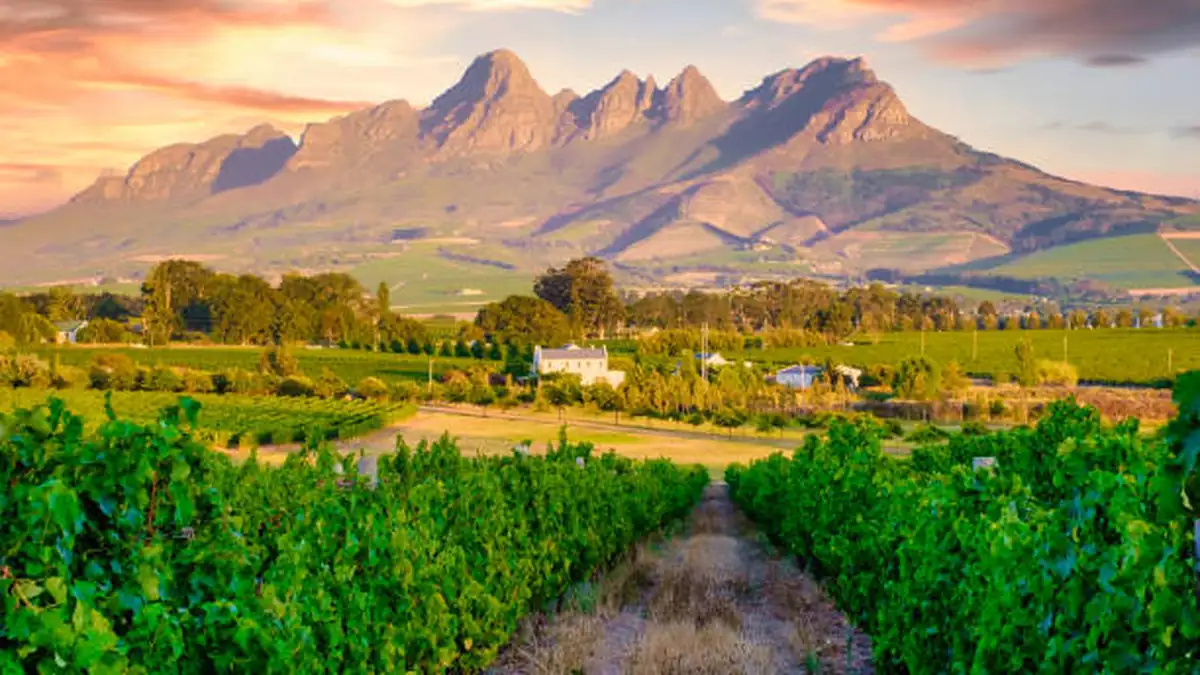
Less than an hour from Cape Town, Stellenbosch anchors South Africa’s wine country. The town is about a 40-minute drive from Cape Town and can be explored independently by rental car or via an organized tour. Nearby, Constantia holds Groot Constantia, the country’s oldest wine-producing estate, if you’d rather stay closer to the city.
Tastings here are shockingly affordable by international standards — travelers regularly report full flights for the equivalent of a couple of dollars. Pair a cellar tour with lunch on the estate; most wine farms run their own restaurants with views over the vines.
Things to Do Along the Garden Route and South Africa’s Coastline
The Garden Route stretches along the country’s south-east coast and is one of the most scenic stretches of road in South Africa. Renting a car and driving it yourself, rather than taking an organized tour, tends to be the more rewarding way to experience it.
Highlights along the way:
- Tsitsikamma National Park — named from a Khoekhoe phrase meaning “land of plentiful water,” with roaring rivers, waterfalls, and ancient forest ideal for hiking, including the multi-day Otter Trail.
- Knysna — a lagoon town famous for oysters and coastal scenery.
- Hermanus — a seaside town about 1.5 hours from Cape Town, famous for whale watching, with Southern Right whales visiting between June and October, plus daily boat departures during peak season.
- Jeffrey’s Bay — near Port Elizabeth, this is the most famous surf destination in the country, known for big waves and multiple breaks.
If surfing is new to you, Durban is a friendlier entry point thanks to reliable waves and warm Indian Ocean water, with beginner lessons running around 250 ZAR for about 90 minutes.
Things to Do in South Africa for History and Culture
South Africa’s recent past is inseparable from its identity, and the country confronts it directly rather than glossing over it. Apartheid — the system of institutionalized racial segregation — shaped the country from the 1940s into the 1990s, and understanding it changes how you see everything else here.
Johannesburg’s Apartheid Museum, opened in 2001, does an excellent job covering that history and its ongoing legacy, with admission around 150 ZAR. It uses video, documents, and photographs to walk visitors through the system’s rise and fall. Nearby, the Hector Pieterson Memorial and Museum in Soweto recounts the story of a 12-year-old who became the first victim of police fire during the 1976 student uprisings against Afrikaans-language instruction. A short walk away, Mandela House preserves the modest four-room home where Nelson Mandela lived, showing family photos and personal belongings from the man who later became the country’s first democratically elected president after 27 years in prison.
In Johannesburg, also visit Constitution Hill, built on the site of a former political prison, where you can walk through the ruins and learn about the political prisoners once detained there.
For something lighter, no visit is complete without a braai — South Africa’s version of a barbecue, treated as a social ritual rather than just a meal, and one that locals will organize with almost no excuse needed. If you want the full local experience, township braais like Mzoli’s in Cape Town open the tradition up to visitors, though going with a larger group is safer and easier logistically.
Adventurous and Off-the-Beaten-Path Things to Do in South Africa
South Africa rewards travelers who look past the standard checklist.
- Shark cage diving in Gansbaai — boats chum the water to draw great white sharks close, then lower divers in a cage to watch them pass, sometimes within touching distance.
- Bungy jumping at Bloukrans Bridge on the Garden Route, one of the highest commercial bungy jumps in the world.
- Kelp forest diving near Cape Town, an underwater experience unlike typical tropical dives.
- Namaqualand’s wildflower bloom — this stretch of the Northern Cape, usually parched and sunbaked, comes alive with wildflowers each July.
- Bo-Kaap — Cape Town’s colorfully painted former Malay Quarter, one of the most photographed neighborhoods in the “Mother City.”
- Cradle of Humankind — a UNESCO World Heritage paleoanthropological site near Johannesburg holding the ancestral remains of some of the earliest known humans.
Planning Your Things-to-Do List for South Africa: Timing, Costs, and Safety
When to go: June to September is best for safari viewing; June to October for whale watching in Hermanus; July for the Namaqualand bloom. Cape Town’s summer (November–March) is best for beaches and hiking.
Getting around: Self-driving is common and generally straightforward on major routes like the Garden Route and around Cape Town, though guided transfers are worth it for game drives and townships.
Costs: Compared to many international destinations, South Africa is good value — wine tastings can cost a few dollars, museum entry runs 150–250 ZAR, and a surf lesson is around 250 ZAR.
Safety: Like any major destination, exercise normal city precautions in Johannesburg and Cape Town’s urban centers, avoid isolated areas after dark, and book reputable operators for townships, safaris, and hikes.
Final Thoughts on Things to Do in South Africa
South Africa isn’t a country you “do” in one trip — it’s one you keep coming back to. Start with Cape Town and a safari, add the winelands and Garden Route if you have more time, and build in the history that makes the rest of it make sense. If you’re planning your first visit, map out 10–14 days minimum to cover Cape Town, a safari park, and one stretch of coastline without rushing.
Discover more destinations and planning tips in our travel guide library.