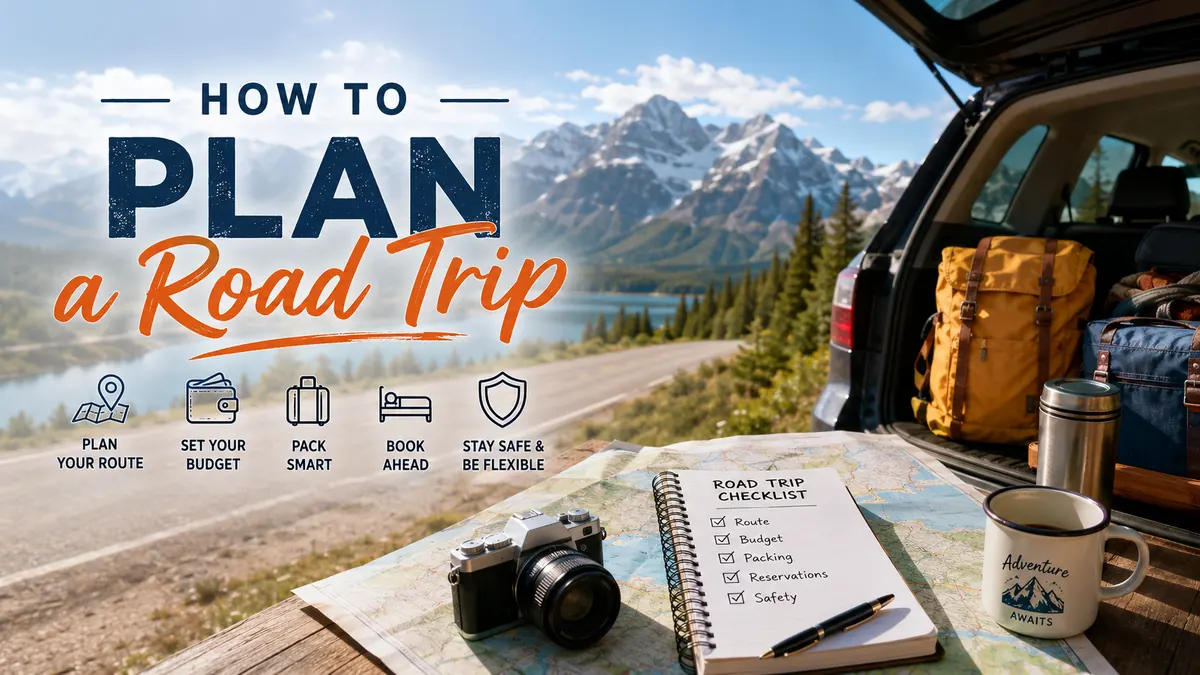
A great road trip feels spontaneous, but the smoothest ones usually have a solid plan behind them. The trick is knowing what to organize in advance and what to leave flexible.
If you’re figuring out how to plan a road trip, start with the big decisions: how many days you have, where you want to go, how far you’re comfortable driving each day, and what you can afford. From there, build a realistic route, choose worthwhile stops, estimate costs, prepare your vehicle, book critical accommodation, and create backup plans for weather, traffic, closures, or poor cell service.
The simplest road trip planning process is to choose your destination and trip length, map a realistic route, set a budget, divide the journey into manageable driving days, add overnight and sightseeing stops, prepare your vehicle, pack essential supplies, download offline maps, and check weather and road conditions before leaving.
1. How to Plan a Road Trip by Defining the Trip First
Opening a map and immediately adding attractions is tempting. It is also one of the easiest ways to create an itinerary that looks fantastic on a screen but becomes exhausting on the road.
Start with the shape of the trip.
Answer these basic questions:
- How many full days do you have?
- Where will you start and finish?
- Are your dates flexible?
- Who is traveling?
- Are you using your own car, a rental car, an RV, a motorcycle, or an EV?
- What kind of experience matters most: scenery, cities, national parks, food, hiking, beaches, history, or simply the drive?
- How much driving feels reasonable each day?
- What is your approximate total budget?
These decisions determine nearly everything that follows.
Choose the Right Road Trip Structure
Most journeys fit into one of three formats.
| Trip type | How it works | Best for |
|---|---|---|
| Point-to-point | Start in one location and finish somewhere else | Long-distance routes and one-way trips |
| Loop | Start and finish in the same place | Using your own vehicle and avoiding one-way logistics |
| Hub-and-spoke | Stay primarily in one destination and make day trips | Slower travel and shorter driving days |
A loop is often easiest when driving your own car because you don’t have to arrange transportation back to the starting point.
Point-to-point routes can cover more territory, but travelers using rental vehicles should check one-way restrictions and possible drop-off charges before finalizing the itinerary.
Pick Two or Three Anchor Destinations
Don’t try to plan every roadside stop immediately.
Choose the places that would genuinely disappoint you to miss. These are your anchor destinations.
For example, a seven-day road trip might have:
- one major city,
- one national park,
- one scenic region.
Once those anchors are fixed, you can connect them with smaller attractions, restaurants, viewpoints, trails, towns, and spontaneous detours.
Quick Takeaway: Build the road trip around a few must-see places instead of turning every interesting location on the map into a mandatory stop.
2. how to plan a road trip Route Without Overloading Your Days
Your next job is turning those ideas into a route you can realistically drive.
Digital mapping and dedicated trip-planning tools make this considerably easier. Google Maps is useful for basic routing and navigation, while tools such as Roadtrippers and AAA TripTik can help identify attractions, hotels, fuel stops, restaurants, and other points of interest along a driving route. AAA says its TripTik planner can accommodate up to 25 stops.
Calculate the Entire Route First
Map:
- Starting point
- Final destination
- Anchor destinations
- Overnight locations
- Major attractions
Look at both the total distance and estimated driving time.
Then divide the route across your available days.
Don’t assume a six-hour Google Maps estimate means you’ll arrive exactly six hours after leaving. Fuel, charging, meals, restrooms, traffic, photographs, construction, scenic viewpoints, and unexpected stops all add time.
How Many Hours Should You Drive Per Day?
There isn’t one ideal number for everyone. A recent road-trip planning guide recommends treating roughly four to six hours as a comfortable daily driving cap when designing an itinerary.
That can be a useful starting point rather than a rigid rule.
Four hours behind the wheel may already feel like a long day if you also plan a major hike. Six hours might feel easy when the drive itself is the day’s main activity.
Consider:
3–4 hours: comfortable for sightseeing-heavy days.
4–6 hours: workable for many longer road trips.
6+ hours: better treated as a substantial travel day with fewer activities.
An occasional long driving day is manageable. Building an entire vacation around them can make the trip feel like transportation rather than travel.
Don’t Trust Distance Alone
Two 200-mile drives can be completely different.
A straightforward interstate journey may be relatively predictable. Two hundred miles through mountain passes, small towns, winding coastal roads, national parks, or congested urban areas may take considerably longer.
Check the actual roads you will use, not just mileage.
Compare the Fastest and Scenic Routes
The fastest route isn’t necessarily the best road trip route.
Look for:
- scenic byways,
- coastal roads,
- mountain passes,
- historic highways,
- national parks,
- interesting small towns,
- overlooks,
- unusual roadside attractions.
Then decide where the slower road provides enough value to justify the extra time.
Roadtrippers, for example, is specifically designed to find places and detours between a starting point and destination, while AAA also publishes preplanned scenic driving routes.
Check Seasonal Road Access
A road that exists on a map isn’t necessarily accessible when you arrive.
Mountain passes and park roads may close seasonally. Wildfires, floods, snow, storms, construction, and other conditions can also affect routes.
Before departure, check official transportation agencies, national park authorities, or other appropriate local sources for current conditions.
This matters particularly when your itinerary depends on one remote road with few alternatives.
3. Build a Road Trip Itinerary That Has Breathing Room
One of the biggest road trip planning mistakes is scheduling every hour.
A useful itinerary gives your trip structure without making you feel late all day.
Plan Each Day Around One Main Objective
For every day, decide what matters most.
A simple itinerary could look like this:
| Time | Plan |
| 8:00 a.m. | Breakfast and depart |
| 10:00 a.m. | Scenic stop |
| 12:30 p.m. | Lunch |
| 2:00 p.m. | Main attraction or hike |
| 5:00 p.m. | Continue to overnight destination |
| 7:00 p.m. | Check in and dinner |
Notice that the day isn’t packed with eight attractions.
One significant experience plus a few optional stops usually creates a much more enjoyable pace.
Separate Must-See and Optional Stops
Create two categories.
Must-see stops are places worth planning your day around.
Optional stops are places you’ll visit only if time, weather, and energy allow.
This tiny distinction can prevent a surprising amount of stress.
If you’re ahead of schedule, take the detour. If traffic has already cost you an hour, skip it without feeling as though the itinerary has failed.
Plan Regular Breaks
Driving fatigue can creep up gradually.
Build breaks into long driving days instead of waiting until the driver is exhausted. A planning baseline of stopping approximately every two to three hours is sensible for longer days, with more frequent breaks whenever the driver needs them.
Use breaks productively when possible. A fuel stop can also be a restroom, coffee, stretching, snack, and driver-change stop.
Leave Room for Discovery
Some of the best road trip moments won’t appear in your itinerary.
You might notice an unexpected viewpoint, local market, diner, short hiking trail, or tiny town worth exploring.
Leave enough flexibility to say yes occasionally.
That’s the difference between an itinerary that supports your trip and one that controls it.
Quick Takeaway: Schedule your essential experiences and overnight destinations. Treat most smaller attractions as options.
4. How to Budget for a Road Trip
Road trips can be affordable, but they’re not automatically cheap.
The major expenses usually include:
- fuel or EV charging,
- accommodation,
- food and drinks,
- parking,
- tolls,
- attractions and entrance fees,
- vehicle preparation,
- rental-car costs,
- insurance,
- camping fees,
- emergency expenses.
Build your budget before booking accommodation so you understand what the complete journey is likely to cost.
Estimate Fuel Costs
A useful basic formula is:
Fuel cost = (total distance ÷ vehicle fuel economy) × fuel price
For example, imagine you’re planning a 1,500-mile trip in a car averaging 30 MPG.
1,500 ÷ 30 = 50 gallons.
At $3.50 per gallon:
50 × $3.50 = $175 estimated fuel cost.
Add a buffer because detours, city driving, idling, weather, terrain, and real-world fuel economy can change the final number.
For international trips, simply use the corresponding kilometers, liters, and local fuel prices.
Estimate Accommodation
Multiply the average nightly rate by the number of paid nights, then include taxes, resort fees, parking charges, or campground fees where applicable.
Don’t compare hotels using room price alone. A slightly cheaper city-center hotel with expensive overnight parking may cost more overall than a higher-priced property with free parking.
Create a Daily Food Budget
You don’t need to eat every meal at a restaurant.
A simple strategy is:
- breakfast from the hotel, campsite, or groceries,
- packed snacks and drinks,
- inexpensive lunch,
- restaurant dinner.
A cooler can be particularly useful for longer journeys.
Include a Contingency Fund
Keep part of your budget untouched.
Unexpected expenses might include:
- a damaged tire,
- extra accommodation,
- parking,
- route changes,
- emergency transportation,
- vehicle repairs,
- higher-than-expected fuel prices.
A road trip budget without any flexibility is only accurate when everything goes perfectly.
5. Decide What to Book Before the Road Trip
You don’t necessarily need to reserve every night months in advance.
How much you should book depends on where and when you’re traveling.
Book Early When Availability Is Limited
Advance reservations become more valuable when visiting:
- popular national parks,
- major cities,
- beach destinations,
- small towns with limited accommodation,
- festivals or special events,
- holiday destinations,
- peak summer locations,
- remote areas.
The same applies to timed-entry attractions, ferries, popular campgrounds, tours, and other capacity-limited experiences.
Leave Some Flexibility When You Can
On quieter routes, leaving an occasional night flexible can create freedom to stay longer somewhere you enjoy.
The trade-off is uncertainty.
Last-minute accommodation may be more expensive or unavailable, particularly during busy travel periods.
A useful compromise is to reserve critical nights and keep less important portions flexible.
Check Cancellation Policies
Flexible or refundable accommodation can be valuable during a road trip because routes are more exposed to weather, vehicle trouble, road closures, and changing plans.
Know the cancellation deadline for each booking.
6. Prepare Your Vehicle Before a Long Road Trip
An excellent itinerary isn’t much help when your vehicle is sitting on the shoulder.
Vehicle preparation deserves its own place in your road trip plan.
Do a Basic Vehicle Inspection
Before a long journey, check:
- tire condition and pressure,
- spare tire or tire repair kit,
- engine oil,
- coolant,
- brake fluid where appropriate,
- windshield washer fluid,
- headlights,
- brake lights,
- turn signals,
- windshield wipers,
- battery condition,
- brakes,
- warning lights.
If the vehicle is due for maintenance or you’re unsure about its condition, have a qualified mechanic inspect it before a demanding trip.
Don’t leave significant maintenance until the night before departure. If a problem is discovered, you need time to fix it.
Know How Your Spare Tire Works
Finding out that the spare is flat—or discovering you don’t have one—after a puncture isn’t ideal.
Some modern vehicles use inflator or sealant kits instead of conventional spare tires. Know what your vehicle carries and how it works.
Consider Roadside Assistance
Roadside assistance can be particularly useful on long-distance trips.
Coverage varies, but services may include towing, jump-starts, tire assistance, fuel delivery, or lockout support.
Understand your coverage before leaving rather than after something goes wrong.
Planning an EV Road Trip
Electric vehicles require an additional layer of route planning.
Map charging stations around your realistic driving range, not merely the manufacturer’s maximum range. Weather, speed, elevation, climate control, payload, and driving conditions can affect energy consumption.
Roadtrippers currently includes EV charging station discovery among its planning features, while other charging-network and navigation apps can provide charger-specific information.
Have backup charging locations for important legs of the journey, especially in remote areas.
7. What Should You Pack for a Road Trip?
Packing depends on climate, destination, vehicle, and activities, but some essentials apply to almost everyone.
Navigation and Documents
Keep:
- driver’s license,
- vehicle registration where required,
- insurance information,
- rental agreement if applicable,
- reservation confirmations,
- emergency contact details,
- necessary permits or passes.
For international driving, research the destination’s license, insurance, toll, border, and vehicle requirements before departure.
Emergency Supplies
A practical vehicle emergency kit may include:
- first-aid kit,
- flashlight,
- charging cables,
- portable power bank,
- basic tools,
- tire equipment,
- jumper cables or an appropriate jump starter,
- reflective warning equipment where appropriate,
- drinking water,
- nonperishable food,
- warm layers or blankets in cold conditions.
Adjust the kit for your route.
Driving across a populated region with frequent services is different from crossing a desert, remote mountain area, or isolated winter highway.
Food and Comfort
Useful everyday items include:
- refillable water bottles,
- cooler,
- snacks,
- sunglasses,
- sunscreen,
- tissues,
- hand sanitizer,
- trash bags,
- comfortable layers,
- pillows for passengers,
- entertainment.
Don’t bury everything under luggage.
Water, documents, chargers, medications, snacks, and frequently used items should stay accessible.
Don’t Forget a Paper Backup
Phones are excellent navigation tools until the battery dies or coverage disappears.
Berkshire Hathaway Travel Protection’s 2026 road-trip guidance specifically recommends carrying important documents and paper maps as a backup.
You don’t need a stack of atlases for every journey, but having some form of offline backup is sensible.
8. Use Road Trip Planning Apps Without Depending on Them Completely
Technology has made route planning dramatically easier.
A useful setup might include:
Google Maps or another navigation app: everyday navigation, traffic, restaurants, fuel, and local searches.
Roadtrippers: route building, waypoint management, attractions, detours, fuel estimates, and trip discovery. Its planning tools can also arrange stops and customize routes.
AAA TripTik: driving routes, maps, points of interest, hotels, restaurants, and gas stations.
Weather apps: forecasts and severe-weather information.
Official transportation sources: road construction, closures, restrictions, and current driving conditions.
Download Offline Maps
Do this before entering remote areas.
Offline navigation can be invaluable when cellular coverage disappears.
Also save:
- accommodation addresses,
- confirmation numbers,
- important phone numbers,
- key route information.
Screenshots can provide another simple backup for critical information.
Use AI as a Starting Point, Not the Final Authority
AI itinerary tools can quickly suggest routes and stops. Roadtrippers, for example, currently offers its Autopilot AI-powered trip-planning feature.
These tools are useful for brainstorming and building a first draft.
But verify critical information independently.
Opening hours, seasonal road access, entrance requirements, reservation rules, and travel times can change. Your final itinerary should rely on current information from the attraction, park, transportation authority, or other authoritative source when it matters.
9. Plan for Weather, Traffic, Tolls, and Road Closures
A route isn’t finished simply because you’ve drawn a line between destinations.
Check the conditions that could change that line.
Weather
Look at forecasts for the entire route, not just the final destination.
A trip from warm lowlands into high elevations can cross several climates in one day.
Potential problems include:
- thunderstorms,
- flooding,
- extreme heat,
- snow,
- ice,
- high winds,
- wildfire conditions,
- fog.
Check again shortly before departure because forecasts change.
Traffic
Think about when you’ll pass major metropolitan areas.
Leaving an hour earlier or later can sometimes prevent a long delay.
Avoid designing an itinerary where arriving at the next hotel on time depends on experiencing zero traffic.
Tolls
Research toll roads before leaving.
Depending on the country or region, payment may involve:
- cash,
- cards,
- electronic transponders,
- license-plate billing,
- online payment,
- road vignettes.
Rental-car toll policies deserve particular attention because administrative fees can apply.
Border Crossings
International road trips require more preparation.
Check:
- passport and visa requirements,
- driver’s license rules,
- International Driving Permit requirements where applicable,
- vehicle insurance,
- rental-car border restrictions,
- customs regulations,
- road rules,
- required safety equipment.
Never assume that a rental vehicle can cross an international border simply because a road does.
10. how to plan a road trip Safely
Safety isn’t a separate activity you handle after planning the fun parts. It should influence the route itself.
Share Your Itinerary
Give a trusted person basic information about:
- your route,
- overnight destinations,
- expected return date,
- remote areas you intend to visit.
This becomes more important when traveling alone or through areas with unreliable communications.
Don’t Build a Schedule Around Exhausted Driving
If the plan only works when one person drives for extremely long periods, reconsider the plan.
Rotate drivers when possible.
If you feel sleepy, stop somewhere safe and rest. Coffee, music, cold air, and open windows aren’t substitutes for adequate sleep.
Keep Fuel or Charge Levels Sensible
In populated areas, driving until the fuel warning appears may only be inconvenient.
In remote regions, it can become a genuine problem.
Look ahead at the distance between service stations or chargers and refill earlier when options become sparse.
Keep Valuables Out of Sight
Don’t leave passports, electronics, wallets, cameras, or luggage visibly unattended in a parked vehicle.
Take essential documents with you whenever practical.
Know Your Emergency Options
Know the emergency number for the country you’re visiting and understand how your roadside assistance works.
When traveling through remote areas, recognize that cell coverage may be unavailable.
Quick Takeaway: The safest road trip itinerary isn’t necessarily the shortest. It’s one that gives the driver adequate rest, maintains sensible fuel or charging margins, and includes alternatives when conditions change.
11. Common Road Trip Planning Mistakes
Even experienced travelers can overplan.
Avoiding a few predictable mistakes makes a noticeable difference.
Trying to See Everything
Ten saved attractions don’t have to become ten itinerary stops.
Choose the places that matter most and treat the rest as possibilities.
Underestimating Driving Time
Map estimates don’t include your complete day.
Add time for breaks, food, fuel, charging, parking, traffic, photographs, and detours.
Changing Hotels Every Night
Constantly unpacking, checking in, sleeping, packing, and checking out becomes tiring.
When a destination deserves more exploration, consider staying two nights and giving yourself one day without relocating.
Booking Too Much—or Nothing
Overbooking removes spontaneity.
Booking nothing can create unnecessary stress in popular areas.
Reserve the parts of the journey where availability matters and keep flexibility elsewhere.
Ignoring Parking
A hotel may look perfect until you discover parking is difficult or expensive.
Research overnight parking in major cities and at heavily visited attractions.
Forgetting the Return Journey
A classic planning mistake is using most of your available time reaching the farthest destination and then realizing you still have to drive home.
Map the complete journey before committing to stops.
Packing Too Much
A road trip offers more luggage space than flying, which makes overpacking tempting.
But an overloaded car makes essential items harder to reach, reduces passenger comfort, and can affect vehicle handling when taken too far.
Pack for actual needs, not every imaginable situation.
12. A Simple Road Trip Planning Timeline
You don’t need to complete everything at once.
Several Weeks or Months Before
Depending on the trip:
- Choose dates.
- Establish the total budget.
- Pick anchor destinations.
- Map the overall route.
- Reserve scarce accommodation or campsites.
- Book timed-entry attractions when necessary.
- Research vehicle or rental requirements.
One to Two Weeks Before
Start tightening the details:
- Confirm accommodation.
- Review daily driving distances.
- Check vehicle maintenance.
- Plan important fuel or charging stops.
- Organize documents.
- Buy missing emergency supplies.
- Review cancellation policies.
A Few Days Before
Check information that changes frequently:
- weather,
- road closures,
- construction,
- wildfire or flood conditions where relevant,
- attraction opening hours,
- reservations,
- traffic expectations.
The Night Before
Finish the simple jobs:
- charge phones and power banks,
- download offline maps,
- fill the fuel tank or charge the EV,
- load luggage,
- prepare water and snacks,
- check tire pressure,
- confirm the first day’s route.
That leaves departure morning much calmer.
13. A Practical Example: Planning a Seven-Day Road Trip
Suppose you have seven days and want to travel roughly 1,200 miles.
The wrong approach would be finding seven major destinations and trying to spend one night in each.
A better structure might be:
| Day | Main plan | Driving |
| 1 | Travel to first destination | 4–5 hours |
| 2 | Explore | Minimal |
| 3 | Scenic drive to second destination | 3–4 hours |
| 4 | Explore | Minimal |
| 5 | Travel toward home via another region | 4–5 hours |
| 6 | Shorter drive + activities | 2–3 hours |
| 7 | Return home | 3–4 hours |
Notice the rhythm: drive, explore, drive, explore.
You aren’t spending every day checking out of a hotel and racing to the next town.
That pattern also gives you some flexibility. If bad weather affects Day 2, you may have room to reorganize an activity rather than abandoning it completely.
14. How Much Planning Does a Road Trip Really Need?
Enough to remove the stressful uncertainty, but not so much that there’s no room for discovery.
Before leaving, you should generally know:
- where you’re going,
- how you’ll get there,
- where you’re sleeping when availability is critical,
- what the trip should cost,
- whether the vehicle is ready,
- which attractions require reservations,
- what weather and road conditions to expect,
- what you’ll do if the original route doesn’t work.
You don’t need to know where you’ll eat lunch at exactly 12:35 p.m. on Day 4.
Think of your itinerary as a framework.
The essential pieces—route, accommodation, safety, vehicle, budget, and high-priority reservations—should be reliable. Everything else can move.
Final Road Trip Planning Checklist
Before turning the key, make one final check:
- Route and daily distances are realistic
- Important accommodation is confirmed
- Must-see attractions and required reservations are organized
- Fuel or EV charging strategy is clear
- Road and weather conditions have been checked
- Vehicle inspection is complete
- Driver’s license and necessary vehicle documents are packed
- Emergency and first-aid supplies are accessible
- Water and snacks are ready
- Phones and power banks are charged
- Offline maps are downloaded
- Important addresses and confirmations are saved
- A trusted person knows the general itinerary
- Backup routes or alternative plans exist for vulnerable sections
- Enough free time remains for unexpected discoveries
Learning how to plan a road trip is ultimately about balancing preparation with freedom. Plan the elements that can create serious problems if they go wrong—your route, budget, accommodation, vehicle, documents, safety, and essential reservations—then leave enough space for the unexpected places that make driving trips memorable.
A good next step is simple: choose your dates and two or three anchor destinations, map the complete route, and check whether the daily driving times actually fit the experience you want.