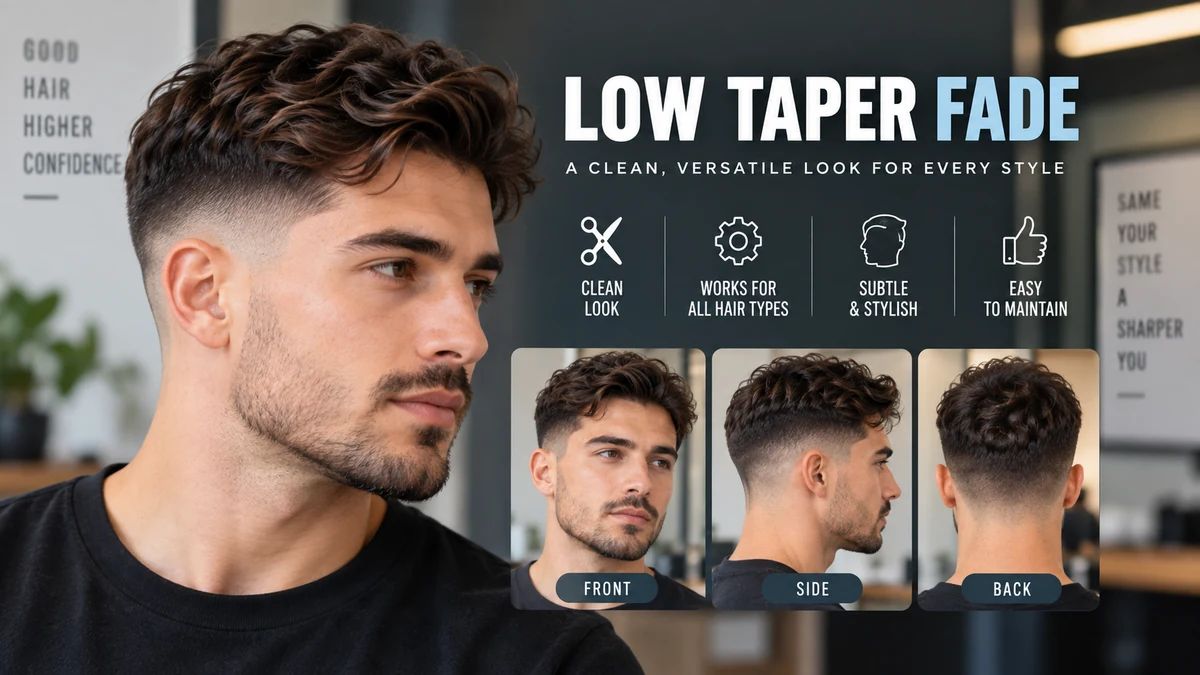
A low taper fade is one of those haircuts that can make a noticeable difference without completely changing how you look. It cleans up the sideburns and neckline, preserves more weight through the sides, and gives almost any hairstyle on top a sharper outline.
That subtlety is a major reason the cut remains prominent in men’s grooming guides in 2026. Current barber and hairstyle references consistently describe it as a versatile option for straight, wavy, curly, and coily hair, with the top left flexible enough for crops, curls, waves, side parts, textured styles, and longer cuts.
A low taper fade is a haircut in which the hair gradually becomes shorter around the sideburns, ears, and neckline while most of the sides remain relatively full. Because the transition starts close to the natural hairline, the result is softer and less dramatic than a mid or high fade.
The most useful thing to understand before asking for one is that the words low, taper, and fade each describe part of the haircut. Once you know what they mean, choosing the right version becomes much easier.
What Is a Low Taper Fade?
A taper gradually reduces the length of the hair toward its edges. A fade takes that graduation further by blending progressively shorter lengths together so no obvious line separates them.
With a low taper fade, that shortening happens primarily in the lowest portion of the haircut. The barber concentrates on areas such as:
- The sideburns
- Around or slightly above the ears
- Behind the ears
- The lower neckline or nape
Most of the upper sides stay darker and fuller than they would with a conventional low, mid, or high fade.
This distinction matters because barber terminology is not completely standardized. Some barbers use “low taper” and “low taper fade” almost interchangeably, while others use low fade to describe a continuous faded band running farther around the head. Barber.Style, for example, distinguishes a low taper as localized shortening around the sideburn and nape from a low fade that removes more weight across the lower sides.
The safest approach is therefore not simply to say, “Give me a low taper.” Explain how much of the sides you want faded and whether you want the shortest area taken to skin, zero, half guard, or something longer.
What Does a Low Taper Fade Look Like?
From the front, the difference can be surprisingly restrained. You still see substantial hair through the sides rather than a large pale section of scalp.
From the side, the transition becomes clearer. Hair gradually shortens near the sideburn and ear before blending into fuller hair above.
From the back, the neckline is tapered rather than left heavy and bulky.
The essential visual feature is a smooth gradient. There should not be a harsh horizontal line separating short hair from long hair. Current barber guides generally place the transition close to the natural hairline and above the ear rather than high on the side of the head.
How Low Is “Low”?
There is no universal measurement that every barber follows.
In practice, low means keeping the transition within the lower portion of the sides rather than moving it toward the temple or upper parietal area. Some barbers create only a compact taper around the sideburn and neckline; others extend the graduation slightly farther behind the ear.
This is why showing your barber a reference photo remains useful. It communicates the fade height, contrast, top length, neckline, and overall silhouette faster than haircut terminology alone.
Low Taper Fade vs Low Fade, Mid Fade, and High Fade
These haircuts may use the same clipper techniques, but the placement of the transition changes the entire appearance.
| Haircut | Where the fade begins | Side fullness | Overall effect | Grow-out visibility |
|---|---|---|---|---|
| Low taper fade | Around sideburns, ears and neckline | High | Soft and subtle | Usually gradual |
| Low fade | Low around most of the head | Medium | Clean with greater contrast | Moderate |
| Mid fade | Around middle of the sides | Lower | Balanced and noticeable | More obvious |
| High fade | Near temples/upper sides | Low | Bold and high contrast | Most noticeable |
| Skin fade | Can be low, mid or high | Depends on height | Very sharp | Shortest areas show quickly |
The most important distinction is between the low taper fade and low fade.
A conventional low fade usually forms a broader, continuous gradient across the lower sides and back. A low taper tends to preserve a darker side panel and concentrates the shortest work near the edges.
That makes the taper useful for someone who likes the shape and volume of their existing hairstyle but wants the outline cleaned up.
Low Taper Fade vs Skin Fade
“Skin fade” describes the shortest length, not the height of the fade.
A skin fade reaches bare or nearly bare scalp at its shortest point. A taper can instead finish at:
- Skin
- Zero/no guard
- 0.5 guard
- Number 1 guard
- A softer scissor or clipper finish
Some guides define a traditional low taper as stopping short of bare skin, while other contemporary barbers use “skin taper” for a taper that reaches skin. The terminology varies between shops, so specify the shortest length you want rather than relying on the name alone.
Taper vs Fade: Why People Confuse Them
The words overlap because both techniques use gradual length changes.
Think of it this way:
Taper: usually localized around the haircut’s edges.
Fade: usually spreads the gradient over a larger portion of the sides and back.
A low taper fade combines both ideas: a very low, controlled fade focused around the perimeter.
Best Low Taper Fade Styles
The taper is primarily the foundation. What changes the personality of the haircut is the hair above it.
That is why two people can both have a low taper while looking completely different.
Classic Low Taper Fade
The classic version keeps the side taper restrained and blends it naturally into medium-length hair.
There is no exaggerated disconnect and no dramatic design. The goal is simply to sharpen the edges.
It works particularly well with:
- Short textured hair
- Side parts
- Comb overs
- Natural waves
- Brushed-back hair
- Conservative professional cuts
Current style guides commonly pair low tapers with comb overs, side parts, pompadours and similar classic shapes because the subtle fade leaves enough weight to support them.
Low Taper Fade With Textured Top
Texture makes a subtle taper look more contemporary.
Instead of combing every strand into position, the top is cut or styled to create separation and movement. The contrast between a relaxed top and precise edges prevents the haircut from looking overly formal.
For styling, start with slightly damp hair, add a small amount of lightweight product, and use your fingers rather than a fine-tooth comb.
A matte clay or paste can add separation to straight or wavy hair without creating excessive shine.
Low Taper Fade With Curly Hair
Curly hair is particularly well suited to a low taper because the haircut removes bulk from the perimeter without sacrificing the curl pattern above.
Keeping fullness through the upper sides also avoids turning the haircut into an extreme “top-heavy” shape.
For defined curls:
- Keep enough length for the natural curl pattern to form.
- Use conditioner regularly if the hair becomes dry easily.
- Apply curl cream or leave-in product while the hair is damp.
- Avoid repeatedly brushing dry curls.
- Let the taper provide structure rather than cutting the entire side very short.
Current haircut guides specifically show low tapers paired with both short curls and longer curly styles.
Low Taper Fade With Coily Hair
Coily and Afro-textured hair allows the gradient around the temples and neckline to appear especially defined.
Popular combinations include:
- Short natural Afro
- Sponge curls
- Twists
- Locs
- Defined coils
- Waves
- Longer natural texture
A crisp lineup can make the result look even sharper, but it should suit the person’s natural hairline. Continually pushing the front hairline backward to create an artificially straight edge can eventually make the haircut appear less natural.
For a softer result, ask the barber to keep the front line close to its natural position.
Low Taper Fade With Waves
A low taper works with 360 waves because it can clean the temples and neckline while leaving enough hair across the rest of the head for the wave pattern to remain connected.
Communication is especially important here.
Ask the barber not to take the fade too high into the wave pattern. Keeping the transition compact helps maintain continuity across the sides.
Low Taper Fade With Straight Hair
Straight hair reveals graduation clearly, making precision particularly important.
Good top styles include:
- Textured crop
- Side part
- Messy fringe
- Quiff
- Slick back
- Short brush-up
- Caesar-inspired crop
Fine straight hair often benefits from matte products that add texture without weighing it down.
Thicker straight hair may need debulking or point cutting through the top and upper sides so the haircut does not develop a mushroom-like silhouette as it grows.
Low Taper Fade With Wavy Hair
Wavy hair sits between straight and curly textures, so it can support both structured and relaxed styles.
Instead of flattening the waves, leave enough length for them to create natural movement.
A sea-salt spray, lightweight cream, or low-shine paste can emphasize texture, although people with naturally dry hair may prefer moisturizing products over salt-heavy formulas.
Low Taper Fade With Fringe
A fringe changes where the visual emphasis sits.
Because the fade remains low, the front can stay:
- Short and textured
- Forward and messy
- Curly
- Longer and swept
- Choppy
- Soft and natural
This combination is useful if you want a modern shape without exposing much scalp through the sides.
Low Taper Fade With Longer Hair
You do not need short hair on top to wear a taper.
In fact, a taper is useful when growing the hair because it allows the top and upper sides to retain length while cleaning areas that usually start looking untidy first.
One contemporary barber-style reference describes the low taper as particularly suitable for growing hair out because the barber can tidy the sideburns and neckline without substantially shortening the side panel.
Longer combinations include:
- Curtains
- Flow hairstyles
- Longer curls
- Slick backs
- Layered tops
- Braids
- Twists
- Locs
Low Taper Fade With a Pompadour
A pompadour needs weight and length through the top.
Because a low taper preserves more side hair than a high fade, it creates a smoother transition into that volume.
Blow-dry the front upward and backward before applying styling product. This gives the shape structure without requiring excessive pomade.
Low Taper Fade With a Side Part
For a more traditional haircut, pair the taper with a side part and scissor-cut top.
The result looks cleaner than a fully grown-out classic cut but less severe than a skin fade.
This is one of the easiest versions to move between professional, formal, and casual settings.
Low Taper Fade With a Mullet
The modern mullet often uses a taper around the temples while retaining significant length behind the head.
Here the taper performs a different role: instead of removing the back, it cleans the area around the ear and separates the longer sections visually.
Modern barber references increasingly include mullets, faux hawks and other expressive styles among compatible low-taper combinations.
Low Taper Fade With Hair Design
A haircut design can be added above or within the taper using a trimmer or razor.
Examples include:
- Single shaved line
- Curved line
- Double line
- Geometric pattern
- Custom neckline detail
The design makes the otherwise understated haircut more noticeable.
The trade-off is maintenance. Fine shaved details become less crisp as soon as the surrounding hair grows, so they require more frequent refreshing than a plain taper. Dedicated 2026 low-taper design guides show razor lines, curves and geometric details as common variations.
Best Low Taper Fade for Different Hair Types
One reason the haircut is so adaptable is that the taper itself occupies only a small part of the head.
Your natural texture can remain the main feature.
| Hair type | Good pairing | Main styling priority |
|---|---|---|
| Fine straight | Textured crop, fringe | Volume and separation |
| Thick straight | Quiff, crop, side part | Weight control |
| Wavy | Natural textured top | Definition without stiffness |
| Curly | Curls, fringe, longer top | Moisture and curl shape |
| Coily | Afro, sponge curls, twists | Shape and edge definition |
| Waves | 360 waves | Preserve pattern connectivity |
| Long hair | Flow, curtains, slick back | Keep the taper compact |
| Locs/braids | Natural long top | Clean perimeter without over-fading |
Fine Hair
A very aggressive fade can exaggerate the difference between thin hair on top and exposed scalp on the sides.
A low taper is gentler.
Keep some visual weight around the head and use light styling products. Heavy gels or greasy pomades can separate fine strands and expose more scalp.
Thick Hair
Thick hair gives a barber plenty of material for a seamless blend, but it can create excessive bulk above the taper.
The key is not necessarily making the fade higher. Often the better solution is removing weight with scissor-over-comb, clipper-over-comb, layering, or careful texturizing.
Curly and Coily Hair
The biggest mistake is asking for a picture without accounting for shrinkage.
Curly hair looks longer when wet or stretched. Tell your barber how you normally wear it and preferably arrive with your hair close to its normal everyday state.
That makes it easier to judge the finished silhouette accurately.
Does a Low Taper Fade Suit Every Face Shape?
No haircut automatically flatters every person in exactly the same way, but the low taper is unusually adaptable because its top can be modified.
The taper stays fairly constant. The proportions above it do most of the face-shape work.
Oval Face
Oval faces can generally handle a broad range of top lengths.
Good choices include:
- Textured crop
- Short curls
- Side part
- Quiff
- Slick back
- Fringe
Avoid adding unnecessary height if your face is already especially long.
Round Face
A round face often benefits from additional vertical structure.
Try:
- Quiff
- Brush-up
- Textured top
- Moderate pompadour
Keeping the sides controlled while adding height can make the overall silhouette look less wide.
Square Face
Square faces already have strong angles, so both neat and textured versions work.
A short crop creates a strong masculine outline, while curls or waves can soften the geometry slightly.
Oblong or Rectangular Face
Avoid excessive height on top.
A tall pompadour plus tight sides can visually lengthen the face further.
Better options include:
- Textured fringe
- Medium crop
- Side-swept top
- Natural waves
Keeping some fullness through the sides is another reason a low taper can work better than an aggressive high fade.
Heart-Shaped Face
A heart-shaped face tends to be wider near the forehead and narrower around the chin.
Moderate side fullness and textured movement on top usually create good balance.
Very severe temple fading can make the upper face appear wider by comparison.
Diamond Face
Diamond-shaped faces often have pronounced cheekbones.
Keeping some weight through the sides rather than exposing them completely can soften the transition between the cheekbones and forehead.
The adaptability of the haircut across face shapes is a recurring theme in current low-taper guides, although the top shape and length remain important variables.
How to Ask Your Barber for a Low Taper Fade
This is where many otherwise good haircuts go wrong.
Do not rely on the haircut name alone.
A useful barber request communicates five things:
- Fade height
- Shortest length
- How much of the side should be tapered
- Top length
- Neckline and hairline preference
You might say:
“I want a low taper concentrated around the sideburns and neckline. Keep the upper sides full, blend it smoothly, and don’t take the fade high. Keep the top textured and just remove enough length to reshape it.”
Then specify your preferred shortest length.
For example:
- Skin: highest contrast
- Zero: extremely short stubble
- 0.5: slightly softer
- #1: conservative and less exposed
Exact guard choices vary because different clipper systems, lever positions, hair densities and barber techniques produce different results.
That is why a photograph is more useful than demanding a specific sequence of guard numbers.
Bring the Right Reference Photo
Choose a photo showing hair similar to yours.
Look for similarities in:
- Hair density
- Curl pattern
- Top length
- Hairline
- Head shape
- Overall texture
A low taper on thick coily hair will not reproduce identically on fine straight hair.
Show the barber the picture and explain what you like about it rather than expecting an exact copy.
Tell the Barber What You Do Not Want
Negative instructions can be surprisingly helpful.
For example:
- “Don’t take the fade above this point.”
- “Don’t remove too much weight from the sides.”
- “I don’t want skin showing.”
- “Keep my natural neckline.”
- “Don’t push my front hairline back.”
- “Leave enough length for my curls.”
Barber-focused guides repeatedly emphasize clear communication because the same haircut name can be interpreted differently.
How a Barber Creates a Low Taper Fade
Professional techniques vary, but the underlying process is based on controlled graduation.
A barber generally begins by deciding where the shortest area will sit.
They then create progressively longer sections using combinations of:
- Clippers
- Adjustable clipper lever positions
- Guards
- Trimmers
- Scissors
- Clipper-over-comb
- Scissor-over-comb
The barber removes visible weight lines until the transition appears continuous.
The Sideburn Taper
This section determines much of the haircut’s side profile.
The shortest point sits near the bottom of the sideburn, and the blend gradually becomes darker moving upward.
If it climbs too far above the ear, the cut starts resembling a broader low fade rather than a compact taper.
The Neck Taper
At the back, the hair gradually shortens toward the nape.
A well-executed neck taper helps the haircut grow out more softly because there is less abrupt contrast between the neckline and longer hair above.
The Blend
The quality of the haircut comes from the blend rather than the shortest guard.
When you look at the side in normal lighting, you should not see heavy horizontal bands.
Hair density can affect how perfectly uniform the gradient appears. Very dark, coarse hair may reveal tiny transitions more readily than lighter or finer hair.
Skin, Zero, Half, or Number 1 Low Taper?
The shortest setting changes the character of the haircut.
Skin Taper
The edge reaches bare or nearly bare scalp.
Best for: maximum sharpness.
Downside: the contrast becomes visible quickly as the hair regrows.
Zero Taper
A clipper without a guard leaves extremely short stubble.
Best for: a sharp finish without necessarily shaving completely to the skin.
Half-Guard Taper
The bottom stays slightly darker.
Best for: a softer transition and people who dislike exposed scalp.
Number 1 Taper
This creates a conservative finish.
Best for: subtle grooming, sensitive scalps, professional styling, or anyone trying a taper for the first time.
There is no objectively superior starting length. Choose according to the amount of scalp exposure and contrast you want.
How to Style a Low Taper Fade
The faded section requires almost no daily styling.
Nearly all your effort goes into the top.
For a Textured Top
- Start with slightly damp hair.
- Apply a small amount of styling cream, clay, or paste.
- Work it from the roots outward.
- Use your fingers to create separation.
- Add product only where needed.
Using too much product from the beginning is one of the easiest ways to flatten natural texture.
For a Quiff
Use a blow dryer to create height before applying the finishing product.
Dry the front upward and slightly backward. A pre-styler can help provide grip, followed by clay or paste for hold.
For a Slick Back
Comb the hair backward while slightly damp.
Use pomade for shine or a lower-shine cream for a softer finish.
Long, thick hair may need blow-drying first to train the direction.
For Curls
Apply leave-in conditioner or curl cream to damp hair.
Scrunch gently and allow the curls to dry naturally or use a diffuser at a controlled heat setting.
The goal is definition without creating a hard shell around the curls.
For Waves
Maintain your usual brushing and compression routine while allowing the tapered perimeter to provide the clean outline.
Avoid brushing so aggressively around a freshly cut hairline that the skin becomes irritated.
Hair Products That Work With a Low Taper
Choose products for your hair texture and top style, not because the haircut contains a taper.
Matte Clay
Useful for:
- Short straight hair
- Textured crops
- Quiffs
- Thick hair
Provides texture with relatively low shine.
Styling Paste
Useful for:
- Medium hair
- Messy styles
- Natural texture
Usually more flexible than heavy clay.
Pomade
Useful for:
- Side parts
- Comb overs
- Slick backs
- Pompadours
Choose water-based or traditional formulas according to your preferred hold and finish.
Curl Cream
Useful for:
- Wavy hair
- Curly hair
- Coily styles needing softness
Helps encourage definition while reducing a dry appearance.
Leave-In Conditioner
Particularly useful for hair that loses moisture easily.
It can improve manageability without requiring a rigid hold.
Sea-Salt Spray
Useful for creating rough texture and volume in some straight or wavy hairstyles.
Do not overuse it if your hair already feels dry.
How Often Should You Maintain a Low Taper Fade?
There is a difference between keeping a taper fresh and merely keeping the haircut presentable.
For the crispest appearance, some people refresh the edges every one to two weeks.
For normal maintenance, roughly every three to four weeks is realistic for many wearers. Several current barber guides similarly place the low taper around a three-to-four-week maintenance cycle because the low, subtle graduation generally grows out more softly than more aggressive fades.
Your actual schedule depends on:
- Hair growth rate
- Hair color
- Hair density
- Skin-to-hair contrast
- Shortest fade setting
- How sharp you want the haircut to remain
A skin taper usually looks grown out sooner than a taper beginning at a #1.
What Happens as It Grows?
During the first stage, the formerly skin-close area develops visible stubble.
Next, the transition becomes darker and less defined.
Eventually, the sideburn and neckline begin losing their tapered shape.
The haircut does not suddenly become bad. It simply becomes softer and less obviously faded.
This relatively forgiving grow-out is one of the practical advantages repeatedly highlighted in current low-taper references.
Low Taper Fade Maintenance at Home
Avoid trying to reconstruct the entire fade yourself unless you are comfortable with clipper blending.
One incorrect guideline can force the fade higher and higher as you attempt to fix it.
Between barber appointments, focus on simpler maintenance.
Keep the Hair Clean
Wash according to your scalp and hair type rather than following a rigid universal schedule.
People with oily scalps may need more frequent cleansing than people with dry, curly, or coily hair.
Condition When Needed
Conditioner is particularly useful for longer, curly, bleached, coarse, or naturally dry hair.
The taper may be short, but the longer section still needs normal hair care.
Avoid Heavy Product Buildup
Heavy waxes, oils, and pomades can accumulate around the hairline.
Clean the scalp thoroughly enough to remove buildup without aggressively scratching freshly faded skin.
Protect the Hairline
Freshly clipped skin can feel more sensitive.
Avoid repeatedly running a trimmer across the same area just to keep it looking freshly cut. Irritation can make an otherwise sharp haircut look worse.
Common Low Taper Fade Mistakes
Understanding the mistakes helps you communicate more effectively with your barber.
Taking the Fade Too High
This is the most common mismatch.
Once too much hair has been removed above the ear, the haircut becomes closer to a conventional fade.
You cannot put that length back immediately, so agree on the fade height before the barber begins.
Removing Too Much Side Weight
The appeal of a taper is that it preserves fullness.
If the upper side is cut extremely short, you lose much of the distinction between a taper and a full fade.
Using the Wrong Reference Hair Type
Reference images show proportions, not guarantees.
Hair density, cowlicks, curl pattern, recession, growth direction and head shape all affect the outcome.
Choosing an Extremely Sharp Hairline When You Want Natural Grow-Out
A heavily enhanced lineup looks very crisp immediately after the cut but can appear different once natural growth becomes visible.
If your priority is subtlety and longevity, ask for a natural or lightly cleaned hairline.
Ignoring the Top
A technically perfect taper cannot rescue a top shape that does not suit your texture.
The barber should treat the fade and top as one haircut, not two unrelated jobs.
Overusing Styling Product
More product rarely means better styling.
Start with a small amount, distribute it fully, and add more only if necessary.
Who Should Get a Low Taper Fade?
The haircut makes sense if you want cleaner edges without removing most of the side hair.
It is particularly useful when you:
- Want your haircut to remain relatively subtle
- Are growing the top longer
- Prefer gradual grow-out
- Want to maintain curls, waves or natural texture
- Need a haircut that works with several styling options
- Are trying a fade for the first time
- Want less scalp exposure than a dramatic skin fade
- Want to clean up long or medium-length hair without changing its overall silhouette
It may be less appropriate if you specifically want very short sides, maximum scalp exposure, or a high-contrast military-inspired shape. A mid, high, drop, burst, or skin fade may better match those goals.
Can You Get a Low Taper Fade With Long Hair?
Yes.
Long hair is actually one of the strongest use cases for a taper because the barber can tidy the perimeter without cutting away the length you have spent months growing.
Imagine shoulder-length or medium-length hair that looks good on top but becomes bulky near the sideburns and neck.
A compact taper can clean those areas while leaving the overall hairstyle intact.
This technique can complement:
- Long curls
- Braids
- Twists
- Locs
- Curtains
- Shag-inspired cuts
- Flow hairstyles
- Slick backs
The key is keeping the taper genuinely low.
Is a Low Taper Fade Professional?
Usually, yes.
Because it preserves more hair and creates less scalp contrast than a high fade, the style can look restrained enough for many workplaces.
For a conservative interpretation:
- Use a #0.5 or #1 instead of skin
- Avoid shaved designs
- Keep the neckline neat
- Pair it with a side part, crop, comb over, curls, or brushed-back top
- Maintain a balanced shape
Current guides commonly describe the haircut as compatible with professional as well as casual settings.
Of course, workplace dress standards differ, so the top style and overall grooming matter as much as the taper itself.
Is a Low Taper Fade High Maintenance?
Compared with longer, unstructured haircuts, any visible fade requires maintenance if you want it consistently crisp.
Compared with a high skin fade, however, the low taper is relatively forgiving.
Because only a small area is cut extremely short, regrowth does not transform the entire side profile immediately.
There are therefore two answers:
To keep it barber-fresh: fairly frequent maintenance.
To keep it looking acceptable: relatively low maintenance.
That distinction explains why someone might refresh the cut every two weeks while someone else comfortably waits three or four weeks.
Low Taper Fade vs Drop Fade
A drop fade is named after its shape.
Instead of following roughly the same horizontal level around the head, the fade drops lower behind the ear toward the back.
A low taper concentrates much more narrowly around the perimeter.
Choose a drop fade when you want the faded contour itself to become part of the hairstyle. Choose a taper when you want the transition to stay understated.
Low Taper Fade vs Burst Fade
A burst fade radiates around the ear in a semicircular shape.
It is often paired with:
- Mohawks
- Faux hawks
- Mullets
- Curly tops
The low taper is much less dramatic.
Instead of creating a clearly visible circular faded area, it simply cleans the lower edges.
Low Taper Fade vs Undercut
An undercut deliberately separates longer top hair from shorter sides.
The contrast can be abrupt.
A taper does the opposite: it emphasizes smooth blending.
If you want disconnected contrast, consider an undercut.
If you want gradual continuity, the taper is usually the better direction.
Why the Low Taper Fade Works So Well
The haircut’s strength is not novelty. It is adaptability.
The barber can modify nearly every variable while preserving the underlying idea:
Fade height: very low or slightly expanded.
Shortest length: skin through longer guard settings.
Top: short or long.
Texture: straight, wavy, curly or coily.
Finish: natural or sharply lined.
Style: classic, professional, athletic, textured or expressive.
That is also why image-heavy men’s haircut guides continue to feature dozens of low-taper variations rather than treating it as one rigid hairstyle.
The most important decision is not simply whether you want a taper. It is how the taper should interact with the rest of your haircut.
Final Thoughts on the Low Taper Fade
The low taper fade gives you the clean outline of a fade without forcing you to remove most of the hair from your sides. Its transition stays close to the sideburns, ears, and neckline, while the top and upper sides can remain short, long, straight, textured, curly, wavy, coily, braided, or styled almost any way you prefer.
For the best result, decide how low you want the taper, how short the bottom should be, how much side weight you want to preserve, and what you want done with the top. Bring a reference photo with similar hair texture and tell your barber explicitly if you do not want the fade taken high.
Done well, the haircut should not look like a separate fade attached to a hairstyle. It should look like one continuous shape—full where you want fullness, progressively cleaner toward the edges, and naturally balanced from every angle.