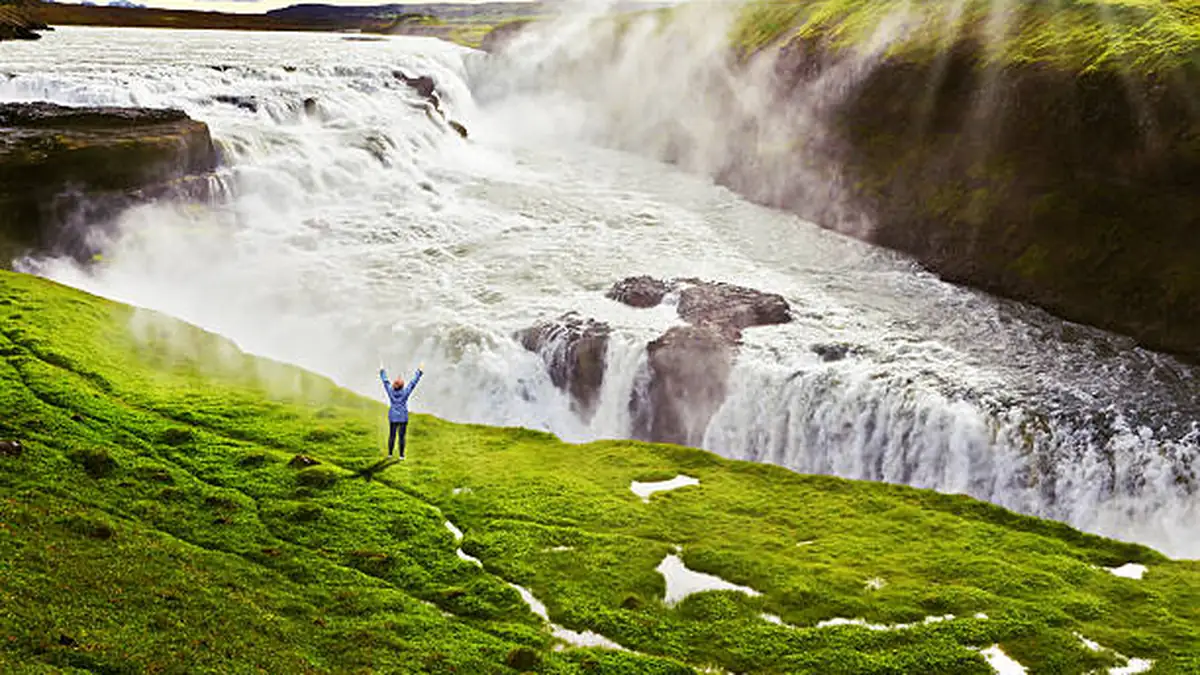
The Gullfoss waterfall hike is one of the shortest, easiest, and most rewarding walks in Iceland — you don’t need hiking boots or a training plan to stand in front of one of the most powerful sights in the country. That’s the strange thing about it: it’s short, it’s easy, and it still manages to leave people speechless.
The Gullfoss waterfall hike takes you along Iceland’s Golden Circle to a two-tier waterfall where the Hvítá River drops 32 meters into a narrow canyon. The main hike from the parking area to the viewpoints takes 10–30 minutes round trip, is rated easy, and requires no special gear in summer. It’s free to visit and open 24 hours a day, year-round.
What Is the Gullfoss Waterfall Hike and Why Everyone Stops Here
Gullfoss means “Golden Falls,” and depending on who you ask, the name comes from the golden-brown glacial sediment in the water or the golden mist that hangs over the falls when the sun hits it. Either way, it’s earned.
The Hvítá River carries meltwater down from Langjökull, Iceland’s second-largest glacier, and about a kilometer above the falls it bends sharply before tumbling down a wide, curved staircase of rock. Then it drops twice — 11 meters, then 21 meters — into a canyon roughly 70 meters deep and 2.5 kilometers long.
None of that fully prepares you for standing there. In summer, around 140 cubic meters of water crash over the edge every second — enough to fill an Olympic pool in under a minute. In winter, that drops to somewhere between 80 and 109 cubic meters per second, and parts of the falls freeze into jagged ice sculptures while the main channel keeps roaring underneath.
It’s one stop on the Golden Circle, alongside Geysir and Þingvellir National Park, and it’s usually the one people remember most.
Getting to Gullfoss (and Where to Park)
Gullfoss sits about 116 km from Reykjavík, roughly an hour and 45 minutes by car via Route 35. The road is fully paved and doesn’t require a 4×4 — a point worth repeating, since some travelers assume Iceland’s countryside always means rough roads. It doesn’t, here.
There’s no public bus route to Gullfoss. Your options are a rental car or a guided Golden Circle tour, and both are genuinely reasonable choices depending on how you like to travel. Self-driving gives you control over timing and photo stops. A tour takes the winter-driving stress off your plate entirely.
Parking is free at both the upper lot (next to the visitor center, restaurant, and gift shop) and a smaller lower lot with no facilities. Space fills up fast around midday in July and August, so if you’re driving yourself, aim for early morning or late afternoon.
The Main Hike — Upper Viewpoint to Lower Viewpoint
This is the part almost every visitor does, and it’s less a “hike” in the technical sense than a short walk with a few staircases.
From the upper parking area, a paved path leads to the first viewpoint in about 5–10 minutes. From there, stairs drop down toward the lower viewpoint, putting you close enough to feel the spray on your face — bring a rain jacket even on a clear day.
Trail distance gets reported inconsistently across guides, anywhere from roughly 1.1 miles to just over 2 miles, depending on how much of the surrounding path network you walk. The honest answer: the core viewpoint loop is closer to 1–1.5 miles round trip and takes 20–40 minutes at a relaxed pace. If you follow every branch of the trail network along the canyon rim, you can stretch that into a 4-kilometer, 1–2 hour walk.
Quick takeaway: Budget 30 minutes if you just want the main view. Budget 60–90 minutes if you want to walk the full loop, visit both viewpoints, and stop at the café.
The East Side Trail Almost Nobody Takes
Here’s the angle most guides skip entirely. Gullfoss has a second, far quieter side.
The west side — where the parking lot, visitor center, and paved paths are — handles the vast majority of visitors. The east side has no infrastructure, no signage past the trailhead, and noticeably fewer people.
Getting there means crossing a small ladder over a fence, then following an unmarked but well-worn path for about 20 minutes, often through waist-high fields of lupines in early summer. There’s no clear trail sign pointing you forward — you just follow the mist rising off the falls in the distance.
It’s not for everyone. If you want facilities, railings, and a guaranteed easy walk, stick to the west side. But if you’ve already done the standard viewpoints and want a different angle on the same waterfall — with basalt columns visible in the canyon wall and almost total quiet — the east side is worth the extra 40 minutes round trip.
How Hard Is the Gullfoss Hike, Really?
Not hard at all, in the traditional sense. AllTrails rates the main route as easy, with about 131 feet (40 meters) of elevation gain over roughly a mile — closer to a brisk walk than a hike.
There are stairs on the main path, which matters if mobility is a concern. For wheelchair users or anyone with a stroller, a gentler ramp route from the upper parking area takes about 20 minutes instead of the 10-minute stair route, and it’s a genuinely usable alternative rather than an afterthought.
Families do this walk constantly, including with young kids, though it’s worth keeping a hand on little ones near the unfenced sections close to the canyon edge.
When to Go — Season by Season
Gullfoss works in every season, but the experience shifts a lot.
Summer (June–August): Maximum water flow, green surroundings, long daylight hours, and the biggest crowds. Rainbows are common on sunny afternoons when light hits the spray.
Shoulder season (May, September): Fewer people, still-decent weather, and a good chance of catching autumn color near the falls.
Winter (October–April): This is where planning actually matters. The lower viewpoint path is frequently closed due to ice, though the upper platform stays open. Daylight is limited — sometimes just a few hours in December — so time your visit accordingly. Roads can be icy, and if you’re not confident driving in winter conditions, a guided tour is the lower-stress option.
For photography, mid-morning and late afternoon light tend to be softer and less crowded than the midday rush, in any season.
What to Wear and Bring
- Waterproof jacket and pants (the spray reaches further than you’d think, especially near the lower viewpoint)
- Sturdy, closed-toe shoes with grip
- Microspikes or crampons in winter — the paths near the falls ice over and get genuinely slippery
- A lens cloth if you’re bringing a camera; the mist finds every lens
- Layers, regardless of season — wind off the canyon cuts through anything thin
The Woman Who Refused to Let Gullfoss Be Dammed
Most visitors never hear this story, and it’s one of the more interesting things about the site.
In the early 20th century, foreign investors wanted to dam the Hvítá River for hydroelectric power, which would have altered or destroyed the falls. Sigríður Tómasdóttir, daughter of the local farmer who owned the land, fought the plan for years — reportedly threatening to throw herself into the falls rather than see them dammed, and walking barefoot to Reykjavík to press her case with lawyers.
The dam was never built. Iceland eventually took the land into state protection, and Gullfoss became one of the country’s first protected natural sites. There’s a small memorial to her near the visitor center — easy to miss, worth stopping for.
It’s a good reminder that a lot of what feels like “untouched nature” in Iceland survived because someone specifically fought for it.
Building a Day Around Gullfoss
Gullfoss rarely stands alone on an itinerary — it’s built for pairing.
The classic combination is the full Golden Circle: Þingvellir National Park (about 50 minutes away, where you can walk between tectonic plates), Geysir Geothermal Area (10 minutes from Gullfoss, home of the reliably erupting Strokkur), and Gullfoss itself.
If you want to go further off the main loop:
| Add-on | Distance from Gullfoss | Why go |
|---|---|---|
| Faxi Waterfall | ~15 min | Small, quiet, “little Gullfoss” |
| Brúarfoss | ~30 min + short hike | Famous turquoise water |
| Langjökull snowmobile tour | Departs from Gullfoss area | Ride the glacier that feeds the falls |
| Icelandic horse tölt ride | Nearby farms | Slower-paced half-day option |
| Geothermal soak | ~30 min | Relax after a day of walking |
Mistakes First-Timers Make at Gullfoss
A few patterns show up again and again:
- Rushing it. People treat Gullfoss as a 10-minute photo stop and miss the lower viewpoint entirely, which is the more dramatic vantage point.
- Skipping the rain jacket in summer. The spray is stronger and reaches further than photos suggest.
- Assuming you need hiking boots. For the main viewpoints, regular closed-toe shoes are fine most of the year — this isn’t a technical hike.
- Driving yourself in winter without checking conditions. Roads can close or ice over fast; check road.is or book a tour if unsure.
- Missing the east side entirely. Most visitors never realize there’s a quieter alternative view just 20 minutes away.
For more practical travel planning tips, check out our collection of travel guides.
FAQ Section
Do you need to hike to see Gullfoss?
No. A short paved path from the upper parking area gets you to the main viewpoint in about 5–10 minutes. Reaching the lower viewpoint or the quieter east side involves more walking, but none of it requires technical hiking experience or gear.
How long is the walk to Gullfoss?
The core walk from parking to the main viewpoints takes 20–40 minutes round trip. If you explore the full trail network along the canyon rim, plan for up to 1.5–2 hours.
Is the Gullfoss hike difficult?
No — it’s rated easy, with minimal elevation gain and a mostly paved or well-maintained path. Winter ice can make footing tricky, so microspikes are recommended between roughly October and April.
Can you visit Gullfoss without a car?
Yes, but not independently. There’s no public bus service to Gullfoss, so you’ll need a rental car or a guided Golden Circle tour departing from Reykjavík.
Is Gullfoss free to visit?
Yes. There’s no entrance fee, and parking at both the upper and lower lots is free.
Is Gullfoss open in winter?
Yes, the site is open 24/7 year-round, though the lower viewpoint path is frequently closed due to ice, and daylight hours are limited in midwinter.
How much time should I spend at Gullfoss?
Budget 30 minutes for a quick visit to the main viewpoint, or 60–90 minutes if you want to walk the full loop, visit the café, and take in both viewpoints unhurried.
Can you walk behind or very close to Gullfoss?
You can get close enough at the lower viewpoint to feel the spray, but there’s no walking-behind-the-falls path like at Seljalandsfoss on the South Coast.