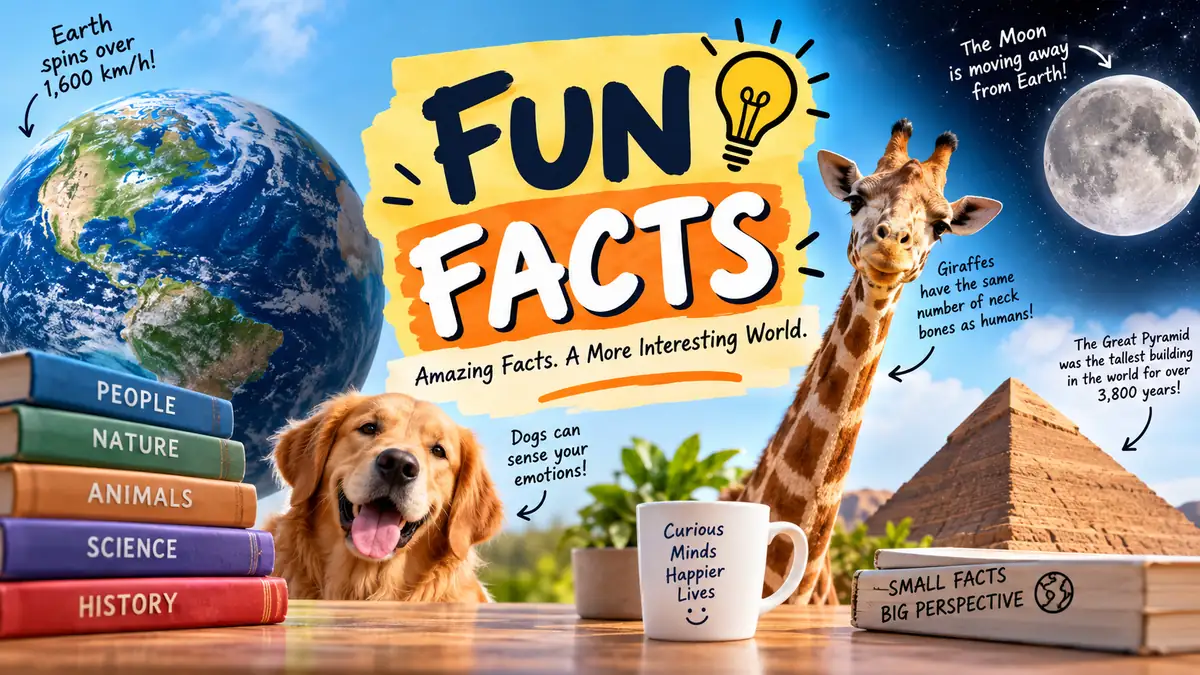
The world gets much stranger the closer you look. Octopuses have three hearts, a day on Venus lasts longer than its year, and the largest animal known to have existed is alive today.
Fun facts are short, surprising pieces of true information that reveal something unexpected about animals, science, space, history, geography, food, technology, or everyday life. The best ones are not merely strange—they are memorable, verifiable, and give you a new way to see something you thought you already understood.
Here are 100 fun facts organized by subject, with enough context to make them useful for trivia, classrooms, conversations, presentations, or simply satisfying your curiosity.
Fun Facts About Animals
The animal kingdom is a reliable source of facts that sound invented. Evolution has produced everything from three-hearted mollusks to mammals that lay eggs.
1. Octopuses have three hearts
An octopus has three hearts. Two branchial hearts move blood through the gills, while the systemic heart pumps oxygenated blood through the rest of its body.
Even stranger, an octopus’s blood is blue because its oxygen-carrying protein, hemocyanin, contains copper rather than the iron found in human hemoglobin.
2. Wombats produce cube-shaped poop
Wombats are famous for producing unusually cube-shaped feces. Researchers studying their digestive systems found that differences in the elasticity and contraction of the intestine help form the distinctive shape.
The cubes are useful because they are less likely to roll away when wombats use droppings to mark territory.
3. Platypuses lay eggs
The platypus is a mammal, but females lay eggs instead of giving birth to live young.
Platypuses are monotremes, an unusual group of egg-laying mammals that also includes echidnas.
4. Platypuses do not have nipples
A mother platypus produces milk, but she does not have nipples. Milk is secreted through specialized mammary openings in her skin, where the young can lap it up.
5. A group of flamingos can be called a flamboyance
“Flamboyance” is one of the collective nouns used for a group of flamingos—an unusually fitting name for birds famous for their vivid pink plumage.
6. Octopus arms can process information locally
An octopus has a highly distributed nervous system. A large proportion of its neurons are located in its arms rather than only in its central brain.
That arrangement helps the arms perform complex sensory and movement tasks.
7. Camels do not store water in their humps
A camel’s hump primarily stores fat, not water.
Camels have several physiological adaptations that help them cope with dehydration and desert heat. They can also drink very large quantities of water rapidly when it becomes available.
8. Blue whales are the largest known animals
The blue whale is the largest animal known to have lived on Earth, exceeding even the largest known dinosaurs in body mass.
Adults can grow to around 30 meters long, although size varies among individuals and populations.
9. Some sharks are older as a lineage than trees
Shark ancestors appeared hundreds of millions of years ago. Recognizable early sharks existed before the first trees evolved.
That makes the evolutionary history of sharks far older than many familiar features of modern forests.
10. Some salamanders launch their tongues extremely quickly
Certain salamanders capture prey using remarkably fast projectile tongues.
Research on species such as Bolitoglossa dofleini has documented tongue movements occurring within milliseconds.
11. Dolphins use distinctive signature whistles
Bottlenose dolphins develop individually distinctive whistles. Research suggests these “signature whistles” can function somewhat like individual identifiers during communication.
12. Male seahorses carry developing young
In seahorses, the female deposits eggs into a specialized brood pouch on the male.
The male fertilizes and carries the embryos before contractions eventually release the young.
13. A snail has thousands of microscopic teeth
Many snails feed using a ribbon-like structure called a radula.
Instead of teeth arranged like ours, the radula can carry rows containing hundreds or thousands of tiny tooth-like structures used to scrape food.
14. A giraffe’s tongue can be exceptionally long
Giraffe tongues can reach roughly 45–50 centimeters in length, helping the animals pull leaves from branches.
Their tongues are also remarkably tough, an advantage when feeding among thorny acacia branches.
15. Crows can solve surprisingly complex problems
Crows and other corvids demonstrate sophisticated cognition.
Experiments have shown abilities involving tool use, memory, causal reasoning, and multi-stage problem solving, making corvid intelligence an important field of animal cognition research.
Quick Takeaway: Many of the best animal fun facts are really examples of evolution solving familiar problems—finding food, surviving extreme environments, reproducing, and communicating—in unfamiliar ways.
Fun Facts About Space and the Universe
Space produces some of the most mind-bending fun facts because everyday intuition stops working when distances, temperatures, gravity, and time become astronomical.
16. A day on Venus is longer than its year
Venus rotates extremely slowly.
One complete rotation relative to distant stars takes about 243 Earth days, while Venus completes an orbit around the Sun in roughly 225 Earth days.
That means its sidereal day is longer than its year.
17. Venus rotates backward compared with most planets
Most planets rotate in the same general direction.
Venus has retrograde rotation, meaning it spins in the opposite direction from most planets in the Solar System.
18. The Moon has much weaker gravity than Earth
Surface gravity on the Moon is approximately one-sixth of Earth’s.
A person’s mass would remain unchanged on the Moon, but their weight would be about one-sixth of their Earth weight.
19. The Sun contains almost all the Solar System’s mass
The Sun contains roughly 99.8% of the mass of the Solar System.
That enormous concentration of mass explains why the Sun’s gravity dominates the orbits of the planets.
20. Sunlight takes about eight minutes to reach Earth
Light travels at approximately 299,792 kilometers per second in a vacuum.
Even at that extraordinary speed, sunlight needs roughly eight minutes and 20 seconds to travel the average distance between the Sun and Earth.
So you never see the Sun exactly as it is “right now.”
21. Footprints can last an extremely long time on the Moon
The Moon has no weather system comparable to Earth’s—no rain or flowing surface water to quickly erase tracks.
Astronaut footprints can therefore persist for extraordinarily long periods, although micrometeorite impacts and other space-weathering processes gradually disturb the surface.
22. Mars has the largest volcano in the Solar System
Olympus Mons on Mars is an enormous shield volcano roughly 22 kilometers high depending on the reference level used.
Its footprint is hundreds of kilometers across.
23. Saturn would be less dense than water
Saturn’s average density is lower than that of liquid water.
The popular statement that Saturn would “float” is therefore based on density, although there is obviously no practical ocean remotely large enough to perform the experiment.
24. Space is not completely empty
Even the vast regions between stars contain particles, electromagnetic radiation, magnetic fields, and other forms of matter and energy.
“Vacuum” in astronomy does not mean absolutely nothing exists there.
25. Nothing inside a black hole’s event horizon can escape outward
An event horizon marks the boundary beyond which signals cannot escape to a distant observer.
Even light cannot travel outward across that boundary, which is why black holes appear black.
26. The International Space Station experiences many sunrises
Because the International Space Station circles Earth roughly every 90 minutes, its crew can experience around 16 sunrises and sunsets during a 24-hour period.
27. Earth is about 4.54 billion years old
Scientists estimate Earth’s age at approximately 4.54 billion years using radiometric dating of meteorites and ancient terrestrial and lunar materials.
28. The observable universe contains an enormous number of galaxies
Modern observations show that the observable universe contains vast numbers of galaxies, each potentially containing millions, billions, or even trillions of stars.
The exact total depends on how galaxies are defined and on observational limits.
29. Neutron stars pack extraordinary mass into a small space
A neutron star can contain more mass than the Sun while measuring only around the size of a city.
This makes neutron-star matter extraordinarily dense.
30. There is no sound in a perfect vacuum
Sound is a mechanical wave and needs a medium—such as air, water, or solid material—to propagate.
Because ordinary sound cannot travel through a vacuum, the dramatic explosions heard in many space movies are artistic additions.
Science Fun Facts That Sound Impossible
Science often becomes most interesting when ordinary objects behave in unexpected ways.
31. A typical cloud can weigh hundreds of tonnes
Clouds look nearly weightless, but the tiny water droplets spread throughout a large cloud add up.
A roughly cubic-kilometer cumulus cloud can contain hundreds of tonnes of water, with some estimates approaching a million tonnes depending on its water content and dimensions.
32. Water can boil and freeze under special conditions
At water’s triple point, solid ice, liquid water, and water vapor can coexist in thermodynamic equilibrium.
It occurs only at a specific combination of temperature and pressure.
33. Lightning can heat air to temperatures hotter than the Sun’s surface
The channel produced by a lightning discharge can briefly heat surrounding air to temperatures of tens of thousands of degrees Celsius.
That is hotter than the visible surface, or photosphere, of the Sun.
34. Hot water can sometimes freeze faster than colder water
Under certain experimental conditions, initially hotter water has been observed freezing faster than initially colder water.
This phenomenon is known as the Mpemba effect, but it does not happen under every set of conditions.
35. Glass is an amorphous solid
A persistent myth says old windows are thicker at the bottom because glass slowly flows like a liquid.
Ordinary window glass is an amorphous solid. Uneven thickness in old panes is primarily a consequence of historical manufacturing methods.
36. Diamond and graphite are made from the same element
Both diamond and graphite consist primarily of carbon.
Their dramatically different properties come from how their carbon atoms are bonded and arranged.
37. Sound travels faster in water than in air
Particles are arranged differently in liquids than in gases, allowing pressure disturbances to propagate faster through water.
Sound travels even faster through many solids.
38. Helium can make balloons rise because it is less dense than air
A helium-filled balloon experiences an upward buoyant force from the surrounding air.
If that buoyant force exceeds the total weight of the balloon and helium, the balloon rises.
39. The Eiffel Tower can change height with temperature
Metal expands when heated and contracts when cooled.
Because the Eiffel Tower is made primarily of iron, thermal expansion can make its height vary by several centimeters as temperatures change.
40. Absolute zero is the theoretical lower limit of temperature
Absolute zero is defined as 0 kelvin, equivalent to −273.15°C.
It represents the lower limit of the thermodynamic temperature scale.
Fun Facts About the Human Body
Your body performs thousands of processes without conscious instruction. Some familiar body facts also come with myths worth correcting.
41. Most adults have 206 bones
The commonly cited adult human skeleton contains 206 bones.
Babies begin life with more separate skeletal elements because several bones fuse during growth.
42. The smallest bone is in your ear
The stapes, one of three tiny middle-ear bones, is generally regarded as the smallest bone in the human body.
It helps transmit vibrations involved in hearing.
43. The femur is the body’s longest bone
The femur runs from the hip to the knee and is both the longest and one of the strongest bones in the human skeleton.
44. Skin is the body’s largest organ
Skin forms the body’s external protective covering.
It helps regulate temperature, provides sensation, limits water loss, and serves as an important barrier against the outside environment.
45. Your heart beats around 100,000 times a day
At an average resting rate near 70 beats per minute, the human heart beats roughly 100,000 times over 24 hours.
The actual number varies substantially with age, fitness, activity, health, and heart rate.
46. Humans continuously shed skin cells
Cells in the outer layers of your skin are constantly being lost and replaced.
Much of this happens without you noticing it.
47. Saliva plays an essential role in taste
Food molecules generally need to dissolve in saliva before they can effectively interact with taste receptors.
That is one reason a very dry mouth can make foods seem less flavorful.
48. Your body contains trillions of human cells
Modern estimates put the number of cells in a typical adult human body in the tens of trillions.
There is no universal exact number because body size, age, sex, tissue composition, and counting methods differ.
49. Humans blink thousands of times per day
Blinking spreads tears across the eye, clears small particles, and helps protect the cornea.
Blink frequency varies according to activity and environment.
50. Your brain itself lacks ordinary pain receptors
Brain tissue itself does not contain nociceptors in the way skin does.
Pain associated with headaches can arise from surrounding structures, including blood vessels, muscles, nerves, and membranes.
51. Goosebumps are an evolutionary leftover
Tiny muscles attached to hair follicles contract when you are cold or experience certain emotions.
For furry mammals, raising the hair can improve insulation or make the animal appear larger. The effect is much less useful on relatively hairless human skin.
52. Fingerprints form before birth
The ridge patterns on fingers develop during fetal growth.
Genes influence their formation, but local developmental conditions help make the fine details distinctive.
53. Humans have more than five senses
The familiar five—sight, hearing, smell, taste, and touch—are useful categories, but the nervous system also detects balance, temperature, pain, body position, and internal physiological conditions.
54. The human body contains enough blood vessels to stretch enormous distances
If the blood vessels of an adult were placed end to end, estimates commonly put their total length at tens of thousands of miles.
The precise figure varies because microscopic vessels are extremely numerous and difficult to measure directly.
55. Your skeleton is living tissue
Bones are not inert supports.
They contain living cells, undergo continuous remodeling, store minerals, and house marrow involved in producing blood cells.
Quick Takeaway: Human-body trivia is especially vulnerable to exaggerated internet claims. Treat suspiciously precise numbers—such as exact daily cell counts or universal heartbeats—as estimates rather than fixed values.
Fun Facts About Earth and Geography
Earth contains deserts buried under ice, moving continents, enormous oceans, and geographical quirks that make flat maps surprisingly misleading.
56. Antarctica is the world’s largest desert
A desert is defined primarily by low precipitation, not high temperature.
Antarctica receives very little precipitation across much of its surface, making it the largest desert on Earth.
57. Antarctica contains most of Earth’s freshwater ice
The Antarctic ice sheet stores the majority of Earth’s freshwater ice.
If that ice were lost, global sea level would rise dramatically.
58. The Pacific Ocean is Earth’s largest ocean
The Pacific covers more area than any other ocean basin.
It is also home to the Mariana Trench, including Challenger Deep, the deepest known region of the global ocean.
59. The average ocean depth is several kilometers
Earth’s oceans average roughly 3.7 kilometers deep, though depths vary enormously.
The deepest trenches extend to nearly 11 kilometers below sea level.
60. Mount Everest is not the point farthest from Earth’s center
Everest has the greatest elevation above mean sea level.
However, because Earth bulges around the equator, the summit of Ecuador’s Chimborazo lies farther from Earth’s center.
61. Continents are still moving
Earth’s tectonic plates move at rates typically measured in centimeters per year.
That sounds slow, but over millions of years it completely rearranges oceans and continents.
62. Africa looks smaller on many familiar maps than it really is
The widely used Mercator projection enlarges regions increasingly toward the poles.
As a result, equatorial Africa can appear much smaller relative to high-latitude regions than its true area would suggest.
63. Russia spans 11 time zones
Russia stretches across an enormous east-west distance and officially uses 11 time zones.
Few countries demonstrate Earth’s geographical scale so clearly.
64. Canada has an extraordinarily long coastline
Canada has the longest national coastline in the world when its mainland and numerous islands are counted.
Exact coastline measurements vary depending on measurement scale, a phenomenon called the coastline paradox.
65. Earth’s surface is mostly water
Approximately 71% of Earth’s surface is covered by water.
Oceans contain the overwhelming majority of that water.
Weird History Fun Facts
History becomes easier to remember when it includes details that do not sound like textbook material.
66. The Anglo-Zanzibar War lasted less than an hour
The Anglo-Zanzibar War of 1896 is commonly described as the shortest recorded war.
Accounts differ slightly on the precise duration, but fighting lasted less than an hour.
67. Cleopatra lived closer to the Moon landing than to the construction of the Great Pyramid
The Great Pyramid of Giza was completed around the 26th century BCE.
Cleopatra VII lived in the first century BCE, meaning more time separated her from the pyramid’s construction than separates her from the 1969 Apollo 11 Moon landing.
68. Oxford University predates the Aztec Empire
Teaching existed at Oxford by the late 11th century.
The Aztec Empire emerged centuries later, in the 15th century.
69. Woolly mammoths survived after the Great Pyramid was built
Small populations of woolly mammoths survived on isolated islands long after most mammoths disappeared from continental regions.
Mammoths on Wrangel Island survived until roughly 4,000 years ago—after Egypt’s Great Pyramid had already been built.
70. Ancient Romans used public toilets
Roman settlements included sophisticated water and sanitation infrastructure in many locations.
Archaeological evidence from Pompeii also reveals toilets and plumbing arrangements in multi-story buildings.
71. Toilet paper is relatively recent
Humans have used many materials for personal hygiene across history.
Mass-produced modern toilet paper is a comparatively recent development; earlier cultures used materials ranging from water and cloth to purpose-built implements.
72. The ancient Olympic Games differed greatly from today’s Olympics
The ancient Greek Olympic festival included fewer sports and operated within a very different cultural and religious context from the modern Olympic Games.
The modern international Olympics began in 1896.
73. The fax machine concept predates the telephone
Scottish inventor Alexander Bain patented an early facsimile-related device in 1843.
Alexander Graham Bell received his famous U.S. telephone patent decades later, in 1876.
74. The first photographs required extremely long exposures
Early photographic techniques needed much more light exposure than modern cameras.
Some of the earliest surviving photographs required exposures lasting many minutes or even hours.
75. Humans landed on the Moon before inventing the modern World Wide Web
Apollo 11 landed on the Moon in July 1969.
Tim Berners-Lee proposed the system that became the World Wide Web in 1989, two decades later.
Fun Facts About Food
Everyday foods hide chemistry, botany, and history that can be surprisingly counterintuitive.
76. Bananas are botanically berries
In botanical terminology, bananas qualify as berries because of the way their fruits develop.
Everyday culinary categories and scientific botanical categories often use the same words differently.
77. Strawberries are not true botanical berries
A strawberry is an aggregate accessory fruit.
The small seed-like structures visible on its surface are actually individual fruits called achenes.
78. Peanuts are legumes
Despite their name, peanuts are not true nuts botanically.
They belong to the legume family alongside foods such as peas, beans, and lentils.
79. Tomatoes are fruits botanically
A tomato develops from the flower’s ovary and contains seeds, so botanically it is a fruit.
In cooking, however, tomatoes are commonly treated as vegetables.
80. Chocolate comes from cacao seeds
Chocolate begins with seeds from the fruit of the cacao tree, Theobroma cacao.
Fermentation, drying, roasting, grinding, and further processing transform cacao seeds into the ingredients used for chocolate.
81. Honey can remain edible for a remarkably long time
Honey’s low water activity, acidity, and chemical properties make it difficult for many microorganisms to grow.
Properly stored honey can remain stable for very long periods, although it may crystallize or change in appearance.
82. Popcorn pops because of water trapped inside the kernel
A popcorn kernel contains a small amount of moisture.
Heating converts that water to vapor, pressure builds inside the hard outer hull, and eventually the kernel ruptures and expands.
83. Carrots were not always predominantly orange
Cultivated carrots have appeared in several colors, including purple, yellow, white, red, and orange.
Selective breeding helped orange varieties become especially widespread.
84. Apples float because they contain plenty of air
An apple’s internal structure contains numerous air spaces.
Its overall density is therefore low enough for most apples to float in water.
85. Chili peppers feel hot because of capsaicin
Capsaicin activates receptors involved in detecting heat and pain.
Your mouth is not literally being heated to a dangerous temperature—the compound is stimulating sensory pathways associated with heat.
Random Fun Facts About Technology and Everyday Life
Technology changes so quickly that objects considered ordinary today would have seemed extraordinary only a few generations ago.
86. The first computer “bug” was literally associated with a moth
In 1947, operators working with the Harvard Mark II found a moth trapped in a relay and taped it into their logbook.
The word bug for a technical defect existed earlier, so the moth did not originate the term, but it became a famous episode in computing history.
87. The World Wide Web and the internet are not the same thing
The internet is the global network infrastructure connecting computers and networks.
The World Wide Web is a system of linked documents and resources accessed over that infrastructure using technologies such as HTTP and URLs.
88. The first web page is still historically important
Tim Berners-Lee created the first website at CERN while developing the World Wide Web.
It explained the Web project itself and provided information about using the system.
89. Email is older than the World Wide Web
Networked electronic messaging existed well before the Web.
Ray Tomlinson is widely credited with implementing network email using the @ symbol for addressing in the early 1970s.
90. GPS depends on relativity
Satellites and receivers experience differences in gravitational conditions and motion.
Corrections predicted by Einstein’s special and general theories of relativity are necessary for GPS to maintain high positional accuracy.
91. QR codes were invented for manufacturing
The QR code was developed by Denso Wave in Japan during the 1990s.
It was initially designed to improve tracking of automotive components before spreading into consumer applications.
92. Bluetooth is named after a king
Bluetooth technology was named after Harald “Bluetooth” Gormsson, a 10th-century Scandinavian king associated with unifying parts of Denmark and Norway.
The name reflected the idea of bringing different communication technologies together.
93. The QWERTY keyboard layout is more than a century old
The familiar QWERTY arrangement emerged during the era of mechanical typewriters.
Despite enormous changes in writing technology, the layout remains dominant in many English-language markets.
94. Modern smartphones contain several types of sensors
A typical smartphone may include accelerometers, gyroscopes, magnetometers, proximity sensors, ambient-light sensors, microphones, cameras, satellite-navigation receivers, and biometric sensors.
That makes a phone much more than a miniature computer with a touchscreen.
95. Digital information ultimately depends on physical systems
Although files can seem intangible, every stored bit has a physical representation somewhere—such as electrical charge, magnetic orientation, or a state in flash memory.
“The cloud” ultimately means computers and storage hardware operating in physical data centers.
Fun Facts About Words, Numbers, and Everyday Life
Some of the best trivia requires no exotic animal or distant galaxy. Language, mathematics, and ordinary objects contain plenty of surprises.
96. Zero was a major mathematical innovation
Humans counted long before modern zero notation existed.
The development of zero as both a placeholder and a number was a crucial step in the history of mathematics, with major contributions arising from ancient Indian mathematics.
97. There are infinitely many prime numbers
Euclid demonstrated more than two thousand years ago that no finite list can contain every prime number.
No matter how many primes you find, there will always be more.
98. A shuffled deck can produce an astonishing number of arrangements
A standard 52-card deck can be arranged in 52 factorial, or 52!, different orders.
That is approximately (8.07 \times 10^{67}) possible arrangements—so many that a thoroughly shuffled deck may easily produce an ordering that has never occurred before.
99. The ampersand was once taught alongside the alphabet
The symbol &, called an ampersand, has a long history connected to a ligature of the Latin word et, meaning “and.”
Historical alphabet recitations sometimes included the symbol after Z, though calling it a literal 27th letter oversimplifies that history.
100. “Fun facts” are most useful when they are checked
A surprising claim is easy to remember—which is exactly why false trivia spreads so effectively.
Reliable fun facts should survive a basic test: Is the claim specific? Can it be verified? Is important context missing? Current fact collections increasingly emphasize verification because popular trivia lists often repeat myths without checking original evidence.
How to Tell Whether Fun Facts Are Actually True
A statement sounding scientific does not make it accurate. Many viral “facts” begin with something true and become exaggerated through repetition.
For example, saying humans “only use 10% of their brains” is a myth. Saying the Great Wall of China is plainly visible from the Moon with the naked eye is also misleading. Claims about animals sleeping for exact numbers of years, precise numbers of smells humans can detect, or universal behaviors across an entire species often need context.
When checking random facts, use a simple process:
- Look for the original source. Prefer scientific papers, universities, museums, government agencies, respected reference works, or established scientific organizations.
- Check what the number measures. “Largest,” “oldest,” “fastest,” and “deepest” can change depending on definitions.
- Watch for absolute language. Words such as “always,” “never,” and “every” should make you check more carefully.
- Check the date. Records and scientific estimates can change as new evidence appears.
- Separate a useful simplification from literal truth. A statement may work as trivia while needing extra context to be scientifically precise.
This matters because popular collections now span hundreds or even thousands of facts covering animals, science, history, space, geography, food, technology, and the human body.
Why Are Fun Facts So Easy to Remember?
Surprise is a powerful attention grabber.
A fact such as “Venus has a day longer than its year” creates a small conflict with what you expect. You already understand days and years, but the relationship between them suddenly behaves differently.
Good trivia also tends to have three qualities: it is short, concrete, and easy to visualize.
Compare these statements:
“Octopus cardiovascular anatomy differs from that of humans.”
“An octopus has three hearts.”
The second version gives your brain an immediate mental picture. You can remember it, explain it, and connect it to knowledge you already have.
Context makes the information even stronger. Knowing that two octopus hearts serve the gills while another supplies the body turns a novelty into something you actually understand.
What Makes a Good Fun Fact?
The best fun facts do more than make someone say, “Really?”
They reveal something meaningful.
A blue whale being huge is interesting. Learning that the largest known animal in Earth’s history still lives in our oceans changes your sense of scale. Knowing that Cleopatra lived closer to the Moon landing than to the construction of the Great Pyramid changes your perception of historical time.
That’s why useful trivia usually combines surprise with context.
When you find a fact worth sharing, learn the sentence behind the sentence: why does it happen, how do we know, and is there an exception?
That approach turns random trivia into real knowledge.
Final Thoughts on Fun Facts
These fun facts reveal just how strange ordinary reality can be. Animals evolved remarkable adaptations, the human body constantly rebuilds itself, planets behave in ways that challenge everyday intuition, and events we mentally group together as “ancient history” can actually be separated by thousands of years.
Pick a few favorites and follow the questions they create. The octopus’s three hearts can lead into evolutionary biology. Venus’s slow rotation opens the door to planetary science. Cleopatra and the Great Pyramid can completely reshape your understanding of historical timelines.
A good fun fact gives you something interesting to remember. A great one makes you curious enough to learn what comes next.