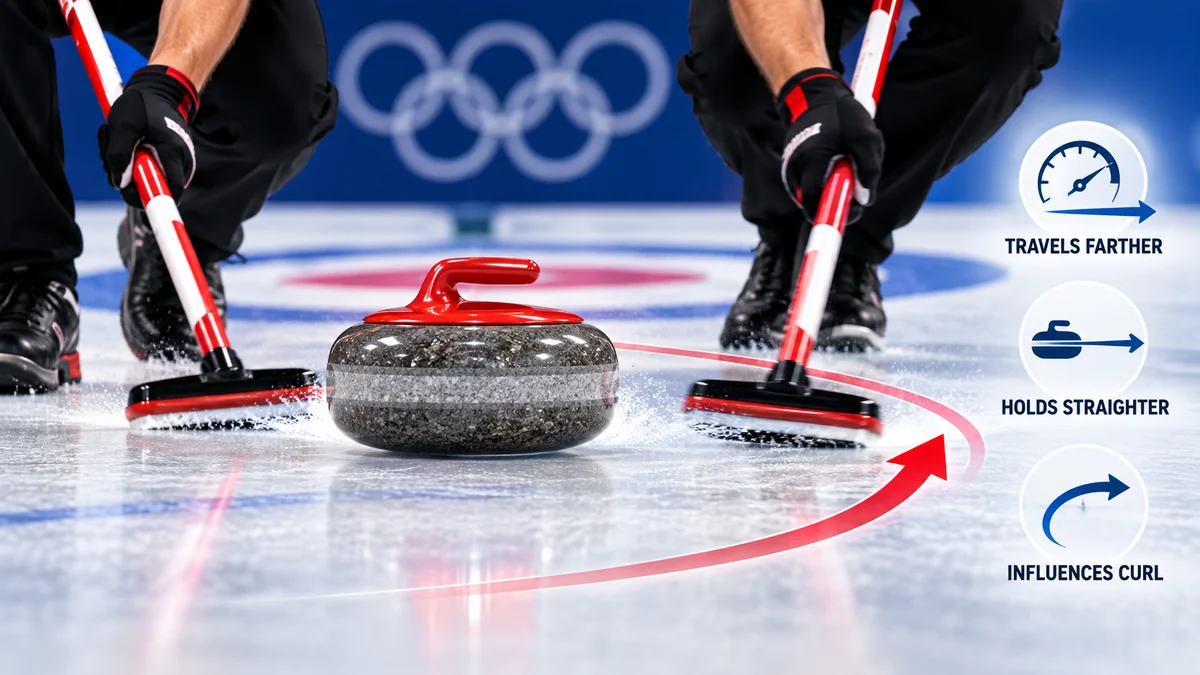
One of the strangest sights in Olympic curling is also one of the sport’s most important skills: two athletes vigorously brushing the ice while a granite stone slides toward the house. The sweeping may look like simple cleaning, but it can meaningfully influence how far and how straight the stone travels.
In brushes affect on stone’s path in olympic curling, sweeping changes the stone’s movement primarily by modifying friction between the stone and the pebbled ice. Vigorous brushing warms the ice surface, temporarily reducing friction. This helps the stone travel farther and generally straighter, while skilled sweepers use timing, pressure, speed, and technique to influence its final trajectory. DOI
How brushes affect on stone’s path in olympic curling
Curling is unusual because athletes can influence a projectile even after it has been released.
Once the thrower lets go of the stone, the sweepers watch its speed and line. Depending on the shot, they may sweep aggressively, sweep lightly, or stop sweeping entirely.
According to World Curling’s current Sweeping Technique Policy, acceptable sweeping effects include making a stone travel farther, holding it straighter, and allowing some enhancement of its curling trajectory. Techniques intentionally designed to create unacceptable effects, including increasing a stone’s rate of deceleration, are prohibited. World Curling Federation
In practical terms, brushing can affect three major aspects of a shot:
| Effect | What sweeping can do |
|---|---|
| Distance | Helps the stone travel farther |
| Curl | Can help hold the stone straighter |
| Trajectory | Allows players to influence the stone’s path |
| Friction | Temporarily reduces resistance between stone and ice |
| Shot control | Gives the team additional control after release |
This ability is a major reason sweeping is so important in competitive curling.
Why curling ice is different from ordinary ice
To understand sweeping, first look at the surface beneath the stone.
A curling sheet is not perfectly smooth like the surface people may imagine when thinking about ice skating. Before play, small droplets of water are applied to the sheet and freeze into tiny raised bumps called pebbles.
The curling stone moves across these pebbles.
The stone itself also has a specialized bottom. Rather than its entire base touching the ice, contact occurs around a narrow circular area known as the running band. Research into curling-stone mechanics shows that the interaction between this running band and the ice pebbles is central to the stone’s motion and curl. J-STAGE
That limited contact creates a sensitive frictional system. Small changes to the ice can therefore affect how the rock travels.
Why is curling ice pebbled?
Pebbling allows a curling stone to glide efficiently while still developing the characteristic curved trajectory that gives the sport its name.
Without properly prepared ice, the frictional behavior would be very different.
Ice technicians consequently play an important role in elite curling. Pebble size, ice temperature, wear and other surface conditions can influence how quickly the sheet plays and how much stones curl.
Sweeping changes friction
The central physics behind sweeping is friction.
When a curling brush moves rapidly across the ice, friction between the brush head and surface generates heat. Scientific experiments involving Olympic-level curlers have demonstrated that vigorous sweeping raises the surface temperature of the ice and reduces its coefficient of friction. DOI
Researchers have also found that the temperature change depends on factors including:
- sweeping velocity;
- downward force;
- sweeping pattern.
The lower-friction surface allows the stone to maintain more of its motion.
This distinction matters because sweepers are not adding propulsion directly to the stone. They are not pushing it forward with the brush. Instead, they modify the surface over which it is about to travel.
Does sweeping make a curling stone faster?
Not in the same sense as applying an additional forward force.
Once released, the stone gradually loses speed. Sweeping reduces the friction acting against its movement, so it loses speed more slowly and consequently travels farther than it otherwise would.
To a television viewer, that can look as though the rock has accelerated. In reality, sweeping primarily changes its rate of deceleration.
How sweeping makes a stone travel farther
Distance control is one of sweeping’s clearest effects.
Imagine a throw that has the correct line but is slightly too slow. Without intervention, it might stop several feet short of its intended location.
Aggressive sweeping can reduce the resistance encountered by the stone and help it continue toward the target.
A 2006 study of frictional heat in curling specifically examined this effect and found that sweeping increases ice-surface temperature and lowers friction, helping stones slide farther. DOI
At Olympic level, this gives teams another layer of shot control.
The thrower determines the initial speed, rotation and direction, but the sweepers continue evaluating the rock as it moves.
They may receive instructions to sweep intensely when the stone appears light, then immediately stop when its weight looks correct.
How brushes affect the curl of the stone
Distance is only part of the story.
A curling stone is deliberately released with a relatively small amount of rotation. As it moves down the sheet, interaction between its running band and the pebbled surface produces the characteristic sideways movement called curl.
Sweeping can influence that behavior.
Reducing friction can help a stone remain straighter for longer. Smithsonian’s explanation of curling physics notes that sweeping reduces friction and helps stones travel farther and straighter. Smithsonian Magazine
This is particularly important late in a shot.
Curling stones often show increasingly noticeable lateral movement as they slow. Strategic sweeping can therefore help hold a desired line when the team does not want the rock to curl too early.
Can brushing actually change the stone’s direction?
Yes, although the mechanics are more complicated than simply “brushing it left” or “brushing it right.”
Modern research continues to investigate how different sweeping techniques influence curl. A 2024 study examining sweeping effects found measurable trajectory-control effects from half-side sweeping, although the researchers cautioned that the magnitude may be smaller than players expect. Springer
So the safest way to understand Olympic sweeping is this: sweeping clearly affects friction and distance, can help hold a stone straighter, and sophisticated techniques may also influence its curling trajectory.
The exact physics of curling remains an active research subject.
What makes Olympic sweeping effective?
Watching elite curlers reveals that sweeping is much more than rapidly moving a brush.
Several variables matter simultaneously.
Brush speed
Fast brush movement generates frictional heat at the ice surface. Research has connected sweeping velocity with changes in surface temperature. DOI
Downward pressure
Sweepers press the brush against the ice rather than lightly passing it across the surface.
Greater effective force, combined with appropriate brush speed, can increase the sweeping effect.
Timing
Even powerful sweeping is useless if applied at the wrong moment.
Sweepers must constantly judge the rock’s speed and anticipated stopping point. They need to know when additional distance is necessary and when continuing to sweep could carry the rock beyond its intended position.
Communication
Curling is highly coordinated.
The player directing the shot evaluates its line, while sweepers judge speed and respond to commands. Their decisions can change within seconds as the rock moves down the sheet.
Ice conditions
No two sheets behave exactly alike.
Pebble condition, temperature, wear and previous stones can change how the surface behaves. Elite players therefore spend considerable effort learning the ice during a game.
Quick Takeaway: Powerful sweeping alone does not produce an accurate curling shot. Effective sweeping combines speed, pressure, timing, communication and a precise reading of the ice.
Why the stone curls in the first place
The question of sweeping naturally leads to another: why doesn’t the rock simply travel straight?
A curling stone is given a gentle clockwise or counterclockwise rotation at release.
Its bottom is concave, meaning only the narrow running band interacts directly with the pebbles. As the rotating stone travels, complex frictional interactions between this running band and the ice cause its trajectory to curve.
Scientists have proposed and tested several explanations for the precise curl mechanism, and research continues to refine the physics. What is well established is that the stone-ice interface, running band, pebbles, rotation and friction all matter. J-STAGE
A typical competitive shot makes relatively few complete rotations during its journey. The goal is not to spin the rock rapidly but to give it controlled rotation so its movement remains predictable.
Sweeping then gives the team a way to influence that already developing trajectory.
The role of heat and the thin surface layer
A common simplified explanation says that brushes “melt the ice.”
There is truth behind that description, but the physics deserves more precision.
Sweeping generates frictional heat and raises the temperature of the ice surface. This changes conditions at the interface between the running band and the pebbles and lowers friction. Experimental work has directly measured the temperature-changing effect of vigorous sweeping. DOI
A very thin liquid or quasi-liquid layer at the stone-ice interface has also been discussed in scientific explanations of curling friction. This lubricating effect helps explain why warmer surface conditions can let the rock slide farther. Scientific American
The effect is temporary.
Curlers are therefore modifying the surface immediately before the moving rock reaches it, rather than permanently changing a large section of the sheet.
Sweeping also removes debris
Heating the surface is not the only useful function of the brush.
Sweeping can clear small pieces of frost or debris from the stone’s path.
That matters because a curling stone depends on a narrow running band. A small contaminant encountered by that contact surface can potentially affect the shot.
Research reviews have identified both warming the ice and clearing or smoothing its surface as mechanisms associated with sweeping, although under frost-free conditions the temperature-related reduction in friction is considered particularly important. PubMed Central (PMC)
So when athletes brush furiously ahead of the rock, they are simultaneously maintaining a clean path and manipulating friction.
Why Olympic curling regulates brushes and sweeping
If sweeping can alter a stone’s trajectory, equipment becomes a competitive issue.
A brush that changes the ice too aggressively could give players excessive control after release.
World Curling therefore regulates elite competition brushes. Brush specifications were introduced in 2016, and equipment requirements have continued to evolve. World Curling Federation
Ahead of the 2025–2026 Olympic season, World Curling updated sweeping-equipment compliance regulations after concerns about the effectiveness of several brush-head constructions. Certain configurations remained approved while others were removed from approved competition use. World Curling Federation
The governing body’s 2026 Sweeping Technique Policy also defines acceptable and prohibited sweeping effects. World Curling says permitted sweeping should allow players to make a stone travel farther, hold it straighter and achieve some enhancement of the curling trajectory. World Curling Federation
These restrictions preserve an important balance.
Sweeping should reward athleticism, judgment and teamwork without giving equipment or unusual techniques so much influence that the throw itself becomes secondary.
What happens when sweepers stop brushing?
Stopping is just as important as starting.
Once sweeping stops, the stone encounters ice that has not received the same immediate sweeping treatment. Friction then plays its normal role in slowing the rock.
As speed decreases, curl can become more noticeable.
That is why Olympic teams may switch rapidly between sweeping and stopping during the final portion of a shot. They are trying to balance two variables at once: weight, meaning how far the rock travels, and line, meaning where it travels.
Consider a stone approaching the house.
If it appears likely to stop short, the team may call for vigorous sweeping.
If its distance looks correct but it threatens to curl too much, sweeping may be used to help hold the line.
If it is already traveling too far, the team cannot simply brush it backward or physically brake it under normal permitted sweeping. Instead, they generally stop sweeping and let friction act.
Current World Curling policy specifically prohibits sweeping techniques intended to increase a stone’s rate of deceleration. World Curling Federation
The strategy behind Olympic sweeping
The physics explains how sweeping works. Strategy explains why it matters so much.
Curling shots often need extraordinary precision.
A rock may need to stop behind a guard, pass narrowly between other stones, reach the button, or strike another rock at a particular angle.
The thrower cannot perfectly predict every tiny variation in ice and speed at release.
Sweepers provide a limited form of real-time correction.
For example, a team attempting a draw might initially leave the stone alone because its speed appears correct. Halfway down the sheet, the sweepers determine it is beginning to lose too much momentum. They sweep hard to preserve distance. Near the house, they stop when the rock reaches the desired weight.
On another shot, the weight might be excellent but the rock begins curling earlier than expected. The team can sweep to help keep it straighter.
This interaction between delivery and sweeping is why curling requires such precise communication.
Sweeping does not replace a good delivery
The control provided by brushing has limits.
Sweepers cannot completely rescue a badly thrown stone.
A rock released with far too much speed may still travel through the house. One thrown dramatically off line cannot simply be steered around the sheet like a remote-controlled vehicle.
The initial delivery establishes the fundamental conditions of the shot:
speed + direction + rotation
Sweeping then works within those conditions by influencing the stone-ice interaction.
That distinction is essential for understanding Olympic curling. The brush is a control tool, not a steering wheel.
Why brushing is so physically demanding
Olympic sweepers make the movement look simple, but effective sweeping requires substantial physical effort.
Athletes must move quickly alongside a sliding rock while repeatedly applying force through the brush. They also need enough balance to avoid touching the stone while maintaining effective pressure and brush speed.
Biomechanical research on curling has examined variables including sweeping speed, vertical load, ice-temperature changes and athlete muscle activity, showing that effective sweeping is a genuinely athletic task rather than a ceremonial part of the sport. PubMed Central (PMC)
The challenge becomes even greater because physical effort must be combined with constant tactical judgment.
A sweeper is simultaneously moving, listening, assessing the stone and adjusting technique.
What viewers should watch during Olympic curling
Understanding sweeping makes Olympic curling much easier to follow.
Instead of simply watching the brush movement, watch what happens immediately before and after the team begins sweeping.
When vigorous sweeping starts, ask:
Is the rock short?
The team may be trying to preserve its momentum and extend its distance.
Is the stone beginning to curl?
They may be trying to hold its line straighter.
Why did they suddenly stop?
The rock may have enough distance, or the team may want it to begin following its natural curl more freely.
Why are players shouting?
They are exchanging information and instructions about the stone’s weight, line and required sweeping.
Those details transform curling from what appears to be people pushing rocks and brushing ice into a visible exercise in physics, strategy and teamwork.
Final Takeaway
The simplest explanation of brushes affect on stone’s path in olympic curling is that sweeping changes the frictional conditions immediately ahead of the moving stone.
Rapid brushing warms the pebbled ice surface and reduces friction, helping the granite rock retain momentum and travel farther. Sweeping can also help hold the stone straighter and, depending on technique, influence its curling trajectory. Scientific research confirms that sweeping speed, applied force and surface-temperature changes all contribute to the effect. DOI
That is why the brushes are far more than cleaning tools. They give Olympic curlers a carefully regulated way to influence a shot after release, turning every stone into a combination of delivery skill, friction physics, athletic sweeping and split-second tactical judgment.