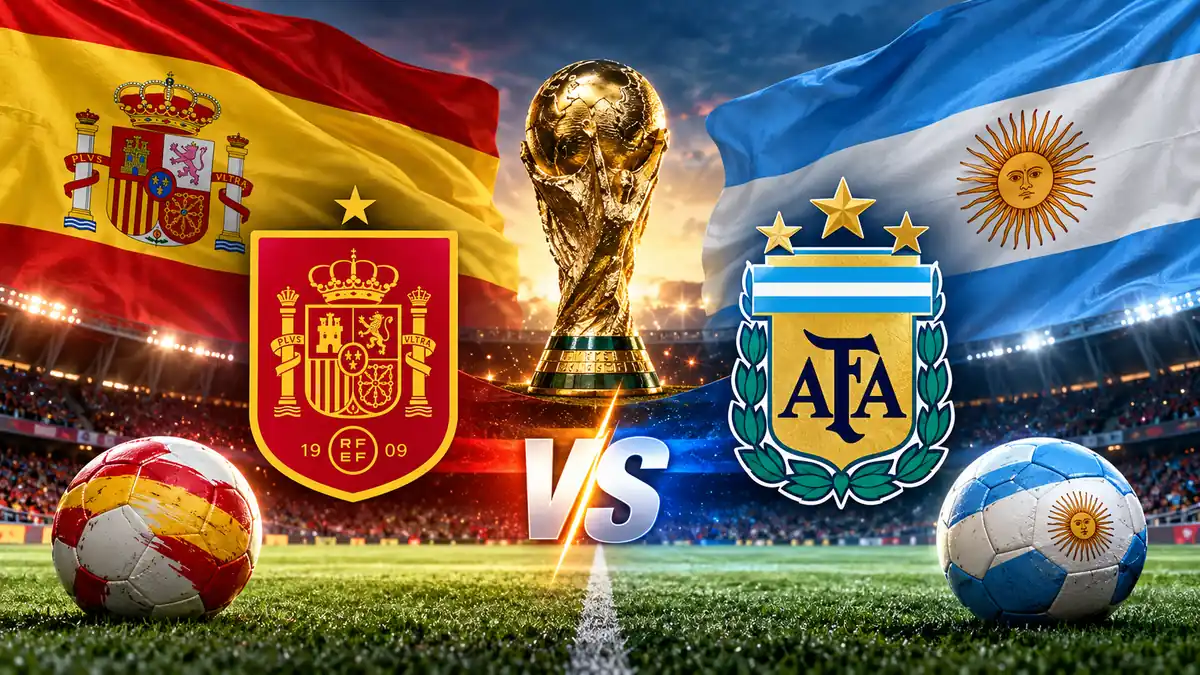
Few international football matchups combine history, technical quality, and global star power quite like spain vs argentina. Both nations have produced World Cup champions, legendary players, influential tactical ideas, and generations capable of dominating international football.
The rivalry reached a historic new level in 2026. Spain and Argentina met in the FIFA World Cup final on July 19, with Spain winning 1-0 after extra time. Ferran Torres scored the decisive goal in the 106th minute, giving Spain its second men’s World Cup title. FIFA
Spain and Argentina have now met 15 times at senior international level. Spain lead the head-to-head with seven victories, Argentina have six wins, and two matches have ended in draws. Spain have scored 20 goals to Argentina’s 18. World Football
spain vs argentina Head-to-Head Record
The overall numbers show just how closely matched these two football nations have been.
| Head-to-head statistic | Spain | Argentina |
|---|---|---|
| Total meetings | 15 | 15 |
| Wins | 7 | 6 |
| Draws | 2 | 2 |
| Goals scored | 20 | 18 |
| Biggest H2H win | 6-1 | 4-1 |
| World Cup titles after 2026 | 2 | 3 |
| Confederation | UEFA | CONMEBOL |
| Traditional nickname | La Roja | La Albiceleste |
Spain’s victory in the 2026 World Cup final tipped what had previously been an exceptionally balanced series in La Roja’s favor. Before that final, the teams had six victories apiece and two draws from 14 encounters. FIFA
Another unusual feature of this rivalry is how rarely the teams have met in major competitive football. For decades, most encounters were friendlies.
That changed dramatically when they faced one another for the world championship in 2026.
spain vs argentina All-Time Results
The history between La Roja and La Albiceleste stretches back to 1952.
Here is the complete senior head-to-head record listed by FIFA, including their latest World Cup encounter. FIFA
| Date | Fixture | Score | Competition |
|---|---|---|---|
| 19 Jul 2026 | Spain vs Argentina | 1-0 AET | FIFA World Cup |
| 27 Mar 2018 | Spain vs Argentina | 6-1 | Friendly |
| 7 Sep 2010 | Argentina vs Spain | 4-1 | Friendly |
| 14 Nov 2009 | Spain vs Argentina | 2-1 | Friendly |
| 11 Oct 2006 | Spain vs Argentina | 2-1 | Friendly |
| 17 Nov 1999 | Spain vs Argentina | 0-2 | Friendly |
| 20 Sep 1995 | Spain vs Argentina | 2-1 | Friendly |
| 12 Oct 1988 | Spain vs Argentina | 1-1 | Friendly |
| 12 Oct 1974 | Argentina vs Spain | 1-1 | International |
| 11 Oct 1972 | Spain vs Argentina | 1-0 | International |
| 13 Jul 1966 | Argentina vs Spain | 2-1 | FIFA World Cup |
| 11 Jun 1961 | Spain vs Argentina | 2-0 | Friendly |
| 24 Jul 1960 | Argentina vs Spain | 2-0 | Friendly |
| 5 Jul 1953 | Argentina vs Spain | 1-0 | Friendly |
| 7 Dec 1952 | Spain vs Argentina | 0-1 | Friendly |
The pattern is interesting. Argentina controlled the earliest part of the series, winning the first three meetings. Spain gradually reversed that trend and have been the stronger side in more recent encounters.
When Did Spain and Argentina First Play?
Spain and Argentina first met at senior level on December 7, 1952.
The match was played in Madrid, and Argentina won 1-0. It began a strong opening run for La Albiceleste in the fixture.
Argentina won again in 1953 and then recorded a 2-0 victory in 1960.
Spain had to wait until June 1961 for its first victory over Argentina, winning 2-0.
Those early matches established a rivalry between two countries that already shared a deep football connection but were developing distinct identities on the pitch.
Argentina became associated with a combination of technical creativity, individual flair, aggression, and tactical adaptability. Spain would eventually build an international identity around possession, positional play, technically gifted midfielders, and patient ball circulation.
spain vs argentina at the FIFA World Cup
Despite their enormous international pedigree, Spain and Argentina have met only twice at the men’s FIFA World Cup.
Those two matches came exactly 60 years apart.
Argentina 2-1 Spain — 1966 World Cup
Their first World Cup meeting took place on July 13, 1966, during the group stage in England.
Argentina won 2-1.
Luis Artime scored twice for Argentina, while Pirri scored Spain’s goal. The result remains one of the historically important encounters between the countries because it was their only World Cup meeting for six decades. Legion Report
Spain and Argentina subsequently appeared in numerous World Cups without being drawn against one another.
Then came 2026.
Spain 1-0 Argentina — 2026 World Cup Final
The second World Cup meeting could hardly have been bigger.
Spain and Argentina met in the 2026 FIFA World Cup final at New York New Jersey Stadium on July 19, 2026.
The match remained goalless through 90 minutes.
Ferran Torres, who had entered as a substitute, finally broke the deadlock in the 106th minute, finishing from a Nico Williams assist to put Spain ahead 1-0. Spain protected the lead through the remainder of extra time and became world champions for the second time. Sky Sports
The result also gave Spain its first World Cup victory over Argentina.
Spain vs Argentina World Cup Record
| World Cup | Result | Winner |
|---|---|---|
| 1966 | Argentina 2-1 Spain | Argentina |
| 2026 | Spain 1-0 Argentina AET | Spain |
The World Cup record therefore stands perfectly level: one victory each.
The difference is that Spain’s victory came in a final.
What Happened in the 2026 World Cup Final?
The 2026 final provided a fascinating contrast between Spain’s control of possession and Argentina’s attempts to disrupt their rhythm.
Spain finished with 65.1% possession compared with Argentina’s 34.9%. The Spanish side also produced 20 shots to Argentina’s two and registered 12 shots on target, while Argentina failed to record one. Sky Sports
The passing numbers told a similar story.
Spain completed 763 passes at 89.4% accuracy. Argentina completed 357 at 76.9%. Spain also won the corner count 9-4. Sky Sports
Yet the score remained 0-0 after regulation time.
The decisive moment arrived 16 minutes into extra time.
Nico Williams supplied Ferran Torres, who scored the goal that separated the teams.
It was an especially significant result because Spain followed its UEFA Euro 2024 triumph by winning the 2026 World Cup.
For Argentina, the final represented another appearance on football’s biggest stage after winning the 2022 World Cup.
Who Has Won More: Spain or Argentina?
Spain currently hold the narrow advantage in direct meetings.
After 15 senior internationals:
- Spain wins: 7
- Argentina wins: 6
- Draws: 2
- Spain goals: 20
- Argentina goals: 18
The numbers underline how little separates the teams historically. World Football
However, head-to-head victories tell only part of the story.
Argentina remain ahead in men’s World Cup titles, with championships in 1978, 1986, and 2022. Spain won its first World Cup in 2010 before adding a second in 2026.
Spain also became European champion for a record fourth time at Euro 2024, while Argentina won a record 16th Copa América title in 2024. UEFA.com
The two nations therefore belong firmly among international football’s most successful teams.
Biggest spain vs argentina Wins
This rivalry has produced several surprisingly one-sided matches despite the balanced overall record.
Spain 6-1 Argentina — 2018
Spain’s biggest victory over Argentina came on March 27, 2018, at the Metropolitano in Madrid.
Spain won 6-1.
Isco delivered the standout individual performance with a hat-trick as Spain overwhelmed the Argentine defense.
The score remains the largest winning margin in the history of this matchup. World Football
There was an important caveat: Lionel Messi did not play because of injury.
Even so, the performance demonstrated the technical strength of the Spanish side immediately before the 2018 World Cup.
Argentina 4-1 Spain — 2010
Argentina had produced its own emphatic result eight years earlier.
On September 7, 2010, Argentina defeated Spain 4-1 in Buenos Aires.
What made the result particularly striking was its timing. Spain had just become world champions after winning the 2010 World Cup in South Africa.
Lionel Messi opened the scoring, and Argentina proceeded to punish a Spanish team that included many players from its championship-winning generation.
The result remains Argentina’s biggest victory over Spain. World Football
Spain’s Strong Modern Record Against Argentina
The early history of the rivalry favored Argentina.
The modern era tells a different story.
Spain won 2-1 in 2006 and repeated that scoreline in 2009. Argentina responded with its memorable 4-1 victory in 2010.
Spain then produced the 6-1 demolition in 2018 before eventually defeating Argentina 1-0 in the 2026 World Cup final.
That gives Spain four wins from the five meetings since 2006.
The change reflects Spain’s transformation into one of international football’s dominant forces during the 21st century.
Its golden generation won Euro 2008, the 2010 World Cup, and Euro 2012. A new generation later captured Euro 2024 and the 2026 World Cup.
Spain vs Argentina Playing Styles
Part of the fascination surrounding Spain against Argentina comes from the contrast—and occasional similarities—in their football philosophies.
Spain: Possession and Positional Control
Modern Spain is strongly associated with possession-based football.
The country’s most famous international sides have relied on technically gifted midfielders capable of controlling space, circulating the ball quickly, and forcing opponents to defend for long periods.
The tiki-taka era involving players such as Xavi, Andrés Iniesta, Sergio Busquets, David Silva, and Xabi Alonso became the most recognizable version of this approach.
Spain’s later generations evolved rather than simply copying that system.
Players such as Rodri, Pedri, Dani Olmo, Nico Williams, and Lamine Yamal helped introduce more direct attacking qualities while maintaining Spain’s technical foundation.
The 2026 World Cup final demonstrated that emphasis on control. Spain had significantly more possession, shots, and completed passes than Argentina. Sky Sports
Argentina: Adaptability and Individual Creativity
Argentina traditionally combines technical skill with a greater willingness to adapt its tactical approach to the opponent.
La Albiceleste has produced some of football’s greatest individual talents, including Diego Maradona and Lionel Messi.
Yet successful Argentine teams have rarely depended solely on individual brilliance.
The 2022 World Cup-winning side demonstrated the value of defensive organization, midfield intensity, tactical flexibility, and collective resilience around Messi.
Players such as Emiliano Martínez, Cristian Romero, Rodrigo De Paul, Enzo Fernández, Alexis Mac Allister, and Julián Álvarez became central pieces of that structure.
This ability to switch between possession, counterattacking, pressing, and deeper defensive phases has made Argentina difficult to predict.
Lionel Messi’s Connection to Spain
No discussion of Spain and Argentina in modern football can ignore Lionel Messi.
Messi represented Argentina throughout his international career, but his club development took place largely in Spain.
He joined Barcelona’s youth system as a teenager and eventually became one of the most successful players in the history of Spanish club football.
That connection created an unusual dynamic whenever Argentina faced Spain.
Many Spanish players knew Messi intimately from La Liga or from playing alongside him at Barcelona.
The 2010 meeting was particularly memorable because Messi scored against a Spain team filled with Barcelona teammates shortly after Spain had won the World Cup.
His presence also added another layer to the 2026 World Cup final, which came when Messi was 39. Before the game, he was set to become only the second player to appear in three men’s World Cup finals, after Brazil’s Cafu. Opta Analyst
Spain and Argentina’s Greatest Generations
Both countries have experienced periods when their national teams set the standard for international football.
Spain’s 2008-2012 Generation
Spain’s greatest sustained period began at Euro 2008.
The team then won the 2010 FIFA World Cup and Euro 2012, becoming the first European men’s national side to win three consecutive major international tournaments.
That generation included:
- Iker Casillas
- Sergio Ramos
- Carles Puyol
- Xavi
- Andrés Iniesta
- Sergio Busquets
- Xabi Alonso
- David Villa
- Fernando Torres
Its influence extended beyond trophies. Spain’s style shaped tactical conversations throughout world football.
Argentina’s World Champion Generations
Argentina’s first World Cup triumph came on home soil in 1978.
Eight years later, Diego Maradona inspired the country to another championship at Mexico 1986.
A long wait followed before Argentina returned to the summit.
Lionel Messi’s generation won the 2021 Copa América, the 2022 Finalissima against Italy, the 2022 World Cup, and the 2024 Copa América.
Argentina beat Italy 3-0 at Wembley in the 2022 Finalissima, with Messi captaining the South American champions. UEFA.com
That run established the side as one of Argentina’s most successful generations.
The Finalissima That Was Supposed to Bring Them Together
Before their 2026 World Cup meeting, considerable attention had surrounded another potential Spain-Argentina showdown.
Spain won UEFA Euro 2024 by defeating England 2-1 in the final in Berlin.
Argentina won the 2024 Copa América, beating Colombia 1-0 after extra time.
That made Spain and Argentina the respective European and South American champions, setting up a planned Finalissima between the two continental winners.
UEFA had announced the match for March 27, 2026, at Lusail Stadium in Qatar. The competition brings together the reigning UEFA European Championship and Copa América champions. UEFA.com
The matchup was particularly anticipated because Argentina were also the reigning world champions and defending Finalissima winners.
Instead, the rivalry’s defining competitive encounter ultimately came on an even larger stage: the World Cup final.
Spain vs Argentina: Which Team Has the Better International Record?
There is no single statistic that completely answers this question.
Argentina have the stronger historical World Cup record.
La Albiceleste have won three men’s World Cups, compared with Spain’s two.
Argentina also have a rich Copa América history and have produced globally influential players across several generations.
Spain’s international dominance has been concentrated more heavily in the modern era.
The extraordinary run from Euro 2008 through Euro 2012 established Spain as one of the greatest national teams ever assembled. Later victories at Euro 2024 and the 2026 World Cup reinforced the country’s position among international football’s elite.
So the answer depends on the measurement.
World Cup titles: Argentina lead.
Direct head-to-head: Spain lead.
European championships: Spain have dominated their confederation competition.
Copa América success: Argentina have an exceptional South American record.
Rather than establishing one country as definitively superior, the numbers demonstrate that both have achieved success across different eras.
Why Spain vs Argentina Is Such a Rare Matchup
Spain and Argentina are global football powers, yet they have played relatively few competitive matches against one another.
The reason is simple: they belong to different confederations.
Spain compete under UEFA in Europe, while Argentina compete under CONMEBOL in South America.
Their regular competitive schedules therefore never overlap.
Spain’s major regional competition is the UEFA European Championship. Argentina’s is the Copa América.
That leaves the FIFA World Cup and inter-confederation events such as the Finalissima as the main opportunities for meaningful competitive encounters.
Even at the World Cup, teams must land in compatible groups or progress through the bracket in a way that brings them together.
That explains why 60 years separated their World Cup meetings.
What Makes the Rivalry Special?
Spain against Argentina is not a traditional geographic rivalry.
There is no shared border, and the teams do not compete regularly for the same regional trophy.
Its appeal comes from football quality and history.
Both countries have produced some of the sport’s greatest players. Both place enormous cultural importance on football. Both have developed distinctive tactical traditions, and both expect to compete for major trophies.
There is also a deep linguistic and historical connection between the countries.
On the football field, however, familiarity has not translated into frequent competition.
That scarcity makes the matchup more intriguing.
When Brazil and Argentina meet, decades of South American rivalry shape the occasion. When Spain play another major European country, continental history provides context.
Spain against Argentina feels different because meetings are comparatively rare and often connect different football eras.
Key Numbers From the Rivalry
Several statistics capture the history of spain vs argentina particularly well.
Spain and Argentina have played 15 senior internationals, with Spain leading seven wins to six and two draws. The aggregate score is 20-18 in Spain’s favor. World Football
Their biggest result was Spain’s 6-1 victory in 2018.
Argentina’s largest win was 4-1 in 2010.
They have met twice at the FIFA World Cup, with each country winning once.
Their first World Cup encounter was Argentina’s 2-1 victory in 1966.
Their second was Spain’s 1-0 extra-time victory in the 2026 World Cup final.
Ferran Torres scored the winning goal in the 106th minute of that final. Sky Sports
Those numbers tell the story of an unusually balanced rivalry that took more than seven decades to produce its biggest match.
spain vs argentina: How the Rivalry Stands Today
The historical balance between these football powers remains remarkable.
Argentina dominated the earliest meetings. Spain became more successful as the rivalry moved into the 21st century. Along the way, both countries produced World Cup-winning generations and some of the most recognizable footballers of their eras.
The 2026 World Cup final transformed the matchup.
Spain’s 1-0 extra-time victory gave La Roja its second world championship, its first World Cup win over Argentina, and a 7-6 advantage in the overall head-to-head record. FIFA
For anyone comparing spain vs argentina, the simplest summary is that very little separates them. Argentina still lead in total World Cup titles, while Spain now hold the direct head-to-head advantage.
Their limited number of competitive meetings makes every future encounter significant—and after a World Cup final finally added a championship match to their shared history, the rivalry carries more weight than ever before.