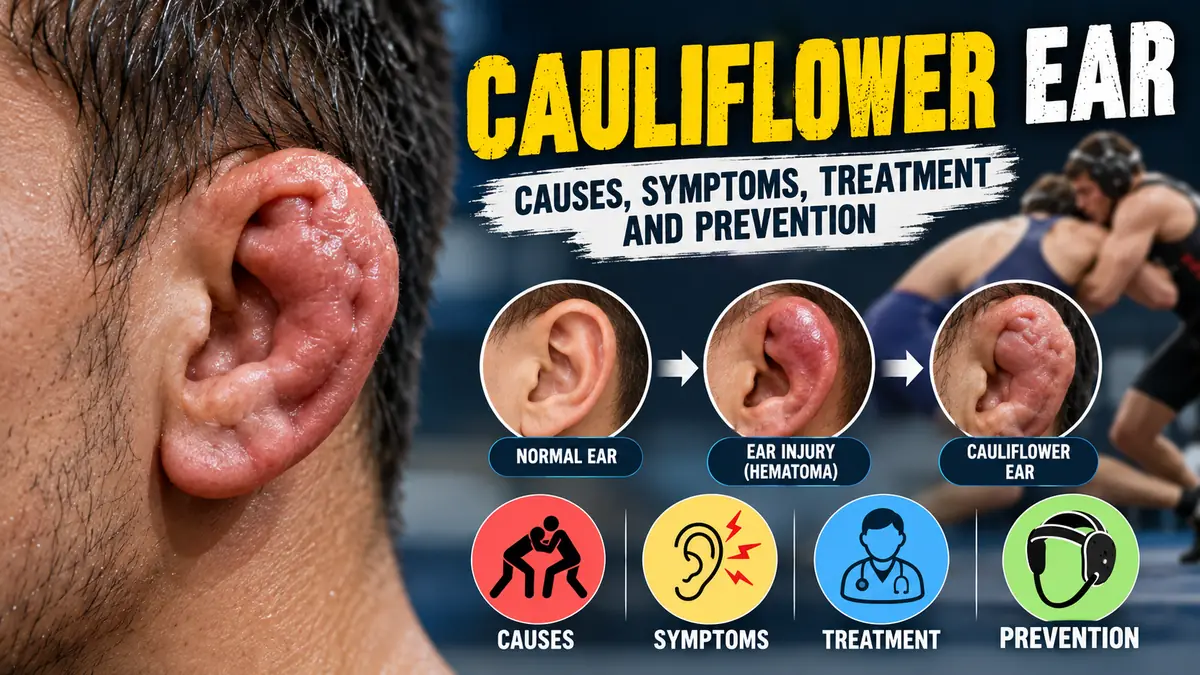
A swollen, bruised ear after wrestling, boxing, or another physical activity might seem like a minor injury. But without timely treatment, that swelling can develop into a permanent change in the ear’s shape.
cauliflower ear is a deformity of the outer ear caused by trauma that damages blood vessels and disrupts the blood supply to cartilage. Blood can collect beneath the skin, forming an auricular hematoma. Without prompt treatment, damaged cartilage and scar tissue may produce permanent thickening, swelling, and an irregular appearance.
Although this condition is particularly common among wrestlers and mixed martial arts fighters, anyone who experiences significant ear trauma can develop it.
Understanding the early warning signs, available treatments, and preventive measures can help protect both the appearance and function of your ears.
What Is cauliflower ear?
Cauliflower ear, sometimes called wrestler’s ear or boxer’s ear, is a permanent or potentially permanent deformity of the external ear, medically known as the auricle or pinna.
The condition usually develops after an injury causes blood to accumulate between the ear cartilage and its surrounding tissue.
The resulting collection of blood is called an auricular hematoma.
If the hematoma is not treated appropriately, it can interrupt the cartilage’s normal blood supply. The damaged tissue may then heal abnormally, creating thickened cartilage and fibrous scar tissue.
Over time, the ear can develop a wrinkled, swollen, or irregular appearance resembling the surface of a cauliflower.
The Cleveland Clinic identifies prompt treatment of ear injuries as a key measure for reducing the risk of permanent deformity.
Cleveland Clinic
+1
Why Does the Ear Become Deformed?
The outer ear contains flexible cartilage that provides its distinctive shape.
Unlike many other tissues, cartilage has no direct blood supply. Instead, it receives nutrients through surrounding tissue, particularly a thin connective tissue layer called the perichondrium.
When the ear experiences blunt force trauma, small blood vessels can rupture.
Blood then collects between tissue layers or within the cartilage, potentially separating the perichondrium from the cartilage.
This process can cause:
- Reduced delivery of oxygen and nutrients
- Inflammation and swelling
- Cartilage damage or tissue death, known as necrosis
- Formation of fibrous scar tissue
- Abnormal growth of new cartilage
- Permanent changes to the ear’s natural contours
The severity depends on the injury, the amount of bleeding, and how quickly appropriate treatment begins.
What Causes cauliflower ear?
The most common cause is repeated or significant trauma to the external ear.
The injury does not necessarily need to involve a powerful punch. Repeated rubbing, pressure, or twisting forces can also damage delicate blood vessels.
Wrestling and Grappling Sports
Wrestlers are particularly vulnerable because their ears frequently experience friction against opponents, wrestling mats, and protective equipment.
During grappling, an ear can become compressed or folded between two surfaces.
Repeated injuries increase the likelihood of developing auricular hematomas and eventual cartilage deformity.
Boxing and Mixed Martial Arts
Boxing and mixed martial arts (MMA) involve direct impacts to the head and ears.
Activities such as sparring, clinching, and ground fighting expose athletes to repeated ear trauma.
The risk is especially relevant when injuries are ignored or training resumes before healing is complete.
Brazilian Jiu-Jitsu and Judo
Brazilian jiu-jitsu (BJJ) and judo involve close physical contact, throws, submissions, and ground grappling.
The ears may experience substantial friction during movements such as escaping headlocks or passing an opponent’s guard.
Even athletes who rarely receive direct punches can develop ear hematomas through repeated pressure.
Rugby and Other Contact Sports
Rugby players may experience ear injuries during tackles, scrums, and collisions.
Similar injuries can occur in other contact sports, particularly when the outer ear is compressed or struck.
Causes Outside Sports
Although combat sports receive the most attention, cauliflower ear is not limited to athletes.
Other possible causes include:
- Accidental falls or blows to the ear
- Physical assaults
- Motor vehicle accidents
- Repeated mechanical pressure
- Certain inflammatory conditions affecting ear cartilage
- Rare spontaneous auricular hematomas
People taking anticoagulant medications or living with bleeding disorders may also be more susceptible to hematoma formation.
Conditions such as relapsing polychondritis can cause ear inflammation and deformity, although the underlying mechanism differs from a typical traumatic hematoma.
Early Signs and Symptoms of cauliflower ear
Recognizing the condition early offers the best opportunity to prevent lasting damage.
The first symptoms generally appear shortly after an injury, while permanent deformity develops later.
Early Symptoms
Common warning signs include:
- Sudden swelling of the outer ear
- Tenderness or pain when touching the ear
- Red, purple, or bruised skin
- A soft, fluid-filled lump
- Changes in the ear’s normal contours
- A sensation of pressure or fullness
- Localized warmth
The swelling may occur around the antihelix, concha, or other cartilage-containing areas of the ear.
A newly formed hematoma often feels soft or fluctuant because blood has collected beneath the tissue.
Symptoms of Established Deformity
As the condition progresses, the appearance and texture of the ear can change.
Possible findings include:
- Thickened or irregular cartilage
- Firm, hardened lumps
- Wrinkled or folded tissue
- Loss of normal ear definition
- Asymmetry between the ears
- Permanent changes in ear shape
Some individuals experience little pain after the initial injury has healed.
However, a painless deformity does not necessarily mean that the ear has returned to normal.
Can cauliflower ear Affect Hearing?
Yes, although hearing loss does not occur in every case.
Severe swelling or deformity can narrow the external auditory canal, potentially affecting sound transmission or increasing difficulty with ear hygiene.
In some cases, hearing problems following trauma may result from additional injuries to the ear canal, eardrum, or deeper structures rather than the cartilage deformity itself.
Persistent hearing changes, tinnitus, dizziness, or ear discharge require medical evaluation.
How Does cauliflower ear Develop Over Time?
Cauliflower ear usually begins with an acute auricular hematoma and progresses when the underlying injury remains untreated or inadequately managed.
The progression is not identical for everyone.
| Stage | Typical changes | Clinical significance |
|---|---|---|
| Initial injury | Pain, bruising, and swelling | Blood vessels may be damaged |
| Early hematoma | Soft, localized fluid collection | Prompt drainage may prevent deformity |
| Ongoing inflammation | Persistent swelling and tissue injury | Risk of cartilage damage increases |
| Healing and scarring | Tissue becomes thicker and firmer | Abnormal cartilage formation may begin |
| Established deformity | Hard, irregular ear contours | Surgical correction may be necessary |
The First Several Hours
Shortly after trauma, blood may begin collecting around the cartilage.
This is the most important period for obtaining medical assessment.
Healthcare professionals generally prefer early treatment because prompt evacuation of the hematoma reduces the likelihood of permanent structural changes.
The Following Days
Without appropriate treatment, the hematoma may continue disrupting the cartilage’s blood supply.
Inflammation, fibrosis, and abnormal cartilage formation can gradually change the shape of the ear.
The affected area may become increasingly firm.
After One or Two Weeks
Established deformity may become difficult to reverse without surgical intervention.
Cleveland Clinic notes that permanent changes can develop within approximately seven to ten days in untreated cases, although the timing varies.
This does not mean treatment is pointless after that period. Older injuries still deserve specialist assessment.
Cleveland Clinic
+1
How Is cauliflower ear Diagnosed?
Diagnosis usually begins with a physical examination and a discussion of recent injuries.
A healthcare professional may ask about participation in wrestling, boxing, martial arts, or other activities involving repeated ear trauma.
The examination focuses on identifying swelling, tenderness, bruising, and changes to the external ear’s structure.
Physical Examination
The clinician typically examines:
- The shape and contour of the outer ear
- Areas of swelling or fluid accumulation
- Skin discoloration and tenderness
- Possible cuts or abrasions
- Signs of infection
- The external auditory canal and eardrum
An otoscope may be used to examine the ear canal and tympanic membrane.
Are Imaging Tests Necessary?
Most uncomplicated auricular hematomas can be diagnosed without imaging.
However, additional investigations may be necessary when the injury involves suspected fractures, neurological symptoms, significant hearing changes, or an uncertain diagnosis.
Conditions That Can Look Similar
Not every swollen or misshapen ear is cauliflower ear.
Other conditions include:
| Condition | Distinguishing features |
|---|---|
| Auricular hematoma | Blood collection after injury; often soft and tender |
| Auricular pseudocyst | Fluid-filled swelling, sometimes without obvious trauma |
| Perichondritis | Infection or inflammation around ear cartilage |
| Otitis externa | Inflammation primarily involving the ear canal |
| Keloid scar | Raised scar tissue, often after piercing or injury |
| Relapsing polychondritis | Recurrent inflammatory episodes affecting cartilage |
A clinician can distinguish these conditions and recommend appropriate treatment.
cauliflower ear Treatment: What Actually Works?
Treatment depends on whether the injury is recent or the ear has already developed permanent cartilage deformity.
A fresh auricular hematoma requires prompt medical attention. An established, hardened deformity may require reconstructive surgery if correction is desired.
The primary goal of early treatment is to remove accumulated blood, restore contact between tissue layers, and prevent further cartilage damage.
1. Immediate Care After an Ear Injury
If the ear becomes swollen following trauma, seek medical assessment as soon as possible, ideally the same day.
While waiting for medical care:
- Stop the activity that caused the injury.
- Apply a cold pack wrapped in a clean cloth.
- Keep the cold pack against the affected area for approximately 10–15 minutes at a time.
- Avoid additional pressure, rubbing, or impact.
- Do not attempt to puncture or drain the swelling yourself.
Cold therapy may temporarily reduce pain and swelling, but it cannot remove a significant hematoma.
If the injury also involves severe headache, confusion, loss of consciousness, significant dizziness, or sudden hearing loss, seek emergency care.
2. Professional Hematoma Drainage
For a recent auricular hematoma, a trained healthcare professional may recommend drainage.
The procedure involves removing collected blood so the tissue can return to its normal position.
Depending on the size, age, and characteristics of the hematoma, the clinician may use needle aspiration or incision and drainage.
However, needle aspiration alone has a substantial risk of recurrence.
The 2025 Merck Manual professional guidance favors incision and drainage rather than routine needle aspiration because blood frequently reaccumulates after aspiration.
Merck Manual Professional Edition
+1
3. Compression Dressings and Bolsters
Removing the blood is only part of the treatment.
The tissue layers must remain in close contact while healing.
Healthcare professionals may use:
- Compression dressings
- Specialized ear bolsters
- Dental-roll bolsters
- Mattress or quilting sutures
- Other techniques designed to prevent fluid reaccumulation
These methods help eliminate the space where blood could collect again.
Dressings or bolsters are commonly maintained for approximately five to seven days, depending on the technique and clinical findings.
Follow-up appointments are essential because hematomas can recur.
4. Antibiotics and Infection Management
Antibiotics may be prescribed in selected cases, particularly when infection risk or clinical findings justify them.
They are not a substitute for proper drainage.
Potential complications include perichondritis, chondritis, and cartilage infection.
Increasing redness, worsening pain, fever, or discharge after treatment should be assessed promptly.
5. Surgery for Established cauliflower ear
Once cartilage becomes permanently thickened or distorted, drainage alone cannot restore its original shape.
In these situations, an ear, nose, and throat specialist—also called an otolaryngologist—or a plastic surgeon may recommend reconstructive surgery.
One possible procedure is otoplasty, which reshapes the external ear.
Depending on the deformity, surgery may involve:
- Removing excess fibrous tissue
- Reshaping abnormal cartilage
- Reconstructing damaged ear contours
- Improving symmetry
- Addressing narrowing of the ear canal when appropriate
Surgery can improve the ear’s appearance, but complete restoration is not guaranteed.
The outcome depends on the amount of cartilage damage, skin condition, previous injuries, and surgical technique.
Can You Fix cauliflower ear at Home?
There is no reliable home treatment that reverses established cartilage deformity.
Ice and rest may relieve symptoms following a recent injury, but they cannot reliably prevent permanent damage when a hematoma is present.
Why You Should Never Drain It Yourself
Some athletes attempt to drain swollen ears using needles or syringes.
This is risky for several reasons.
First, puncturing the ear can introduce bacteria and cause infection.
Second, incomplete drainage may leave blood trapped around the cartilage.
Third, even when blood is removed, the hematoma can return unless the tissue layers are appropriately compressed.
Repeated attempts can cause additional tissue damage and scarring.
Professional treatment addresses both the blood collection and the risk of recurrence.
Can Massage Reverse the Deformity?
No reliable clinical evidence shows that massage can reverse established cauliflower ear.
Forcefully manipulating damaged cartilage may cause further injury.
Similarly, creams, oils, and supplements cannot reshape permanently distorted cartilage.
Is cauliflower ear Permanent?
Cauliflower ear can become permanent when untreated injury leads to fibrosis and abnormal cartilage growth.
However, an early auricular hematoma does not automatically result in permanent deformity.
Timely professional treatment can significantly reduce the risk.
Can cauliflower ear Go Away on Its Own?
A small amount of swelling or bruising may improve naturally, but a true auricular hematoma should not be left untreated in the hope that it will resolve safely.
Even if swelling eventually decreases, the cartilage may heal in an abnormal position.
Once the ear becomes hard and misshapen, spontaneous restoration of its original appearance is unlikely.
Can Old cauliflower ear Be Reversed?
Established deformity generally requires surgical correction if reshaping is desired.
Some people choose not to undergo surgery, especially when the deformity is painless and does not interfere with hearing or daily activities.
Others seek treatment because of discomfort, repeated irritation, ear-canal obstruction, or cosmetic concerns.
A specialist can explain the realistic benefits and limitations of reconstruction.
Recovery Time and Healing Expectations
Recovery depends on the severity of the injury and the treatment performed.
A recent hematoma treated promptly generally heals faster than an established deformity requiring surgery.
| Treatment or condition | Approximate recovery expectations |
|---|---|
| Minor bruising without hematoma | Often improves over several days |
| Professional hematoma drainage | Commonly around 1–2 weeks |
| Compression dressing | Often maintained for 5–7 days |
| Reconstructive ear surgery | Initial healing often takes several weeks |
| Established untreated deformity | May remain indefinitely |
These are general estimates, not guaranteed recovery times.
Recovery After Hematoma Drainage
Following drainage, patients may experience temporary tenderness, mild swelling, and discomfort from the dressing.
Follow-up is especially important during the first week because the hematoma can refill.
Athletes should avoid contact sports until a clinician confirms that healing is adequate.
Returning too soon can cause another hematoma.
Recovery After Reconstructive Surgery
Surgical recovery depends on the procedure’s complexity.
Swelling and bruising may persist for several weeks, while final cosmetic results can take longer to become apparent.
The surgeon may recommend temporary activity restrictions and protection from direct pressure.
How to Prevent cauliflower ear in Contact Sports
Prevention is particularly important for athletes who experience repeated ear contact.
The most effective approach combines properly fitted protective equipment with early recognition and treatment of injuries.
Wear Protective Wrestling Headgear
Protective wrestling headgear, often called ear guards, helps reduce direct impacts and friction.
The equipment should fit securely without causing excessive pressure.
Poorly fitted headgear may shift during training or fail to protect vulnerable areas.
Use Protection During Practice
Many athletes focus on protective equipment during competitions but overlook daily training.
However, repeated practice sessions can expose the ears to frequent minor injuries.
An older study involving more than 500 college wrestlers found that athletes who wore headgear reported fewer auricular hematomas and ear deformities than those who did not.
The study reported cauliflower ear deformity in approximately 10.6% of headgear users compared with 26.6% of nonusers.
These figures describe the surveyed population and should not be interpreted as universal risk estimates.
NCBI Bookshelf
+1
Adjust Training Habits
Athletes can also reduce their risk by:
- Avoiding unnecessary ear friction during drills
- Checking protective equipment regularly
- Reporting new swelling immediately
- Allowing adequate recovery after injuries
- Following medical return-to-sport instructions
- Avoiding repeated trauma to an already injured ear
Coaches and training partners should recognize that persistent ear swelling is a medical issue, not merely an expected part of combat sports.
Does Headgear Completely Prevent It?
No protective equipment eliminates every risk.
Strong impacts, improper fit, and repeated pressure can still produce injuries.
However, appropriate ear protection substantially reduces exposure to the forces associated with auricular hematomas.
cauliflower ear in Wrestling, BJJ, Boxing, and MMA
Cauliflower ear is strongly associated with combat sports, but the mechanism and frequency of injury can differ between disciplines.
| Sport | Common injury mechanism | Prevention considerations |
|---|---|---|
| Wrestling | Ear compression, friction, and grappling | Proper wrestling headgear |
| Brazilian jiu-jitsu | Repeated rubbing during ground techniques | Ear guards and prompt injury assessment |
| Boxing | Direct punches and blunt impacts | Appropriate training protection and injury management |
| MMA | Strikes, clinching, and grappling | Ear protection when practical during training |
| Judo | Throws, gripping, and ground fighting | Protective equipment permitted by training rules |
| Rugby | Tackles, scrums, and collisions | Suitable scrum caps or ear protection |
Why Is It So Common Among Wrestlers?
Wrestling repeatedly exposes the outer ear to shearing forces.
These forces can separate tissue layers and damage small blood vessels even without a direct punch.
Because athletes may train frequently, minor injuries can accumulate before an earlier hematoma has fully healed.
Why Do Some Fighters Have cauliflower ear?
Some fighters develop prominent deformities after years of repeated trauma.
The condition has historically been viewed by some combat-sport communities as a symbol of experience.
However, it is not evidence of superior skill, strength, or athletic ability.
It is a consequence of tissue injury.
Can You Get cauliflower ear Without Fighting?
Yes.
A single significant injury can be enough to cause an auricular hematoma.
Falls, accidents, and other forms of trauma may produce the same biological process.
Rare inflammatory disorders can also produce similar ear deformities.
Potential Complications of Untreated cauliflower ear
The condition is often discussed primarily as a cosmetic concern, but complications can extend beyond appearance.
Permanent Cartilage Deformity
The most recognizable complication is irreversible thickening and distortion of the outer ear.
Abnormal cartilage and scar tissue can replace the ear’s normal smooth contours.
Infection and Perichondritis
Damaged tissue may become infected.
Perichondritis involves inflammation or infection of the tissue surrounding ear cartilage.
In severe cases, infection can contribute to additional cartilage damage.
Symptoms requiring medical attention include increasing pain, redness, warmth, fever, or discharge.
Hearing Problems
Severe deformity can partially obstruct the ear canal.
This may interfere with sound conduction or contribute to difficulties with ear hygiene.
However, most people with mild external ear deformity do not necessarily develop significant hearing loss.
Recurrent Hematomas
A hematoma can return after drainage if blood reaccumulates.
This is why compression techniques and follow-up visits are essential.
Repeated episodes can worsen structural damage.
Emotional and Cosmetic Concerns
Visible ear deformity can affect confidence or cause self-consciousness.
The impact varies considerably.
Some people are comfortable with their ear’s appearance, while others prefer reconstructive treatment.
Neither choice changes the importance of treating an active injury appropriately.
When Should You See a Doctor?
Seek same-day medical care if you develop new swelling or a soft lump on the outer ear following an injury.
Do not wait until the ear becomes visibly deformed.
An urgent care clinician, emergency physician, or ENT specialist can assess whether an auricular hematoma requires drainage.
Seek emergency evaluation if ear trauma occurs alongside:
- Sudden or significant hearing loss
- Severe dizziness or balance problems
- Loss of consciousness
- Confusion or worsening headache
- Significant bleeding
- Facial weakness
- Signs of a serious head injury
Fever, spreading redness, worsening pain, or pus-like discharge also require prompt assessment for infection.
For an older, hardened deformity, an appointment with an ENT specialist or reconstructive plastic surgeon can help determine whether treatment is appropriate.
Common Misconceptions About cauliflower ear
Several misunderstandings can lead people to underestimate the condition.
Myth: Only Professional Fighters Get It
Anyone who experiences sufficient ear trauma can develop an auricular hematoma.
Professional athletes simply have greater exposure to repeated injury.
Myth: Every Ear Injury Leads to Permanent Deformity
Not every injury produces a hematoma, and prompt treatment can prevent many permanent changes.
Myth: Draining the Blood Once Guarantees Recovery
Blood can reaccumulate after drainage.
Appropriate compression and follow-up are essential parts of care.
Myth: A Hard, Deformed Ear Can Be Fixed With Ice
Ice can reduce discomfort and early swelling, but it cannot reverse established scar tissue or abnormal cartilage.
Myth: cauliflower ear Is Always Harmless
Many people experience only cosmetic changes, but infection, recurrent hematomas, discomfort, and ear-canal obstruction can occur.
Long-Term Outlook for People With cauliflower ear
The long-term outlook depends largely on whether treatment begins before permanent cartilage changes develop.
When an auricular hematoma is identified and treated promptly, many patients recover without substantial deformity.
If cartilage has already become hardened and irregular, the ear may remain permanently altered unless reconstructive surgery is performed.
Some people live comfortably with mild deformity and require no further intervention.
Others experience recurrent irritation, difficulty wearing certain earphones or protective equipment, or concerns about appearance.
The condition does not automatically mean someone has impaired hearing or ongoing disease.
However, any new swelling, pain, or discharge should be evaluated rather than assumed to be part of an old injury.
Final Thoughts on cauliflower ear
Cauliflower ear develops when trauma causes bleeding around the outer ear cartilage, followed by disrupted blood supply, scarring, and abnormal cartilage formation.
It is especially common in wrestling, boxing, BJJ, and MMA, but it can affect anyone who sustains an ear injury.
The most important distinction is between an early, treatable auricular hematoma and an established cartilage deformity.
Prompt professional treatment can prevent many cases of permanent cauliflower ear, while protective headgear and careful injury management can reduce future risk.
If your outer ear becomes swollen after an injury, seek medical evaluation the same day rather than attempting to drain it yourself or waiting for the swelling to disappear.