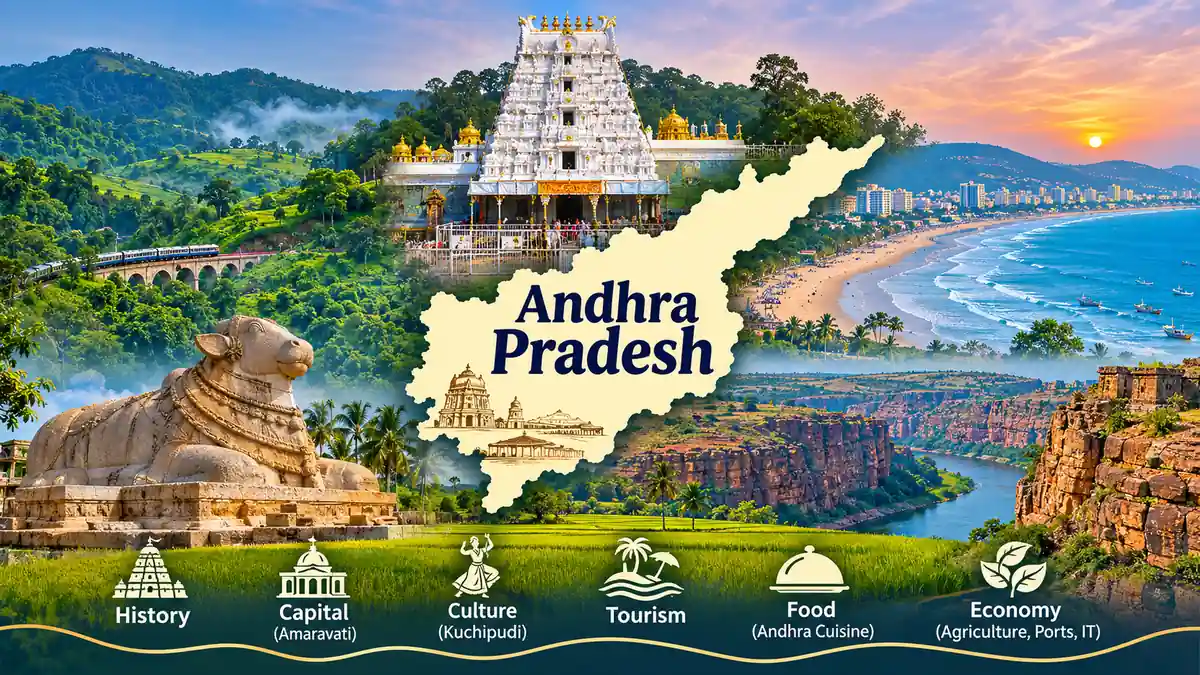
andhra pradesh is a southeastern Indian state known for its long Bay of Bengal coastline, ancient temples, Telugu heritage, fertile river deltas, and growing industrial economy. From the sacred hills of Tirumala to the beaches of Visakhapatnam and the historic sites of Amaravati, the state combines religious significance, natural beauty, and economic importance.
andhra pradesh is one of India’s major Telugu-speaking states, with Amaravati designated as its capital and Visakhapatnam as its largest city. Formed in its present boundaries following the creation of Telangana in 2014, the state has 26 districts, important agricultural regions along the Krishna and Godavari rivers, and a diverse landscape stretching from coastal plains to the Eastern Ghats.
Where Is andhra pradesh Located?
andhra pradesh lies in southeastern India, along the Bay of Bengal. Its location gives it strategic importance for maritime trade, agriculture, fishing, tourism, and industrial development.
The state shares boundaries with Telangana to the northwest, Chhattisgarh and Odisha to the north, Karnataka to the west, and Tamil Nadu to the south. Its eastern boundary follows the Bay of Bengal.
Key facts about andhra pradesh
| Feature | Details |
|---|---|
| Country | India |
| Region | Southeastern India |
| Capital | Amaravati |
| Largest city | Visakhapatnam |
| Official language | Telugu |
| State formation | November 1, 1956 |
| Reorganization | June 2, 2014 |
| Area | Approximately 162,970 sq. km |
| Districts | 26 |
| Coastline | Approximately 974 km |
| Major rivers | Godavari, Krishna, Penna |
| Major geographic feature | Eastern Ghats |
| Time zone | Indian Standard Time (UTC+5:30) |
| State animal | Blackbuck |
| State bird | Rose-ringed parakeet |
| State flower | Jasmine |
| State tree | Neem |
The state’s coastline is among the longest of any Indian state. Its ports, fishing communities, and coastal industries are closely connected to the regional economy.
Major geographical regions
The landscape can broadly be divided into three geographical zones.
Coastal plains: Fertile lowlands along the Bay of Bengal, especially around the Krishna and Godavari deltas, support rice cultivation, aquaculture, and dense settlements.
Eastern Ghats: Hills and forested valleys extend through parts of the state, including the Araku region and the Nallamala Hills. These landscapes support wildlife, tribal communities, and nature tourism.
Rayalaseema: The southern interior includes relatively dry districts such as Kurnool, Anantapur, Kadapa, and Chittoor. Agriculture here depends heavily on rainfall, groundwater, and irrigation infrastructure.
History of andhra pradesh
The history of andhra pradesh spans ancient kingdoms, powerful dynasties, colonial administration, linguistic movements, and modern state reorganization.
Ancient Andhra and the Satavahana dynasty
The Andhra region has a long history of settlement and cultural development. Ancient literary sources mention the Andhras, while archaeological evidence reveals important Buddhist and commercial centers.
The Satavahana dynasty, which ruled large parts of the Deccan during the early historic period, played an influential role in regional political and economic development.
Amaravati became an important Buddhist center, famous for its stupa, sculptures, and artistic traditions. Buddhist remains at sites such as Nagarjunakonda and Salihundam also demonstrate the region’s historical connections with religious learning and trade.
Medieval kingdoms and Telugu culture
Several dynasties shaped the region during the medieval period, including the Eastern Chalukyas, Cholas, Kakatiyas, and Vijayanagara rulers.
The Eastern Chalukyas contributed to the development of Telugu literature and regional cultural traditions. Rajaraja Narendra, a ruler associated with Rajamahendravaram, is remembered for his patronage of literary activity.
Nannaya, traditionally regarded as the first major poet of Telugu literature, began translating the Mahabharata into Telugu during the 11th century.
Later, the Vijayanagara Empire became a major political and cultural force in southern India. Its rulers supported temple architecture, literature, commerce, and artistic traditions.
British rule and the movement for a Telugu-speaking state
During British colonial rule, much of coastal Andhra and Rayalaseema formed part of the Madras Presidency, while Telangana belonged to the princely state of Hyderabad.
After Indian independence in 1947, demands for linguistic states intensified.
Potti Sriramulu became a central figure in the movement for a separate Telugu-speaking state. His death in December 1952 following a prolonged fast prompted widespread public demonstrations.
On October 1, 1953, Andhra State was created from Telugu-speaking areas of Madras State, with Kurnool serving as its capital.
Formation in 1956 and division in 2014
On November 1, 1956, Andhra State merged with the Telugu-speaking Telangana region of Hyderabad State to form the larger state of Andhra Pradesh.
Hyderabad became its capital.
Decades later, demands for a separate Telangana state resulted in the Andhra Pradesh Reorganisation Act, 2014.
On June 2, 2014, Telangana became India’s 29th state at that time, and the remaining territory continued as Andhra Pradesh.
The division brought major administrative, financial, and infrastructure challenges, particularly concerning the development of a capital and the distribution of public institutions.
What Is the Capital of andhra pradesh?
Amaravati is the designated capital of andhra pradesh, located near the Krishna River in the region between Vijayawada and Guntur.
The capital question became particularly important after Telangana separated in 2014.
Why was Amaravati selected?
Amaravati was selected for the development of a new capital because of its location within the state’s central coastal region and its proximity to established urban centers.
The area also has historical significance because of the ancient Amaravati Buddhist site.
Capital development plans have included government buildings, administrative facilities, transport connections, residential districts, and public infrastructure.
Amaravati, Visakhapatnam, and Kurnool
Different administrative proposals have created confusion about the state’s capital.
In 2020, the state government pursued a three-capital model under which Visakhapatnam would serve as the executive capital, Amaravati as the legislative capital, and Kurnool as the judicial capital.
That legislation was repealed in 2021, and subsequent political developments restored Amaravati to the center of capital-development policy.
Visakhapatnam remains the state’s largest city and a major economic center, while Kurnool is historically significant as the capital of Andhra State between 1953 and 1956.
Capital-development projects and the location of government offices can change over time, so current administrative arrangements should be checked against official government notifications.
Major Cities and Districts of andhra pradesh
andhra pradesh has several important urban centers, each contributing to administration, education, trade, tourism, or industrial development.
Important cities and what they are known for
| City | Major significance |
|---|---|
| Visakhapatnam | Port city, industry, beaches, and naval facilities |
| Vijayawada | Commercial center and major transport junction |
| Guntur | Agriculture, chilli trading, and education |
| Tirupati | Sri Venkateswara Temple and pilgrimage tourism |
| Kurnool | Historic capital and gateway to Rayalaseema |
| Nellore | Agriculture, aquaculture, and industrial activity |
| Rajamahendravaram | Telugu literary heritage and Godavari River |
| Kakinada | Port activities, energy, and seafood industries |
| Anantapur | Groundnut cultivation and regional commerce |
| Kadapa | Historical sites, agriculture, and mineral resources |
How many districts are in andhra pradesh?
The state government reorganized its district administration in April 2022, increasing the number of districts from 13 to 26.
The 26-district structure includes:
- Alluri Sitharama Raju
- Anakapalli
- Anantapuramu
- Annamayya
- Bapatla
- Chittoor
- Dr. B. R. Ambedkar Konaseema
- East Godavari
- Eluru
- Guntur
- Kakinada
- Krishna
- Kurnool
- Nandyal
- NTR
- Palnadu
- Parvathipuram Manyam
- Prakasam
- Sri Potti Sriramulu Nellore
- Sri Sathya Sai
- Srikakulam
- Tirupati
- Visakhapatnam
- Vizianagaram
- West Godavari
- YSR Kadapa
This administrative arrangement was designed to improve access to government services and strengthen district-level administration. The national government’s climate dashboard also lists 26 districts in its August 2026 dataset. MoEFCC
Population, Languages, and Education
The population of andhra pradesh reflects a combination of rural agricultural communities, growing cities, coastal settlements, and tribal populations.
Population and demographic characteristics
According to the 2011 Census figures for the territory of present-day Andhra Pradesh, the population was approximately 49.6 million.
The state’s 2024–25 Socio-Economic Survey reports the following historical demographic indicators:
| Indicator | Figure |
|---|---|
| Population, 2011 | Approximately 4.96 crore |
| Population density | 304 people per sq. km |
| Literacy rate | 67.35% |
| Female literacy rate | 59.96% |
| Sex ratio | 997 females per 1,000 males |
| Urban population share | 29.47% |
These are census-based figures rather than current population measurements. Amazon Web Services, Inc.
What language is spoken in andhra pradesh?
Telugu is the principal language and an official language of the state. It belongs to the Dravidian language family and has a rich literary history extending back more than a thousand years.
Urdu also has official recognition in the state. English is widely used in higher education, business, technology, and some administrative settings.
Other languages spoken by communities across the state include Tamil, Kannada, Odia, and several tribal languages.
Education and universities
The state has a network of government and private schools, colleges, universities, engineering institutions, and medical colleges.
Notable higher education institutions include Andhra University in Visakhapatnam, Acharya Nagarjuna University near Guntur, Sri Venkateswara University in Tirupati, and Jawaharlal Nehru Technological University Kakinada.
The Indian Institute of Technology Tirupati and Indian Institute of Management Visakhapatnam are also important institutions in the state’s higher education landscape.
Educational priorities include improving school infrastructure, literacy, vocational training, digital learning, and access to higher education in rural districts.
Economy of andhra pradesh
The economy of andhra pradesh is supported by agriculture, fisheries, manufacturing, ports, information technology, trade, and services.
The fertile coastal regions make the state an important agricultural producer, while its coastline provides opportunities for maritime commerce and industrial expansion.
Agriculture and major crops
Agriculture remains central to employment and rural livelihoods.
Rice is one of the state’s most important crops, particularly in the irrigated Krishna and Godavari delta regions.
Other major agricultural products include:
- Chilli, especially in the Guntur region
- Groundnut, particularly in Rayalaseema
- Sugarcane and maize
- Cotton and pulses
- Mango, banana, and citrus fruits
- Tobacco in selected agricultural areas
The Godavari and Krishna rivers support irrigation networks that help sustain agricultural production.
However, farming conditions vary significantly across the state. Coastal districts benefit from fertile alluvial soils, while parts of Rayalaseema face recurring water scarcity.
Fisheries and aquaculture
Aquaculture is a major economic activity, particularly in coastal districts.
Shrimp farming, fish cultivation, seafood processing, and marine fishing provide employment and export earnings.
The state’s access to the Bay of Bengal supports fishing harbors, cold-storage facilities, and seafood-processing businesses.
Sustainable aquaculture requires attention to water quality, disease prevention, coastal ecosystems, and responsible land use.
Manufacturing, ports, and technology
Visakhapatnam is one of the state’s major industrial centers, with activities involving steel, petroleum refining, shipbuilding, pharmaceuticals, and logistics.
Other industrial areas support food processing, textiles, cement, automotive components, and electronics.
Major maritime facilities include Visakhapatnam Port, Gangavaram Port, Krishnapatnam Port, and Kakinada Port.
The technology sector is developing through IT services, digital infrastructure, business services, and emerging industrial investment.
How large is the state economy?
According to the Andhra Pradesh Socio-Economic Survey 2024–25, the state’s Gross State Domestic Product at current prices was estimated at approximately ₹16.06 lakh crore for 2024–25.
The same survey estimated:
| Sector | Gross Value Added, 2024–25 |
|---|---|
| Agriculture and allied activities | ₹5.19 lakh crore |
| Industry | ₹3.41 lakh crore |
| Services | ₹6.11 lakh crore |
These are advance estimates for the stated financial year, not final figures for 2026. Amazon Web Services, Inc.
Best Tourist Places in andhra pradesh
andhra pradesh offers religious destinations, hill stations, beaches, archaeological sites, caves, and wildlife habitats.
Its tourism appeal comes from the variety of experiences available within one state, from major Hindu pilgrimage centers to Buddhist heritage sites and coastal landscapes. Incredible India
File:Tirumala Venkateswara temple entrance 09062015.JPG – Wikimedia Commons
1. Sri Venkateswara Temple — Tirupati
Located in the Tirumala Hills, this temple is dedicated to Lord Venkateswara and is among India’s most important pilgrimage destinations. Visitors should check official darshan arrangements before traveling.
2. Visakhapatnam — Beaches and coastal scenery
Also called Vizag, the city is known for RK Beach, Rushikonda Beach, Kailasagiri, and the INS Kursura Submarine Museum. It combines urban facilities with coastal attractions.
3. Araku Valley — Hills and coffee plantations
Araku is a scenic hill destination associated with tribal culture, coffee cultivation, green valleys, and mountain landscapes. The nearby Borra Caves are another major attraction.
Hidden Gems Every Traveller Should Visit in India
4. Gandikota Fort — Canyon landscapes
Gandikota is famous for its dramatic gorge carved by the Penna River, historic fortifications, and panoramic viewpoints. It is sometimes called the Grand Canyon of India.
Hanging Pillar – Lepakshi Temple
5. Veerabhadra Temple — Vijayanagara architecture
Lepakshi is celebrated for its elaborate stone carvings, murals, distinctive pillars, and enormous monolithic Nandi sculpture.
6. Mallikarjuna Swamy Temple — Sacred hill destination
Situated in the Nallamala Hills, Srisailam is known for the Mallikarjuna temple, nearby forest landscapes, and the Krishna River reservoir.
4.8
4.5
4.1
4.4
4.4
4.6
Use two fingers to move the map
Use ctrl + scroll to zoom the map
Other important attractions
Beyond these six destinations, travelers can explore the ancient Buddhist remains of Amaravati and Nagarjunakonda, the Undavalli Caves near Vijayawada, and the Belum Caves in the Nandyal region.
The state also has important wildlife habitats, including Kolleru Lake, Pulicat Lake, Coringa Wildlife Sanctuary, and Rollapadu Wildlife Sanctuary.
Pulicat and Kolleru are particularly significant for wetland ecosystems and migratory birds. Their ecological value makes responsible tourism and habitat conservation essential.
Culture, Festivals, and Traditions
The culture of andhra pradesh is closely associated with Telugu literature, classical dance, temple traditions, festivals, handicrafts, and distinctive regional cuisine.
Kuchipudi classical dance
Kuchipudi is one of India’s recognized classical dance forms. It originated in the village of Kuchipudi in the Krishna region.
The dance tradition combines expressive storytelling, rhythmic footwork, music, and dramatic performance.
Performances frequently draw from Hindu mythology and devotional literature, with elaborate costumes and carefully developed facial expressions.
Kuchipudi has become an internationally recognized symbol of Telugu cultural heritage.
Famous festivals
Several festivals are celebrated throughout the state.
Sankranti: A major harvest festival observed in January, featuring traditional food, decorations, family gatherings, and agricultural celebrations.
Ugadi: The Telugu New Year, usually celebrated in March or April, marks a new beginning in the traditional calendar.
Dasara: Celebrated prominently at the Kanaka Durga Temple in Vijayawada, with special religious observances and large numbers of devotees.
Vinayaka Chavithi: Dedicated to Lord Ganesha and celebrated through household worship and community activities.
Deepavali: The festival of lights, celebrated with lamps, sweets, family gatherings, and religious traditions.
Tirumala Brahmotsavam: An important annual religious festival associated with the Sri Venkateswara Temple.
Traditional arts and handicrafts
The state’s craft traditions include Kalamkari textiles, Kondapalli wooden toys, Etikoppaka lacquerware, and handloom weaving.
Kalamkari is particularly associated with Srikalahasti and Machilipatnam, where artisans use distinctive hand-painting or block-printing techniques.
Venkatagiri and Uppada are known for fine handloom textiles and sarees.
These crafts represent important sources of cultural identity and livelihoods for artisan communities.
Famous Food of andhra pradesh
Andhra cuisine is widely recognized for its bold flavors, chilli-based preparations, tangy pickles, rice dishes, and distinctive regional cooking traditions.
Not every dish is extremely spicy. Coastal Andhra, Rayalaseema, and other regions have different approaches to ingredients, seasoning, and preparation.
Popular traditional dishes
Lokpriya – Celebrating Indian Heritage & Culture
Gongura Pachadi
A tangy chutney made from sorrel leaves, commonly served with rice and ghee. It is one of the most recognizable flavors of Andhra cooking.
Pesarattu Or Green Moong Dosa Recipe by Swati Keshri 👩🍳 – Cookpad
Pesarattu
A savory crepe prepared from green gram, frequently served for breakfast with ginger chutney or upma.
Naivedya in Madhapur Hyderabad | Order Food Online | Swiggy
Pulihora
A tangy rice preparation flavored with tamarind, turmeric, curry leaves, mustard seeds, and peanuts.
Unveiling the Flavours: Authentic Andhra Chicken Curry Recipe Revealed | Swagath Catering
Andhra Chicken Curry
A richly seasoned curry commonly prepared with chilli, onions, ginger, garlic, and regional spice combinations.
Facts About Tirumala Laddu Prasadam. – Restaurant solutions in India
Tirupati Laddu
A famous sweet offering associated with the Sri Venkateswara Temple, made using ingredients such as gram flour, sugar, ghee, and dried fruits.
Other well-known preparations include avakaya mango pickle, gutti vankaya curry, ragi sangati, and various seafood dishes.
The regional differences in Andhra cooking reflect local crops, climate, agricultural practices, and culinary history. Incredible India
Climate and Best Time to Visit andhra pradesh
The state generally experiences a tropical climate, with hot summers, seasonal monsoon rainfall, and relatively mild winters.
However, climate conditions vary between coastal districts, hill regions, and the drier Rayalaseema interior.
Seasonal weather patterns
| Season | Approximate months | General conditions |
|---|---|---|
| Summer | March–June | Hot, especially inland |
| Southwest monsoon | June–September | Seasonal rainfall and humidity |
| Northeast monsoon | October–December | Important rainfall period, especially in southern coastal areas |
| Winter | December–February | Generally milder and more comfortable |
Which month is best for visiting?
November to February is generally a comfortable period for exploring temples, historical sites, cities, and many outdoor attractions.
Hill destinations such as Araku Valley can be appealing during cooler months, while waterfalls and green landscapes may be particularly scenic following the monsoon.
Coastal visitors should monitor weather forecasts because the Bay of Bengal can produce cyclones and heavy rainfall, especially during parts of the pre-monsoon and post-monsoon seasons.
Travelers visiting Tirumala should also consider festival dates, religious holidays, and pilgrimage crowds rather than relying only on seasonal weather.
Rivers, Wildlife, and Natural Resources
The natural environment of andhra pradesh supports agriculture, water supply, fisheries, forests, tourism, and biodiversity.
Major rivers and irrigation
The Godavari and Krishna are the two most prominent rivers associated with the state.
The Godavari forms an extensive delta near the Bay of Bengal, supporting agriculture and aquaculture.
The Krishna flows through important agricultural and urban regions and is connected to irrigation and water-management infrastructure.
Other rivers include the Penna, Vamsadhara, Nagavali, and Tungabhadra.
Important water infrastructure includes the Polavaram irrigation project on the Godavari and the Srisailam and Nagarjuna Sagar reservoirs associated with the Krishna river system.
These projects are important for irrigation, electricity generation, drinking water, and regional water management.
Forests and biodiversity
Forested landscapes occur in the Eastern Ghats, Nallamala Hills, and other upland regions.
Wildlife includes leopards, deer, blackbuck, numerous bird species, reptiles, and other animals adapted to the region’s ecosystems.
The Nagarjunasagar-Srisailam Tiger Reserve extends across parts of Andhra Pradesh and Telangana and is an important conservation landscape.
Coastal wetlands and mangroves provide breeding habitats for fish and shelter for migratory birds.
Environmental challenges
Several environmental pressures affect the state.
Water scarcity is a recurring issue in parts of Rayalaseema, while coastal districts face risks from cyclones, flooding, shoreline erosion, and saline-water intrusion.
Agricultural groundwater use, urban expansion, industrial pollution, and habitat loss create additional challenges.
Long-term development depends partly on balancing economic growth with water conservation, forest protection, sustainable farming, and disaster preparedness.
Transport and Connectivity
andhra pradesh has road, rail, air, and maritime transport networks connecting it with other parts of India and international trade routes.
Roads and highways
National Highway 16 is a major transport corridor along the eastern coast, connecting important urban and industrial centers.
Other highways connect coastal Andhra with Rayalaseema, Telangana, Karnataka, Tamil Nadu, and Odisha.
Road conditions and journey times vary considerably between urban highways, rural districts, and mountainous areas.
Railway connectivity
The state is served by major railway routes connecting southern, eastern, and central India.
Important railway centers include Vijayawada, Visakhapatnam, Guntur, Rajamahendravaram, Tirupati, and Guntakal.
Vijayawada is a particularly important railway junction for passenger and freight movement.
Airports
Major airports serving the state include:
- Visakhapatnam Airport
- Vijayawada Airport
- Tirupati Airport
- Rajahmundry Airport
- Kadapa Airport
- Kurnool Airport
Flight availability and international connections depend on current airline schedules.
Seaports and maritime trade
Ports play a particularly important role in the state’s industrial economy.
Visakhapatnam Port is a major cargo-handling facility on India’s eastern coast. Gangavaram, Krishnapatnam, and Kakinada also support industrial and commercial activity.
The coastline creates opportunities for logistics, shipbuilding, seafood exports, manufacturing, and coastal tourism.
What Makes andhra pradesh Different From Telangana?
andhra pradesh and Telangana share substantial linguistic and cultural history, but they are separate Indian states with different capitals, geographic characteristics, and economic structures.
| Feature | Andhra Pradesh | Telangana |
|---|---|---|
| Capital | Amaravati | Hyderabad |
| Largest city | Visakhapatnam | Hyderabad |
| Geography | Coastal plains, Eastern Ghats, Rayalaseema | Primarily inland Deccan Plateau |
| Coastline | Bay of Bengal coastline | Landlocked |
| Main language | Telugu | Telugu |
| Major economic strengths | Agriculture, aquaculture, ports, manufacturing | IT, pharmaceuticals, manufacturing, services |
| Separate state status | Present boundaries from 2014 | Formed June 2, 2014 |
Both states have important Telugu-speaking populations, and their cultural traditions overlap in literature, food, music, and festivals.
The most obvious geographical difference is that Andhra Pradesh has extensive coastal access, while Telangana is landlocked.
Hyderabad, which was part of the former undivided Andhra Pradesh, became the capital of Telangana following reorganization.
Government and Political Administration
andhra pradesh operates under India’s federal parliamentary system.
The Governor serves as the constitutional head of the state, while the Chief Minister leads the elected state government.
The state has a bicameral legislature consisting of the Legislative Assembly and Legislative Council.
The Legislative Assembly has 175 elected seats.
The Andhra Pradesh High Court is located at Amaravati.
Role of local administration
District administrations oversee revenue services, local development, welfare programs, and coordination of government activities.
Municipal corporations and municipalities handle many urban services, while gram panchayats are central to village-level governance.
The 2022 district reorganization aimed to make administrative services more accessible by reducing the distance between many communities and district headquarters.
Public services increasingly use digital platforms for applications, certificates, welfare information, and other administrative processes.
Development Opportunities and Challenges
The future development of andhra pradesh is closely linked to its ability to strengthen infrastructure, improve education, expand employment, and manage environmental risks.
Major development opportunities
Its location on India’s eastern coast provides potential for port-led industrial growth and international trade.
Agricultural processing, cold-chain logistics, fisheries, electronics, renewable energy, tourism, and information technology are important areas for investment and employment.
The state’s Tourism Policy 2024–2029 identifies heritage, nature, coastal tourism, and sustainable visitor infrastructure as priorities for economic development. apedb.ap.gov.in
Challenges that need attention
The state also faces several structural challenges, including uneven regional development, pressure on water resources, infrastructure financing, and the need to generate employment opportunities for young people.
Some districts benefit from ports, established industries, and fertile agricultural land, while others depend more heavily on rain-fed agriculture and rural livelihoods.
Improving educational outcomes, healthcare access, public transport, and disaster resilience will be important for balanced growth.
Capital development at Amaravati represents another long-term administrative and infrastructure undertaking.
Why Is andhra pradesh Famous?
andhra pradesh is especially famous for its Telugu cultural heritage, Tirupati temple, Kuchipudi classical dance, spicy regional cuisine, fertile agricultural deltas, and long coastline.
Its historical importance includes ancient Buddhist centers, medieval dynasties, and major contributions to Telugu literature.
The state is also known for Guntur chillies, Kalamkari textiles, Araku coffee, Kondapalli toys, and important religious destinations such as Srisailam and Srikalahasti.
For travelers, its combination of beaches, mountains, temples, caves, wildlife habitats, and historic architecture offers considerable variety.
For students and researchers, the region provides a valuable example of how geography, language, political reorganization, and economic development interact within modern India.
Conclusion
andhra pradesh is a culturally rich and economically significant state in southeastern India. Its identity is shaped by Telugu language and literature, centuries of historical development, major river systems, religious traditions, and coastal geography.
From Amaravati’s administrative importance to Visakhapatnam’s industrial activity, Tirupati’s religious significance, and the agricultural productivity of the Krishna and Godavari deltas, the state plays several important roles in India’s development.
Understanding andhra pradesh means looking beyond its famous temples and food to appreciate its history, regional diversity, natural resources, educational institutions, and evolving economy. Its combination of heritage and modern development makes it an important part of India’s cultural and economic landscape.