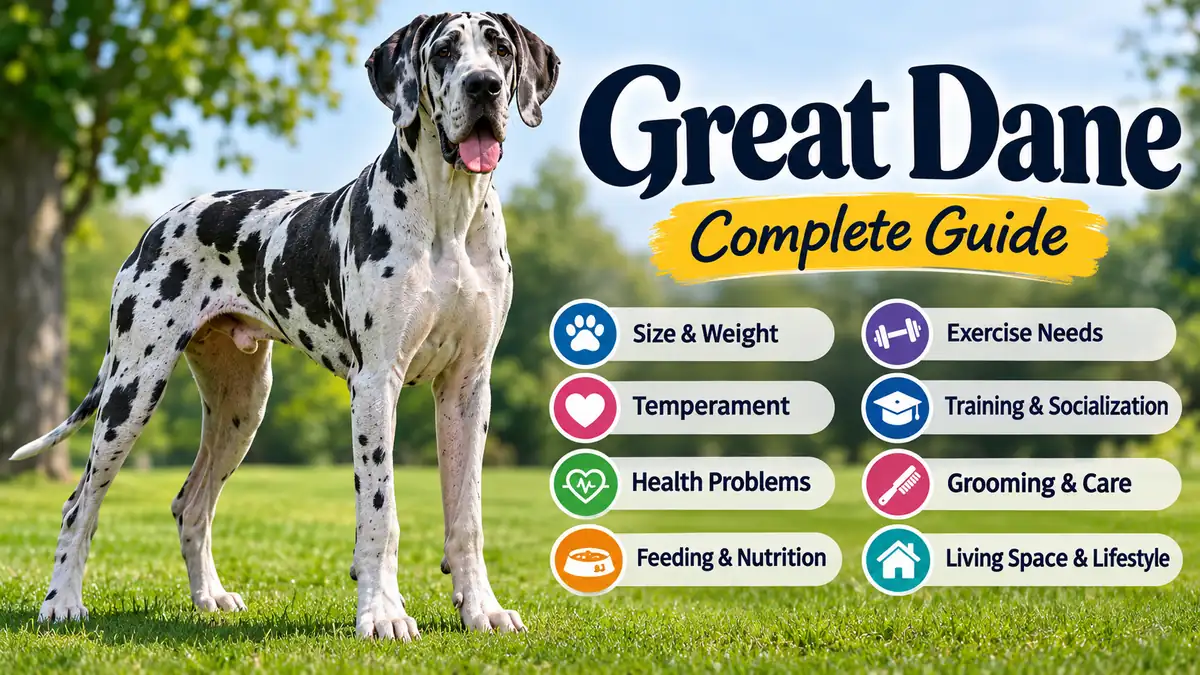
The Great Dane is one of the world’s most recognizable giant dog breeds, combining remarkable height with an affectionate personality. Often called the “gentle giant,” this dog can be a devoted family companion, but its enormous size brings responsibilities that prospective owners should understand.
A great dane is a giant working dog breed originating in Germany, historically developed for hunting wild boar and guarding estates. Adult males typically stand 30–32 inches tall at the shoulder, while females stand 28–30 inches. Great Danes are generally friendly, patient, and loyal, with an average lifespan of 7–10 years. American Kennel Club+1
Their temperament makes them appealing, but proper nutrition, early training, adequate living space, and preventive veterinary care are essential for a healthy life.
Great Dane Breed Overview
The Great Dane belongs to the Working Group recognized by the American Kennel Club (AKC). Its impressive physical proportions, muscular frame, and dignified appearance have earned it the nickname “Apollo of Dogs.”
Despite its name, the breed originated in Germany rather than Denmark.
| Characteristic | Details |
|---|---|
| Breed name | Great Dane |
| Country of origin | Germany |
| Breed group | Working |
| Size | Giant |
| Male height | 30–32 inches |
| Female height | 28–30 inches |
| Male weight | 140–175 pounds |
| Female weight | 110–140 pounds |
| Average lifespan | 7–10 years |
| Coat | Short, smooth |
| Temperament | Friendly, affectionate, patient |
| Shedding | Moderate, seasonal |
| Trainability | Generally good with consistency |
| Exercise needs | Daily walks and age-appropriate activity |
Typical breed characteristics based on AKC and veterinary breed information. Individual dogs may fall outside these ranges. American Kennel Club+1
History and Origin of the Great Dane
The Great Dane’s ancestors were powerful European hunting dogs developed to pursue wild boar. Hunting such dangerous animals required strength, courage, speed, and stamina.
German breeders gradually refined these dogs, producing an imposing but elegant breed known as the Deutsche Dogge, or German Mastiff.
As hunting practices changed, the breed became increasingly valued for guarding estates and providing companionship.
The American Kennel Club officially recognized the Great Dane in 1887.
Modern Great Danes retain their powerful appearance, but responsible breeding emphasizes a stable, friendly temperament rather than aggression.
Why Is It Called a Great Dane?
The name can be misleading because the breed’s development is closely associated with Germany.
The English name became established through historical European naming conventions, including references to large Danish dogs.
Today, the breed is internationally recognized as the Great Dane, while Deutsche Dogge remains its German name.
Great Dane Size, Weight, and Physical Appearance
Die Deutsche Dogge: sanfter Hunde-Riese im Rasseportrait
Great Dane Dog Breed Information | Purina
10
The Great Dane is among the tallest domestic dog breeds. Its combination of long legs, a deep chest, a powerful neck, and a well-proportioned body creates a distinctive silhouette.
Unlike some heavy mastiff breeds, a well-conditioned Great Dane should appear athletic rather than excessively bulky.
How Big Does a Great Dane Get?
Adult males are generally larger and heavier than females.
| Measurement | Male | Female |
|---|---|---|
| Typical height | 30–32 inches | 28–30 inches |
| Height in centimeters | 76–81 cm | 71–76 cm |
| Typical weight | 140–175 lb | 110–140 lb |
| Weight in kilograms | 64–79 kg | 50–64 kg |
These measurements describe typical adults rather than strict limits. Genetics, body condition, nutrition, and individual development influence final size.
The tallest individuals can exceed standard measurements, but exceptional height should not be confused with better health.
Great Dane Growth Stages
Great Dane puppies grow rapidly, particularly during their first year. Their bones, joints, and muscles continue developing after they begin to resemble adults.
| Age | Typical development |
|---|---|
| 0–3 months | Rapid early growth and social development |
| 3–6 months | Significant increases in height and weight |
| 6–12 months | Continued skeletal growth and increasing strength |
| 12–18 months | Height approaches adult proportions |
| 18–24 months | Further physical maturity and muscle development |
| 24+ months | Most dogs have reached physical maturity |
These are general developmental stages, not fixed milestones for every dog.
Owners should monitor body condition rather than trying to make puppies reach a particular weight as quickly as possible.
Excessive calorie intake and inappropriate mineral supplementation can contribute to orthopedic problems in growing giant-breed dogs.
Great Dane Coat Colors and Patterns
Great Dane Dog Breed Information
Fawn
29 amazing pictures of brindle great danes – Artofit
Brindle
Great Dane Colors: The Standard & Rare Great Dane Coat Colors – K9 Web
Harlequin
Dogue Alemão — Filhotes de Linhagem Europeia com Pedigree CBKC | Canil Lothbrok BH
Black
Breed Details – Perfect Pup Match — Perfect Pup Match
Blue
Grey and Black Merle Great Dane on Grey Background
Merle
Common coat varieties include fawn, brindle, black, blue, harlequin, mantle, and merle.
- Fawn: Golden-yellow coloring, often with a black facial mask.
- Brindle: Dark stripes over a fawn-colored background.
- Black: A glossy, predominantly black coat.
- Blue: A solid steel-blue or grayish-blue appearance.
- Harlequin: White background with irregular black patches.
- Mantle: Predominantly black with characteristic white markings.
- Merle: A mottled pattern involving gray and black pigmentation.
Breed standards distinguish accepted show colors from other naturally occurring coat combinations.
Color should never take priority over health, temperament, or responsible breeding practices. Certain pigmentation combinations, particularly those involving two merle parents, can increase the risk of hearing and vision abnormalities in offspring.
Great Dane Temperament and Personality
One of the most appealing features of the Great Dane is the contrast between its enormous body and its often gentle personality.
Many Great Danes form strong emotional attachments to their families and enjoy spending time close to their owners.
They are typically affectionate, sociable, and attentive, although personality varies between individuals.
Are Great Danes Good Family Dogs?
Great Danes can make excellent family companions when properly socialized and trained.
Their common personality traits include:
- Affectionate: They often seek attention and physical closeness.
- Patient: Many tolerate normal household activity well.
- Loyal: They frequently develop strong family bonds.
- Alert: Their size and awareness make them noticeable watchdogs.
- Playful: Young dogs can be energetic and enthusiastic.
- Sensitive: Many respond better to calm guidance than harsh corrections.
The breed’s friendly reputation does not mean every individual will automatically behave gently.
Genetics, early experiences, training, health, and the household environment all affect behavior.
Are Great Danes Good With Children?
A well-socialized Great Dane can be loving and patient with children.
However, even a friendly adult may accidentally knock over a small child while turning, running, or wagging its powerful tail.
Families should establish clear rules for interactions.
Children should not climb on dogs, pull their ears, disturb them while sleeping, or approach their food without adult guidance.
Supervision is essential, especially with toddlers.
A Great Dane’s size makes reliable obedience and impulse control particularly valuable.
Do Great Danes Get Along With Other Dogs and Cats?
Many Great Danes coexist successfully with other dogs, particularly when introduced to different animals during puppyhood.
Compatibility depends on the individual dog’s temperament, socialization history, and previous experiences.
Some Great Danes also live peacefully with cats.
However, their historical hunting background means that prey drive can vary. Small animals may trigger chasing behavior in some individuals.
Introductions should be gradual, controlled, and supervised.
Are Great Danes Aggressive?
Aggression is not considered a desirable characteristic of the breed.
A properly socialized Great Dane is generally expected to be confident and friendly rather than unnecessarily fearful or hostile.
Nevertheless, any dog can develop reactive or aggressive behavior because of fear, pain, inadequate socialization, or other factors.
Because Great Danes are extremely strong, behavioral concerns should be addressed early with a qualified reward-based trainer or veterinary behavior professional.
Do Great Danes Bark a Lot?
Great Danes are not typically considered excessive barkers.
They may bark when someone approaches the house, when they notice unusual activity, or when they want attention.
Their bark is often deep and powerful because of their body size.
Persistent barking may indicate boredom, anxiety, insufficient enrichment, or environmental triggers rather than an inherent breed characteristic.
Great Dane Lifespan and Common Health Problems
The average Great Dane lifespan is approximately 7–10 years, although individual dogs may live shorter or longer lives.
Like several other giant breeds, Great Danes generally have shorter life expectancies than many smaller dogs.
Genetics, preventive veterinary care, body condition, and underlying medical conditions can influence longevity. American Kennel Club+1
Gastric Dilatation-Volvulus (Bloat)
Gastric dilatation-volvulus, commonly called GDV or bloat, is one of the most serious health emergencies affecting Great Danes.
GDV occurs when the stomach becomes distended and twists, potentially disrupting blood flow and causing rapid deterioration.
Warning signs can include:
- Repeated attempts to vomit without producing anything
- A swollen or tight abdomen
- Excessive drooling
- Restlessness or obvious distress
- Rapid breathing or weakness
- Pale gums or collapse
GDV is a life-threatening emergency. If these signs appear, seek emergency veterinary care immediately. Do not wait to see whether symptoms improve.
Preventive strategies often include dividing daily food into multiple meals and discussing individual risk factors with a veterinarian.
A preventive procedure called gastropexy surgically attaches the stomach to the abdominal wall to reduce the risk of twisting. It does not prevent every form of stomach distension.
Owners should discuss the potential benefits, limitations, and timing of gastropexy with their veterinarian.
Dilated Cardiomyopathy (DCM)
Dilated cardiomyopathy is a heart muscle disease that can impair the heart’s ability to pump blood effectively.
Great Danes are among the breeds predisposed to this condition.
Possible symptoms include reduced exercise tolerance, coughing, weakness, fainting, and breathing difficulties.
Some affected dogs show few obvious signs in the early stages.
Veterinarians may use physical examinations, echocardiography, electrocardiography, and other diagnostic tests to evaluate cardiac health.
Early detection can help guide treatment and ongoing monitoring.
Hip Dysplasia and Joint Problems
Hip dysplasia occurs when the hip joint develops abnormally, potentially leading to pain and degenerative joint disease.
Affected dogs may show stiffness, difficulty standing, reluctance to exercise, or changes in their walking pattern.
Maintaining a healthy body condition and providing appropriate exercise are important for joint health.
Other orthopedic concerns can include elbow dysplasia, osteoarthritis, and developmental bone disorders.
Wobbler Syndrome
Wobbler syndrome, also called cervical spondylomyelopathy, affects the cervical spine and can compress the spinal cord.
Symptoms may include an unsteady gait, weakness, difficulty coordinating the legs, and neck discomfort.
A dog showing these signs needs veterinary assessment. Advanced imaging may be required to determine the cause and appropriate treatment.
Thyroid, Eye, and Other Health Conditions
Great Danes may also develop hypothyroidism, autoimmune thyroiditis, eyelid abnormalities, certain cancers, and inherited muscle disorders.
Responsible breeding programs use appropriate screening to identify some inherited risks.
The Great Dane Club of America and AKC recommend health evaluations involving:
| Health screening | Purpose |
|---|---|
| Hip evaluation | Assess hip joint health |
| Cardiac examination | Identify potential heart abnormalities |
| Ophthalmologist examination | Screen for eye conditions |
| Thyroid evaluation | Assess thyroid health |
These tests cannot guarantee that a dog will never develop a health problem, but they provide useful information for breeding decisions and veterinary care. American Kennel Club+1
How to Help a Great Dane Live Longer
No routine can guarantee a particular lifespan, but owners can support their dog’s health through consistent care.
Priorities include maintaining an appropriate weight, providing complete nutrition, scheduling regular veterinary examinations, and responding promptly to changes in behavior or mobility.
Dental care, parasite prevention, vaccination, and age-appropriate exercise also matter.
As Great Danes age, veterinary visits may need to become more frequent to identify problems earlier.
Great Dane Feeding and Nutrition Requirements
Feeding a Great Dane correctly is especially important because giant-breed puppies develop rapidly and adult dogs have substantial nutritional needs.
The goal is steady, controlled growth rather than maximum weight gain.
What Should a Great Dane Eat?
Great Dane puppies should receive a complete diet specifically formulated for the growth of large or giant-breed dogs.
These diets are designed to provide appropriate energy and mineral levels during skeletal development.
Excess calcium supplementation, inappropriate homemade diets, and overfeeding can create nutritional imbalances.
Adult Great Danes generally need a complete, balanced diet suited to their age, activity level, and health status.
A veterinarian can help determine appropriate portions based on the dog’s ideal body condition.
How Much Food Does a Great Dane Need?
Daily food requirements vary considerably depending on age, weight, activity level, metabolism, and the calorie density of the food.
A growing puppy may require more calories per pound of body weight than a mature adult.
Rather than relying on a universal number of cups, use the feeding instructions on an appropriate diet as a starting point and adjust with veterinary guidance.
Monitor body condition regularly. A healthy Great Dane should have a visible waist when viewed from above and ribs that can be felt beneath a thin layer of tissue.
Great Dane Feeding Schedule
| Life stage | General feeding approach |
|---|---|
| Young puppy | Three or more measured meals daily, as advised |
| Older puppy | Usually two or three meals daily |
| Adult | Commonly two or more meals daily |
| Senior | Individualized portions and meal frequency |
Feeding one enormous meal each day is generally discouraged.
Dividing food into smaller meals can be more practical, particularly for dogs at risk of GDV.
Avoid strenuous activity immediately around mealtimes, although no feeding routine completely eliminates the risk of bloat.
Foods Great Danes Should Avoid
Like other dogs, Great Danes should not consume foods known to be toxic to canines.
Examples include chocolate, grapes, raisins, onions, garlic in toxic quantities, xylitol, and alcoholic beverages.
Cooked bones can splinter and cause choking or gastrointestinal injury.
Human medications and nutritional supplements should never be given without appropriate veterinary guidance.
Fresh drinking water should always be available.
Great Dane Exercise and Activity Needs
Despite their imposing size, Great Danes are not necessarily high-endurance athletes.
Many adults enjoy regular walks, moderate play, and relaxed time indoors.
However, they still need daily physical activity and mental stimulation.
How Much Exercise Does a Great Dane Need?
Exercise recommendations vary according to age, fitness, and individual health.
The PDSA recommends substantial daily activity for healthy adult Great Danes, while veterinary guidance emphasizes moderate, controlled exercise suited to the individual dog. PDSA+1
Suitable activities may include walking, exploring secure outdoor areas, gentle games, and supervised social interaction.
Owners should watch for excessive panting, stiffness, limping, or reluctance to continue.
Exercise should be adjusted during hot weather because overheating can be dangerous.
Exercise for Great Dane Puppies
Puppies need movement and opportunities to explore, but their developing joints should not be subjected to excessive repetitive stress.
Avoid forced long-distance running, prolonged jogging, and repeated high-impact jumping during growth.
Short, age-appropriate walks and self-directed play on safe surfaces are generally preferable.
There is no single exercise duration that suits every puppy. Ask a veterinarian for guidance based on the dog’s developmental stage.
Can Great Danes Go Running?
Healthy, physically mature Great Danes may enjoy some running, but prolonged jogging is not appropriate for every individual.
The AKC advises waiting until approximately two years of age before introducing more demanding activities such as regular jogging or hiking. American Kennel Club
Before beginning a running program, consider the dog’s joint health, cardiovascular fitness, body condition, and environmental temperature.
Great Dane Training and Socialization
Training a Great Dane is essential because an adult can easily outweigh the person holding its leash.
Behaviors that appear harmless in a small puppy can become difficult or dangerous when the dog reaches full size.
Are Great Danes Easy to Train?
Great Danes are generally intelligent and capable of learning obedience commands.
Many respond particularly well to positive reinforcement, including treats, praise, and play.
However, their size, occasional stubbornness, and sensitivity can make consistent training important.
Harsh corrections may create fear or damage trust without improving long-term reliability.
Essential Commands for Great Danes
Start with these practical skills:
- Sit: Helps develop impulse control during greetings and daily routines.
- Stay: Encourages calm behavior around doors and visitors.
- Come: Builds a reliable recall in safe environments.
- Leave it: Helps prevent unwanted investigation or ingestion.
- Loose-leash walking: Makes controlling a large adult much safer.
- Settle: Teaches the dog to relax in a designated place.
Short, frequent sessions are often more productive than lengthy training periods.
Practice commands in gradually more distracting environments as the dog becomes reliable.
Socializing a Great Dane Puppy
Early socialization involves helping a puppy develop positive associations with different people, animals, sounds, surfaces, and environments.
Good experiences during puppyhood can reduce the likelihood of fear-related behavior later.
Socialization should not mean forcing a puppy to interact with every unfamiliar dog or person.
Instead, allow controlled exposure at a comfortable distance, rewarding calm behavior.
Puppy classes led by qualified trainers can provide useful opportunities for learning and supervised interaction.
Great Dane Grooming and Daily Care
The Great Dane has a short, smooth coat that is comparatively easy to maintain.
However, its enormous body means even simple grooming tasks can require more time and equipment than they would for a smaller dog.
Do Great Danes Shed?
Yes. Great Danes shed throughout the year, with some experiencing heavier seasonal shedding.
Their short hairs can accumulate on furniture, carpets, and clothing.
Weekly brushing with a rubber grooming mitt or soft brush helps remove loose hair.
More frequent brushing may be useful during periods of heavier shedding.
Bathing and Skin Care
Great Danes generally need occasional baths rather than frequent washing.
Use a mild shampoo formulated for dogs and rinse thoroughly.
Excessive bathing can dry the skin and remove protective natural oils.
Check the coat regularly for redness, irritation, unusual lumps, or areas of hair loss.
Nail, Ear, and Dental Care
Nails should be trimmed or filed regularly to prevent discomfort and changes in walking posture.
Ears should be checked for redness, odor, discharge, or irritation. Cleaning should follow veterinary guidance rather than a rigid schedule.
Dental care is equally important.
Regular brushing with dog-safe toothpaste can reduce plaque accumulation and help maintain oral health.
Do Great Danes Drool?
Many Great Danes drool, particularly after drinking, eating, or becoming excited.
The amount varies between individuals.
Keeping a towel nearby is a practical solution for everyday drooling.
Sudden excessive salivation, particularly when accompanied by abdominal swelling, distress, or unproductive retching, may indicate a medical emergency and requires immediate veterinary attention.
Great Dane Living Space and Lifestyle Compatibility
A Great Dane’s physical size influences nearly every aspect of daily life.
Beds, vehicles, doorways, travel arrangements, and veterinary handling all require consideration.
Can a Great Dane Live in an Apartment?
Some Great Danes can adapt to apartment living, especially if they are calm indoors and receive appropriate daily exercise.
However, limited space creates practical challenges.
A large dog needs enough room to stand, turn, lie down comfortably, and move without constantly bumping into furniture.
Access to safe walking areas and reliable elevators or manageable stairs may also matter.
A house with a secure garden can make daily care easier, but outdoor space does not replace walks, training, or companionship.
Can Great Danes Be Left Alone?
Great Danes often develop strong attachments to their families.
Some tolerate short periods alone, while others experience separation-related distress.
Gradual independence training can help.
Start with brief absences and reward relaxed behavior, increasing duration only when the dog remains comfortable.
Destructive chewing, persistent vocalization, pacing, and attempts to escape may indicate distress rather than disobedience.
Dogs showing significant separation anxiety may benefit from professional behavioral support.
Are Great Danes Good for First-Time Owners?
A first-time owner can successfully care for a Great Dane, but the breed presents challenges that should not be underestimated.
The most significant considerations are physical strength, training, space, veterinary expenses, and the potential for serious health conditions.
Owners should be comfortable managing a powerful dog and providing consistent structure.
Previous dog-handling experience can help, but commitment to appropriate training and responsible care is more important than experience alone.
Great Dane Care Expenses
Although Great Danes have relatively simple grooming requirements, other expenses can be substantial.
Their food consumption, medication doses, bedding, equipment, and veterinary procedures may cost more than those of smaller breeds.
| Expense | Why it matters |
|---|---|
| Food | Large body size creates substantial nutritional requirements |
| Veterinary care | Diagnostic tests, medications, and surgery may be expensive |
| Bedding | Large, supportive beds help provide comfortable rest |
| Transport | Suitable vehicle space and safe restraints are needed |
| Training | Early obedience and socialization are particularly important |
| Preventive care | Vaccinations, parasite control, and health screening require ongoing budgeting |
Unexpected veterinary treatment, particularly emergency surgery for GDV, can create significant financial pressure.
Planning for these possibilities is part of responsible giant-breed ownership.
Great Dane Compared With Other Giant Dog Breeds
Great Danes share some characteristics with other giant breeds, but differences in build, temperament, coat, and activity requirements can be significant.
| Breed | General build | Coat | Typical characteristics |
|---|---|---|---|
| Great Dane | Very tall, athletic | Short | Affectionate, alert, sociable |
| English Mastiff | Extremely heavy, muscular | Short | Calm, protective, devoted |
| Irish Wolfhound | Very tall, lean | Rough | Gentle, independent, quiet |
| Saint Bernard | Heavy, powerful | Short or long | Patient, friendly, substantial grooming needs |
| Newfoundland | Large, heavy | Dense double coat | Gentle, water-oriented, affectionate |
These descriptions represent broad breed tendencies rather than guarantees about individual dogs.
Great Dane vs. English Mastiff
The English Mastiff is generally heavier and more thickly built, while the Great Dane tends to have a taller, leaner appearance.
Both breeds can be affectionate companions, but their physical handling requirements differ.
Great Dane vs. Irish Wolfhound
The Irish Wolfhound is another exceptionally tall breed.
It has a rough coat and a historical background involving hunting large animals.
The Great Dane typically has a smoother coat and a more muscular, compact outline.
Both breeds require thoughtful exercise management and appropriate veterinary care.
Is the Great Dane the Biggest Dog Breed?
The answer depends on how size is measured.
Great Danes are among the tallest breeds, while English Mastiffs commonly exceed them in body mass.
Individual Great Danes have held world records for height, including dogs named Zeus.
However, exceptional record-holding individuals are not representative of typical breed size.
Choosing and Caring for a Great Dane Puppy
Great Dane Animal Pictures | A-Z Animals
Harlequin Great Dane Puppy Sitting In Grass Hd Wallpaper | Rare Gallery
11
A Great Dane puppy may look manageable at eight weeks old, but its growth can be remarkably rapid.
Preparing for adulthood before bringing a puppy home makes daily life easier.
What to Look for in a Healthy Great Dane Puppy
A healthy puppy should generally appear alert, curious, and comfortable moving around.
The eyes should be clear, breathing should appear normal, and the puppy should not show persistent coughing, diarrhea, or obvious lameness.
Temperament is also important.
A puppy should have opportunities for appropriate social interaction and gradual exposure to normal household experiences.
Ask for veterinary records, vaccination information, and details of any medical concerns.
Understanding Health Testing
Responsible breeders should be able to explain the health screening performed on the puppy’s parents.
For Great Danes, particular attention should be paid to hip, heart, eye, and thyroid evaluations.
The Orthopedic Foundation for Animals (OFA) maintains health-testing records that can help verify certain results.
The Canine Health Information Center (CHIC) program provides a framework for documenting recommended breed-specific screening.
A CHIC number indicates that required testing has been completed and made available according to program rules; it does not necessarily mean every result was normal.
Preparing the Home
Before a Great Dane puppy arrives, arrange a safe resting area, appropriately sized feeding equipment, secure storage for hazardous items, and a suitable walking harness or collar.
Use non-slip surfaces where practical, especially in areas where the puppy frequently walks or plays.
A supportive bed and enough room to stretch out comfortably are worthwhile.
Introduce household routines gradually, including toileting, handling, grooming, and brief periods of independence.
Common Mistakes to Avoid
Some preventable problems arise when owners underestimate how quickly giant-breed puppies mature physically.
Common mistakes include overfeeding to encourage faster growth, delaying leash training, allowing repeated jumping on people, and introducing strenuous exercise too early.
Another mistake is assuming a friendly puppy will automatically become a well-mannered adult.
Consistent guidance during the early months helps establish habits that remain manageable as the dog grows.
Is a Great Dane the Right Dog for Your Family?
The Great Dane combines an affectionate temperament with extraordinary physical size.
For households that can accommodate its needs, the breed can be a loyal, entertaining, and deeply attached companion.
However, its short average lifespan and predisposition to serious medical conditions deserve careful consideration.
Advantages of Living With a Great Dane
Great Danes are often affectionate and strongly people-oriented. Many enjoy relaxed indoor companionship once their exercise needs have been met.
Their short coats are comparatively easy to groom, and they are generally responsive to consistent reward-based training.
They can also be effective watchdogs because their imposing appearance and deep bark may alert household members to unfamiliar activity.
Challenges of Living With a Great Dane
The breed’s greatest challenges arise from its size and health considerations.
An adult Great Dane requires substantial food, appropriately sized equipment, safe transportation, and potentially expensive veterinary treatment.
Its strength makes early training essential, while its relatively short lifespan can be emotionally difficult for owners.
Some dogs also struggle with being left alone for extended periods.
What Makes a Responsible Great Dane Owner?
Successful ownership depends on realistic expectations and consistent daily care.
A suitable household should be prepared to provide:
- Sufficient indoor space and a comfortable resting area.
- Daily exercise appropriate to the dog’s age and health.
- Positive reinforcement training and socialization.
- Complete, balanced nutrition and weight management.
- Routine veterinary care and awareness of emergency symptoms.
- Time for companionship and mental enrichment.
- Financial preparation for both routine and unexpected expenses.
A secure garden is helpful but does not replace human interaction or structured activity.
Final Thoughts on the Great Dane
The great dane is an extraordinary combination of strength, elegance, and affection. Its towering appearance may seem intimidating, but many individuals are gentle, playful, and devoted to their families.
Understanding Great Dane size, temperament, lifespan, feeding requirements, and health risks is essential before taking responsibility for one of these giant dogs.
Early socialization, appropriate nutrition, controlled growth, regular exercise, and preventive veterinary care all contribute to better long-term welfare.
For people who have the space, resources, and time to meet its needs, the Great Dane can be a rewarding family companion whose personality is every bit as memorable as its size.