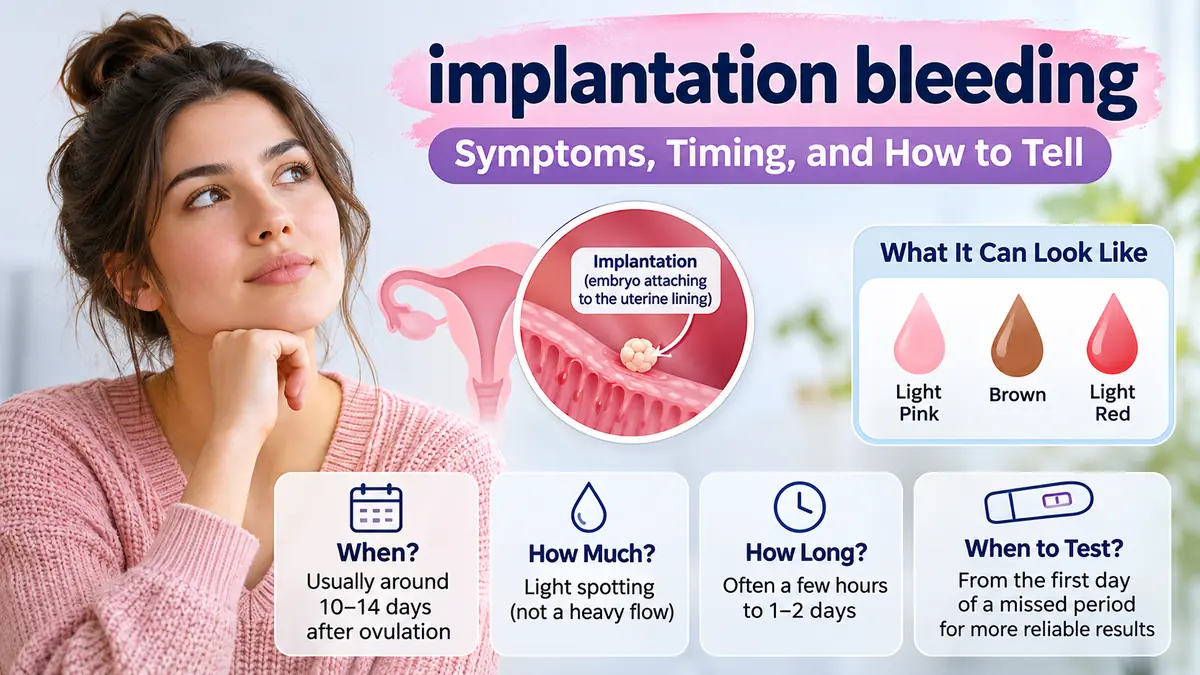
Noticing light pink or brown spotting before your expected period can leave you wondering whether pregnancy has begun. One possible explanation is implantation bleeding, but spotting alone cannot confirm pregnancy.
Implantation bleeding is light vaginal spotting sometimes reported around the time a fertilized egg attaches to the uterine lining during early pregnancy. It is generally described as lighter and shorter than menstrual bleeding. However, not everyone experiences it, and research has not established that implantation itself directly causes the spotting.
Understanding the timing, appearance, and other possible causes of early pregnancy bleeding can help you decide when to test and when to seek medical care.
What Is implantation bleeding?
Implantation is the process by which an early embryo, called a blastocyst, attaches to and begins embedding in the endometrium, the lining of the uterus. This is a normal stage of early pregnancy.
After fertilization, the developing embryo travels through the fallopian tube toward the uterus. It undergoes several rounds of cell division before reaching the stage at which implantation can begin.
Implantation typically begins about six to ten days after fertilization, although the timing varies.
Some people notice light spotting during this general period. This is commonly called implantation bleeding.
There is an important scientific distinction: although the term is widely used, spotting around implantation does not necessarily mean that the attachment process caused bleeding. Prospective research has not consistently found bleeding to occur on the exact day of implantation.
Does everyone experience implantation bleeding?
No. Many healthy pregnancies begin without any noticeable bleeding.
There is no reliable, universally accepted percentage of pregnant people who experience bleeding specifically caused by implantation. Estimates frequently quoted online may combine different types of first-trimester spotting.
The absence of spotting does not mean implantation failed, just as spotting does not prove that implantation occurred.
When Does implantation bleeding Happen?
Spotting described as implantation bleeding is usually reported around the expected menstrual period, often approximately 10–14 days after ovulation.
The timing can overlap with the beginning of menstruation, which makes the two difficult to distinguish without pregnancy testing.
Early pregnancy timeline
Illustrative timing in a cycle with ovulation around day 14
Day 14
Ovulation
An egg is released from the ovary.
Days 14–15
Possible fertilization
Sperm may fertilize the egg in the fallopian tube.
Days 20–24
Implantation begins
The developing embryo may start attaching to the uterine lining.
Around day 28
Expected period
A home pregnancy test becomes more reliable around a missed period.
Actual timing varies with ovulation, cycle length, and individual pregnancy development. This is not a diagnostic timeline.
Can implantation bleeding happen five days after ovulation?
Bleeding five days after ovulation is generally earlier than the usual implantation window. If ovulation was accurately identified, implantation would be an unlikely explanation at that point.
However, ovulation dates calculated by period-tracking apps are estimates. Hormonal changes, cervical irritation, or other causes may explain spotting during this time.
Can it happen after a missed period?
Light bleeding can occur after a missed period, including during an established pregnancy. It should not automatically be attributed to implantation.
A positive pregnancy test followed by bleeding deserves particular attention, especially when accompanied by pain, dizziness, or increasing blood flow.
What Does implantation bleeding Look Like?
Spotting commonly described as implantation bleeding is usually light, sometimes appearing as a few spots on underwear or toilet paper.
Its appearance varies, and color alone cannot establish the cause.
Color: Pink, Brown, or Red?
- Light pink: A small amount of blood mixed with cervical mucus or vaginal discharge.
- Brown: Blood that has taken longer to leave the reproductive tract.
- Light red: Fresh bleeding, which can have several possible causes.
Bright red bleeding does not automatically rule out pregnancy, but heavier or persistent bleeding should be medically assessed.
How much bleeding is typical?
The term generally refers to spotting rather than a continuous menstrual-like flow.
Someone may notice a few drops or a small stain without needing a regular menstrual pad.
Bleeding that soaks pads, contains substantial clots, or becomes progressively heavier is not typical of what is usually described as implantation spotting.
How long does implantation bleeding last?
Descriptions commonly range from a few hours to one or two days.
However, these durations are not reliable diagnostic criteria. Early pregnancy spotting can last longer or recur for reasons unrelated to implantation.
If bleeding continues, worsens, or occurs with pain, a healthcare professional can help identify its cause.
implantation bleeding vs. Period: Key Differences
Implantation spotting and menstruation may appear similar, particularly when bleeding occurs near the expected period.
The most useful distinctions involve flow, duration, associated symptoms, and pregnancy testing, although none of these can provide a definite diagnosis by themselves.
| Feature | Spotting described as implantation bleeding | Menstrual period |
|---|---|---|
| Timing | Around the expected period | Usually follows the person’s menstrual cycle |
| Flow | Generally very light | Light to heavy |
| Color | Often pink or brown | Red, dark red, or brown |
| Duration | Often brief | Commonly 2–7 days |
| Clots | Not typical | May occur |
| Cramps | May be absent or mild | Can range from mild to severe |
| Pregnancy test | May become positive as hCG rises | Usually negative unless pregnancy is also present |
These differences are tendencies, not rules. Some menstrual periods begin with light brown spotting, while early pregnancy bleeding may look red.
Can implantation bleeding be as heavy as a period?
Bleeding heavy enough to resemble a normal or heavy period should not be assumed to be implantation bleeding.
Possible explanations include menstruation, an early pregnancy loss, or another gynecological condition.
If pregnancy is possible, take a pregnancy test and seek medical advice for substantial bleeding.
Does implantation bleeding have clots?
Small amounts of spotting usually do not contain noticeable clots.
Passing clots or tissue during a possible pregnancy warrants medical evaluation, especially if bleeding is accompanied by pelvic pain.
Clots alone cannot determine whether a pregnancy is viable.
Symptoms That May Occur Around Early Pregnancy
Some people notice mild cramping, breast tenderness, fatigue, or changes in vaginal discharge around the same time as spotting.
These symptoms can occur in early pregnancy, but they also overlap with premenstrual syndrome (PMS).
Mild cramps and lower abdominal discomfort
Mild pelvic cramping can occur around the expected period or in early pregnancy.
It may feel like a dull ache, pressure, or intermittent discomfort.
Cramping should not be considered proof of implantation. Persistent, severe, or one-sided pain needs prompt medical assessment because it may indicate an ectopic pregnancy or another medical problem.
Breast tenderness and fatigue
Changes in estrogen and progesterone can cause breast sensitivity, bloating, tiredness, and mood changes.
These hormones also fluctuate during the normal menstrual cycle, making symptoms alone unreliable for identifying pregnancy.
Nausea and frequent urination
Nausea and increased urination may develop during early pregnancy, often after a missed period.
They are not specific signs of implantation and can have other explanations.
Can implantation bleeding occur without symptoms?
Yes. Someone may notice light spotting without cramps, nausea, breast tenderness, or any other changes.
Likewise, a person may have a confirmed pregnancy without spotting or obvious early symptoms.
What Causes Spotting During Early Pregnancy?
Not every episode of bleeding near a missed period is associated with implantation.
Several conditions can cause vaginal spotting, ranging from minor cervical changes to complications requiring urgent treatment.
Hormonal changes and cervical sensitivity
During pregnancy, increased blood flow can make the cervix more sensitive.
Spotting may occur after sexual intercourse, a pelvic examination, or other contact with cervical tissue.
Hormonal fluctuations can also contribute to irregular bleeding outside pregnancy.
Subchorionic hematoma
A subchorionic hematoma is a collection of blood between the chorion, a membrane surrounding the developing pregnancy, and the uterine wall.
It may cause spotting or heavier bleeding and can sometimes be identified through ultrasound.
Its significance depends on factors such as size, location, gestational age, and associated symptoms.
Chemical pregnancy and early miscarriage
A chemical pregnancy is a very early pregnancy loss detected through a positive pregnancy test before the pregnancy can usually be seen on ultrasound.
Bleeding may resemble a late or heavier-than-usual period.
Early miscarriage can also cause vaginal bleeding, cramping, and passage of tissue. However, bleeding does not always mean a miscarriage is occurring.
Ectopic pregnancy
An ectopic pregnancy occurs when a fertilized egg implants outside the uterine cavity, most commonly in a fallopian tube.
It can cause vaginal spotting or bleeding, sometimes accompanied by one-sided pelvic pain.
An ectopic pregnancy can become life-threatening if internal bleeding occurs.
Seek emergency medical care immediately for severe abdominal or pelvic pain, shoulder-tip pain, fainting, marked dizziness, or weakness, especially if pregnancy is possible. Do not wait for a positive home test if these symptoms occur.
Infections, polyps, and other causes
Other potential causes include cervical polyps, vaginal or cervical infections, sexually transmitted infections, and irritation.
Bleeding accompanied by fever, unusual discharge, unpleasant odor, or pelvic pain should be evaluated by a clinician.
When to Take a Pregnancy Test After Spotting
A home pregnancy test detects human chorionic gonadotropin (hCG), a hormone produced after implantation begins.
Testing too early can produce a negative result even when pregnancy has started.
Best time for a home pregnancy test
For most people, testing on or after the first day of a missed period provides more reliable results than testing several days beforehand.
If your menstrual cycles are irregular or you do not know when your period is due, the UK’s National Health Service recommends testing at least 21 days after unprotected sex.
For early testing, first-morning urine may improve the chance of detecting low hCG levels. Follow the manufacturer’s instructions and read results within the specified time window.
What if the test is negative?
A negative test taken before or shortly after the expected period may be too early.
If menstruation has not started, repeat the test after 48–72 hours or according to the test instructions.
If results remain negative but your period is significantly delayed, contact a healthcare professional.
Can you get a positive test during implantation bleeding?
A positive result is possible during an episode of spotting if enough hCG has accumulated in the urine.
However, a positive test cannot establish that the bleeding came from implantation.
If a test is positive and you are bleeding, contact a pregnancy-care clinician for advice, particularly if bleeding persists or pain develops.
Blood hCG tests and ultrasound
Healthcare professionals may use quantitative serum hCG testing to measure pregnancy hormone levels.
Repeated measurements can help assess how a pregnancy is progressing, although hCG patterns alone cannot reliably determine the pregnancy’s location or viability.
Transvaginal ultrasound may be used to locate the pregnancy and evaluate bleeding. Very early scans may be inconclusive, making follow-up testing necessary.
When Should You Seek Medical Attention?
Light spotting does not always indicate a serious problem. Nevertheless, bleeding during a confirmed or suspected pregnancy should not automatically be dismissed as harmless implantation bleeding.
Warning signs requiring urgent attention
Seek emergency care if you experience severe or worsening abdominal pain, shoulder-tip pain, fainting, significant dizziness, or heavy bleeding, particularly if pregnancy is possible.
Contact a healthcare professional promptly if you have a positive pregnancy test with bleeding, persistent spotting, increasing cramps, fever, or unusual vaginal discharge.
A clinician may review your menstrual history, pregnancy-test results, symptoms, and risk factors before recommending an examination, ultrasound, or laboratory testing.
What information should you track?
Keeping a brief record can make a medical consultation more useful.
Record the date spotting began, its approximate amount, color, whether it stopped or continued, any associated pain, and the results of pregnancy tests.
Also note the first day of your last menstrual period and any known ovulation date. These details help clinicians interpret symptoms and estimate pregnancy timing.
Does bleeding mean the pregnancy is not viable?
No. Many pregnancies continue normally after first-trimester bleeding.
However, the appearance and amount of bleeding cannot confirm that a pregnancy is developing normally.
Clinical assessment is particularly important when symptoms are worsening or when the location of the pregnancy has not been established.
Common Misconceptions About implantation bleeding
Misunderstandings about implantation spotting can lead to unnecessary worry or false reassurance.
Myth: Implantation bleeding confirms pregnancy
Spotting cannot confirm pregnancy. Menstrual changes, ovulation-related spotting, and cervical irritation may produce similar symptoms.
A pregnancy test is a more dependable first step.
Myth: No implantation bleeding means pregnancy is unlikely
Many people who become pregnant never notice spotting. Its absence does not indicate infertility, failed implantation, or a higher risk of miscarriage.
Myth: Brown spotting is always harmless
Brown blood generally indicates blood that has taken longer to leave the body. It does not establish why bleeding occurred.
Brown discharge can sometimes accompany an ectopic pregnancy, miscarriage, or infection, so associated symptoms matter more than color alone.
Myth: You can identify implantation by the exact day bleeding starts
Ovulation dates are often uncertain, and spotting does not provide a precise implantation date.
Even when ovulation is carefully tracked, bleeding patterns cannot reliably pinpoint when an embryo attached to the uterine lining.
What to Do If You Think You Have implantation bleeding
If you notice unexpected spotting and pregnancy is possible, focus on confirming pregnancy and monitoring symptoms rather than trying to diagnose implantation from appearance.
- Check your cycle dates. Note your last menstrual period, estimated ovulation, and when spotting began.
- Monitor the bleeding. Record whether it remains light, stops, or becomes heavier.
- Take a pregnancy test at the appropriate time. Testing from the first day of a missed period is generally more reliable.
- Repeat an early negative test. If your period has not arrived, test again after a few days.
- Contact a healthcare professional if pregnancy is confirmed and bleeding occurs. They can advise whether an examination or further testing is needed.
- Seek emergency care for warning signs. Severe pain, fainting, shoulder-tip pain, or heavy bleeding require immediate assessment.
There is no proven home treatment that causes implantation spotting to stop or guarantees that an embryo will implant successfully.
Normal daily activities generally do not need to be restricted solely because of a small amount of spotting, but follow individualized medical advice if you have a confirmed pregnancy or additional symptoms.
Final Thoughts on implantation bleeding
Implantation bleeding is a commonly used term for light spotting around the beginning of pregnancy. It is typically described as pink or brown, brief, and much lighter than a menstrual period.
However, the timing and appearance of spotting cannot reliably identify its cause or confirm pregnancy. Many people experience no bleeding at all.
The most useful next step is to take a pregnancy test at the appropriate time. If pregnancy is confirmed and bleeding occurs, seek medical advice. Heavy bleeding, severe abdominal pain, shoulder pain, or fainting requires emergency assessment.
Understanding these distinctions can help you recognize early pregnancy changes without overlooking symptoms that deserve medical attention.