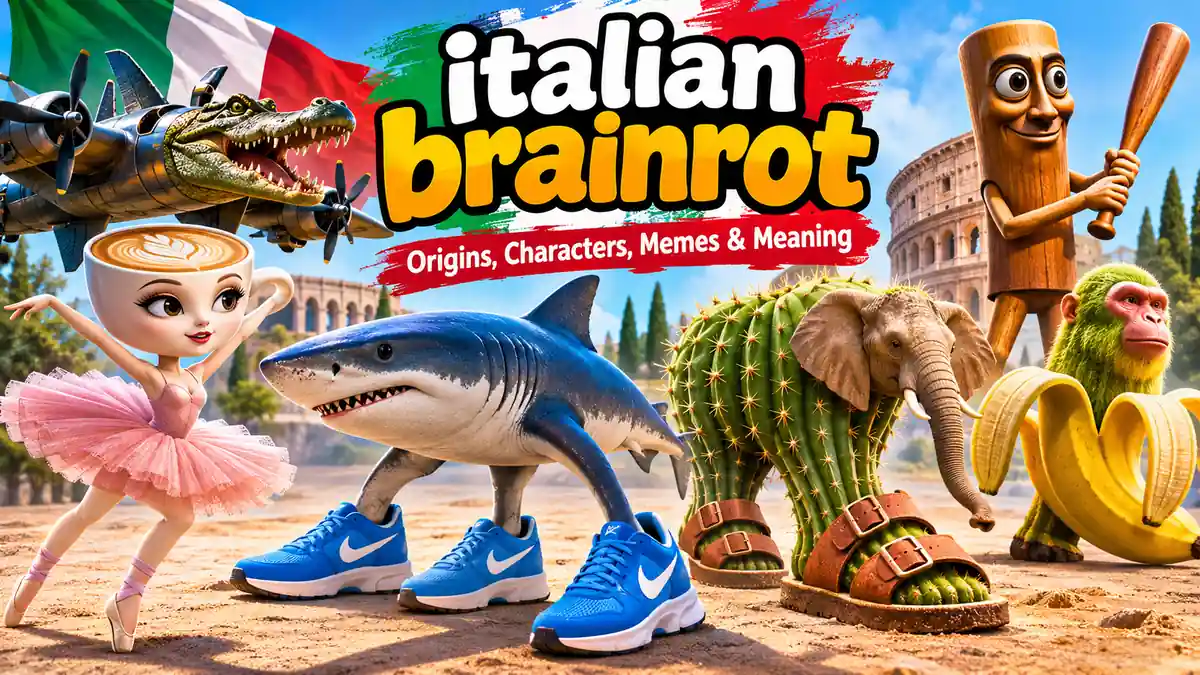
Imagine a shark wearing bright blue sneakers, a crocodile fused with a military aircraft, and a ballerina with a cappuccino cup for a head. Now imagine all three appearing in absurd videos with dramatic Italian-sounding narration. That is the strange, hilarious world of italian brainrot.
italian brainrot is a viral internet meme trend featuring surreal, often AI-generated characters with bizarre names, exaggerated Italian-style voiceovers, and nonsensical stories. It became especially popular on TikTok in 2025 before spreading across YouTube Shorts, Instagram Reels, gaming communities, and other social platforms.
What makes the trend unusual is that the characters are more than random images. They have names, recognizable appearances, recurring audio clips, and sometimes elaborate fictional relationships or rivalries.
Understanding the phenomenon means looking at how it started, who its most famous characters are, and why its chaotic humor became so appealing to internet audiences.
What Is italian brainrot?
The term italian brainrot describes a style of absurdist internet humor built around fictional creatures, AI-generated visuals, and exaggerated Italian-sounding narration.
A typical video features a character that combines unrelated objects, animals, foods, or machines. A synthesized voice then repeats the character’s unusual name or delivers a rhyming monologue.
The result is intentionally ridiculous.
Unlike traditional comedy, these memes do not always have a clear setup or punchline. Their humor comes from unexpected combinations, strange sounds, exaggerated delivery, and repetition.
Why Is It Called Brainrot?
The word brainrot, often written as brain rot, is internet slang for content perceived as silly, repetitive, or mentally numbing, particularly when someone consumes large amounts of it online.
Oxford University Press selected “brain rot” as its 2024 Word of the Year, reflecting the term’s growing use in discussions about internet culture.
In the context of these memes, the term is generally playful rather than a medical description.
People might jokingly say they have brainrot after repeatedly hearing a character’s name or recognizing an obscure meme that makes little sense outside their online community.
Is italian brainrot Actually Italian?
The trend uses elements associated with Italian language and culture, including Italian-sounding names, exaggerated pronunciation, coffee references, and musical rhythms.
However, the content is not necessarily created by Italian people, and much of its language is invented, distorted, or grammatically nonsensical.
Some names contain recognizable Italian words, while others are simply designed to sound entertaining when spoken aloud.
It is better understood as a global internet meme using an exaggerated Italian-inspired aesthetic than as an authentic representation of Italian culture.
How Did italian brainrot Start?
The trend emerged from a combination of AI-generated imagery, text-to-speech narration, absurdist humor, and short-form video culture.
Its most recognizable form spread rapidly during early 2025, when creators began sharing bizarre animal-object hybrids accompanied by rhythmic, Italian-sounding audio.
Rather than developing through one official creator or storyline, the trend expanded through countless remixes, reposts, and new character designs.
The Rise of Tralalero Tralala
One of the earliest and most recognizable figures associated with the trend is Tralalero Tralala.
This character is usually depicted as a shark with legs wearing blue sneakers, often resembling Nike footwear.
The unusual visual design and memorable repeated phrase made it especially suitable for short videos and remixes.
The audio associated with early versions also contains offensive religious language in some recordings. That detail is often absent from simplified explanations of the meme, but it matters when considering whether particular clips are appropriate for younger audiences.
The shark’s popularity helped establish a recognizable format: a strange AI creature, a memorable name, and an exaggerated voiceover.
Why AI-Generated Images Became Central
Generative artificial intelligence made it easier for creators to visualize combinations that would otherwise require advanced illustration or animation skills.
A prompt describing a crocodile merged with an aircraft, for example, could produce a surreal image that became the basis for a new fictional character.
Creators could then combine that image with synthetic speech, sound effects, captions, and editing software.
The resulting videos were inexpensive to imitate and easy to remix.
This accessibility helped the meme format spread across languages and communities.
The Role of TikTok and Short-Form Video
TikTok’s short-video format was particularly suited to the trend because the memes rely on immediate visual surprise and recognizable sounds.
A viewer does not need several minutes of explanation to understand that a walking coffee cup or a sneaker-wearing shark is intentionally absurd.
Other creators can reproduce the format, add their own characters, or combine existing ones into fictional battles.
YouTube Shorts and Instagram Reels helped extend that circulation beyond TikTok.
The trend became recognizable not because every video told the same story, but because the videos shared a consistent style of visual and audio absurdity.
Most Popular italian brainrot Characters and Their Names
The characters are the heart of the phenomenon. Some became famous through a single viral sound, while others developed elaborate fan-created backstories.
There is no universally accepted official character list. New creations appear regularly, and spellings can vary between videos.
Here are some of the best-known characters associated with the original trend and its international spin-offs.
1. Tralalero Tralala
The iconic shark wearing blue sneakers, sometimes depicted with three legs. Its rhythmic name and dramatic narration helped establish the meme format in January 2025.
TikTok: Qué es Tralalero Tralala y cuál es el origen del meme
2. Bombardiro Crocodilo
A crocodile combined with a military bomber aircraft. It became a recognizable character in February 2025. Some original versions contain disturbing references to real-world violence, although many later remixes focus only on the bizarre appearance.
Italian Brainrot: Meaning, Characters, Roblox Game, Risks And How It Took Over Gen Alpha
3. Ballerina Cappuccina
A ballerina with a cappuccino cup for a head, usually wearing a tutu and ballet shoes. Her dance-inspired presentation made her popular in edits, fictional relationships, and fan-created stories.
Lirili Larila(Lirilì Larilà) – Italian Brainrot Wiki
4. Lirili Larila
An elephant-cactus hybrid commonly shown walking through a desert in oversized sandals or slippers. Its unusual appearance demonstrates the trend’s love of combining unrelated objects and animals.
Feet Pics Everyday – Italian Brainrot Wiki
5. Brr Brr Patapim
A monkey-like creature merged with a tree or forest, often shown with enormous feet. Its repetitive name and distinctive design helped it gain attention in March 2025.
Chimpanzini Bananini Meaning: Everything to Know About It
6. Chimpanzini Bananini
A chimpanzee and banana hybrid. The character uses a simple visual joke, combining a fruit associated with monkeys and the animal itself into one surreal creature.
Что обозначает Тунг-Тунг-Тунг Сахур и как появился этот мем — Московские новости
7. Tung Tung Tung Sahur
A wooden humanoid figure frequently shown carrying a bat. It originated in Indonesian meme culture and references sahur, the pre-dawn meal eaten during Ramadan. Although not originally Italian, it became closely associated with the broader brainrot character universe.
Stream Cappuccino Assassino music | Listen to songs, albums, playlists for free on SoundCloud
8. Cappuccino Assassino
An anthropomorphic cappuccino character portrayed as a ninja or assassin. Fan-made storylines frequently connect the character with Ballerina Cappuccina.
These characters illustrate how the trend moved beyond its original shark meme into a growing collection of fictional creatures. Know Your Meme+2
More italian brainrot Names You Might Recognize
Other recurring characters include Bombombini Gusini, Frigo Camelo, Trippi Troppi, Boneca Ambalabu, and La Vaca Saturno Saturnita.
Some belong to the original Italian-inspired format, while others come from related international meme communities.
Their designs vary, but the underlying concept remains consistent: combine recognizable objects or animals in unexpected ways, then give the result a memorable name.
italian brainrot Characters Explained: Meanings and Origins
Although the names sound meaningful, many are built primarily for rhythm, repetition, and humor.
Some contain recognizable Italian vocabulary. Others are invented expressions with no reliable literal translation.
| Character | Recognizable meaning or association | Visual concept |
|---|---|---|
| Tralalero Tralala | Playful, song-like syllables | Shark wearing sneakers |
| Bombardiro Crocodilo | Resembles words for bombing and crocodile | Crocodile-aircraft hybrid |
| Ballerina Cappuccina | Ballerina and cappuccino | Dancing coffee cup |
| Lirili Larila | Rhythmic nonsense syllables | Elephant-cactus hybrid |
| Chimpanzini Bananini | Chimpanzee and banana | Chimpanzee-banana hybrid |
| Cappuccino Assassino | Cappuccino and assassin | Ninja-like coffee character |
| Frigo Camelo | Refrigerator and camel associations | Camel-refrigerator hybrid |
| Tung Tung Tung Sahur | Indonesian percussion-like call associated with sahur | Wooden humanoid |
These are explanations of word associations, not necessarily official translations or creator-confirmed meanings.
Why Do the Names Sound Like Italian?
Many names imitate the musical qualities of Italian speech, particularly repeated vowels, rhyming endings, and rhythmic syllables.
Words such as cappuccino, ballerina, and assassino are recognizable enough to make a name sound familiar even when the full phrase is nonsensical.
The exaggerated text-to-speech delivery strengthens that impression.
However, invented names should not be mistaken for genuine Italian expressions.
Do the Characters Have Official Backstories?
Generally, no.
The trend is decentralized, meaning there is no single organization or creator controlling the entire fictional universe.
Fans regularly invent relationships, rivalries, friendships, and family connections.
For example, some videos portray Ballerina Cappuccina and Cappuccino Assassino as romantic partners, while others introduce dramatic conflicts involving additional characters.
These stories can contradict one another because they are community-created interpretations rather than established canon.
That flexibility is part of the appeal. Anyone can extend the fictional universe.
Why Did italian brainrot Become So Popular?
The trend’s success comes from several characteristics that make it particularly suitable for social media.
1. The Visuals Are Instantly Surprising
A shark in sneakers or an elephant made from a cactus creates an immediate visual contradiction.
People recognize the individual objects but cannot logically explain their combination.
That unexpected imagery can attract attention even without a traditional joke.
2. Repetition Makes the Names Memorable
Many names follow rhythmic patterns that are easy to repeat.
A phrase such as Tralalero Tralala can remain recognizable even when viewers forget the rest of the video.
This makes the audio useful for remixes, reaction videos, and recurring jokes.
3. The Humor Requires Little Explanation
Much of the comedy depends on visual absurdity rather than complex dialogue.
Viewers from different countries can recognize the bizarre character designs without understanding Italian.
That gives the format considerable international reach.
4. Anyone Can Participate
Creators do not need to reproduce the original characters exactly.
They can invent their own hybrids, record new narration, or create imaginary competitions between existing figures.
This turns the trend into a participatory form of internet humor rather than a collection of videos watched passively.
5. The Community Builds Its Own Lore
The word lore refers to the background stories and fictional history surrounding a character or universe.
Fans develop character rankings, alliances, rivalries, and imagined powers.
A simple meme can therefore become part of a much larger collaborative story.
The Associated Press has documented how the phenomenon expanded from viral videos into children’s entertainment, merchandise, and gaming culture. AP News+1
italian brainrot on TikTok, YouTube, and Roblox
The phenomenon developed differently across social platforms.
TikTok: The Original Viral Format
TikTok helped popularize the combination of AI imagery and synthesized Italian narration.
Early videos were often short and centered on a single character.
As the trend developed, creators began producing comparison edits, character battles, and compilations.
Some used phonk music, exaggerated sound effects, and dramatic visual transitions to make their videos feel like action sequences.
YouTube Shorts: Compilations and Character Rankings
YouTube Shorts introduced the format to audiences who might not regularly use TikTok.
Common variations include character identification challenges, rankings, animated battles, and collections of unusual names.
Longer YouTube videos also provide explanations of fictional relationships and character histories.
Because so much of this information comes from fan-created content, different videos may offer contradictory explanations.
Roblox: Steal a Brainrot
Steal a Brainrot helped introduce the characters to a more interactive environment.
Instead of simply watching videos, players encounter brainrot-inspired characters as collectible game elements.
The game centers on acquiring characters, generating in-game currency, protecting collections, and stealing characters from other players.
This gaming adaptation demonstrates how an internet meme can develop into an interactive experience with its own gameplay rules.
It also helps explain why some children recognize characters from games before discovering their original TikTok videos.
Instagram Reels and Meme Communities
Instagram Reels, fan accounts, and meme-sharing communities contributed additional artwork, remixes, and reinterpretations.
Character popularity can vary substantially between platforms.
A figure considered obscure in one community may be a favorite in another.
How Are italian brainrot Memes Created?
Most examples follow a relatively simple creative process involving visual generation, narration, and editing.
Step 1: Invent an Unusual Character
The creator combines two or more unrelated concepts.
For example, imagine a penguin whose body resembles a pineapple and whose feet are roller skates.
The combination should be visually recognizable but logically impossible.
Step 2: Create a Surreal Image
AI image generators can transform a written description into a visual character.
Creators may use tools such as ChatGPT image generation or other image-generation software.
The image usually emphasizes exaggerated proportions, strange textures, and a deliberately unrealistic combination of objects.
Step 3: Give the Character a Rhythmic Name
The name should be easy to pronounce and memorable.
Repeated syllables, rhymes, and exaggerated endings are common.
There is no requirement that the name be grammatically correct Italian.
Step 4: Add Text-to-Speech Narration
Synthetic narration is one of the most recognizable elements of the format.
A creator may use an Italian-language text-to-speech voice, an exaggerated performance, or an invented monologue.
The narration often repeats the character’s name before describing an absurd situation.
Step 5: Edit the Video
Editing applications such as CapCut can combine the image, narration, subtitles, sound effects, and transitions.
Some creators animate the character, while others rely on a static image with dramatic audio.
The final result is usually short enough to be easily shared or remixed.
The same process also explains why so many new characters appeared in a relatively short period.
Is italian brainrot Appropriate for Kids?
Not every video in the trend is suitable for children.
The visual designs are often cartoonish and entertaining, but some original audio recordings contain profanity, religious insults, violent descriptions, or references to disturbing events.
For example, the early Tralalero Tralala recording includes offensive language, while versions of Bombardiro Crocodilo have included references to violence involving civilians.
Those details can be overlooked when a character becomes popular through a harmless-looking image or a shortened audio remix. Know Your Meme+1
Does Watching Brainrot Damage Your Brain?
There is no established medical condition called italian brainrot.
The slang term does not mean that watching these memes directly causes brain damage.
Concerns about excessive screen time, sleep disruption, and compulsive scrolling are broader digital-wellbeing issues, not effects uniquely demonstrated for this meme trend.
The distinction matters because enjoying absurd humor is not the same thing as experiencing a health problem.
Why Are Children So Interested in These Memes?
The characters offer several features that appeal to younger internet audiences: unusual designs, memorable sounds, repeated jokes, and opportunities to participate in shared fictional stories.
Recognizing a character can also become a form of social knowledge.
Children who know the names, rivalries, and popular audio clips can participate in jokes that may seem incomprehensible to adults.
Researchers discussing the trend have noted that concerns about new youth entertainment often resemble earlier debates about television, comics, and other media. AP News
What Should Parents Know?
Parents and caregivers can distinguish between the characters themselves and the specific videos featuring them.
A harmless character illustration may be appropriate for a child, while an original audio clip involving offensive language may not be.
Useful precautions include checking the full audio, reviewing the context of a video, and paying attention to how much time children spend scrolling.
It is also worth remembering that gaming adaptations may introduce separate concerns, such as in-game purchases or interactions with other players.
The most useful approach is to understand the content rather than assume every example is either harmless or dangerous.
Is italian brainrot Different From Other Internet Memes?
The trend belongs to a longer history of surreal internet comedy, but its distinctive presentation sets it apart from earlier formats.
| Feature | italian brainrot | Traditional image memes | Skibidi Toilet |
|---|---|---|---|
| Main format | AI creatures with narration | Images with captions | Animated video series |
| Typical humor | Surreal combinations and nonsense | Relatable situations or visual jokes | Absurd action and recurring conflicts |
| Character creation | Decentralized and community-driven | Usually based on existing images | More closely associated with a particular creator |
| Storytelling | Mostly fan-created lore | Often minimal | Recurring fictional narrative |
| Recognizable audio | Rhyming names and synthetic voices | Varies widely | Recurring sounds and music |
Connection to Gen Alpha Humor
The trend is frequently associated with Generation Alpha, a demographic commonly defined as people born from the early 2010s onward, although generational boundaries vary.
Its appeal also extends to older teenagers and adults.
The humor emphasizes randomness, repetition, exaggerated editing, and shared internet references.
These features overlap with other meme traditions, including surreal memes, shitposting, and absurdist comedy.
Is It Just AI Slop?
The phrase AI slop is often used critically to describe mass-produced, low-effort AI-generated content.
Some brainrot videos fit that description, especially when creators repeatedly reproduce the same formula with minimal originality.
However, the wider phenomenon also includes inventive character designs, elaborate fan animations, music remixes, and collaborative storytelling.
The presence of AI-generated imagery does not automatically determine whether a particular meme is creative or entertaining.
The distinction depends on how the tools are used and what the creator contributes.
The Cultural Impact of italian brainrot
What began as a strange short-video format developed into a recognizable internet subculture.
Its characters have appeared in fan art, online games, merchandise, character-ranking discussions, and social media challenges.
The trend illustrates several changes in how internet culture develops.
First, generative AI can accelerate meme production by making elaborate surreal images easier to create.
Second, a recognizable character no longer needs a traditional movie, television series, or comic book to become popular.
Third, fictional universes can emerge through decentralized participation, with thousands of creators inventing stories around the same characters.
Why the Trend Spread Internationally
The format’s reliance on visuals and rhythmic sounds made it relatively easy to adapt across languages.
Indonesian creations such as Tung Tung Tung Sahur and Boneca Ambalabu became associated with the wider brainrot ecosystem even though their cultural and linguistic origins differ from the Italian-inspired characters.
This international crossover helped transform the trend from a narrowly defined set of memes into a broader category of absurd AI-character entertainment. Know Your Meme
Will the Trend Remain Popular?
Individual characters and sounds may rise and fall in popularity, but the underlying format is easy to reproduce.
Its longevity depends on whether creators continue finding entertaining ways to reinterpret the characters rather than simply repeating familiar jokes.
Gaming adaptations, fan-created stories, and new character designs give the phenomenon additional ways to circulate beyond its original short-video format.
At the same time, rapid imitation can make individual memes feel repetitive.
Both possibilities are typical of internet trends built around easily recognizable formats.
How to Understand an italian brainrot Meme When You See One
Someone encountering these videos for the first time can usually identify the format by looking for a few recurring elements.
- An impossible character: An animal, food, machine, or household object combined into a surreal creature.
- A rhythmic name: Repeated syllables or exaggerated Italian-sounding words.
- Synthetic narration: A dramatic voice describing the character or repeating its name.
- Absurd humor: A joke based on randomness rather than a conventional punchline.
- Community references: Mentions of rival characters, fictional relationships, or imaginary battles.
Not every video includes all five elements, but most recognizable examples share several of them.
It also helps to distinguish the original meme from later reinterpretations. A character’s appearance may be relatively consistent, while its personality, powers, and relationships change from one fan community to another.
For readers curious about the historical development of the trend, Know Your Meme’s Italian Brainrot archive documents early examples and related characters.
Final Thoughts on italian brainrot
italian brainrot is one of the more distinctive examples of AI-assisted internet humor to emerge in 2025.
Its combination of surreal animal hybrids, exaggerated narration, rhythmic names, and fan-created storytelling turned simple memes into a recognizable online phenomenon.
Characters such as Tralalero Tralala, Bombardiro Crocodilo, Ballerina Cappuccina, and Tung Tung Tung Sahur demonstrate how quickly fictional creations can spread across social platforms and gaming communities.
The trend does not require a hidden meaning or complicated explanation to be understood. Much of its humor comes from deliberately combining things that do not belong together.
Knowing the characters, their origins, and the difference between original recordings and later fan-made stories makes it easier to appreciate the phenomenon while recognizing that not every version is suitable for every audience.