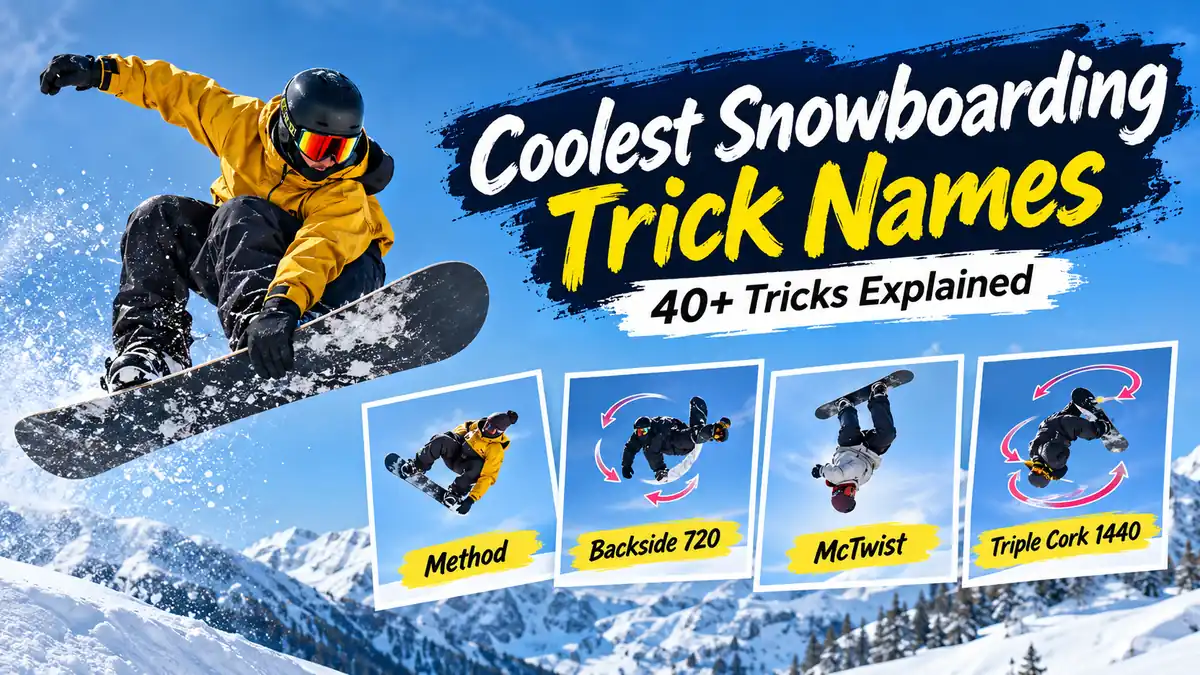
Snowboarding has some of the most creative trick names in action sports. From the stylish Method and the playful Chicken Salad to the legendary Triple Cork 1440, every name represents a particular movement, technique, or piece of snowboarding history.
The coolest snowboarding trick names include Method, Japan Air, Stalefish, Roast Beef, Chicken Salad, McTwist, Wildcat, Tamedog, Misty Flip, Double Cork 1080, and Triple Cork 1440. Some describe how a rider grabs the board, while others identify rotations, inverted maneuvers, or combinations performed on jumps and halfpipes.
Understanding these names makes watching snowboard competitions more enjoyable and helps riders recognize the difference between a simple grab, a technical spin, and an advanced aerial trick.
What Makes Snowboarding Trick Names So Cool?
Snowboarding trick names reflect the sport’s roots in skateboarding, surfing, freestyle competition, and mountain culture.
Unlike sports that use purely technical descriptions, snowboarding mixes numerical rotations with memorable nicknames. A trick might be named after its appearance, the body position involved, or the athlete who popularized it.
For example:
- Method: A classic grab known for its distinctive arched body position.
- Chicken Salad: An unusual grab with a memorable name.
- McTwist: An inverted aerial maneuver associated with skateboarder Mike McGill.
- Triple Cork 1440: A complex aerial trick involving 1,440 degrees of rotation and three off-axis inversions.
Trick names can also describe several elements simultaneously. A rider might perform a backside 720 with a mute grab, combining a spin direction, rotation amount, and grab style.
That combination of technical precision and creativity is what makes freestyle snowboarding terminology distinctive.
Coolest Snowboarding Trick Names for Grabs
Grabs are among the most recognizable freestyle snowboard tricks. They involve reaching down and holding a particular part of the board while airborne.
Although some grabs are accessible to progressing riders, others demand exceptional flexibility, balance, and air awareness.
| Trick name | What it means | General difficulty |
|---|---|---|
| Indy | Rear hand grabs the toe edge between the bindings | Beginner–Intermediate |
| Mute | Front hand grabs the toe edge between the bindings | Beginner–Intermediate |
| Melon | Front hand grabs the heel edge between the bindings | Intermediate |
| Stalefish | Rear hand grabs the heel edge between the bindings | Intermediate |
| Method | A styled melon grab with an arched body position | Intermediate–Advanced |
| Japan Air | Front-hand toe-edge grab with a distinctive tweaked position | Advanced |
| Nose Grab | Holding the nose of the snowboard | Intermediate |
| Tail Grab | Holding the tail of the snowboard | Intermediate |
| Seatbelt | Front hand reaches across the body to grab the tail | Intermediate–Advanced |
| Truck Driver | Both hands grab opposite ends of the board | Advanced |
| Roast Beef | Rear hand reaches between the legs to grab the heel edge | Intermediate–Advanced |
| Chicken Salad | Front hand reaches between the legs to grab the heel edge | Intermediate–Advanced |
Difficulty varies with jump size, body position, and the rider’s experience.
Method: The Most Iconic Snowboard Grab
The Method is one of the most celebrated tricks in snowboarding.
It combines a melon-style heel-edge grab with a dramatic extension of the body. Riders pull the board upward and emphasize the shape by arching their back.
A well-executed Method is recognizable because of its silhouette rather than its rotation count.
It has remained popular across halfpipe riding, natural terrain, and freestyle photography.
Japan Air: A Stylish Freestyle Classic
The Japan Air is known for its compact, tweaked position.
In common snowboard terminology, the rider uses the front hand to grab the toe edge while drawing the board into a distinctive position. The rear leg and board angle contribute to its appearance.
The trick has strong connections to skateboarding and rewards style rather than simply maximizing difficulty.
Stalefish: A Classic Heel-Edge Grab
The Stalefish uses the rear hand to grab the heel edge between the bindings.
It looks especially stylish when the rider extends the legs and tweaks the snowboard sideways.
Stalefish grabs appear in halfpipe runs, straight airs, and rotational tricks.
Chicken Salad and Roast Beef
Few snowboard trick names are as memorable as Chicken Salad and Roast Beef.
Both involve reaching between the legs, but they differ in which hand performs the heel-edge grab.
The names may sound humorous, yet the movements require coordination and good control in the air.
These grabs illustrate how snowboard culture embraces creativity without abandoning technical precision.
Coolest Snowboarding Trick Names for Spins
Spins involve rotating around the body’s vertical axis while airborne. Snowboarders usually identify them by direction and degrees of rotation.
A complete rotation equals 360 degrees.
| Spin name | Rotation | Description |
|---|---|---|
| 180 | 180° | Half rotation |
| 360 | 360° | One full rotation |
| 540 | 540° | One and a half rotations |
| 720 | 720° | Two full rotations |
| 900 | 900° | Two and a half rotations |
| 1080 | 1080° | Three full rotations |
| 1260 | 1260° | Three and a half rotations |
| 1440 | 1440° | Four full rotations |
| 1620 | 1620° | Four and a half rotations |
| 1800 | 1800° | Five full rotations |
| 1980 | 1980° | Five and a half rotations |
| 2160 | 2160° | Six full rotations |
These names describe rotation amounts, not complete trick identities. Adding the approach direction, axis, and grab provides a more precise description.
Frontside 360
A frontside 360 involves one full rotation in the rider’s frontside direction.
For a rider approaching a conventional jump in their normal stance, frontside and backside are defined by the direction the rider initiates the rotation relative to their stance.
A frontside 360 can be performed with a grab, making the maneuver more visually expressive.
Backside 720
The backside 720 involves two full rotations in the backside direction.
Riders need to coordinate takeoff, rotation speed, spotting the landing, and board alignment.
A backside 720 with a clean grab often looks more controlled than a larger spin performed without good style.
Switch 540
A switch 540 begins with the snowboarder riding in the opposite stance from their natural one.
The rider completes one and a half rotations before landing.
Switch tricks are challenging because takeoff timing and rotational awareness may feel less familiar.
Cab 900
In modern snowboard competition terminology, a Cab spin is generally a switch-frontside rotation.
A Cab 900 combines that switch-frontside approach with two and a half rotations.
The name traces back to the Caballerial, a skateboarding trick associated with Steve Caballero.
Why Do Snowboarders Use Numbers Like 1080 and 1440?
The numbers represent degrees of rotation.
A 1080 is three complete turns, while a 1440 is four.
However, higher numbers do not automatically mean a trick is more stylish or better executed. Landing quality, amplitude, grab control, and technical precision all influence how a performance is evaluated.
Coolest Snowboarding Trick Names for Flips and Inverts
Flips and inverted tricks are among the most spectacular movements in freestyle snowboarding.
Unlike ordinary spins, which primarily rotate around a vertical axis, inverted maneuvers involve flipping or tilting the body substantially off-axis.
Laax Open 2023 are ready for take-off! — Pleasure Snowboard Mag
8
Inverted freestyle tricks combine rotation, aerial awareness, and precise landings.
Wildcat: The Cartwheel-Style Backflip
The Wildcat is a backward flip performed in a cartwheel-like motion over the tail of the snowboard.
Rather than resembling a conventional gymnastics backflip, its axis follows the board’s length more closely.
The trick is popular in freestyle videos because its movement is distinctive and easy to recognize.
Tamedog: The Forward-Flipping Wildcat
The Tamedog is the forward-flipping counterpart to the Wildcat.
The rider rotates forward over the nose of the snowboard, creating a cartwheel-like motion.
Despite its playful name, a Tamedog is an advanced maneuver. Attempting it without appropriate progression, coaching, and a controlled training environment creates a substantial injury risk.
McTwist: A Legendary Halfpipe Trick
The McTwist is an inverted backside 540 associated with skateboarder Mike McGill.
In snowboarding, the traditional McTwist is performed off a halfpipe wall, combining a forward-flipping motion with 540 degrees of backside rotation.
It became a foundational maneuver in competitive halfpipe riding and helped establish the vocabulary for more complex inverted aerials.
Misty Flip: A Rotating Forward Flip
A Misty Flip combines a forward-flipping movement with rotation, traditionally described as a partially inverted 540 performed off a straight jump.
Its path differs from a conventional flat spin because the rider’s body moves off the vertical axis.
Misty variations can incorporate different rotation amounts, making the term part of a larger family of freestyle maneuvers.
Rodeo: A Backward-Flipping Rotation
The Rodeo combines a flipping motion with a horizontal spin.
A Backside Rodeo 540, for example, incorporates backside rotation and an inverted movement.
Rodeos are recognizable by their sweeping aerial path and are frequently associated with big-air and slopestyle snowboarding.
Double Cork 1080
A Double Cork 1080 combines three complete rotations with two distinct off-axis or inverted movements.
The term cork describes rotation away from the normal upright spinning axis.
Double Cork tricks require enough airtime to complete both the rotation and the off-axis movements before landing.
Triple Cork 1440
A Triple Cork 1440 combines four full rotations with three distinct off-axis or inverted movements.
It is one of the most technically demanding categories of snowboarding tricks.
Triple Cork variations have played a major role in the progression of elite big-air and halfpipe competition.
The International Ski and Snowboard Federation (FIS) maintains formal trick terminology for identifying these movements in competitive snowboarding. International Ski and Snowboard Federation+1
Legendary Snowboarding Trick Names Made Famous by Professionals
Some of the coolest snowboarding trick names became widely recognized because elite athletes performed them in major competitions.
Haakon Flip
Named after Norwegian snowboard legend Terje Håkonsen, the Haakon Flip is an inverted 720 performed from a switch approach on a halfpipe wall.
The maneuver reflects the technical and stylistic innovations that helped shape modern freestyle snowboarding.
YOLO Flip
The YOLO Flip is a nickname for a Cab Double Cork 1440 in the halfpipe.
Swiss snowboarder Iouri Podladtchikov popularized the maneuver, which became especially famous during the 2014 Winter Olympics in Sochi.
The name stands out because it replaces a lengthy technical description with a memorable expression.
Tomahawk
The Tomahawk is associated with Shaun White and refers to a Double McTwist 1260.
It combines two inverted movements with three and a half rotations.
White’s performances helped make the maneuver one of the best-known tricks in halfpipe snowboarding.
Triple Cork in Olympic Competition
Japanese snowboarder Ayumu Hirano made history by landing a Triple Cork in Olympic halfpipe competition at the 2022 Beijing Winter Olympics.
The achievement demonstrated how far halfpipe snowboarding had progressed in amplitude, rotational complexity, and landing precision.
These named tricks illustrate how athlete innovation and competitive milestones influence snowboarding language. NBC Olympics+1
Coolest Snowboarding Trick Names for Rails, Boxes, and Ground Tricks
Not every impressive snowboard trick requires a massive jump.
Jibbing involves riding on rails, boxes, and other suitable features, while flat-ground freestyle focuses on balance, presses, rotations, and creative board control.
| Trick name | Description |
|---|---|
| Boardslide | Sliding sideways across a rail or box |
| Lipslide | Moving the trailing foot over the feature before sliding sideways |
| 50-50 | Sliding straight along a rail or box with the board aligned to the feature |
| Nose Press | Balancing on the nose while lifting the tail |
| Tail Press | Balancing on the tail while lifting the nose |
| Butter | Rotating or maneuvering while balancing on the nose or tail |
| Pretzel | Rotating out of a slide opposite to the entry rotation |
| Bluntslide | Sliding with the board across the feature and weight toward one end |
| Nollie | Popping off the nose of the snowboard |
| Ollie | Using the board’s tail and flex to generate a hop |
| Handplant | Supporting an inverted or partially inverted maneuver with a hand |
| Alley-Oop | Rotating uphill against the normal direction of travel on a halfpipe wall |
Boardslide: A Classic Snowpark Trick
The Boardslide is one of the most recognizable rail maneuvers.
The snowboard is positioned approximately perpendicular to the rail, with the feature passing between the bindings.
Riders can approach from different directions, creating frontside and backside variations.
Pretzel: A Creative Rail Exit
A Pretzel involves rotating off a rail or box in the opposite direction from the rotation used to enter the trick.
For example, a rider might rotate 270 degrees onto a feature and then rotate back in the opposite direction to exit.
The resulting movement has a twisted appearance, which helps explain its name.
Butter: A Stylish Ground Trick
Butter tricks involve balancing on one end of the snowboard while rotating or changing direction.
Common variations include nose butter, tail butter, butter 180, and butter 360.
They are especially popular because they emphasize smooth movement and board control rather than maximum airtime.
A butter can look simple when performed by an experienced rider, but maintaining balance throughout the rotation takes practice.
Alley-Oop: A Halfpipe Direction Change
An Alley-Oop is a halfpipe maneuver where the snowboarder rotates uphill relative to the wall’s slope.
This creates a distinctive movement that contrasts with the more natural direction of rotation.
The term can describe several different rotational tricks rather than one fixed degree count.
Funny and Unusual Snowboarding Trick Names
Some of the sport’s most memorable names sound more like menu items, jokes, or fictional characters than athletic maneuvers.
These names have become part of snowboarding’s personality.
| Funny trick name | Meaning |
|---|---|
| Chicken Salad | A between-the-legs heel-edge grab using the rear hand with a distinctive wrist position |
| Roast Beef | Rear-hand heel-edge grab through the legs |
| Canadian Bacon | Rear-hand toe-edge grab behind the rear leg |
| Beef Carpaccio | A combination of Roast Beef and Chicken Salad grabs |
| Beef Curtains | A combination grab involving Roast Beef and Grosman |
| Bloody Dracula | A double-handed tail grab with the front hand reaching behind the back |
| Drunk Driver | A combination of Stalefish and front-hand toe-edge grab |
| Gorilla | Both hands grabbing the toe edge between the bindings |
| Mosquito Air | A heel-edge grab with the front knee tucked toward the board |
| China Air | A front-hand toe-edge grab in front of the front foot |
| Crail | Rear-hand toe-edge grab ahead of the front foot |
| Lien Air | A front-hand heel-edge grab traditionally associated with the frontside halfpipe wall |
These are established terms found in freestyle snowboarding trick references, although some are uncommon in everyday riding. International Ski and Snowboard Federation+2
Why Are So Many Snowboard Tricks Named After Food?
Names such as Roast Beef, Chicken Salad, Canadian Bacon, and Beef Carpaccio reflect the playful language inherited from skateboarding and freestyle culture.
Many grab names originated in skating before being adapted to snowboarding.
The terminology helped distinguish different hand placements and body positions without relying on lengthy technical descriptions.
There is no universal naming system for every informal grab variation, so terminology can differ between riding communities.
Best Snowboarding Trick Names for Beginners
Beginners often want to learn tricks with exciting names, but the most useful starting point is developing balance, edge control, and safe takeoff and landing technique.
A basic trick performed cleanly is more valuable than attempting an advanced inversion before the necessary skills are developed.
| Trick | Skill developed | Suggested progression |
|---|---|---|
| Ollie | Board flex and controlled popping | Early freestyle |
| Nollie | Nose pressure and balance | Early freestyle |
| Tail Press | Weight distribution | Early freestyle |
| Nose Press | Forward balance | Early freestyle |
| Butter 180 | Rotation and edge awareness | Beginner–Intermediate |
| Straight Air | Takeoff and landing control | Beginner–Intermediate |
| Indy Grab | Airborne board control | Intermediate |
| Frontside 180 | Controlled rotation | Intermediate |
| Backside 180 | Rotational awareness | Intermediate |
| 50-50 | Straight feature balance | Supervised freestyle progression |
These classifications are approximate. A beginner’s readiness depends on riding ability, snow conditions, feature size, and instruction.
Which Snowboarding Trick Should You Learn First?
The Ollie is a useful early freestyle skill because it teaches riders to load and release the snowboard’s flex.
After developing reliable turns, speed control, and stopping skills, riders can progress toward small controlled hops and simple presses.
A sensible progression is:
- Build consistent balance and edge control on easy terrain.
- Practice stationary movements and basic board flex.
- Develop small Ollies on suitable flat terrain.
- Learn controlled straight airs on beginner-designed features with instruction.
- Progress toward simple rotations and grabs after mastering takeoffs and landings.
Inverted tricks, large jumps, and advanced rail maneuvers should be approached only with appropriate coaching and specialized training facilities.
How to Understand Complex Snowboarding Trick Names
A complicated trick name becomes easier to understand when separated into its components.
Most advanced freestyle names combine some of the following elements:
- Stance: Regular, goofy, or switch.
- Direction: Frontside or backside.
- Rotation: 180, 360, 540, 720, 1080, 1440, or higher.
- Axis: Flat, corked, double cork, or triple cork.
- Grab: Indy, melon, Method, nose, tail, or another grab.
- Feature: Jump, halfpipe, rail, or box.
Example: Switch Backside Double Cork 1260 Indy
This name describes several actions within one maneuver.
| Component | Meaning |
|---|---|
| Switch | The rider approaches in the opposite stance from their normal one |
| Backside | The rotation begins in the backside direction |
| Double Cork | Two distinct off-axis or inverted movements |
| 1260 | Three and a half full rotations |
| Indy | Rear hand grabs the toe edge between the bindings |
Together, these elements identify a specific combination of stance, rotation, body movement, and grab.
What Is the Difference Between a Cork and a Flip?
A conventional frontflip or backflip primarily involves rotating head-over-heels.
A corked spin uses a tilted rotational axis, combining spinning and off-axis body movement.
In snowboarding, the distinction can become complex because some cork variations involve full inversion while others do not.
Double Cork and Triple Cork describe the number of distinct off-axis or inverted movements within the trick, not simply the number of complete upright spins.
What Does Switch Mean in Snowboarding?
Switch means riding with the opposite foot forward from the rider’s normal stance.
A regular rider normally leads with the left foot, while a goofy rider normally leads with the right.
Switch riding reverses that preferred orientation.
A switch trick can be more challenging because the rider must control takeoff, rotation, and landing from a less familiar stance.
Is a 1440 Harder Than a 1080?
A 1440 requires one additional full rotation compared with a 1080, assuming the tricks otherwise use comparable movements.
However, difficulty is not determined by rotation count alone.
A switch double cork with a difficult grab may be more technically demanding than a larger flat spin. Jump size, axis, grab quality, and landing conditions also affect difficulty.
What Makes a Snowboarding Trick Look Impressive?
The most impressive snowboard tricks are not necessarily those with the largest numbers.
Professional freestyle riding values a combination of technical execution and individual style.
Amplitude
Amplitude describes how high a snowboarder travels above a feature.
In halfpipe riding, strong amplitude provides space for technical maneuvers and contributes to the visual impact of a run.
Grab Quality
A clearly held grab looks more controlled than a brief touch of the board.
The position of the knees, legs, and upper body can transform an ordinary grab into a recognizable stylistic expression.
Clean Landings
Landing with balance and maintaining the intended direction of travel are essential.
A rider who completes a large rotation but struggles to control the landing may produce a less convincing performance than someone executing a smaller trick cleanly.
Creativity and Variety
A run combining spins, grabs, switch tricks, and unusual movements often demonstrates greater versatility than one relying on similar rotations repeatedly.
Competitive judging also considers execution, difficulty, amplitude, variety, and progression, with the precise criteria depending on the event format.
How Snowboarding Trick Names Continue to Evolve
Snowboarding terminology changes as athletes develop new combinations and adapt established maneuvers.
Some tricks receive memorable nicknames, while others are identified using technical descriptions.
The progression from basic 360s and 540s to multiple corks and high-rotation aerials has expanded the vocabulary used by commentators, judges, and riders.
Modern competition also distinguishes between the different demands of three major freestyle disciplines.
Slopestyle
Slopestyle combines jumps, rails, boxes, and other features in one course.
Riders need a broad trick selection, making names such as Boardslide, Pretzel, Backside 1080, and Double Cork particularly relevant.
Big Air
Big Air focuses on aerial tricks performed from a large jump.
High-rotation spins, off-axis maneuvers, and complex grabs are prominent in this discipline.
Halfpipe
Halfpipe riders perform tricks while moving between two opposing walls.
Classic maneuvers such as the McTwist, Haakon Flip, and Alley-Oop remain part of the discipline’s vocabulary alongside modern multi-cork combinations.
These different settings help explain why the same broad trick family can have numerous variations.
Which Are the Coolest Snowboarding Trick Names Overall?
The answer depends on whether you prefer style, humor, history, or technical complexity.
For classic style, Method, Japan Air, Stalefish, and Melon are standout names. They represent the expressive side of freestyle snowboarding, where body position and control are central.
For unusual and funny terminology, Chicken Salad, Roast Beef, Canadian Bacon, and Bloody Dracula are particularly memorable.
For legendary aerial maneuvers, McTwist, Haakon Flip, YOLO Flip, and Tomahawk connect snowboarding vocabulary with influential athletes and competition history.
For advanced technical tricks, Double Cork 1080, Triple Cork 1440, and higher-rotation cork variations demonstrate the progression of modern freestyle riding.
Ultimately, the coolest snowboarding trick names tell a story about the sport. Learning what they mean makes it easier to recognize creativity, appreciate difficult movements, and understand what riders are accomplishing on snow.
The next time you watch a halfpipe or slopestyle competition, try identifying the stance, spin direction, rotation amount, and grab. Even the most complicated trick names become much easier to understand once you know how their individual parts fit together.