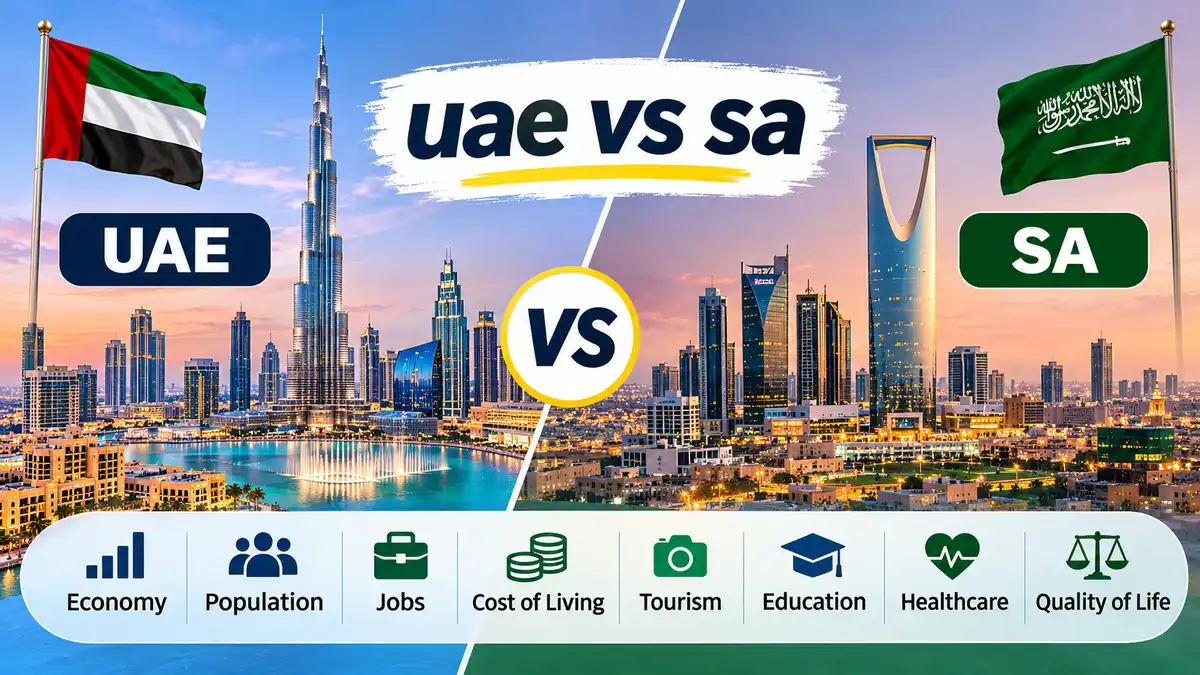
The United Arab Emirates (UAE) and Saudi Arabia (SA) are two of the Middle East’s most influential countries. Both have transformed their economies through investment, infrastructure development, tourism, and ambitious national strategies. Yet their populations, economic structures, lifestyles, and opportunities differ considerably.
In the uae vs sa comparison, Saudi Arabia stands out for its larger population, territory, and overall economy, while the UAE is distinguished by its international business environment, higher GDP per capita, and globally connected cities. Understanding these differences helps explain each country’s strengths in 2026.
uae vs sa: Key Differences at a Glance
The UAE and Saudi Arabia are neighboring Gulf countries with Arabic as their official language and Islam as their dominant religion. Both belong to the Gulf Cooperation Council (GCC), but they operate under different political systems and follow distinct economic development strategies.
| Feature | UAE | Saudi Arabia |
|---|---|---|
| Official name | United Arab Emirates | Kingdom of Saudi Arabia |
| Capital | Abu Dhabi | Riyadh |
| Largest major commercial center | Dubai | Riyadh |
| Population (2025, approximate) | 11.3 million | 36 million |
| Total area | 83,600 km² | 2,149,690 km² |
| Official language | Arabic | Arabic |
| Currency | UAE dirham (AED) | Saudi riyal (SAR) |
| Government | Federation of seven hereditary emirates | Hereditary monarchy |
| Major economic sectors | Trade, finance, tourism, logistics, energy | Energy, manufacturing, construction, tourism |
| Major development strategy | We the UAE 2031 | Saudi Vision 2030 |
| Main international aviation hubs | Dubai and Abu Dhabi | Riyadh and Jeddah |
Population estimates vary by source and reporting year. The figures above are rounded comparisons rather than live population counts. News Unlimited+2
Geography and Population: How Different Are the Two Countries?
Saudi Arabia is significantly larger
Saudi Arabia occupies approximately 2.15 million square kilometers, making it the largest country on the Arabian Peninsula. Its territory includes deserts, mountains, plateaus, and coastlines along the Red Sea and Arabian Gulf.
The UAE covers approximately 83,600 square kilometers of total area, making Saudi Arabia about 26 times larger.
Despite its smaller territory, the UAE has developed highly concentrated urban centers, including Dubai, Abu Dhabi, and Sharjah.
Saudi Arabia’s major cities include Riyadh, Jeddah, Makkah, Madinah, and Dammam.
Population and demographics
Saudi Arabia has roughly three times the population of the UAE.
The UAE has an unusually high proportion of expatriate residents. Workers and families from South Asia, Europe, Africa, and other Arab countries contribute significantly to its demographic composition.
Saudi Arabia also has a substantial expatriate workforce, but Saudi citizens make up a much larger proportion of its population.
This difference influences housing demand, labor markets, education, language use, and the everyday cultural environment.
uae vs sa Economy: Which Country Is Richer?
Economic comparisons require distinguishing between total gross domestic product (GDP) and GDP per capita.
Saudi Arabia has the larger economy overall. The UAE, however, produces more economic output per resident.
GDP comparison
Nominal GDP, 2025 estimates
$0 billion$350 billion$700 billion$1K billion$1.4K billionSaudi ArabiaUAE
Source: Country comparison data published October 2026; estimates may be revised.
Saudi Arabia’s estimated 2025 GDP was approximately $1.27 trillion, compared with about $614 billion for the UAE. News Unlimited
Saudi Arabia’s economic scale reflects its large energy industry, domestic market, government investment, and industrial activities.
The UAE has developed an economy supported by international commerce, financial services, aviation, tourism, real estate, and oil and gas.
GDP per capita comparison
GDP per capita, 2025 estimates
$0$15K$30K$45K$60KUAESaudi Arabia
The UAE’s estimated GDP per capita was approximately $54,151, compared with $35,370 in Saudi Arabia. News Unlimited
This does not mean every UAE resident earns more than every Saudi resident. GDP per capita measures economic output divided by population, not typical household income or individual salaries.
Economic diversification
Both governments are working to reduce their dependence on hydrocarbons.
Saudi Arabia’s Vision 2030 emphasizes tourism, manufacturing, entertainment, logistics, technology, and investment. Major initiatives include NEOM, the Red Sea tourism developments, and projects associated with the Public Investment Fund (PIF).
The UAE’s diversification strategy includes financial services, renewable energy, artificial intelligence, advanced manufacturing, and international trade.
Dubai is a major commercial and tourism center, while Abu Dhabi plays a central role in energy production, investment, and government-led economic development.
Key takeaway: Saudi Arabia leads in total economic size, while the UAE leads in GDP per capita. Neither measurement alone determines which country offers a better standard of living.
Jobs, Salaries, and Business Opportunities
Employment opportunities depend on industry, qualifications, experience, nationality, and labor-market conditions.
Working in the UAE
The UAE has a well-established international employment market, particularly in Dubai and Abu Dhabi.
Major employment sectors include:
- Banking, accounting, and financial services
- Information technology and cybersecurity
- Digital marketing and e-commerce
- Aviation, logistics, and transportation
- Hospitality, tourism, and real estate
- Healthcare, engineering, and education
English is widely used in business environments, although Arabic remains the official language.
The UAE’s free zones, including Dubai Multi Commodities Centre (DMCC) and Dubai International Financial Centre (DIFC), have helped attract international companies.
However, employment competition can be intense, particularly for entry-level and general administrative roles.
Working in Saudi Arabia
Saudi Arabia offers opportunities in industries supported by infrastructure expansion and economic diversification.
Important sectors include construction, engineering, energy, healthcare, logistics, tourism, manufacturing, and technology.
Riyadh is developing as a regional business center, while Jeddah remains important for commerce and logistics.
Saudi Arabia’s localization policies, commonly called Saudization or Nitaqat, influence recruitment requirements in certain industries.
Foreign applicants should check whether their intended occupation is subject to nationality-based employment restrictions.
Which country pays higher salaries?
There is no universally accurate answer.
A senior technology professional in Riyadh may earn more than someone performing a comparable role in Dubai, while a financial services specialist could receive a more competitive package in the UAE.
Salary comparisons should account for:
- Basic monthly salary and allowances
- Employer-provided accommodation
- Medical insurance and dependent coverage
- Transportation expenses
- School fees for children
- Contract benefits and end-of-service entitlements
Both countries generally do not impose personal income tax on ordinary employment salaries, although other taxes and statutory obligations exist.
Cost of Living: UAE vs Saudi Arabia
Living expenses can significantly affect the financial benefits of working in either country.
Dubai and Abu Dhabi can be expensive, especially in popular residential districts. Saudi cities may offer lower housing costs in some neighborhoods, although Riyadh’s rental market has experienced substantial demand.
| Expense | UAE | Saudi Arabia |
|---|---|---|
| Housing | Often expensive in central Dubai and Abu Dhabi | Can be lower, but varies greatly in Riyadh |
| Groceries | Wide selection of imported products | Local and imported options |
| Transportation | Metro, taxis, buses, and private vehicles | Private vehicles, taxis, and expanding public transport |
| Education | Many international private schools | International and private schools available |
| Healthcare | Public and private healthcare networks | Public and private healthcare networks |
| Entertainment | Extensive international leisure options | Rapidly expanding entertainment industry |
These are general patterns, not fixed cost rankings. A family’s actual expenses depend on its city, neighborhood, housing requirements, and lifestyle.
Is Dubai more expensive than Riyadh?
Dubai is frequently more expensive for premium housing and certain international lifestyle services.
However, comparing entire cities can be misleading. A central Riyadh apartment may cost more than housing in an outer Dubai neighborhood.
A practical comparison should use the same apartment size, commute requirements, school arrangements, and household size.
For expatriate families, accommodation and education often have a greater effect on savings than smaller everyday expenses.
Culture, Religion, and Everyday Lifestyle
The UAE and Saudi Arabia share significant historical, religious, and linguistic connections, but their social environments have developed differently.
Cultural diversity in the UAE
The UAE is home to a highly international population.
Dubai, in particular, has communities from many countries, creating a multilingual environment in workplaces, restaurants, schools, and residential neighborhoods.
Visitors encounter international cuisines, shopping centers, beaches, museums, and cultural attractions.
Islam remains central to Emirati heritage, and visitors are expected to respect local laws and customs.
Cultural traditions in Saudi Arabia
Saudi Arabia has deep historical and religious significance as the home of Islam’s two holiest cities, Makkah and Madinah.
Saudi culture places considerable emphasis on family, hospitality, Arabic traditions, and Islamic heritage.
The country has expanded public entertainment, cultural festivals, sporting events, and tourism as part of its modernization programs.
Social expectations and regulations can differ from those in the UAE. Visitors and expatriates should understand local rules concerning public behavior, clothing, photography, and religious practices.
Which country is more international?
The UAE generally offers a more internationally oriented everyday environment, particularly in Dubai.
Saudi Arabia has a strong international workforce and is becoming increasingly connected to global tourism and investment, but its cultural identity remains more closely associated with its large domestic population and national traditions.
Neither environment is inherently better; suitability depends on personal expectations and circumstances.
Tourism and Major Attractions
Both countries offer substantial tourism opportunities, but their attractions emphasize different experiences.
10 new schools set to open in Dubai in 2021-22 academic year
Dubai
Known for the Burj Khalifa, luxury hotels, shopping, beaches, international dining, and modern architecture.
Full-Day Small-Group Abu Dhabi Louvre and Grand Mosque Tour From Dubai
Abu Dhabi
Features the Sheikh Zayed Grand Mosque, Louvre Abu Dhabi, cultural districts, and waterfront attractions.
Sensational Western Side of Saudi Arabia (6 Days 5 Nights) – Riyadh Trips
AlUla
Offers ancient archaeological sites, dramatic sandstone landscapes, and historical experiences, including Hegra, a UNESCO World Heritage Site.
Riyadh (Saudi Arabia) – Location, History, Facts
Riyadh
Combines modern urban development with historic locations such as Diriyah, museums, and expanding cultural and entertainment venues.
Saudi Arabia also attracts millions of Muslims for Hajj and Umrah. These religious journeys have a distinct purpose from ordinary leisure tourism.
The UAE has an established global aviation and hospitality network, while Saudi Arabia is investing heavily in new tourism destinations and visitor infrastructure.
Education, Healthcare, and Quality of Life
Education and healthcare are essential considerations for residents, particularly families planning long-term employment abroad.
Education systems
The UAE offers numerous international schools following British, American, Indian, International Baccalaureate, and other curricula.
Saudi Arabia also has international schools, alongside its national education system and universities.
In both countries, private school tuition can be a significant expense for expatriate households.
Families should compare curriculum availability, school location, admission requirements, tuition, and transport costs before relocating.
Healthcare services
Both countries have modern hospitals, specialist medical facilities, and public health systems.
Healthcare access for expatriates depends on residency status, insurance arrangements, and applicable regulations.
The UAE has established medical centers in Dubai, Abu Dhabi, and other emirates. Saudi Arabia operates extensive healthcare networks across its major cities.
Life expectancy estimates are generally higher in the UAE. One comparative dataset reports approximately 83 years in the UAE and 79 years in Saudi Arabia for 2024. Us, by Numbers
However, life expectancy alone does not measure hospital quality or determine an individual’s healthcare experience.
Safety and living standards
Both countries maintain structured legal systems and substantial public infrastructure.
Residents should still consider traffic safety, weather conditions, workplace protections, emergency services, and local regulations.
Quality of life is multidimensional. Higher income does not automatically produce better living conditions if housing, transportation, or family expenses are disproportionately high.
Government, International Relations, and Future Development
The UAE and Saudi Arabia are important members of the GCC, alongside Bahrain, Kuwait, Oman, and Qatar.
Both are also members of the United Nations, Arab League, and Organization of the Petroleum Exporting Countries (OPEC).
Despite their shared regional interests, they have distinct government structures and national priorities.
UAE government structure
The UAE is a federation of seven emirates: Abu Dhabi, Dubai, Sharjah, Ajman, Umm Al Quwain, Ras Al Khaimah, and Fujairah.
Each emirate has its own ruler, while federal institutions coordinate national affairs.
The UAE’s long-term development priorities include technology, education, economic competitiveness, sustainability, and international investment.
Saudi Arabia’s political and economic direction
Saudi Arabia is a monarchy led by the House of Saud.
The government’s Vision 2030 program seeks to expand non-oil industries, attract investment, develop tourism, and improve infrastructure.
Its development projects involve the PIF and multiple public- and private-sector organizations.
Regional cooperation and competition
The two countries cooperate in areas such as energy policy, regional trade, investment, and Gulf security.
They also compete to attract multinational companies, tourism spending, logistics activity, and foreign investment.
This combination of cooperation and competition is an important feature of the modern Gulf economy.
Their regional strategies may differ on particular diplomatic or economic questions, so membership in the same organizations does not mean their policies are identical.
uae vs sa: Which Country Is Better for Different Priorities?
The answer depends on the specific criterion being evaluated.
| Priority | Stronger general position | Reason |
|---|---|---|
| Total economic size | Saudi Arabia | Larger GDP and domestic market |
| GDP per capita | UAE | Higher economic output per resident |
| Geographic size | Saudi Arabia | Much larger territory |
| International business connectivity | UAE | Established trade, finance, and aviation networks |
| Large-scale infrastructure development | Saudi Arabia | Extensive national development programs |
| International lifestyle and expatriate communities | UAE | Highly diverse resident population |
| Islamic pilgrimage | Saudi Arabia | Location of Makkah and Madinah |
| Global leisure tourism infrastructure | UAE | Established international tourism hubs |
| Archaeological and heritage tourism | Both | Distinct historical and cultural attractions |
| Employment opportunities | Depends on occupation | Industry, qualifications, and compensation vary |
For someone interested in international business networks and a multicultural urban environment, the UAE may be more suitable.
For someone working in large infrastructure projects, industrial development, or sectors connected to Vision 2030, Saudi Arabia may offer relevant opportunities.
For families, comparing employment contracts, housing costs, healthcare, schooling, and residency conditions is more useful than relying on national averages.
Final Thoughts on uae vs sa
The uae vs sa comparison highlights two countries with shared Gulf heritage but different strengths.
Saudi Arabia has a much larger territory, population, and total economy. Its development strategy emphasizes industrial expansion, tourism, infrastructure, and domestic economic transformation.
The UAE has built a globally connected economy supported by trade, financial services, tourism, aviation, and international investment. Its GDP per capita is higher, and its major cities have extensive expatriate communities.
Neither country is universally superior. The most meaningful comparison depends on whether the priority is economic scale, career opportunities, affordability, education, culture, tourism, or everyday quality of life.
For an accurate personal assessment, compare specific cities and current conditions rather than assuming that national-level statistics tell the whole story.