The first time you see Strokkur erupt twenty feet into the air, you’ll understand why so many people skip the tour bus entirely. Driving the Golden Circle Iceland yourself means you get to stand there as long as you want — no guide checking a watch, no forty strangers shuffling you back to a coach.
The Golden Circle is a roughly 230–300 km (140–190 mile) loop through southwest Iceland connecting Þingvellir National Park, the Geysir geothermal area, and Gullfoss waterfall. Pure driving takes 3–4 hours, but most self-drivers spend 6–8 hours total once you factor in stops, photos, and food.
What Is the Driving the Golden Circle Iceland?
The route starts and ends in Reykjavík, though plenty of travelers pick it up straight from Keflavík International Airport, where the drive to Thingvellir National Park takes about an hour and fifteen minutes. From the capital itself, it’s a much shorter hop — just 45 minutes to Thingvellir.
Distances vary a bit depending on which sources and detours you count, but the loop is generally described as somewhere around 140 miles (230 kilometers) up to closer to 300 kilometers or just under 200 miles once you add the connecting roads back to Reykjavík. Either way, treat it as a solid half-day drive minimum.
If you genuinely just wanted to drive the loop with zero stops, you could knock it out in three to four hours. Nobody actually does that. Realistically, plan for six to eight hours to make the most of each stop, and don’t schedule anything demanding for the evening — you’ll be tired in the good way, the way you get after a full day outdoors.
Quick Takeaway: Budget a full day. Three to four hours of driving, plus real time at each stop, easily fills 6–8 hours door to door.
Self-Drive or Guided Tour — Which Should You Choose?
This is the first real decision, and it’s less about ability than about what kind of day you want.
A guided tour hands you a driver, a schedule, and a running commentary — genuinely useful if you’re arriving off a long-haul flight, visiting in bad winter weather, or just don’t want to think about logistics. It’s also the better call for cruise passengers on a tight window.
Self-driving wins on almost everything else. You go at your own pace and stop wherever you want along the way, customizing the route to exactly what you want to see. You can also outrun the crowds — driving yourself lets you arrive ahead of or behind the big tour groups, and going early or late in the day, especially with Iceland’s long summer daylight, means having Strokkur nearly to yourself.
| Self-Drive | Guided Tour | |
|---|---|---|
| Flexibility | Full control of pace and stops | Fixed schedule |
| Cost | Car rental + fuel + parking | Single ticket price |
| Best for | Independent travelers, photographers, repeat visitors | First-timers, winter storms, no driving experience |
| Crowd avoidance | Easy — go early/late | Harder — buses cluster mid-day |
The Route: Roads, Directions, and Which Direction to Drive
From Reykjavík, the classic clockwise route runs north on Highway 1 to Route 36, heading east toward Þingvellir. From there you continue on toward the Geysir area, then to Gullfoss, and loop back through Route 35 and Route 1 to Reykjavík. If driving directly to Gullfoss Waterfall from Reykjavik, you’d head east along Route 1, then turn onto Route 35 at Selfoss — about 62 miles (100 km) and roughly 1 hour 40 minutes.
Here’s a detail almost nobody mentions: some experienced local guides deliberately reverse the order. One counterclockwise version of the drive is described as “one a local might take,” saving the crowds at the main sights for later or earlier in the day depending on which way the tour buses are flowing. Running the loop counterclockwise — Gullfoss first, Thingvellir last — is a legitimate way to dodge the worst of the midday bus traffic, especially in July and August.
The roads themselves are easy driving in summer. Routes 1, 36, 37, and 35 are all paved and well-maintained, so a standard rental handles them without issue outside winter.
What Car Do You Really Need?
You don’t need a 4×4 to drive the Golden Circle from late spring through early autumn. A standard 2WD compact car is sufficient for driving the Golden Circle during late spring through early autumn, since the main roads are paved and maintained.
Winter is a different story. Between roughly November and April, snow, ice, and sudden weather changes are common enough that a 4×4 becomes the safer, and sometimes necessary, choice — particularly if you’re arriving during or after a storm, or if you plan on detouring toward the highlands or any F-roads, which are typically only recommended for 4×4 vehicles, especially in shoulder and winter months.
Rental prices land somewhere between $60 and $150 per day, depending on the vehicle type and season. Book ahead in summer — inventory tightens fast in July.
The Three Essential Stops
Thingvellir National Park
This is where Iceland’s medieval parliament, the Althing, met for centuries, and it’s also where you can literally stand in the rift between the North American and Eurasian tectonic plates. If you’re up for it, a free ranger-led tour in English runs from June through August, departing at 10 AM from Thingvellir Church or 2 PM from the Visitor Center, and it’s worth timing your visit around.
For something more active, this is also the launch point for snorkeling in Silfra — a guided-only dive through glacial water so clear it feels unreal.
Geysir Geothermal Area
A short hop from Gullfoss, this is the geyser field that gave the English word “geyser” its name. Expect the sulfur smell before you even open the car door — if you’ve been to Yellowstone or Rotorua, you’ll know exactly what to expect the moment you step out of the car. Strokkur, the reliable performer here, erupts every few minutes, so you rarely wait long. If you have the energy, there’s a 1.8-mile moderate hiking loop past steaming vents, mud pots, and geyser eruptions, though you can just as easily see the highlights from the main boardwalk in twenty minutes.
Gullfoss Waterfall
Iceland’s most-visited waterfall drops in two dramatic tiers into a canyon carved by glacial meltwater. Located at the northern edge of the Golden Circle, it draws more visitors than any other waterfall in the country — and once you see the spray catching the light on a clear day, you’ll understand why. Bring a rain jacket even on a sunny day; the mist travels further than you’d expect.
Quick Takeaway: Thingvellir for history and geology, Geysir for the eruption show, Gullfoss for raw power. All three are wheelchair- and stroller-friendly at the main viewpoints.
Hidden Gems Most Guides Skip
The big three get all the attention, but the surrounding detours are where the trip stops feeling like a checklist.
- Fridheimar Greenhouse near Flúðir — a working tomato greenhouse where you can eat a meal (soup, pasta, fresh bread) grown using Iceland’s geothermal energy, seated among the actual tomato plants.
- Secret Lagoon and Laugarvatn Fontana — natural and semi-natural geothermal bathing, less crowded and less expensive than the Blue Lagoon. Fontana is also where you can watch rúgbrauð, dense geothermal rye bread, baked by burying dough in hot ground for up to 24 hours — a tradition passed down for generations.
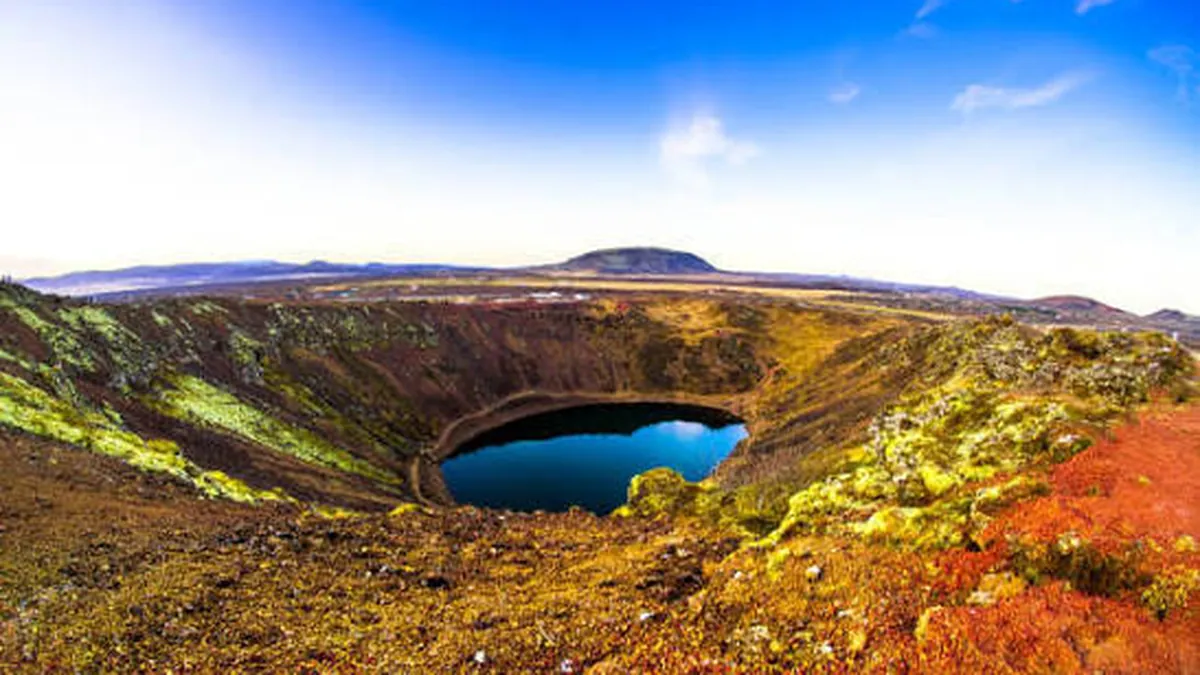
- Kerid Crater — a volcanic crater lake with striking red-black slopes, a five-minute detour off Route 35.
- Brúarfoss — a hidden, brilliantly blue waterfall that doesn’t show up on the main tourist maps.
- Þórufoss — an 18-metre cascade off Route 48 that most tour buses skip entirely, and a filming location fans of a certain fire-and-ice HBO series will recognize.
- Reykjadalur Hot Springs — a short scenic hike ending in a naturally warm river, a nice active add-on if the crowds at the big three wore you out.
Covering even two or three of these is usually what separates a good Golden Circle day from a forgettable one.
Best Time to Drive the Golden Circle (Including Winter)
Iceland’s Golden Circle works year-round, and each season changes the character of the drive.
Summer (June–August) gives you the longest daylight and the easiest roads — this is also when the free ranger tours at Thingvellir run, and when the national park campsite is open for budget travelers. It’s also, unsurprisingly, the busiest.
Winter trades ease for atmosphere. Snow-dusted Gullfoss and steam rising off Geysir against a dark sky are genuinely stunning, but road conditions change fast, daylight is short, and a 4×4 plus winter tires are the smarter call. Always check conditions before setting out — road.is is the standard reference for real-time closures and warnings — and consider a guided tour if a storm is forecast.
Shoulder seasons (April–May, September–October) split the difference: fewer crowds, milder roads than deep winter, and still enough daylight to comfortably do the loop.
One Day or Two? Sample Itineraries
One-Day Itinerary (Classic Loop)
- Depart Reykjavík early (7–8 AM)
- Thingvellir National Park — 1.5–2 hours
- Geysir Geothermal Area — 45 min–1 hour
- Gullfoss Waterfall — 1 hour
- Fridheimar Greenhouse — lunch stop, 45 minutes
- Kerid Crater or Secret Lagoon — 1 hour
- Return to Reykjavík by early evening
Two-Day Itinerary (Slower Pace + Hidden Gems)
- Day 1: Reykjavík → Þórufoss → Thingvellir (with ranger tour or Silfra snorkel) → overnight near Laugarvatn
- Day 2: Laugarvatn Fontana (rúgbrauð baking) → Geysir → Gullfoss → Brúarfoss detour → Fridheimar lunch → Kerid Crater → back to Reykjavík
Two days is worth it if you want the snorkel, the ranger tour, and the hidden waterfalls without rushing.
Costs, Parking, and Practical Driving Tips
Budget for these line items beyond the rental itself:
- Parking: A parking fee applies at several stops along the route, and it’s typically the only “admission” fee you’ll pay. Download the Parka app before you leave Reykjavík — it makes payment simple, and you’ll just need your license plate number handy. Thingvellir uses its own payment system, either at machines on-site or through Checkit.
- Fuel: Iceland’s fuel prices run higher than most of continental Europe; budget accordingly for a 230–300 km loop.
- Food: There aren’t many restaurant choices directly on the route — the cafés at Thingvellir, Gullfoss, and Geysir are decent but pricey. Fridheimar is the standout for an actual sit-down meal. If you’d rather save money, stop at a grocery store like Bonus before you set off and pack your own lunch.
- Connectivity: Cell service can be spotty in parts of the Golden Circle, so download offline maps before you leave Reykjavík.
- Car rental companies: Local operators are generally more flexible on Golden Circle day-rentals than international chains; compare a couple before booking, especially in high season.
Should You Combine It With the Blue Lagoon?
The Blue Lagoon isn’t part of the Golden Circle geographically — it sits well outside the loop — but plenty of travelers pair the two anyway. A Blue Lagoon visit takes around four hours including drive time, though you’ll want longer if you’re actually relaxing in the water rather than rushing through. The cleanest way to combine them is to treat the Blue Lagoon as a bookend — right after landing at Keflavík or right before your flight home — rather than squeezing it into the same day as the Golden Circle loop itself. Trying to do both in one day usually means shortchanging one of them.
Final Thoughts
Driving the Golden Circle in Iceland yourself isn’t complicated — the roads are good, the stops are well-marked, and you genuinely don’t need special skills or a 4×4 in summer. What it does need is a full day, a plan for at least one or two of the hidden gems, and a little patience with parking apps and gas station lunches. Do that, and you’ll leave with a much better day than anyone who stayed on the bus.
Ready to plan the rest of your trip? Book your rental car early if you’re traveling in summer, download the Parka app before you leave, and consider whether a second day for Brúarfoss and the Secret Lagoon is worth it — for most travelers, it is.
For more practical travel planning tips, check out our collection of travel guides.
FAQ Section
How long does it take to drive the Golden Circle in Iceland?
Pure driving time is 3–4 hours, but with stops at Thingvellir, Geysir, and Gullfoss, most people spend 6–8 hours total. Add hidden gems like Brúarfoss or Kerid Crater and it becomes a full day.
Do you need a 4×4 to drive the Golden Circle?
No, not in summer. A standard 2WD car handles the main paved roads fine from late spring through early autumn. In winter, a 4×4 with winter tires is strongly recommended due to snow and ice.
Is it better to drive the Golden Circle yourself or book a tour?
Self-driving gives you full control over pace and stops, and lets you dodge crowds by going early or late. Guided tours suit first-timers, winter storms, or travelers who’d rather not navigate themselves.
Can you do the Golden Circle in one day?
Yes — it’s the most common way to see it, especially as a day trip from Reykjavík. Two days lets you add the Secret Lagoon, Silfra snorkeling, and lesser-known waterfalls without rushing.
What direction should you drive the Golden Circle?
Most tours run clockwise (Thingvellir → Geysir → Gullfoss). Driving counterclockwise can help you avoid the worst of the mid-day tour bus crowds at the main stops.
Is the Golden Circle worth driving in winter?
Yes, but conditions change quickly. Check road.is before heading out, rent a 4×4 with winter tires, and be ready to switch to a guided tour if a storm is forecast.
How much does parking cost along the Golden Circle?
Parking fees apply at most major stops and are typically the only admission cost. Download the Parka app in advance and have your license plate number ready.
Is the Blue Lagoon part of the Golden Circle?
No, it’s a separate detour outside the loop. Most travelers visit it as a bookend trip near their arrival or departure from Keflavík rather than combining it with the Golden Circle in one day.